“Bondi Beach Shooting Hero in Hospital Sends Emotional Message, Warns ‘I’m Going to Die,’ as GoFundMe Surpasses $1 Million”
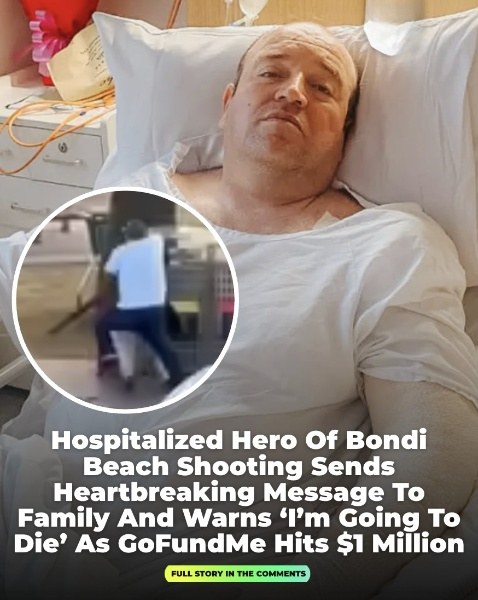
On Sunday, December 14, 2025, Sydney’s iconic Bondi Beach was the scene of a horrific terrorist attack that left at least fifteen people dead and dozens more injured.
Families, friends, and holidaygoers had gathered to celebrate Hanukkah and enjoy a sunny day on the sand, unaware that a tragedy was about to unfold that would shock Australia and the world.
Amid the chaos and terror, one man’s extraordinary courage became a defining story of heroism: Ahmed Al Ahmed, a 43-year-old father of two and a local fruit shop owner, who risked his life to confront an armed attacker in a moment of unimaginable peril.
According to eyewitness accounts and law enforcement briefings, the attack began in the early afternoon, just as over 1,000 Jewish families were gathered along Bondi Beach’s popular promenade.
The attackers, identified as a father-and-son duo—50-year-old Sajid Akram and 24-year-old Naveed Akram—opened fire on civilians with rifles, quickly turning what had been a day of celebration into a scene of carnage.

Among the victims were a 10-year-old girl, a Holocaust survivor, a British rabbi, a retired New South Wales police officer, and a French national, illustrating the indiscriminate nature of the violence.
Authorities confirmed that Sajid Akram died at the scene, while his son Naveed was taken to a nearby hospital in critical condition.
Prime Minister Anthony Albanese addressed the nation, stating that the attacks appeared to have been ideologically motivated acts of terrorism, but emphasized that authorities believed the attackers acted alone and were “clearly radicalized but not part of a broader network.”
Both men had reportedly been interviewed by Australian security services in 2019, although officials have stated that there were no immediate indications that a broader conspiracy was at play.
Amid the chaos, Ahmed Al Ahmed’s courage became the focal point of international attention.
Ahmed, who had moved to Australia from Syria in 2006, was reportedly meeting a friend for coffee near the beach when the attack began.
Witnesses described seeing him crouch behind parked cars as the first shots rang out, observing the attackers’ movements while hundreds of people fled in panic.
According to family members, moments before confronting the gunman, Ahmed sent a desperate message: “I’m going to die, please see my family.”
Those words, a mixture of fear and resolve, captured the intensity of the moment and foreshadowed the extraordinary bravery that would follow.
Rather than running for safety like most bystanders, Ahmed made a split-second decision to intervene. Video footage and eyewitness testimony later confirmed that he moved toward the armed attacker without any weapon or protection.
In a dramatic act of selflessness, he leaped onto the gunman’s back, wrestling him to the ground and successfully disarming him of the rifle.
Ahmed then deliberately placed the firearm on the sand, a gesture that prevented further immediate casualties, rather than attempting to shoot the attacker, demonstrating not only courage but a remarkable presence of mind under extreme stress.
Tragically, in the moments immediately following Ahmed’s heroic act, a second shooter emerged from a nearby bridge, opening fire on civilians and hitting Ahmed multiple times.
He sustained severe injuries to his arm and shoulder, and doctors have indicated that it is currently uncertain whether the limb can be fully saved. Despite his grave injuries, Ahmed reportedly remained focused on the safety of others, asking family and friends to stay calm and reassuring bystanders.
From his hospital bed, he expressed that he would make the same choice again, underscoring the profound sense of duty and compassion that guided his actions.
Ahmed’s parents, speaking from their home in Sydney, shared their perspective on the harrowing events. Far from expressing fear or anger, they expressed immense pride in their son, praising his instinctive heroism.
They emphasized that Ahmed had acted without hesitation to protect strangers, demonstrating a commitment to humanity that transcended personal safety.
“When he did what he did,” Ahmed’s father told local media, “he wasn’t thinking about the background of the people he’s saving.
He doesn’t discriminate between one nationality and another. Especially here in Australia, there is no difference between one citizen and another.”
The impact of Ahmed’s bravery has been felt far beyond the immediate scene of the attack. The story has gone viral, with tributes pouring in from around the world.
From political leaders to ordinary citizens, the consensus has been clear: Ahmed Al Ahmed is a symbol of courage, selflessness, and humanity in the face of terror.
Former President Donald Trump praised Ahmed’s actions, calling him “very brave” and highlighting the life-saving significance of his intervention.
Social media platforms were flooded with messages of support, admiration, and gratitude, reflecting the profound emotional resonance of his deeds.
A GoFundMe campaign was established to support Ahmed during his recovery, quickly surpassing $1.3 million in donations, including a $99,000 contribution from billionaire investor Bill Ackman.
The campaign’s organizers emphasized that the funds were intended not only to assist with medical expenses but also to honor the extraordinary risk Ahmed took in protecting others.
The page described Ahmed as “a hero who, without hesitation, stepped forward during the Bondi tragedy to prevent the loss of countless lives, acting instinctively and selflessly without regard for his own safety.
Early reports indicate he was shot twice in the process while shielding others.”
His cousin, Mustafa, confirmed that Ahmed had sustained gunshot wounds to his arm and hand, but reported that he was conscious, alert, and determined to recover.
“He is a hero, 100 percent,” Mustafa said. “He has two shots, one in his arm and one in his hand, but he is strong and we are hopeful he will recover fully.”
Later updates indicated that doctors were monitoring his injuries carefully, and while his arm function might be compromised, Ahmed remained in high spirits, focused on the well-being of others and the importance of returning to normal life once his recovery allowed.
New South Wales Premier Chris Minns visited Ahmed in the hospital and publicly acknowledged his bravery, writing on social media: “Ahmed is a real-life hero.
Last night, his incredible courage no doubt saved countless lives when he disarmed a terrorist at enormous personal risk. It was an honor to spend time with him and to pass on the gratitude of people across NSW.
There is no doubt that more lives would have been lost if not for Ahmed’s selfless actions.” Minns’ words reflected the widespread sentiment in Australia that Ahmed’s actions had not only prevented further casualties but had also restored a sense of hope and resilience in a community shaken by violence.
The Bondi Beach attack has prompted national reflection on the threats posed by extremism and the ways in which ordinary citizens can demonstrate extraordinary bravery.
Analysts and commentators have noted that Ahmed’s actions illustrate the importance of civic courage and rapid decision-making under pressure, highlighting the potential impact that individuals can have in life-or-death situations.
Schools, local councils, and community organizations have praised Ahmed as a role model, emphasizing lessons of selflessness, moral responsibility, and standing up for others in moments of crisis.
The broader context of Ahmed’s heroism also sheds light on the human dimension of terrorism.
While statistics, security briefings, and forensic reports quantify the damage and analyze motives, stories like Ahmed’s remind the public of the individual lives affected and the extraordinary choices that ordinary people may be called upon to make.
His actions have inspired discussions about community responsibility, preparedness, and the role of personal courage in responding to unexpected danger.
Ahmed’s story has also sparked a conversation about how societies recognize and support heroes in the aftermath of trauma.
Beyond financial contributions and public tributes, officials have discussed providing long-term medical and psychological support for individuals like Ahmed who risk their lives to protect others.
Mental health experts have highlighted the potential emotional toll of witnessing and intervening in violent events, noting that support networks are critical for ensuring that heroes can continue to live fulfilling lives after such experiences.
Moreover, the attack has emphasized the role of ordinary citizens in emergency response.
Law enforcement officials have acknowledged that while trained personnel ultimately manage threats, civilians who act decisively can profoundly influence the outcomes of violent incidents, saving lives in critical moments before first responders arrive.
Ahmed’s courage exemplifies this principle, demonstrating that even unarmed individuals can make a life-saving difference when guided by instinct, courage, and concern for others.
As Sydney continues to mourn the victims of the Bondi Beach attack, Ahmed Al Ahmed’s story stands as a beacon of hope, courage, and human solidarity.
His actions remind the world that in moments of chaos and terror, the choice to act selflessly can ripple outward, protecting countless strangers and inspiring millions globally.
International media coverage has emphasized not only the tactical aspects of his intervention but also the moral clarity he exhibited—choosing to face danger head-on to protect the vulnerable, rather than prioritizing his own safety.
In reflecting on Ahmed’s heroism, one cannot overlook the broader implications for society. His story illustrates the power of individual action, the importance of community, and the enduring human capacity for bravery.
While governments, law enforcement agencies, and security services play critical roles in preventing attacks, it is often the decisions of ordinary people in extraordinary circumstances that determine outcomes, save lives, and inspire hope.
In conclusion, the tragic events of December 14, 2025, at Bondi Beach left a scar on Sydney and the world, but the courage of Ahmed Al Ahmed provides a narrative of heroism that will be remembered for decades.
From his split-second decision to confront an armed attacker without any protection, to his subsequent struggle with injuries sustained in the line of duty, Ahmed embodies the values of selflessness, moral courage, and civic responsibility.
His actions have already saved lives, inspired global admiration, and prompted reflection on what it means to act bravely in the face of terror.
In a world often dominated by fear and violence, Ahmed Al Ahmed’s story shines as a powerful reminder of the human capacity for courage, compassion, and sacrifice—an example that will continue to inspire individuals and communities everywhere.