Palm Scratching – A Subtle Gesture of Attraction or Just a Quirk?
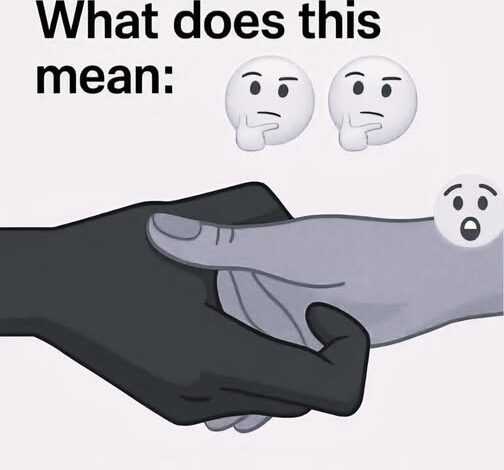
Human communication is a vast, multidimensional landscape where the spoken word often plays second fiddle to the silent language of the body. Among the most enigmatic and debated of these silent signals is the “palm scratch”—a fleeting, almost imperceptible brush of the fingernails against the center of another person’s hand during a handshake. To the casual observer, a handshake is merely a formal boundary, a polite acknowledgment of presence. But when that boundary is crossed by a deliberate scratching motion, the interaction shifts from the mundane to the mysterious. This gesture, small as it may be, acts as a psychological Rorschach test, its meaning morphing depending on the cultural background, the social setting, and the unique history between the two individuals involved. It raises a persistent question: is this a calculated signal of attraction, a relic of secret societies, or simply a physical quirk devoid of deeper intent?
To understand the palm scratch, one must first look at the history of the handshake itself. Historically, the extended hand was a gesture of peace, a way to demonstrate that one was not carrying a weapon. Over centuries, it evolved into a standardized ritual of agreement and greeting. However, within that standardized ritual, subcultures have always sought ways to signal “insider” status. For hundreds of years, fraternal orders, trade guilds, and exclusive societies have used “coded” handshakes to identify fellow members in a crowd. These handshakes often involve specific pressure from the thumb or a particular placement of the index finger against the wrist or palm. In this context, a palm scratch can be seen as a modern, perhaps more localized, evolution of the secret handshake. Within certain cliques or tight-knit social groups, it serves as a silent “I see you,” a confirmation of shared identity that remains invisible to anyone watching from the outside.
However, the most common interpretation of the palm scratch in modern popular culture is rooted in the realm of romantic and sensual attraction. The palm of the hand is one of the most sensitive parts of the human body, densely packed with nerve endings that are highly responsive to light touch. When someone deliberately scratches the palm of another during a brief greeting, they are bypassing the formal nature of the handshake and entering a zone of high intimacy. In many dating cultures, this gesture is viewed as a “low-stakes” trial balloon—a way to test the waters of attraction without the risk of a verbal rejection. It is a bold move cloaked in deniability. If the recipient responds with a smile or a reciprocal touch, the “scratcher” knows the interest is mutual. If the recipient pulls away or seems confused, the scratcher can easily dismiss it as an accidental slip of the hand or an involuntary twitch.
The psychological impact of such a gesture cannot be overstated. Because the palm scratch is unexpected, it often triggers a “micro-moment” of heightened awareness. The recipient is forced to process a sensation that contradicts the social script of a professional or casual greeting. This creates a spark of tension. In a romantic context, this tension is often framed as “chemistry.” The light, scratching motion mimics the kind of tactile grooming or affectionate touch usually reserved for partners, making it a potent tool for flirtation. It suggests a desire for closeness that goes beyond the skin-deep, signaling a level of comfort—or a desire for comfort—that words often fail to convey as effectively.
Yet, to label every palm scratch as an act of flirtation would be a significant oversimplification. Cultural nuances play a massive role in how physical touch is perceived. In some regions of the world, high-contact cultures view the hands as tools of expression where tactile playfulness is common and carries no romantic weight. In these settings, a scratch might simply be a quirk of personality—an idiosyncratic way of saying “hello” that is no more significant than a high-five or a pat on the back. Conversely, in more reserved or “low-contact” societies, such a gesture might be viewed with suspicion or even seen as a breach of personal space. The intent of the person performing the scratch is only half of the equation; the cultural “filter” of the person receiving it determines whether the gesture is seen as a charming overture or an awkward intrusion.

There is also the mundane possibility of the “accidental” scratch. Handshakes are physical interactions involving bone, muscle, and skin, and they don’t always go smoothly. Long fingernails, a slightly mistimed grip, or even a slip of the skin due to humidity can result in a sensation that feels like a scratch. In many cases, the person “giving” the scratch may be entirely unaware they have done so. This is where the danger of over-analysis lies. In the age of digital information, where “body language hacks” are frequently shared on social media, there is a tendency for people to look for hidden meanings where none exist. A person might leave a social encounter convinced they have been flirted with, when in reality, their acquaintance simply had a slightly firm grip and unclipped nails.
To navigate the ambiguity of the palm scratch, one must look at the “clusters” of behavior surrounding it. Body language rarely exists in a vacuum. If a palm scratch is accompanied by prolonged eye contact, a leaning posture, and a genuine “Duchenne” smile—the kind that reaches the eyes—then the probability of romantic intent is high. However, if the person scratches your palm while looking away, checking their watch, or maintaining a stiff, formal distance, it is almost certainly a mechanical quirk or an accident. Context is the ultimate arbiter of truth. A scratch during a business meeting in a brightly lit office carries a very different weight than a scratch exchanged on a crowded dance floor or during a quiet walk after a first date.
Ultimately, the palm scratch remains a fascinating artifact of human interaction because of its inherent mystery. It is a gesture that sits at the intersection of the public and the private. It uses a public ritual—the handshake—to deliver a private message. Whether that message is “I belong to your group,” “I find you attractive,” or simply “Oops, my hand slipped,” it serves as a reminder of how much of our communication happens beneath the surface of our conversations. Our hands are not just tools for manipulation and labor; they are sophisticated transmitters of social information.
In a world that is increasingly dominated by digital screens and distant communication, these small, physical nuances take on a renewed importance. They represent a primal form of connection that cannot be replicated by an emoji or a text message. The palm scratch, regardless of its specific meaning in any given moment, is a testament to the complexity of the human touch. It reminds us that even the most fleeting interaction has the potential to leave a lasting impression, sparking curiosity and inviting us to look a little closer at the people around us. Whether it is a subtle gesture of attraction or just a curious quirk, it proves that in the dance of human sociality, the smallest motions often speak the loudest. By paying attention to these nuances, we gain a deeper appreciation for the rich, unspoken tapestry of the human experience.