Artemis II’s New April Launch Date Is Looking Almost Certain
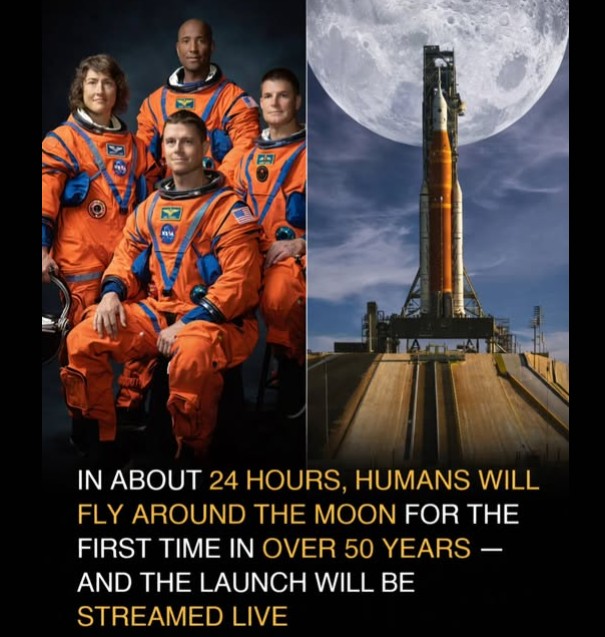
Humanity is headed back to our closest neighbor in space, and beyond. In 2026, for the first time in the 21st century, a crewed mission to the Moon is finally happening. The Artemis II mission, part of NASA’s Artemis program, has been aiming to put human beings back on the Moon, with the long-term intention of establishing a lunar base. The crew of Artemis II won’t be landing on the Moon, but they will be completing several orbits in an Orion spacecraft, NASA’s modern-day equivalent of the Saturn V.
With Moon fever sweeping the world for the first time in half a century, you may have a lot of questions. What is the purpose of Artemis? Who is going to the Moon? And what does this all mean for the future of human space exploration in our time?
Here are quick answers to your burning Artemis questions, from the launch date to the crew, the mission, the streaming documentary show about the mission, and why the launch was recently delayed.
This story was last updated at 10:24 a.m. on March 30, 2026.
What is the new 2026 launch date for Artemis II?
NASA’s Artemis II Space Launch System rocket and Orion spacecraft are rolled out of the Vehicle Asse…
JIM WATSON/AFP/Getty Images
As of March 30, 2026, the Artemis II mission is scheduled to launch on April 1, 2026, at 6:24 p.m. Eastern Time. On March 29, NASA reported that “Teams at NASA’s Kennedy Space Center in Florida are making final preparations toward beginning launch countdown activities for the Artemis II.”

This comes after two major delays of the Artemis II launch. In February, during the fueling of the SLS (Space Launch System), hydrogen leaks were detected by NASA. This posed a significant risk to the launch, so NASA decided to scrap the first launch in February. This happened again in late February, and the launch was again delayed, which leads us to our current launch window.
When Artemis II does blast off, it will do so from Kennedy Space Center’s Launch Complex. This will mark the first time a crewed mission to the Moon has been launched in 54 years. It follows the successful launch of Artemis I, which launched way back in 2022, and was an uncrewed lunar orbit mission.
The last time humans have been to the Moon at all was the Apollo 17 mission in 1972. The first orbit of the Moon, which is what the Artemis mission is all about, was the Apollo 8 mission, which launched on December 21, 1968, and achieved orbit of the Moon on December 24, 1968. Both in 1968 and now, it takes roughly three days to get to the Moon.
What is the Mission of Artremis II?
In Cape Canaveral, Florida, on January 17, 2026, NASA’s Artemis II rolls from the Vehicle Assembly B…
NurPhoto/NurPhoto/Getty Images
In a sense, all the Artemis missions are a kind of proof-of-concept. The overall goal of the Artemis program is to reestablish human abilities to land on the Moon, with the long-term goal of creating a permanent moonbase, which is thought to be a jumping-off point to get to Mars.
The entire mission will last roughly 10 days, which includes the launch, Earth orbit, Lunar orbit, and the return trip.
“The Artemis campaign is really a set of test flights,” Dr. Lori Glaze, Deputy Associate Administrator for NASA’s Exploration Systems Development Mission Directorate, said in a new docuseries, Moonbound. “We haven’t been to the Moon in over 50 years. There are a lot of new systems we need to test out.”
Testing the Orion spacecraft is part of this mission, but Artemis II will also deploy four CubeSats in Earth’s orbit, small research satellites from Argentina, Germany, South Korea, and Saudi Arabia.
Will Artemis II land on the Moon?
CAPE CANAVERAL, FLORIDA – JANUARY 17: NASA Administrator Jared Isaacman (L) holds a press conferenc…
NASA Administrator Jared Isaacman and the crew of Artemis on January 17, 2026.Joe Raedle/Getty Images
Though Artemis II represents the first time humans are returning to the Moon since the Apollo days, the Orion spacecraft will not land on the lunar surface. Right now, the plan is that Artemis III will land on the Moon in 2028.
Who is in the crew of Artemis II?
(L-R) Canadian Space Agency astronaut, NASA Artemis II Mission Specialist Jeremy Hansen, NASA astron…
The Artemis II crew: Jeremy Hansen, Christina Koch, Victor Glover, and Reid Wiseman on January 17, 2026. MIGUEL J. RODRIGUEZ CARRILLO/AFP/Getty Images
The crew of Artemis II includes three astronauts from NASA and one from the Canadian Space Agency. Those four intrepid human beings are:
Reid Wiseman, Commander
Victor Glover, Pilot
Christina Koch, Mission Specialist 1
Jeremy Hansen, Mission Specialist 2
Who is Reid Wiseman?
NASA holds a press conference with Artemis II mission specialist Jeremy Hansen, Christina Koch, pilo…
Reid Wiseman, Commander of Artemis II.NurPhoto/NurPhoto/Getty Images
Wiseman has a long history with space flight and has logged 165 days in space, including stints aboard the International Space Station. In 2020, he was also Chief of the Astronaut Office, a role which he stepped down from to return to flight duty. He is originally from Baltimore.
Who is Victor Glover?
NASA astronaut and Artemis II pilot Victor Gloverand looks on during the rollout of NASA’s next-gene…
Victor Glover, the pilot of Artemis II.MIGUEL J. RODRIGUEZ CARRILLO/AFP/Getty Images
Like many astronaut legends from the 1960s and 1970s, Glover’s background is that of a test pilot, meaning his flight experience is impressive and intense. He is also the first pilot to fly SpaceX’s Dragon. He’s been in space for a total of 167 days, including Expedition 64, the record-breaking ISS stint. Glover hails from Pomona, California. He will become the first person of color to orbit the Moon.
Who is Christina Koch?
The four astronauts from the Artemis II crew to the moon speak to the media ahead of testing at Kenn…
Christina Koch, one of the mission specialists for Artemis II.NurPhoto/NurPhoto/Getty Images
Koch’s background is that of an engineer and astrophysicist. She is one of two mission specialists for Artemis II, and will be largely responsible for checking to make sure the environmental and technical aspects of the Orion spacecraft are functioning correctly. Koch has logged 328 days in space prior to this mission, making her the person on the crew with the most time-in-space experience. She will become the first woman to orbit the Moon during the Artemis II mission. She is from Grand Rapids, Michigan.
Who is Jeremy Hansen?
Canadian Space Agency astronaut, NASA Artemis II Mission Specialist Jeremy Hansen, looks on during t…
Jeremy Hansen is ready for the Moon.MIGUEL J. RODRIGUEZ CARRILLO/AFP/Getty Images
Hansen is a Canadian astronaut originally from London, Ontario. Like Koch, he is a mission specialist for this flight. But, Hansen has flight experience owing to his time in the Royal Canadian Air Force, where he held the rank of Colonel. Though Hansen trained in NASA’s NEEMO 19, an underwater facility to simulate extreme environments, he has not yet been to space, making this flight to the Moon his first time.
There are a lot more details to dive into about Artemis II. And, in addition to the X feed from NASA and the NASA YouTube channel, there’s also a new streaming docuseries created by NASA called Moonbound. This streams on Nasa+, which is 100 percent free and can be watched right here. So far, there are two episodes, each about 30 minutes long.
Assuming there are no weather or technical problems, Artemis II is now expected to launch sometime in March, 2026.