At My Grandmother’s Funeral,Her Lawyer Pulled Me AsideWhat I Saw at the Dark Door Changed Everything
If you’ve ever stood in the middle of your own family and suddenly felt like a stranger, then you know the exact kind of cold that has nothing to do with weather.
My name is Brooke Johnson, and the day we buried my grandmother was the day grief stopped being the worst thing in the room.
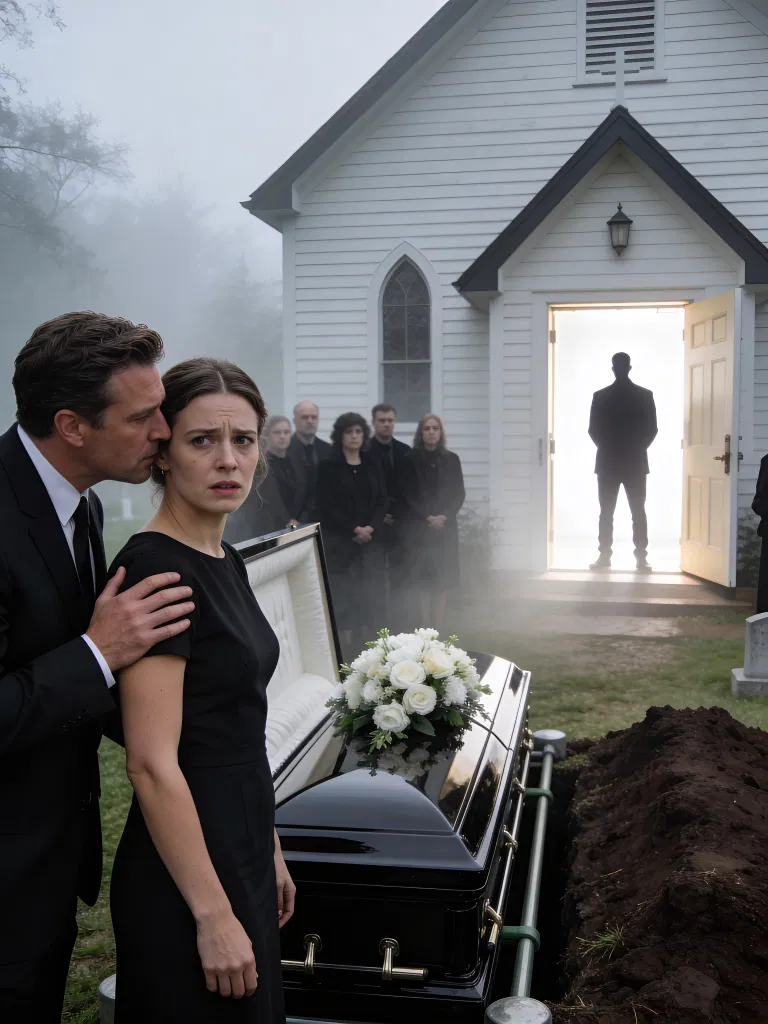
The cemetery sat just outside Seattle, tucked behind a line of evergreen trees that looked like they’d been painted in charcoal. The sky hung low and heavy, the kind of gray that makes everything feel quieter than it should. The wind cut through my coat and found the space between my ribs, as if it had a map.
I stood beside the casket of my grandmother, Dorothy, trying to focus on the simple, painful truth that she was gone. Dorothy had been the calm center of our strange family for as long as I could remember, the woman who brewed tea every afternoon and insisted that patience was the only real weapon a person needed in life. When the pastor finished speaking and people began to drift away in quiet clusters, I noticed my father watching me with an intensity that felt wrong for a funeral.
His name was Harold, and most people in town described him as successful, charismatic, and persuasive. I had always known him as complicated, but on that gray afternoon something about his expression made a warning crawl through my chest. My stepmother Monicastood beside him in a sleek black coat, her hand resting lightly on his arm while she whispered something that made him nod slowly.
My younger brother Caleb shifted beside me and murmured, “You okay, Brooke? You look like you swallowed ice.”
“I’m fine,” I replied automatically, although nothing inside me felt fine.
After the burial finished, people gathered near the cars while rain began falling in thin silver threads. My father approached me with that calm voice he used whenever he wanted to sound reasonable. “Brooke, we should talk about the house and the paperwork soon,” he said quietly.
I frowned, confused by his timing because our grandmother had not even been in the ground for ten minutes. “Dad, can this wait until later?”
Monica smiled with gentle sympathy that somehow never reached her eyes. “Your father is only trying to make sure everything is organized properly, sweetheart.”
The conversation ended there because other relatives were watching, yet a small crack had already opened inside my mind. Later that evening, after the funeral guests left my grandmother’s old house, I walked through the quiet kitchen and noticed the familiar porcelain teapot resting on the counter. It had been Dorothy’s favorite, and she had brewed hundreds of quiet conversations around that chipped little spout.
I lifted the lid and saw something strange sitting beneath it, a folded envelope with my name written across the front in my grandmother’s steady handwriting. My hands began shaking as I opened it because the letter inside did not read like a farewell from a loving grandmother. Instead the message contained careful instructions, warnings about people I trusted, and a sentence that made my entire body go cold.
“Brooke, if you are reading this then I did not die naturally, and you must not trust your father or the woman living in my house.”
For several minutes I stood there staring at the page while the kitchen clock ticked loudly behind me. My mind insisted there must be some mistake because my grandmother had been sick recently and everyone assumed her death had been a sad but natural ending. Yet the rest of the letter described her growing fear, her suspicion that someone had been tampering with her tea, and a set of instructions that led me toward a locked cabinet in the study.
Inside that cabinet I discovered notebooks filled with careful observations, receipts from an independent laboratory test, and a small flash drive containing security footage from a camera my grandmother secretly installed in the kitchen. When I finally played the video on my laptop, the screen showed Monica standing at the counter late at night, quietly pouring a fine white powder into the teapot before sealing the lid again.
I remember whispering into the empty room, “This cannot be real.”
My brother Caleb appeared in the doorway moments later because he heard my voice. “Brooke, what are you talking about?”
I turned the laptop toward him with trembling hands while the video continued playing. Caleb watched silently for a long moment before whispering, “Is she poisoning Grandma?”
The next few days moved quickly once the truth began unraveling. I contacted a lawyer named Anthony Fletcher, a patient man who listened carefully while I explained the letter, the video, and the lab report showing traces of toxic compounds in the tea residue. Anthony Fletcher helped me report everything to the police, and the investigation uncovered even more disturbing evidence inside my father’s financial records and phone messages.
Detectives eventually arrested both Harold and Monica for conspiracy and murder, and the trial that followed revealed a motive that felt almost insulting in its simplicity. My father had believed his mother would soon change her will and transfer most of her property to me instead of him, and Monica had agreed to help eliminate the obstacle quietly through slow poisoning that might appear like natural illness.
During the trial Caleb sat beside me every day, gripping my hand while prosecutors described our family life in cold legal language. When the guilty verdict finally came, I felt relief mixed with a hollow grief that words cannot fully explain.
After the trial ended I inherited my grandmother’s home along with a large portion of her savings, but Dorothy’s letter included another instruction that shaped everything I did afterward. She wrote that money earned through suffering should create safety for people who needed it most, and she specifically mentioned women escaping violent relationships.
Because of that final request I eventually turned the house into a small shelter that offered quiet rooms, legal guidance, and emergency support for people trying to rebuild their lives. Caleb helped renovate the property while I worked with local organizations to create a system that could operate responsibly.
For several years the shelter slowly grew into something meaningful, and the chaos of the past began fading into the background of daily routines. Yet peace has a fragile nature, especially when the past still has people willing to disturb it.
One autumn night the security gate at the shelter opened unexpectedly around two in the morning, and the cameras recorded a figure entering the driveway before disappearing into the darkness. The police found no clear sign of forced entry, which suggested someone might have known the access code.
Concerned about safety, I contacted a private security specialist named Gregory Dalton, a quiet former investigator who studied the camera footage with calm concentration. He replaced several cameras with newer equipment and added stronger monitoring systems around the property.
While sitting at my kitchen table later that evening he finally said, “Someone wanted you to know they could reach this place.”
My stomach tightened as I asked, “Do you think it connects to my father?”
Gregory Dalton paused before replying carefully. “It could, especially if someone outside prison is helping him reopen the case.”
The next morning Caleb arrived looking worried because he had received a strange call from our aunt Marjorie, my father’s sister who lived in Tacoma and had always insisted that family loyalty should come before everything else. Caleb sat across from me in the office and said, “She told me Dad filed an appeal, and she thinks the truth will come out soon.”
That information forced us back into legal meetings with Anthony Fletcher, who confirmed that Marjorie had indeed filed several petitions challenging the inheritance and accusing me of manipulating my grandmother during her final weeks.
The court hearing that followed felt tense but decisive because Anthony Fletcher presented the notebooks, the recordings, the laboratory reports, and the video showing Monica contaminating the teapot. The judge reviewed every piece of evidence before dismissing the challenge and warning Marjorie against further harassment.
Outside the courthouse Marjorie confronted me with tearful anger and whispered, “You destroyed our family, Brooke.”
I answered quietly, “No, my father destroyed it long before I understood what he was doing.”
For several months life returned to a fragile rhythm while winter settled across Seattle with steady rain and short gray afternoons. Caleb began volunteering regularly at the shelter, repairing broken appliances and helping children fix toys that had traveled through difficult homes.
One evening we sat together on the back porch while mist drifted through the porch light, and Caleb admitted something that had clearly been haunting him for years. “Brooke, sometimes I wonder if I unknowingly helped them because I carried tea cups to Grandma all the time.”
I placed my hand over his and replied gently, “You were young and you trusted the adults around you, which means the responsibility belongs to the people who abused that trust.”
Caleb eventually began seeing a therapist and slowly rebuilt his sense of stability, yet another surprise arrived the following spring when Gregory Dalton called with unusual news. Monica had become eligible for a parole review and requested a meeting with me because she claimed to possess information about plans my father had hidden from everyone.
At first I refused because the idea of seeing her again made my chest tighten with anger. After discussing the situation with Anthony Fletcher and Caleb, however, I agreed to attend a supervised meeting inside the correctional facility.
The visitation room contained a thick glass barrier separating us, and when Monica entered wearing a plain prison uniform she looked older and more tired than the polished woman I remembered. She lifted the phone receiver slowly and said through the glass, “Brooke, I know you hate me, but you deserve to know something about your father.”
Caleb picked up another receiver beside me while Gregory Dalton observed quietly from the wall. I kept my voice steady as I asked, “Why should I believe anything you say now?”
Monica inhaled deeply before replying, “Because the truth no longer protects him, and I am tired of carrying his secrets.”
What she revealed during the next hour changed my understanding of the past even further. Harold had planned not only to secure his mother’s estate but also to gain legal authority over me through medical evaluations that could label me unstable after my grandmother’s death. He believed such control would force me to sign financial documents and surrender property without resistance.
Caleb whispered with disbelief, “He would have tried to lock Brooke into some kind of psychiatric control.”
Monica nodded slowly and said, “He talked about it constantly, and he believed fear would make you obedient.”
Hearing that plan confirmed a truth I had already begun accepting. My father’s ambition had never stopped with money, and his need for control had grown more dangerous each year.
When the meeting ended and we walked back toward the parking lot under a soft spring rain, Caleb stared across the river and said quietly, “Brooke, no matter what he planned, he failed because you kept listening to Grandma’s warnings.”
I held my grandmother’s old teapot later that night and realized that surviving the truth sometimes means continuing to confront it whenever new pieces appear. Dorothy had trusted me to protect what she built, and that responsibility now extended beyond property into the safety of every person who found refuge in our shelter.
The past still existed, but it no longer controlled the direction of my life because the truth had finally stepped into the light where it belonged.