“Don’t marry her,” the homeless girl said at the church door, revealing what would later be…
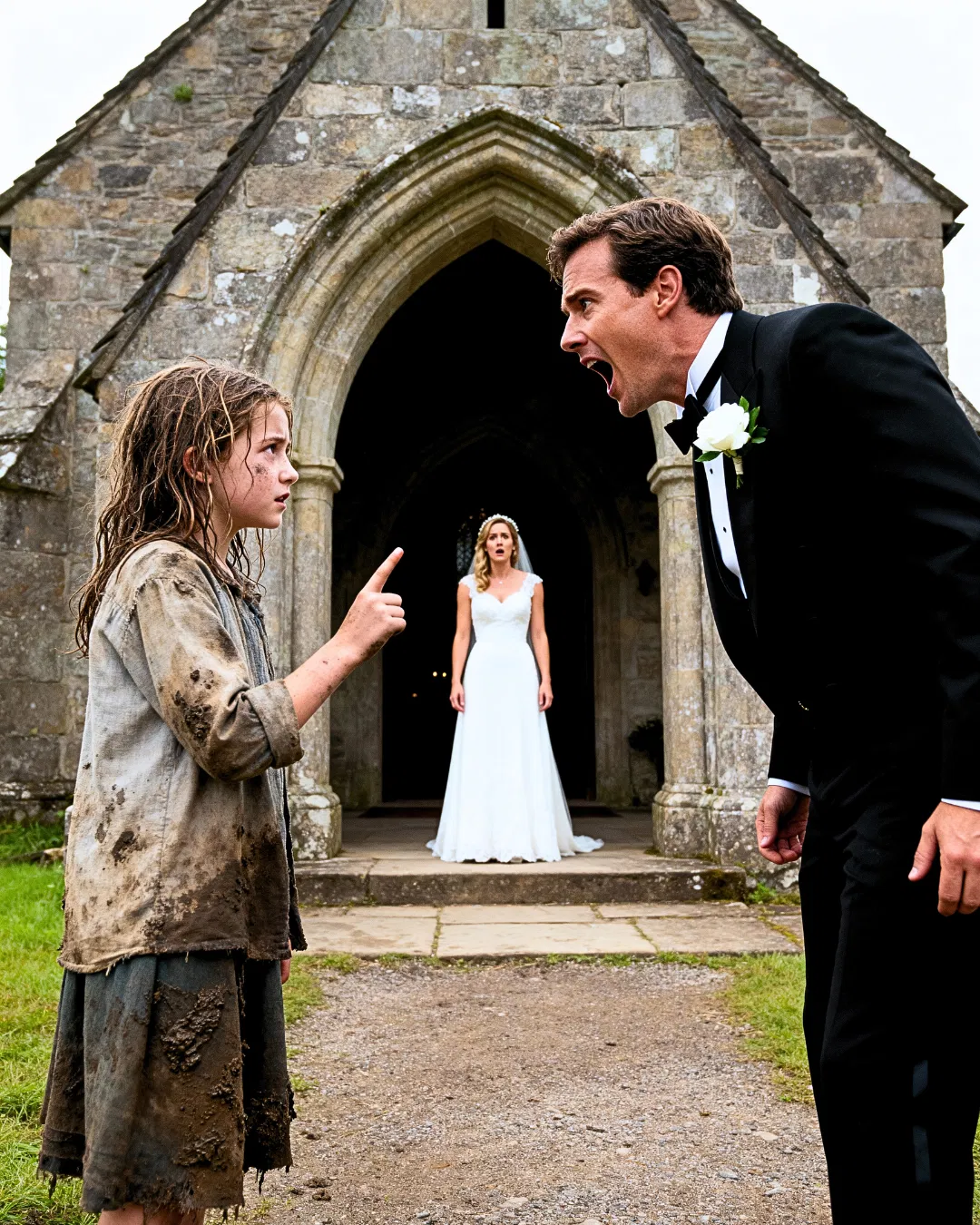
At the church doors, a homeless girl stopped him. “Don’t marry her.” Then she said a word only the bride and the lawyer were supposed to know.
The church looked like it belonged on a postcard—aged stone, silent bells, flawless white flowers arranged with obsessive care. A pale carpet stretched toward the entrance, guiding Lucas Moreno, the wealthy groom everyone had come to see. Not to celebrate—just to watch. Phones were raised, whispers floated, smiles looked rehearsed.
Lucas arrived in a tailored black suit, his watch catching the light, his posture confident, used to space opening for him. Two security guards walked beside him. Behind them, a black SUV idled. And there, disrupting the carefully staged perfection, stood a thin girl in an oversized hoodie and worn sneakers.
She couldn’t have been older than twelve. Her hands were grimy, her face marked by hunger and sun. She pressed herself against the wall, almost invisible—until Lucas stepped forward.
“Don’t marry her!” she shouted.
Time seemed to split. Guests gasped. Phones tilted. The guards moved instantly.
“Move,” one snapped, reaching for her arm.
Lucas froze—not from kindness, but shock. That wasn’t a plea. It was a warning.
“What?” he asked, staring at her.
The guard grabbed her. She didn’t cry or beg. She clutched Lucas’s jacket with surprising strength.
“No,” she said, locking eyes with him. “If you go in, you won’t come out the same.”
“Enough,” the guard growled.
“Let her go,” Lucas ordered sharply.
The grip loosened. The girl didn’t waste the moment.
“Don’t marry her,” she said again. “It’s a trap.”
Lucas laughed shortly. “And what would you know about my life?”
“I know what I heard,” she replied. “I know what they said.”
“Who?”
She nodded toward the church. “Her. And the lawyer.”
Lucas sighed, irritated. Cameras, pressure, deals disguised as love—this day was already heavy. He pulled bills from his pocket and pushed them toward her. “Take this. Eat something. Go.”
She didn’t even glance at the money. “I don’t want it. I want you not to go in.”
The murmurs grew louder.
Then the church doors opened.
Valeria Cruz stepped out in a pristine white dress, her smile polished, her movements calm. Beside her stood an older woman adjusting her veil and a man in a gray suit holding a leather folder—the lawyer.
“Darling,” Valeria said sweetly, “is everything alright?”
The girl stiffened, gripping Lucas’s jacket again. “It’s her,” she whispered.
Valeria glanced at the girl with staged pity. “Poor child. Can someone take care of this? I don’t want a scene.”
“Wait,” Lucas said.
The girl spoke one word. Quiet. Precise.
“Mirror clause.”
Lucas went cold. Not because of the phrase—but because it didn’t belong in a child’s mouth. He turned slowly toward the lawyer. The man’s expression stayed neutral, but his eyes hardened. Valeria’s smile tightened.
“Who told you that?” Lucas asked softly.
“She did,” the girl whispered, staring at Valeria. “She said, ‘Once he signs, we activate the mirror clause.’”
The crowd buzzed.
Valeria laughed lightly. “She’s a child. She must’ve heard something on TV.”
The lawyer cleared his throat. “Mr. Moreno, this isn’t the time—”
“Where did you hear it?” Lucas asked the girl.
“In the sacristy,” she said. “Yesterday. The door was open.”
Valeria snapped, “What was a child doing there?”
“Surviving,” the girl replied.
The guard grabbed her again.
“Don’t touch her,” Lucas snapped.
Valeria leaned in, lowering her voice. “Please. People are recording.”
She didn’t say it wasn’t true. She said don’t humiliate me.
“What’s your name?” Lucas asked.
“Eva,” she said.
“What else did you hear, Eva?”
Valeria’s eyes hardened. The lawyer tightened his grip on the folder.
“They said after the ceremony you’d sign with Attorney Rafael Montoya,” Eva added.
Lucas felt the impact immediately. Montoya was his father’s longtime lawyer.
“What does Montoya have to do with this?” he asked.
Valeria answered too fast. “Nothing.”
“I heard it,” Eva insisted. “Today. With the mirror clause.”
Lucas turned to the lawyer. “What’s a mirror clause?”
Silence.
Valeria clung to his arm. “You don’t have to answer anyone.”
“If I go in,” Eva said urgently, “they won’t let you leave without signing.”
Lucas pulled out his phone and dialed. Speaker on.
“Mr. Moreno,” Montoya’s voice answered smoothly. “Congratulations. I’m ready for the signing.”
“What signing?” Lucas asked.
A pause.
“The post-ceremony confirmation,” Montoya said.
“The one that activates the mirror clause?” Lucas pressed.
Silence again.
That was enough.
Chaos followed—guards moving, a hooded man trying to grab Eva, Lucas stepping in front of her. Accusations flew. Cameras recorded everything.
“Take me to where you heard it,” Lucas said.
She led him to a side passage, cold stone walls, a small wooden door with a crack beneath it. Dust on the floor. Proof someone had been there.
She pulled a torn piece of paper from her pocket. “This fell.”
Printed text. A partial stamp. Underlined words.
Immediate activation. Signature required.
And part of a name.
…Montoya.
That was the end.
Lucas left the church with Eva, no vows spoken, no flowers carried. Evidence in hand, he went straight to an independent lawyer.
The trap unraveled quickly once exposed. Recordings. Documents. Proof.
Valeria’s voice played back coldly: “If he resists, we’ll use the foundation. No one cries for a millionaire.”
This time, people listened.
That night, Lucas sat beside Eva in silence.
“Am I alone now?” she asked.
“No,” he said. “Not anymore.”
And for once, truth stood taller than spectacle.