I Saved a Starving Newborn Found Beside an Unconscious Woman — Years Later, He Honored Me on Stage.
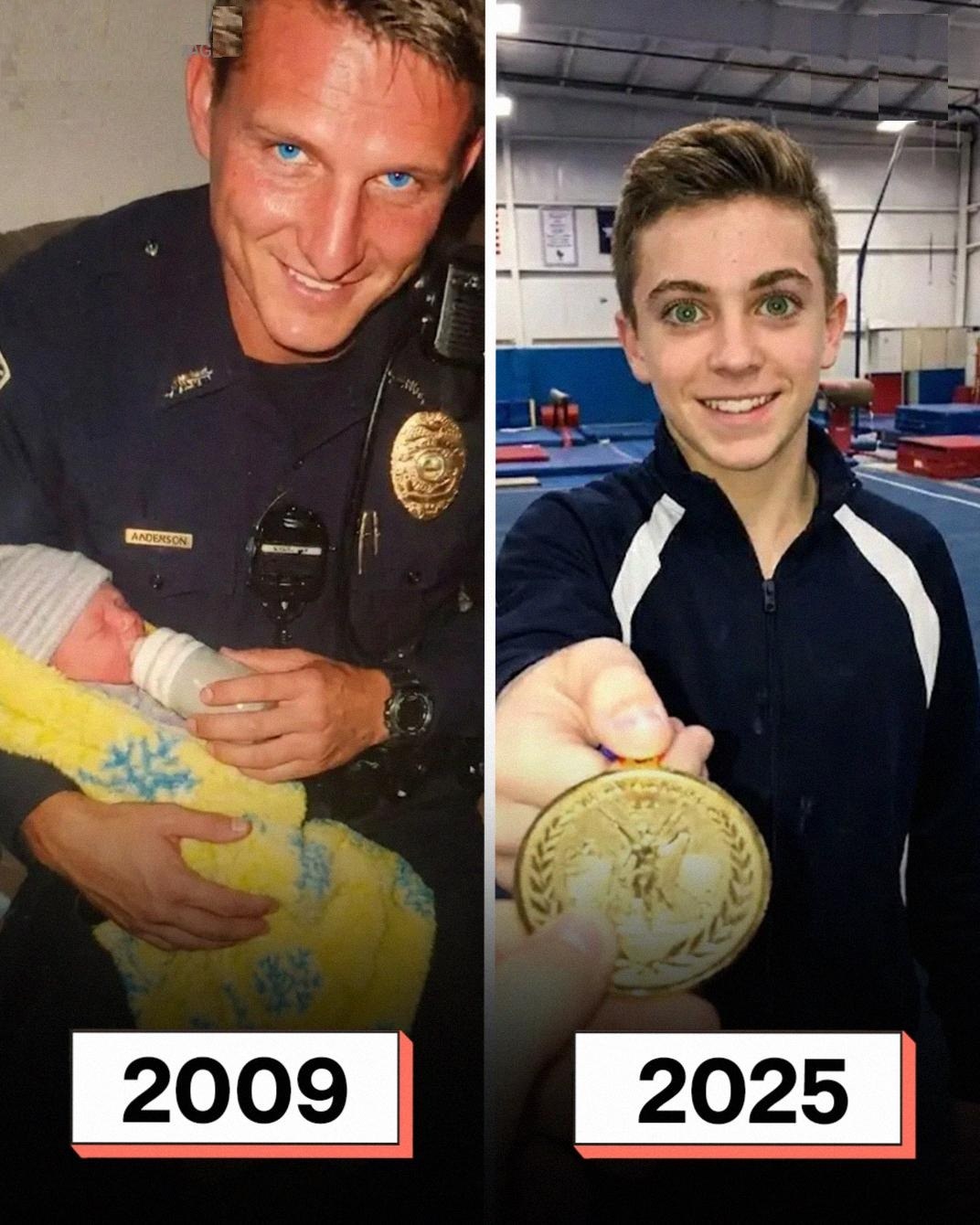
The dispatch call cut through the silence at 2:17 a.m., an hour when the world outside feels heavier, more fragile, and profoundly quiet. I was meticulously finalizing incident reports inside the patrol car, half-listening to the routine radio chatter, when the emergency call abruptly pierced the stillness like a jagged crack in glass.
“Unit 47, welfare check at Riverside Apartments on Seventh. Neighbors reporting a woman unresponsive and an infant crying for several hours.”
Initially, I registered it as just another routine assignment. I was intimately familiar with the Riverside—a site of frequent noise complaints, squatter issues, and the occasional petty dispute. Yet, there was an unmistakable shift in the tone of the dispatcher’s voice that compelled me to sit up straighter. Instinct, an officer’s oldest and most reliably partner, signaled immediately that this particular call would be different.
At 32, I was still relatively junior on the force, yet I felt older in spirit than most of my colleagues. Grief has a way of prematurely aging a person. Two years prior, a devastating house fire had claimed the lives of my wife and our infant daughter. A single, catastrophic night had rewritten the entire manuscript of my life. I wore my badge on my chest, but my crushing, immense loss was a weight I carried perpetually on my shoulders.

Even after sessions of therapy and the unwavering support of my department, the deep sense of emptiness never truly lifted. I had learned to function—to report for duty and execute my tasks—but the grief resided quietly within me, fundamentally reshaping the core of who I was. And on nights like this—cold, dark, and pregnant with unknowns—that grief felt alarmingly close to the surface.
My partner, Riley, glanced over as he started the engine of the cruiser. “You good?” he asked, a question loaded with silent history.
“Yeah,” I lied, pulling my uniform into order. “Let’s go.”
We reached the Riverside Apartments approximately fifteen minutes later. The building stood like a forgotten relic awaiting its final collapse: broken windowpanes, peeling paint, and a front door hanging crookedly from a single hinge. The air was thick with the scent of cold cement and lingering mold, and somewhere in the stairwell, water dripped with a steady, metronomic echo.
But overriding that rhythmic dripping, I heard a sound that caused my blood to run instantly cold.
A baby was screaming.
It was not merely crying—it was screaming. A desperate, raw, visceral sound that spoke of extreme fear and profound hunger.
“Third floor,” Riley muttered grimly, and we took the stairs two at a time, bypassing the slow elevator.
Apartment 3B had its door ajar. I nudged it fully open with my boot and stepped inside the unit.
The scene struck me with immediate, chilling force. A woman lay on a stained mattress in the corner, barely conscious, her breathing shallow and alarming. Trash was strewn haphazardly across the floor. The room was freezing—colder inside than the late-night air outside, as if the walls themselves leaked winter.
But nothing compared to what I saw next.
A baby, no more than four or five months old, sat alone. He wore only a soiled diaper. His tiny arms shook uncontrollably from the cold, his cheeks were raw and irritated from hours of crying, and his little chest violently heaved with every desperate sob.
I froze for a mere half-second, but in that fractional moment, something deep inside me shattered. Grief, professional instinct, and a primal, fatherly impulse fused into one clear, urgent command: Save him.
Riley immediately radioed for paramedics while I swiftly stripped off my patrol jacket and gently, but urgently, wrapped the baby in the heavy material. His skin was ice-cold against my arms. He clutched my uniform shirt with trembling, small fingers, gripping it as if holding onto the last sliver of safety the world had offered.
“It’s okay, buddy,” I whispered, my voice breaking despite years of training and habit designed to keep it steady. “I’ve got you now.”
In that critical, frozen moment, the job ceased to be a professional duty; it became profoundly personal.
As the paramedics rushed in to attend to the woman—who would later be identified as the baby’s biological mother—I searched the derelict room for anything that could help the child. I located a bottle on the floor. It was dirty, but the formula inside was still viable. I warmed the contents under the bathroom tap, testing the temperature on my wrist exactly the way I used to do for my own daughter.
The baby latched instantly, drinking with a savage hunger as though he hadn’t eaten for days—which he likely hadn’t.
That tiny, simple act—his little hand firmly gripping mine while he drank—successfully breached every emotional defense wall I had painstakingly constructed since the loss of my family. I had forgotten the sheer physical weight of holding an infant. I had forgotten how small, how fragile, yet how profoundly trusting they were. And yet, somehow, this tiny boy had fiercely survived hours in the dark, penetrating cold, clinging tenaciously to life.
When social services arrived an hour later, I was deeply reluctant to release him. The worker, a compassionate woman named Linda, promised he would be placed immediately in emergency foster care with a responsible, vetted family. I nodded my agreement. But as I drove home with the first faint edge of sunrise touching the horizon, I could not shake the vivid image of that baby—the way his crying had ceased the instant I held him, the way he had drifted into sleep resting against my chest.
That following night, sleep was impossible. The baby’s image was in my mind every time I closed my eyes. The next morning, before the start of my shift, I drove to the hospital to check on the mother. The nurse shook her head somberly. “She left,” she said. “No documents, no forwarding information. She just… walked out.”
That answer settled an unexpected certainty deep inside my being. If that little baby boy now had no one else in the world, then perhaps, just perhaps, he was meant to have me.
A New Beginning: Trent and Jackson
Within the span of one week, I was seated in the social services office, completing stacks of paperwork—not as a uniformed officer fulfilling a duty, but as a man ready to be a father once again.
“Officer Trent, adoption is a life-changing commitment,” the social worker reminded me, needing to ensure my resolve.
“I know,” I replied, my voice steady and certain. “And I am sure.”
The process spanned months—interviews, home visits, psychological evaluations—but on the emotional, watershed day they placed that child back into my waiting arms, he was no longer a case file. He was my son.
“I’m naming him Jackson,” I whispered, choosing a name that felt strong, warm, and full of the life he represented.
I maintained my long police shifts, and to help, I hired a nanny, Mrs. Smith, a retired teacher who adored children and became a steady, loving presence in our new life.
Jackson single-handedly brought color back into days that had been uniformly gray for years. His curiosity was boundless, his smile lit up every room he entered, and his small, burgeoning stubbornness reminded me so much of my late wife that it often made me laugh unexpectedly. Without ever knowing the history, he began the process of healing me.
The Gymnast with a Lion’s Heart
At the age of six, Jackson discovered gymnastics, and it was like watching a natural spark catch fire. He loved the adrenaline, the necessary focus, and the way his small body could seemingly defy gravity. His first attempted cartwheel resembled little more than a sideways jump, yet he celebrated it as though he had instantly won an Olympic gold medal.
From that point forward, our weeks revolved around gym practice. Tumbles. Back handsprings. Chalk dust seemed to be everywhere. His raw talent flourished alongside his rapidly growing confidence, and by the time he was sixteen, he was a serious competitor in state-level tournaments. Coaches spoke openly of potential college scholarships and national circuits. Our life felt complete, stable, and full of promise.
Neither of us had any premonition that a storm, dormant for sixteen years, was about to return.
The Call That Changed Our World Again
One warm summer afternoon, as we were loading Jackson’s equipment into the car, my phone rang. The number was unrecognizable.
“Is this Officer Trent?” a woman asked, her voice audibly unsteady and thick with emotion.
“Yes. Who’s calling?”
“My name is Sarah… I—I’m Jackson’s biological mother.”
My heart stopped instantly and completely.
She continued quickly, before I could formulate a response. “I survived that night. The hospital saved me. I spent years rebuilding my life. I have a stable home now. I’ve been following Jackson’s progress from a distance. I never wanted to disrupt him, but… I need to see him. Just once. Please.”
I looked over at Jackson, who was laughing as he situated his gym bag in the trunk—completely oblivious that the past he never knew was about to walk back into his life.
Two weeks later, Sarah arrived at our home. She was healthy, sober, and visibly terrified. Trauma leaves deep echoes, even in those who have healed. “Thank you for letting me come,” she whispered.
Jackson stood frozen behind me, utterly confused. “Dad… who is she?”
I took a slow, deliberate breath.
“Jackson… this is Sarah. She’s your birth mother.”
His face instantly went pale.
A Family Redefined
The conversation that followed was raw, profoundly emotional, and painstakingly honest. Sarah explained every detail—how she lost her job while pregnant, how she struggled desperately to care for him alone, how she collapsed from starvation and exhaustion, and how she awoke in the hospital only to learn he had been placed into foster care.
“How could you not come back for me?” Jackson finally asked, his voice cracking with pain.
“I wasn’t stable,” she replied, tears streaming down her face. “I wanted to be someone you’d be proud to meet. Not someone who would break your heart twice.”
Jackson cried. Sarah cried. And I stood quietly, my heart torn between my fierce instinct to protect my son and the necessary allowance for him to fully understand where he came from.
In the end, he found it within himself to forgive her. Not because it was an easy choice, but because his heart was large enough to hold compassion in place of anger.
“I want a relationship with you,” he told her gently, “but this man—” he pointed directly at me “—is my dad. He always will be.”
Her tears flowed faster, but she nodded in acceptance. “I know. And I’m profoundly grateful.”
The Medal Moment
A month later, Jackson’s school hosted its annual awards ceremony. When they announced he had won the prestigious Outstanding Student Athlete Award, the auditorium erupted in thunderous cheers.
Jackson stepped up to the microphone, but instead of beginning his speech, he paused, deliberately scanning the large audience until his eyes finally settled on mine.
“This award is usually for athletic achievement,” he began, his voice steady but thick with emotion. “But tonight, I want to give it to someone who deserves it more than I do.”
I felt my throat tighten, bracing myself.
“Sixteen years ago, a police officer found me alone in a freezing apartment. I was four months old. I was starving, sick, and crying. He could have just done his job, filled out his report, and walked away. But he didn’t. He saved me… and then he adopted me. He raised me. He gave me a life I never would’ve had.”
He motioned for me to join him on the stage.
“Dad… this belongs to you.”
The entire auditorium rose in a sustained standing ovation. I hugged him tightly while the crowd clapped, and in that powerful, emotional moment, I finally understood something profoundly true:
Sometimes the people you rescue… end up rescuing you right back.
And that is precisely what Jackson did for me. Every single day.