Karoline Leavitt takes vicious swipe at Supreme Court over bombshell hearing on trans athletes in women’s sport
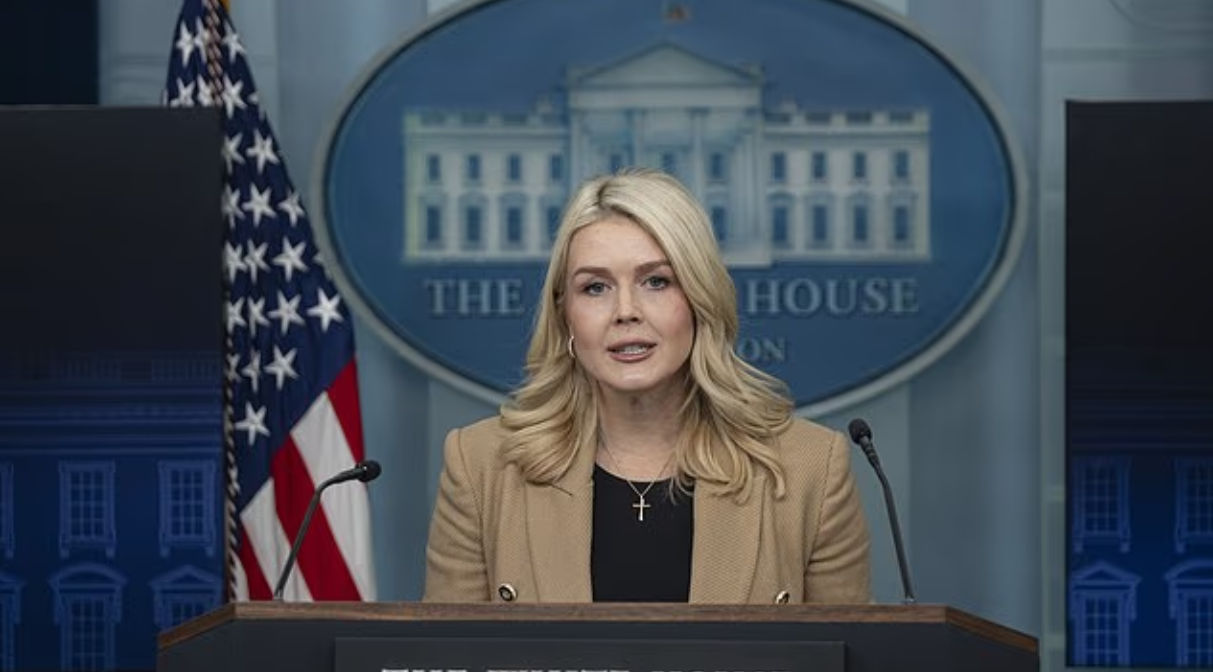
White House press secretary Karoline Leavitt fired back at Supreme Court justices following a hearing on the future of women’s sports earlier this week.
On Tuesday, the Supreme Court heard two cases regarding the participation of transgender athletes in women’s sports pertaining to students at the K-12 and college level.
During the hearings, justices Sonia Sotomayor, Elena Kagan and Ketanji Brown Jackson pressed the state attorneys arguing to keep women’s sport biologically female.
In retaliation, Leavitt accused those justices of challenging biology over for what appeared to be at least a devil’s’ advocate play on their behalf.
‘I think, frankly, it was quite alarming to not only hear a couple of justices grapple over that basic fundamental biological fact that men and women are different but inherently equal, but we are certainly different, and women deserve such rights,’ Leavitt said.

‘We hope and expect that the Supreme Court will rule in the right way on this matter.,’ she added, when addressing the hearings during a briefing on Thursday.
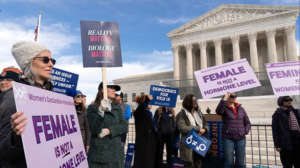
White House press secretary Karoline Leavitt fired back at Supreme Court justices Thursday
SCOTUS heard two cases regarding the participation of trans athletes in women’s sports
The White House mouthpiece was asked by conservative activist and former collegiate swimmer Riley Gaines whether Donald Trump’s administration was prepared to take action against states who would not comply with a potential future ruling from the Supreme Court’s to ban transgender athletes from women’s sport.
‘Absolutely,’ Leavitt responded.
‘The administration … [has] taken action on a number of fronts against these states who are failing to uphold the president’s executive orders and this administration’s policy of simply protecting women and women’s sports and women’s private spaces. We’ve gone to the mat with large universities in this country, as well, to try to fight for what’s right and what’s just for women in this country.
‘I think the president speaks on common sense on this issue, that women’s sports and private spaces should be protected and that there are two genders, there are two sexes – that is not something we should be afraid to say in this country.’
The consensus among pundits following Tuesday’s hearing is that SCOTUS seems likely to uphold state laws barring transgender athletes from playing on school athletic teams.
On Tuesday, the Supreme Court heard opening arguments in the Little v. Hecox and West Virginia v. B.P.J. cases, which address the constitutional rights of states to ban biological males from women’s and girl’s sports.
Lower courts ruled for the transgender athletes who challenged the state bans in Idaho and West Virginia, two of more than 24 Republican-led states to pass such restrictions.
Nonetheless, the conservative-dominated Supreme Court gave no indication after over three hours of arguments that it would follow suit.

Conservative activist and former collegiate swimmer Riley Gaines questioned Leavitt on the hearing during a press briefing on Thursday
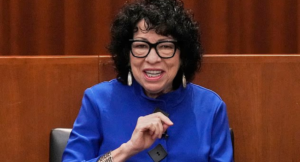
Leavitt accused the three liberal justices, including Justice Sonia Sotomayor (pictured) of challenging biology with their line of questioning during Tuesday’s hearings
Instead, at least five of the six conservatives on the nine-member court indicated they would rule that the laws don’t violate either the Constitution or the landmark Title IX law, which prohibits discrimination in education and has produced dramatic growth in girls’ and women’s sports.
Furthermore, the Supreme Court majority also appeared swayed by the arguments of cisgender athletes who have been accused of bigotry for opposing transgender participation in female sports.
‘Looking to the broader issue that a lot of people are interested in, there are an awful lot of female athletes who are strongly opposed to participation by trans athletes in competitions with them,’ conservative justice Samuel A. Alito Jr. said. ‘Are they bigots? Are they deluded in thinking that they are subjected to unfair competition?’
Meanwhile, the three liberal justices seemed focused on trying to marshal a court majority in support of a narrow ruling that would allow the individual transgender athletes involved in the cases to be allowed to compete.
A ruling is expected by early summer.
The Little v. Hecox lawsuit was initially filed in 2020 by trans athlete Lindsay Hecox, who had Idaho’s state law to prevent trans athletes from competing in women’s sports blocked amid their desire to join the women’s cross-country team at Boise State.
A 9th US Circuit Court of Appeals panel later upheld an injunction blocking the state law in 2023, before the Supreme Court agreed to hear the case despite Hecox asking them to drop it after insisting they were withdrawing and refraining from playing women’s sports at BSU or in Idaho.
The West Virginia v. B.P.J. lawsuit, meanwhile, was brought against the state by trans athlete Becky Pepper-Jackson, who was initially granted a preliminary injunction allowing them to participate on the school’s sports teams. After the 4th Circuit Court of Appeals ruled that law violated Title IX and the equal protection clause, the state’s appeal is also heading to Supreme Court.
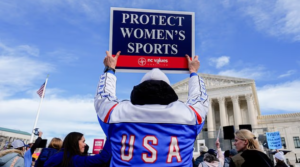
A protester holds a sign outside the Supreme Court during arguments over state laws barring transgender girls and women from playing on school athletic teams

Trans athlete Becky Pepper-Jackson (C) arrives outside the Supreme Court after it heard arguments in two cases that challenge state bans on transgender athletes
President Trump signed an executive order banning trans athletes from women’s sports called ‘Keeping Men Out of Women’s Sports’ back in February 2025.
According to the Supreme Court, 30 states have restrictions on transgender athletes participating against girls and women. However, several Democratic-led states chose to ignore Trump’s executive order last year.
In May, the president threatened to pull federal funding in California if the state did not follow the order, before suing its Department of Education when they refused to do so.
The lawsuit filed by the Justice Department said California’s trans athlete stance violated Title IX, the federal law that bans discrimination in education based on sex.
The department also claimed the state’s policies ‘are not only illegal and unfair but also demeaning, signaling to girls that their opportunities and achievements are secondary to accommodating boys.’
Meanwhile, US Attorney General Pam Bondi warned Minnesota and Maine, along with California, that they could also face challenges by the federal government over allowing transgender athletes to participate in women’s sports.