The Glass You Think Will Fill First Reveals If You’re A Taker
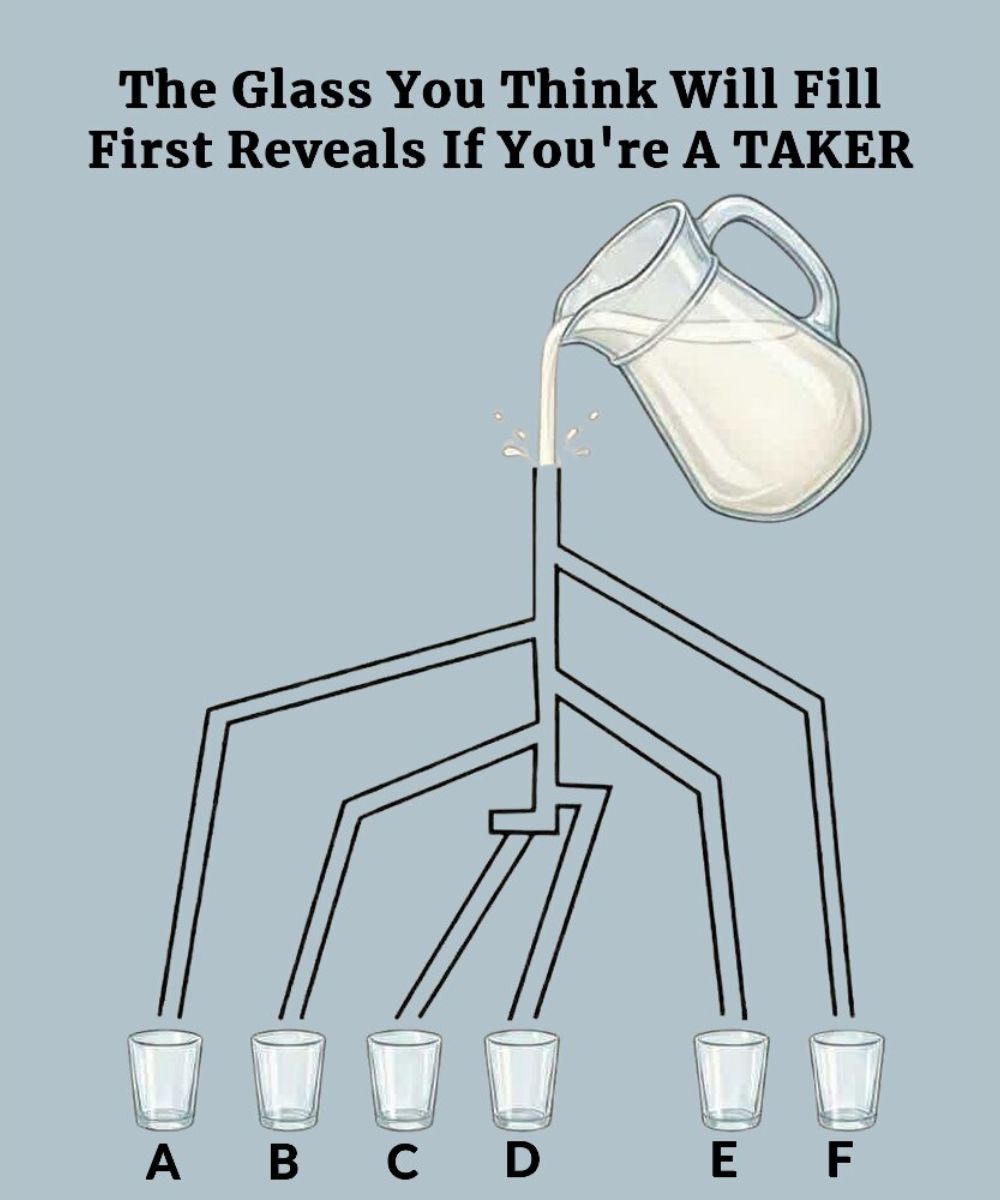
At first glance, the image looks simple: a pitcher pouring liquid into a network of pipes that branch downward toward six glasses labeled A, B, C, D, E, and F. But look closer. Some pipes are blocked. Some paths are dead ends. Only one glass will actually fill first.
This visual puzzle has been circulating online with one provocative question: Which glass fills first? And more interestingly—what does your answer say about you?
Let’s explore both the logic of the puzzle and the psychology behind your choice.
Step One: Slow Down and Observe
The instinct for many people is to pick the glass that appears most directly connected to the source. We assume that the shortest path equals the fastest result. But the trick lies in the hidden blockages.
In puzzles like this, certain pipes are subtly closed off. The liquid may seem to be flowing toward multiple directions, but in reality, only one route is truly open from top to bottom.

Solving it requires patience. You have to trace each path carefully and ignore assumptions. Often, the correct answer is not the one that feels obvious at first glance.
And that’s where personality comes in.
What Your First Choice May Reveal
While this is ultimately a logic puzzle, psychologists often use similar exercises to explore cognitive style.
If you chose quickly without analyzing the blockages, you may be someone who trusts intuition over detail. That can be powerful in leadership or creative roles—but it can also lead to missed information.
If you paused and traced each path carefully, you likely value structure and accuracy. You may be someone who dislikes unfair systems and wants clarity before making decisions.
If you assumed the “most obvious” glass would fill first, you might unconsciously expect resources to flow toward those already positioned closest to opportunity.
And here’s where the “taker” question enters.
The “Taker” vs. “Giver” Interpretation
Some versions of this puzzle suggest that the glass you choose reflects whether you are a “taker” or someone who prioritizes personal gain.
For example:
Choosing a glass that appears easiest to reach might indicate a focus on efficiency—or self-interest.
Choosing one that seems harder to access might suggest patience and fairness.
Changing your answer after re-evaluating the pipes may show adaptability and humility.
But here’s the truth: no single answer defines your moral character.
The real insight lies in how you approached the problem.
Did you rush?
Did you double-check?
Did you reconsider when new information appeared?
Those patterns often reflect how we navigate real-life situations involving money, recognition, or opportunity.
Why These Puzzles Feel So Personal
Visual brainteasers work because they mimic real-world systems. Resources—time, money, attention—rarely flow evenly. There are hidden blockages, invisible advantages, and structural barriers.
When we assume something will “naturally” reach a certain place first, we reveal our mental shortcuts.
Some people believe effort guarantees reward.
Others believe position matters more.
Some assume systems are fair until proven otherwise.
This puzzle forces us to question those assumptions.
The Real Lesson
Whether you chose A, B, C, D, E, or F, the important part isn’t the letter. It’s the pause.
In life, just like in this diagram, not every path is open—even when it looks that way. The people who thrive are not always the ones closest to the source. They’re the ones who learn to read the system.
So before labeling yourself—or anyone else—a “taker,” ask a better question:
Did you look carefully?
Because sometimes the glass that fills first isn’t the one you expect.
And sometimes the most valuable trait isn’t speed or ambition—
It’s awareness.