They Were Rushed to the Hospital After a Terrifying Car Crash. Then They Were Hit with Life-Changing News (Exclusive)
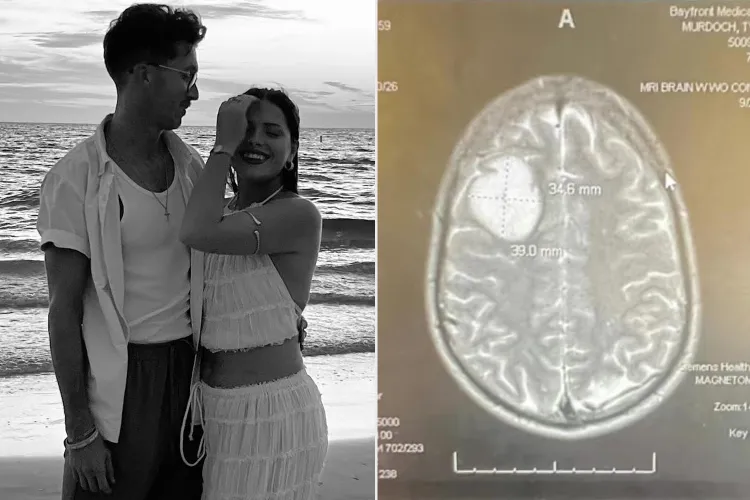
When Emily Starling moved to St. Petersburg, Fla., last November, she never expected love to be waiting just below her apartment. Yet the moment she met the boy living downstairs, Tyler Murdoch, she felt an immediate connection.
Their first official date didn’t happen until months later, during the first week of June, at a Tampa Bay Rays game. Since then, the couple, who planned to take their relationship slow, has savored every date opportunity together — even trying new experiences like a hockey game, which Starling, 23, had never attended before.
In the weeks leading up to the hockey game, Starling was buzzing with excitement. She even joked in a text to Murdoch, 33, a public school teacher, about having a “panic attack” over what to wear. “In hindsight, it’s silly,” she says. “We were in good spirits, just excited to go to the game.”
The day of the game, the couple climbed into Murdoch’s Jeep Wrangler, chatting and taking a familiar shortcut through a quiet neighborhood to avoid Gandy Bridge traffic. “Something feels off,” Murdoch remembers saying just minutes into the drive.
“I asked, ‘What did you say?’ ” Starling, a social media director, recalls. “And then that was it. When I looked over, he was seizing. This was his first seizure.”
From there, Murdoch lost consciousness behind the wheel, and the Jeep veered toward the roadside grass. Starling saw his hands stiffen, legs lock and mouth foam. After realizing he wouldn’t gain control, Starling took action.
“I’ve had seizures before, but never like that — it was terrifying,” she says.
She unbuckled her seatbelt and scrambled onto the center console, attempting to steer while keeping Murdoch’s foot off the gas as they approached a stop sign and houses on the road ahead. “He’s 6’1″, and his leg had stiffened completely. We went from about 25 to 60 miles per hour. It was deafening — it felt like we were flying,” she recalls.
As the Jeep careened along the narrow two-lane road, Starling honked the horn, pounded the windshield and screamed to try and get a bystander to notice. “It felt like forever,” she says. “But it was probably less than half a mile.”
Then, the Jeep flipped three times. Starling was thrown through the soft top, landing fifteen feet away in a puddle of mud, every inch of her body screaming in pain. Murdoch remained slumped in his seat, completely still. “I thought he was dead for like 20 minutes,” she says.
Starling crawled back to the overturned Jeep, pounding on locked windows and shouting for him to wake. A passing car stopped to help, while she says someone called 911. Neighbors rushed out, pulling her from the street, wrapping her in blankets, and praying with her — and for him.
When Murdoch’s door finally gave way, she clung to him instinctively. “That’s the love of my life. Please, I need him. I can’t lose him,” she recalls pleading.
EMTs arrived moments later, stabilizing both of them, starting IVs and instructing her not to move. “I thought my whole body was broken,” she recalls. “But all I could focus on was keeping him alive.”
Once in the ambulance, the couple was separated as medics tended to them both. Amid the chaos, she noticed Murdoch’s eyes fluttered open briefly. “He was alive,” she says, noting her relief, “even though he wouldn’t remember that moment.”
Never miss a story — sign up for PEOPLE’s free daily newsletter to stay up-to-date on the best of what PEOPLE has to offer, from celebrity news to compelling human interest stories.
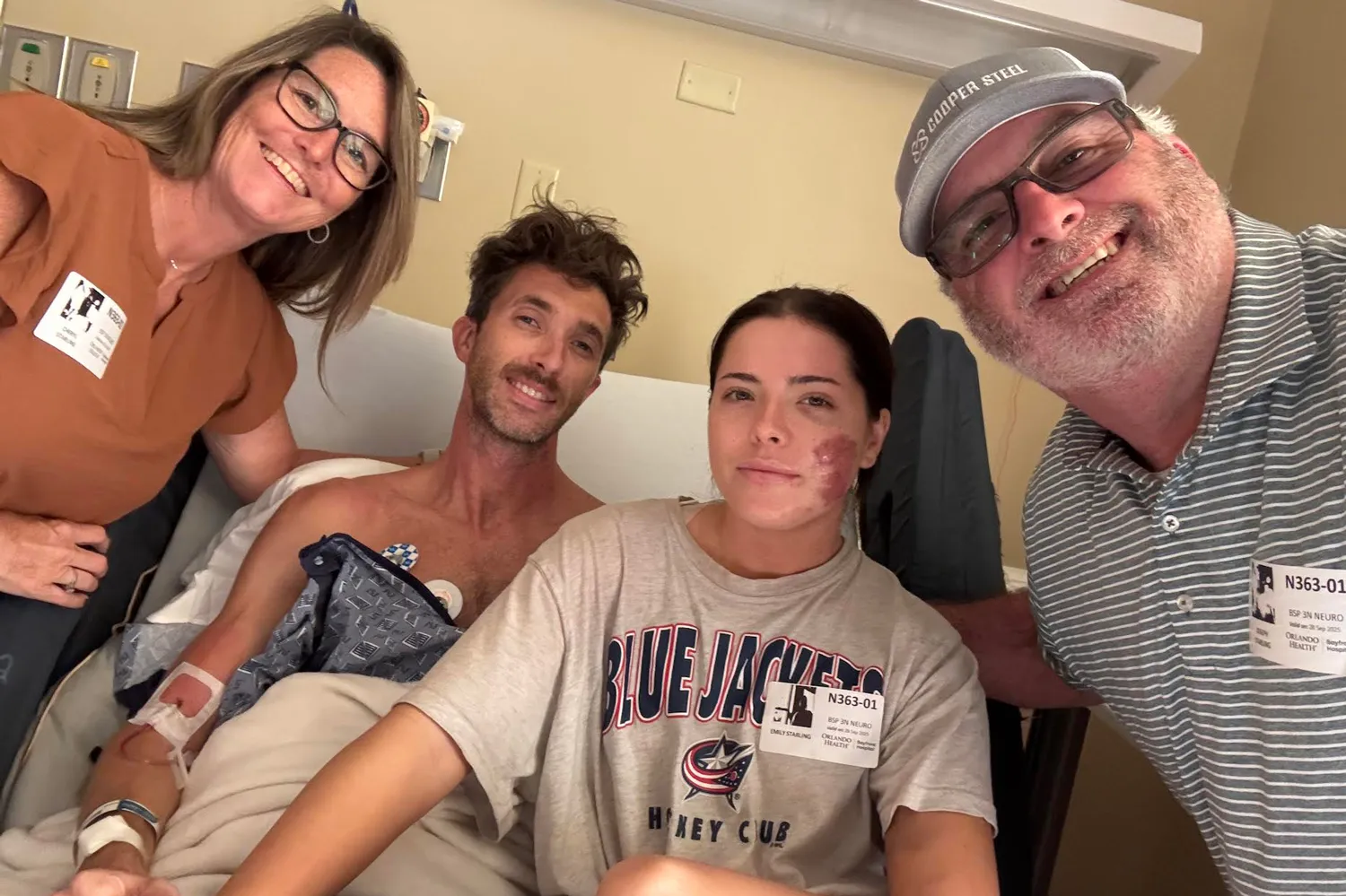
Miraculously, Starling had survived with only a broken bone in her lower arm and minor facial numbness, while Murdoch walked away with just a small scratch on his back.
However, the initial scans of Murdoch’s brain to determine the source of the seizure were inconclusive, suggesting a lesion, a cyst or fluid buildup. For the next 24 anxious hours, they waited for the MRI results.
Throughout the night, Starling anxiously checked in with the medical team, repeatedly asking if he was okay. Eventually, the staff allowed them to communicate via FaceTime from their separate rooms. “He looked at my face, and I was like, I don’t care about my face — I just needed you to be okay,” she says.
When the results finally came the next day, they revealed a brain tumor the size of a plum. Emergency surgery was scheduled for the following Tuesday.
Even amid fear, the couple found reassurance in Dr. Mark Goldman, Murdoch’s surgeon.
“He’s amazing. Super intelligent. Fantastic bedside manner,” Starling says. Murdoch remembers nervously joking, “I asked how long it would take, and he said an hour. I said, ‘That’s it?’ He joked, ‘I can break the world record and do it in 30 minutes.’ ” Starling adds, “Looking at the picture of the tumor, we knew immediately — no second opinions needed.”
From there, support arrived from all directions. Starling’s parents drove two hours from Lakeland, Fla., while Murdoch’s mother traveled from Tennessee and his grandfather from Nebraska. “It felt like worlds colliding,” she says, “but it was the kind of energy that makes the impossible feel possible.”
“My parents met him for the first time, and I met his parents for the first time,” Starling adds. “It was under those intense circumstances, but I’m glad we had that supportive energy surrounding us.”
When the surgery was complete, Murdoch recalls that simply being able to open his eyes felt like a miracle. “I’m pretty religious,” he says. “The anesthesia guy prayed with me, and I was just thanking God that I could come back to life after such a wild time.”
Just two days later, he was able to go home.
Recovery, however, proved grueling. Murdoch lost 30 pounds during his hospital stay, prompting Starling to prepare high-calorie meals, protein smoothies and even steak — his first post-surgery craving. “Dr. Goldman explained it in a fascinating way,” Murdoch says. “I have an opportunity to form new neural connections — to retrain my brain. It feels like a reset.”
Equally important has been tending to their mental health. Both rely on therapy to navigate the trauma and anxiety that followed the accident. “This is a very traumatic situation, and we’re a new couple,” Starling admits.
Amid the challenges, Starling decided to share their story on TikTok. Hair and face unwashed, she turned on the camera and said, “We need help.” The response was immediate and overwhelming. Strangers offered meals, resources and support, helping them raise over $9,000 on GoFundMe.
“People caring and empathizing — it’s been incredible,” Starling says.
Murdoch adds, “Usually I’m the person out there helping others. I always keep tools and a jack in the back of my car. I stop on the side of the road to help people whenever I can. My dad called it ‘paying it forward.’ You do something good, and it comes back as good karma. And it did. I’ve always helped people. Now people are helping us. It’s like good karma coming back.”
Recently, Murdoch received his biopsy results: he will need to pursue targeted therapy at Moffitt Cancer Center for his tumor. They said that without treatment, it could grow back within seven to 10 years.
Looking ahead, they hope to inspire others to advocate for their health, pay attention to warning signs, and cherish meaningful moments. Murdoch plans to visit other brain surgery patients, sharing his journey and offering hope. “Regular checkups, listening to your body, not ignoring warning signs,” Murdoch emphasizes.
The ordeal has only strengthened their bond. “I know how deeply I care about him,” Starling says. “We went from worrying about trivial things to facing life-and-death situations together.” Murdoch nods. “It’s redirected our lives, but in the best way. Every day is a gift.”
“Thirty minutes before this, I was stressed about a verification code and my outfit. None of that matters anymore. Life’s true priorities are love, health and support.” Murdoch adds, “It’s all about perspective. Life is fragile, and every day is a gift.”