We Adopted a Girl No One Wanted Because of a Birthmark – 25 Years Later, a Letter Revealed the Truth About Her Past
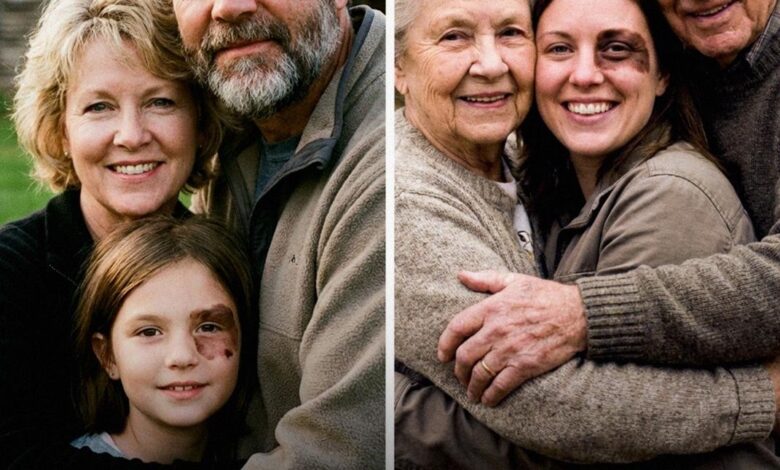
I am seventy-five years old now. My name is Margaret. My husband, Thomas, and I have been married for more than fifty years.
For most of that time, it was just the two of us.
We wanted children. We tried. We tried longer than most people would admit. There were appointments, tests, hormones, calendars marked with hope and crossed out with disappointment. Eventually, a doctor folded his hands, avoided my eyes, and told us our chances were extremely low. That was it. No next steps. No miracle waiting in the wings. Just an ending.
We grieved quietly and then learned how to live with it. By the time I turned fifty, we told ourselves we had made peace with the life we had.
Then one afternoon, a neighbor mentioned a little girl.

Mrs. Collins lived three houses down and volunteered at the local children’s home. She spoke casually, like she was commenting on the weather. “There’s a girl there who’s been waiting five years,” she said. “No one ever comes back for her.”
I asked why.
“She has a large birthmark on her face,” Mrs. Collins said. “People ask for photos, then decide it’s too much. She’s been there since birth.”
That night, I couldn’t sleep. I kept picturing a child learning, over and over, that she wasn’t chosen.
When I told Thomas, I expected practicality. We were older. We were settled. We had routines built for two people, not a child.
Instead, he listened. Then he said, “You can’t stop thinking about her.”
He was right.
We talked honestly. About age. About energy. About money. About what would happen if we didn’t live long enough to see her fully grown. There were no romantic speeches, just reality laid out on the table.
Finally, he said, “Let’s meet her. No promises. Just meet her.”
Two days later, we walked into the children’s home.
A social worker led us to a playroom. She warned us gently that Lily knew she was meeting visitors, nothing more. They didn’t want to raise expectations.
Lily sat at a small table, coloring with careful concentration. Her dress was a little too big, clearly passed down. The birthmark covered most of the left side of her face, dark and unmistakable. Her eyes, though, were sharp and observant, like she’d learned to read people quickly.
I knelt beside her and introduced myself. Thomas did the same.
She looked at him and asked, very seriously, “Are you old?”
He smiled. “Older than you.”
She considered that. Then asked, “Will you die soon?”
I felt the floor drop out from under me. Thomas didn’t flinch. “Not if I can help it,” he said. “I plan to be annoying for a long time.”
That earned a brief, stolen smile before she went back to coloring.
She was polite but guarded. She watched the door constantly, like she was timing how long we would stay.
The paperwork took months.
When it was final, Lily walked out with a small backpack and a worn stuffed rabbit she held by one ear. In the car, she asked quietly, “Is this really my house now?”
“Yes,” I said.
“For how long?”
Thomas turned slightly. “For always. We’re your parents.”
She didn’t cry. She just nodded once, filing it away, waiting to see if we meant it.
The first weeks were hard. She asked permission for everything. To sit. To eat. To speak. It was like she was trying to make herself small enough not to be returned.
One night, she whispered, “What if I do something bad? Will you send me back?”
“No,” I told her. “You might get in trouble. But you won’t be sent away. You’re ours.”
She listened, but she didn’t relax for a long time.
School was worse. Children can be cruel without trying. One day she came home silent, eyes red. A boy had called her a monster. Others had laughed.
I pulled the car over and told her the truth plainly. “You are not a monster. Anyone who says that is wrong. Not you.”
She touched her cheek and said she wished the mark would disappear.
“I don’t,” I told her. “I wish the world were kinder.”
We never hid that she was adopted. We used the word openly. When she was thirteen, she asked about her biological mother. All we could tell her was that she had been very young and left no letter.
“I don’t think you forget a baby you carried,” I said.
Lily nodded, but something tightened in her shoulders.
As she grew, she learned how to answer questions without shrinking. Her voice became steadier. At sixteen, she told us she wanted to be a doctor. She said she wanted children who felt different to see someone like her and know they weren’t broken.
She kept that promise to herself. College. Medical school. Long nights. Setbacks. She didn’t quit.
By the time she graduated, Thomas and I were slowing down. More medications. More appointments. Lily called every day and visited every week, scolding me about salt like I was one of her patients.
Then the letter came.
Plain envelope. No stamp. No return address. Just my name written neatly on the front.
Inside, three pages.
The woman wrote that her name was Emily. She was Lily’s biological mother. She had been seventeen. Her parents had called the birthmark a punishment and refused to let her bring Lily home. She signed the papers because she was a child herself with no power.
She wrote that she visited the children’s home once when Lily was three and watched through a window. She was too ashamed to go in. When she returned later, Lily was gone. Adopted by an older couple. Staff told her we seemed kind.
“I am sick now,” she wrote. “Cancer. I don’t know how much time I have. I don’t want her back. I just want her to know she was wanted.”
We told Lily the truth. We gave her the letter.
She cried once, quietly. Then she said, “You’re my parents. That doesn’t change.”
She chose to meet Emily.
The meeting was gentle and painful and unfinished. There were apologies that couldn’t erase time. There was anger that didn’t explode. There was sadness that sat between them.
When we left, Lily cried in the car. She said the truth hadn’t fixed anything.
“It ended the wondering,” I told her.
That was enough.
Today, Lily doesn’t call herself unwanted. She knows she was wanted twice. By a scared girl who couldn’t fight her parents, and by two people who heard about “the girl no one wanted” and knew that was never true.