172 Days of Silence:The Moment I Stripped Away the Lies In Front of 7 Strangers To Save My Life From a Monster.
I thought I was lucky when Aunt Martha took me in after the accident. 172 days later, I was a ghost of myself, living in a basement and praying for a way out. I finally found my chance at a greasy diner, staring into the eyes of 7 bikers who looked like my only hope or my final mistake.
The bell above the door at Henderson’s Roadside Grill chimed like a death knell.
Martha’s hand was a cold vice on my upper arm, her fingernails digging through the thin fabric of my thrift-store hoodie.
“Smile, Maya,” she hissed, her voice a low vibration that only I could hear. “Remember what happens if you don’t look grateful.”
I looked at the grease-stained floor, counting the cracked tiles to keep my breathing steady. 1, 2, 3… I’d been counting everything for the last 172 days.
Days since my parents’ car went over the bridge. Days since Martha convinced the state she was the only family I had left.
The air in the diner smelled of burnt coffee and old frying oil. It was the most beautiful thing I’d smelled in months because it wasn’t the damp rot of the basement.
At the far corner booth, 7 men sat surrounded by the scent of leather and gasoline.
They were loud, their laughter booming over the country music playing on the jukebox.
They looked dangerous, covered in tattoos and wearing vests with patches I didn’t recognize.
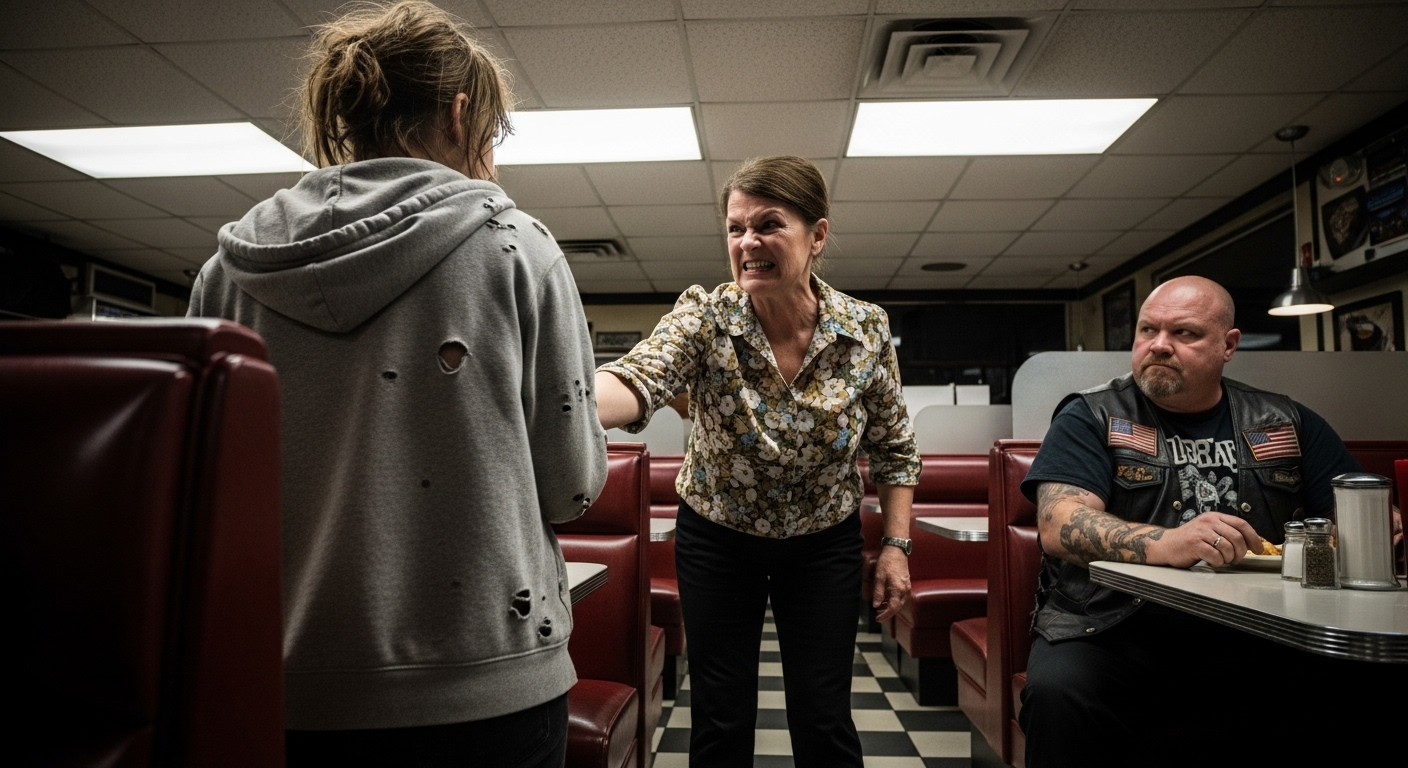
Martha pulled me toward a booth near the window, away from them.
“Don’t look at those animals,” she whispered, her face twisting in a mask of Christian concern.
But I did look. I looked because I knew this was my only shot.
I knew that if we got back into that silver SUV, I wouldn’t survive day 173.
Martha ordered 2 glasses of water and the cheapest side of toast on the menu.
She liked to tell people we were struggling, even though I knew where she kept my father’s life insurance checks.
I felt the weight of the bruises under my shirt, the ones she said were for my own “discipline.”
My heart was hammering against my ribs so hard I thought it might crack.
One of the bikers, a man with a graying beard and a scar across the bridge of his nose, caught my eye.
He didn’t look away. He didn’t look through me like everyone else in town did.
He saw the way Martha’s grip never loosened. He saw the way I flinched when she reached for a napkin.
I had to do it now. Before the waitress came back. Before the chance vanished into the highway heat.
I stood up abruptly, knocking my water glass over.
The water spilled across the Formica tabletop, soaking into Martha’s sleeve.
“You clumsy little brat!” she snarled, her mask slipping for just a fraction of a second.
She raised her hand, the instinct to strike me so ingrained she forgot where we were.
I didn’t cower this time. I stepped back, right into the path of the biker’s booth.
“Help me,” I whispered, but the words were drowned out by Martha’s sudden, fake apology to the room.
“I’m so sorry, she’s been so unwell lately, the trauma…” Martha started, her voice sweet as poisoned honey.
I reached for the hem of my hoodie. My hands were shaking so much I could barely grip the fabric.
I looked at the man with the gray beard. He was watching me with eyes that had seen a thousand wars.
I took a breath and pulled the fabric up, exposing the map of pain Martha had etched into my skin.
The diner went silent. The only sound was the hum of the refrigerator.
The biker stood up, his chair screeching against the floor.
— CHAPTER 2 —
The silence in Henderson’s Roadside Grill wasn’t the peaceful kind. It was the heavy, suffocating silence that happens right before a lightning strike hits a transformer. I stood there, my hoodie pulled up to my collarbone, exposing the jagged, violet-rimmed bruises that mapped out my ribs. The air in the diner felt freezing against my skin, a sharp contrast to the humid Ohio afternoon outside.
Martha’s face went through three different stages of panic in four seconds. First, it was the wide-eyed shock of a predator who had been spotted. Then, it was the calculated mask of a grieving, overwhelmed guardian. Finally, it settled into a cold, murderous rage that she tried to hide behind a trembling lip.
“Maya, honey, put your clothes down,” she said, her voice wobbling with a fake sob. She reached out for me, her fingers twitching like spider legs. “I told you we’d get you help for those… for those self-inflicted marks.”
The lie hung in the air, thick and oily. I didn’t move. I didn’t blink. I kept my eyes locked on the man with the gray beard at the corner table. He had stopped chewing his burger, his hand frozen halfway to his mouth.
The other six men at the table had gone dead still. They weren’t the “wild bikers” you see in the movies, shouting and causing trouble. They were quiet. That kind of quiet is much more terrifying because it means they are thinking, and men like that think in terms of action.
“I didn’t do this to myself,” I said. My voice sounded thin and cracked, like dry leaves skittering across a sidewalk. It was the first time I’d spoken at a normal volume in months. Martha usually made sure I whispered so the neighbors wouldn’t hear the fear.
Martha let out a sharp, hysterical laugh that made the waitress behind the counter jump. “She’s been through so much, officer—oh, wait, there’s no officer here.” She looked around the room, her eyes darting like trapped flies. “She lost her parents in such a tragic way, and her mind just… it just broke.”
She stepped toward me, her hand coming up as if to stroke my hair. I knew that hand. That hand had held my head under the water in the basement sink just three days ago because I’d forgotten to scrub the grout in the shower. I flinched so hard I nearly knocked over the salt and pepper shakers.
The gray-bearded man stood up slowly. He was huge, a wall of denim and muscle that seemed to block out the light from the front window. He had a patch on his vest that said “Roadside Kings,” and another one that simply said “Preacher.” He didn’t look like a preacher.
“Sit down, ma’am,” the man said. His voice was a low rumble, like a semi-truck idling in the distance. It wasn’t a suggestion. It was a command that carried the weight of a mountain.
Martha stiffened, her chin lifting in that indignant way she used whenever a store clerk questioned her expired coupons. “I beg your pardon? This is a family matter. My niece is very sick, and I need to take her home right now.”
She reached for my arm again, her grip tightening like a pair of pliers. I let out a small, involuntary whimper. The sound seemed to ripple through the diner, breaking the spell of the other patrons who were just staring.
“I said,” the man called Preacher repeated, stepping out from behind the table, “sit. Down.” The two men sitting next to him stood up as well. They were younger, with hard eyes and knuckles scarred from years of manual labor or fighting. Maybe both.
Martha’s face turned a blotchy, ugly red. “You have no right! I am her legal guardian! I have the paperwork! I have the power of attorney!” She was screaming now, her voice echoing off the wood-paneled walls.
I looked at the floor, the memory of those one hundred and seventy-two days flooding back. It started the day after the funeral. The house was still full of the scent of lilies and the “I’m so sorry for your loss” casseroles that people leave behind when they don’t know what else to do.
Martha had been my mom’s older sister, the one who moved away to the city and only sent generic Christmas cards. But when the bridge gave way and my parents’ sedan disappeared into the black water of the river, she was the first one at the hospital. She looked like an angel of mercy in her pressed navy suit.
“I’ll take care of her,” she told the social worker. “She’s all I have left of my dear sister.” I was fifteen then, shattered and numb, and I believed her. I thought the basement room she gave me was just because the house was small.
I didn’t realize at first that the lock on the outside of the door wasn’t for my protection. I didn’t realize that the “home schooling” was just a way to keep me from the eyes of teachers who might notice the weight I was losing. I didn’t realize that the “discipline” would start with a slap and end with a belt.
“Maya, we are leaving. Now,” Martha hissed, her voice dropping back into that terrifying, quiet register. She started to pull me toward the door, her strength surprising for a woman her age. I felt my feet dragging across the tile, the old familiar terror rising in my throat.
“She ain’t going nowhere with you,” one of the younger bikers said. He moved with a grace that was startling for a man of his size, cutting off Martha’s path to the exit. He was leaning against the doorframe, picking his teeth with a splinter of wood.
Martha stopped, her chest heaving. “This is kidnapping! I will call the police! I will have you all thrown in jail!” She reached into her oversized leather purse, her hand fumbling for her phone.
“Go ahead,” Preacher said, walking toward us with measured steps. “Call ’em. We’d love to have a chat with the Sheriff about those marks on the girl’s ribs. I’m sure he’d be real interested in how a ‘sick’ girl does that to herself.”
Martha froze, her hand halfway inside her bag. The silence returned, but this time it was different. It was the silence of a trap snapping shut. She looked at the bikers, then at the waitress who was already holding the landline phone behind the counter, her finger hovering over the buttons.
I felt a tiny flicker of something I hadn’t felt in months. It wasn’t quite hope yet—hope was too dangerous a thing to carry in that basement. It was more like a realization. For the first time in one hundred and seventy-two days, Martha was the one who was afraid.
“You don’t understand,” Martha said, her voice cracking. She tried to turn back into the victim, the poor aunt struggling with a wayward teen. “She does this. She hides things. She lies. She’s a pathological liar! Ask anyone in our town!”
“We aren’t in your town, lady,” Preacher said. He was standing right in front of us now. He didn’t look at Martha. He looked down at me. His eyes weren’t hard anymore. They were filled with a deep, weary kind of sadness. “What’s your name, kid?”
“Maya,” I whispered. I forced myself to stand up straight, even though every muscle in my body told me to curl into a ball. “My name is Maya.”
“Well, Maya,” Preacher said, “you want to stay with this woman, or you want to sit down and have a real breakfast?”
I looked at Martha. She was glaring at me, a silent promise of what would happen once we were behind closed doors. The basement. The hunger. The “lessons.” I knew that if I stayed, I would never see day two hundred.
“I want to stay,” I said, my voice getting stronger. “But not with her. Never with her again.”
Martha’s face contorted into a mask of pure evil. She didn’t care about the bikers anymore. She didn’t care about the witnesses. She lunged at me, her fingers aimed for my throat, screaming a word that I’ll never forget.
But she never reached me. One of the bikers grabbed her by the waist and lifted her off the ground like she weighed nothing. She kicked and screamed, a whirlwind of floral fabric and polished shoes.
“Get her out of here,” Preacher said, his voice cold as ice. “Take her to the back office and hold her until the law gets here. Don’t hurt her, but don’t let her move.”
As they dragged a screaming Martha away, the diner returned to a surreal kind of normal. The jukebox started playing a Dolly Parton song. The smell of bacon drifted from the kitchen. But my heart was still racing, and I was shaking so hard I had to lean against the table.
Preacher put a heavy hand on my shoulder. It didn’t feel like Martha’s grip. It felt solid. It felt like an anchor. “Sit down, Maya. You’re safe now.”
I sat. My legs felt like jelly. I looked at the six other men who were now surrounding the table, a silent wall of protection. They weren’t looking at me with pity. They were looking at me like I was one of them. Like I was a survivor.
The waitress came over, her hands trembling as she set a fresh glass of orange juice in front of me. “On the house, sweetie,” she whispered. “I… I’m so sorry I didn’t notice sooner.”
I took a sip of the juice. It was sweet and cold, the most intense thing I’d tasted in forever. I looked at Preacher. “What happens now?”
“Now,” he said, pulling a chair up to the head of the table, “we wait for the Sheriff. And then, we make sure that woman never breathes the same air as you again.”
He paused, looking toward the front door as the sound of a distant siren began to wail. It started low, then grew louder, cutting through the heavy afternoon heat.
“But there’s something you should know, Maya,” Preacher said, his expression darkening.
“What?” I asked, a new surge of fear hitting me.
“Martha isn’t the only one who’s been looking for you,” he said. He reached into his vest and pulled out a crumpled “Missing Person” flier. It wasn’t from the police. It didn’t have the official state seal.
I looked at the photo. it was me, from before the accident. But it was the name at the bottom that made my blood run cold. It wasn’t Martha’s name. It was a name I hadn’t heard since I was five years old. A name my parents told me was dead.
The sirens grew deafeningly loud, and the blue and red lights began to flash against the diner windows, but I couldn’t take my eyes off that paper.
“Your father didn’t have just one sister, Maya,” Preacher whispered as the front door swung open. “And the other one is a lot more powerful than Martha.”
I looked up at the door, expecting to see the Sheriff. Instead, a blacked-out SUV pulled into the lot, screaming to a halt right behind the police cruiser. Two men in suits got out, and they weren’t wearing badges.
The cliffhanger wasn’t just about Martha anymore. The nightmare I thought was ending was just shifting shapes. As the police burst through the door, the men in suits stayed back, watching me through the glass with the clinical precision of hunters who had finally found their mark.
— CHAPTER 3 —
The bells on the diner door didn’t just chime this time; they rattled against the glass as Sheriff Miller pushed his way inside. He was a man who looked like he’d been carved out of an old oak tree, weathered and stiff, with a mustache that hid any expression of his mouth. Two deputies followed him, their hands resting habitually on their belts, their eyes scanning the room with that practiced, weary suspicion of small-town law.
The air in Henderson’s was thick with the smell of old grease and the electric charge of a standoff. My heart was a trapped bird in my chest, fluttering frantically against the bruises on my ribs. I felt the cold sweat slicking my palms as I looked from the Sheriff to the men in the black SUV outside.
“What’s the situation here, Preacher?” Sheriff Miller asked, his voice gravelly and devoid of warmth. He didn’t look at me first; he looked at the giant man standing guard over my chair. It was clear they knew each other, a history of run-ins and mutual respect written in the way they stood.
Preacher didn’t move an inch, his presence a literal wall between me and the rest of the world. “The situation, Miller, is that a monster has been hiding in plain sight in your county for nearly six months,” he said. He gestured toward the back office where the sounds of Martha’s muffled screaming still echoed.
Martha was throwing a fit that would have been embarrassing if it weren’t so terrifying. She was screeching about her rights, about “the girl’s mental health,” and about how these “thugs” were kidnapping her. It was the same voice she used when she told me I was ungrateful for the scraps of food she threw my way.
Sheriff Miller looked at me then, really looked at me, and I saw the moment his professional mask cracked. I was still holding the hem of my hoodie slightly up, the evidence of Martha’s “care” impossible to ignore in the harsh light. The bruises weren’t just bruises; they were fingerprints of a nightmare I couldn’t wake up from.
“Maya, is it?” the Sheriff asked, his voice softening just a fraction, a sound that felt alien in this room. I nodded, unable to find my voice, my throat feeling like it was filled with jagged glass. I let the fabric of my hoodie drop, the sudden coverage making me feel exposed in a different, more vulnerable way.
One of the deputies moved toward the back office to deal with Martha, his boots heavy on the linoleum. The diner patrons were still huddled in their booths, their breakfast getting cold as they watched the drama unfold like a live-action news report. Nobody was eating; nobody was talking; everyone was just breathing in the tension.
But my focus was pulled away from the law and the lady in the back. I looked past the Sheriff, past the “Closed” sign on the front door, to the two men in suits standing by the black SUV. They weren’t moving, weren’t talking, just staring through the glass with a cold, predatory focus.
They looked like they belonged in a skyscraper in Manhattan, not a dusty roadside stop in rural Ohio. Their suits were charcoal gray, perfectly tailored, and their sunglasses were so dark they looked like holes cut into their faces. They didn’t look like they were here to help; they looked like they were here to collect a debt.
“Who are they?” I whispered, my voice finally returning, though it was barely a breath. Preacher followed my gaze, his brow furrowing as he noticed the suits for the first time. He didn’t answer me, but I saw his hand drift toward the heavy silver chain hanging from his pocket.
“Miller, you might want to check the IDs of those gentlemen in the parking lot,” Preacher said, his tone shifting from defensive to alert. The Sheriff turned around, his hand moving toward his holster as he caught sight of the newcomers. Small-town cops generally don’t like out-of-towners in expensive cars who don’t bother to come inside and state their business.
One of the men in suits began to walk toward the door, his movements fluid and unnervingly calm. He didn’t run, didn’t hurry, just moved with the confidence of someone who owned the ground he walked on. The Sheriff stepped outside to meet him, leaving the door propped open so the humid air and the sound of the highway rushed in.
“Can I help you boys?” I heard Miller ask, his voice booming across the asphalt. The man in the suit reached into his breast pocket, and for a second, I thought the Sheriff was going to draw his weapon. But the man simply pulled out a slim, black leather wallet and flipped it open.
I couldn’t see the ID, but I saw the effect it had on Sheriff Miller. The oak-tree man seemed to sag, his shoulders dropping as he stared at whatever was written on that card. He looked back at the diner, his eyes finding mine with a look that wasn’t just pity anymore—it was fear.
“Preacher,” the Sheriff called out, his voice sounding thin against the wind. “We have a problem. A big one.” He stepped back inside, followed by the man in the suit, who stepped into the diner like he was entering a cathedral.
The suit took off his glasses, revealing eyes the color of a winter sky—pale, cold, and utterly detached. He looked around the grease-stained walls and the flickering neon signs with a sneer of pure disgust. Then his gaze landed on me, and I felt a chill run down my spine that had nothing to do with the air conditioning.
“Maya Vance,” the man said, his voice as smooth as silk and just as dangerous. He didn’t ask; he stated it. “My name is Silas. I’m here on behalf of your aunt, Elena Vance. We’ve been looking for you for a very long time.”
The name ‘Elena’ hit me like a physical blow, a name buried under layers of childhood memories and my parents’ warnings. My mother had always spoken of Elena in whispers, a sister she had cut off decades ago, a woman who lived in a world of shadows and power. “She’s not like us, Maya,” my mom had once told me. “She thinks people are just pieces on a board.”
“She’s dead,” I stammered, the words falling out of my mouth before I could stop them. “My parents said she died in a fire before I was born.” I looked at Preacher, pleading for him to tell me this was just another of Martha’s sick games.
Silas gave a small, chilling smile that didn’t reach those ice-blue eyes. “Your parents were very good at keeping secrets, Maya. It’s a pity their driving wasn’t as good as their storytelling.”
The room seemed to tilt on its axis. The implication in his voice wasn’t just a jab at their death; it was a suggestion of something darker. I looked at the bruises on my arms, then at the man in the suit, and I realized that Martha was just the beginning of the nightmare.
“She’s coming with us,” Silas said, looking at the Sheriff as if he were a piece of furniture. “The paperwork is already being processed at the state level. The girl is a Vance, and she belongs with her family.”
“She stays with us,” Preacher growled, his voice rising like a storm. The other six bikers moved in, forming a tight circle around me, their leather jackets creaking as they shifted into a defensive stance. They didn’t care about IDs or state-level paperwork; they only cared about the girl they’d decided to protect.
Silas didn’t look intimidated; he looked bored. He reached into his pocket and pulled out a cell phone, tapping the screen a few times before holding it out. “Sheriff, I believe your supervisor has something to say to you. And Preacher? You might want to check the status of your club’s liquor license and those outstanding warrants in Kentucky.”
The air in the diner grew even heavier, the silence now punctuated by the sound of my own ragged breathing. I was caught between a monster I knew—Martha—and a mystery that felt infinitely more dangerous. I looked at the “Missing Person” flier Preacher had shown me, the one with Elena’s name at the bottom.
If Elena was alive, why had she waited 172 days to find me? Why did she send men in suits instead of coming herself? And most importantly, why did my parents lie to me about her existence for my entire life?
I looked at the door, thinking about running, but Silas’s partner was still standing by the SUV, blocking the only exit. I was trapped in a diner with a Sheriff who was losing his nerve, a gang of bikers who were about to be dismantled, and a man who represented a past I didn’t know I had.
“Maya,” Preacher whispered, leaning down so only I could hear him. “Whatever you do, don’t get in that car. My boys and I, we’ve seen men like this before. They don’t bring people home. They bring them to cages.”
I looked at Silas, who was watching us with that same, bored expression. “The clock is ticking, Maya,” he said. “Your Aunt Elena doesn’t like to be kept waiting. And trust me, she’s much less patient than Martha.”
Suddenly, a loud crash came from the back office. The deputy stumbled out, his face pale, as Martha screamed at the top of her lungs, “She knows! She knows about the ledger! Don’t let them take her!”
Silas’s expression changed instantly. The boredom vanished, replaced by a sharp, lethal intensity. He looked at the back office, then back at me, his eyes narrowing.
“What ledger, Maya?” he asked, his voice now a low, predatory hiss.
I had no idea what he was talking about, but I knew one thing: whatever Martha was hiding in that basement was the reason I was still alive, and it was the reason these men were here.
The cliffhanger wasn’t just about my survival anymore; it was about a secret I didn’t even know I was carrying. As the Sheriff took the phone from Silas, his face turning white, I realized that the 172 days of agony were just the prologue to a much larger, more terrifying story.
“I don’t know anything about a ledger,” I said, my voice finally steady.
Silas stepped closer, ignoring the bikers’ growls. “Then you better hope you find it before we do,” he whispered. “Because your Aunt Elena isn’t the only one looking for it. And the other people… they won’t just give you bruises.”
— CHAPTER 4 —
The mention of a “ledger” changed the atmosphere in Henderson’s Roadside Grill from a rescue mission to a hunt. Silas didn’t wait for the Sheriff to finish his phone call. He didn’t wait for the bikers to move. He simply reached out and grabbed my wrist with a grip that was surprisingly strong and cold.
“Let her go,” Preacher barked, his hand slamming down on Silas’s forearm. The tension was at a breaking point, a powder keg waiting for a single spark. The other bikers stepped forward, their shadows stretching across the floor like long, dark fingers.
Silas didn’t flinch. He looked at Preacher’s hand as if it were a minor inconvenience, a bug to be brushed away. “You’re making a very large mistake, Mr. Vance,” he said, using Preacher’s last name—a detail that made the big man’s eyes widen in shock.
I looked between them, my mind reeling. Preacher? A Vance? Was everyone in this room connected to the web of lies my parents had woven around me? My head was spinning, the hunger and the trauma finally catching up to me as the room began to blur at the edges.
“I haven’t used that name in twenty years,” Preacher growled, his voice vibrating with a raw, hidden pain. He didn’t let go of Silas’s arm. “And I sure as hell don’t answer to Elena. She’s the reason I left that family, and she’s the reason Maya is in this mess.”
The revelation was like a physical weight being dropped on me. The man who had stepped in to save me, the biker with the gray beard and the kind eyes, was my uncle. He was the brother my mother never mentioned, the one who had disappeared into the road and the leather.
“Family reunion aside,” Silas said, wrenching his arm free with a sudden, violent twist, “the girl is coming with us. The Sheriff has been instructed by his superiors to stand down. Isn’t that right, Miller?”
Sheriff Miller handed the phone back to Silas, his hands visibly shaking. He looked at me, then at Preacher, and then at the floor. “I’m sorry, Roy,” he said, using Preacher’s real name. “My hands are tied. Federal oversight, they said. Something about a high-profile missing persons case and state jurisdiction.”
“It’s a kidnapping, Miller!” Preacher shouted, his voice echoing through the diner. “You’re letting them take her right after she showed you what that woman did to her!” He pointed toward the back, where Martha’s muffled screams had turned into a rhythmic, haunting chanting.
“We will handle the aunt’s legal situation,” Silas said, his voice returning to that smooth, oily tone. “But Maya is our priority. Now, Maya, if you would please step outside to the vehicle. We have your belongings—what’s left of them—and a doctor waiting to examine you.”
I looked at Preacher—my Uncle Roy. He looked defeated, his massive shoulders slumped as the reality of the situation set in. He was a man of the road, a man of muscle and grit, but he couldn’t fight the entire legal system of the United States.
“Don’t go with him, Maya,” he whispered, his eyes filled with a desperate plea. “If you get in that car, you’ll never see the sun again. Elena doesn’t want to help you. She wants what you have.”
“I don’t have anything!” I cried out, the frustration finally boiling over. “I have a dead family, a basement room, and a body full of bruises! What could she possibly want from me?”
Silas smiled, and this time it was genuine—and infinitely more terrifying. “You have your father’s eyes, Maya. And more importantly, you have his memory. We believe he left something with you. Something he didn’t want Elena to have.”
The “ledger.” It always came back to the ledger. I tried to think back to the days before the accident. My father had been a quiet man, a local accountant who loved his garden and his old jazz records. He didn’t look like a man who held secrets that would interest men in suits.
But I remembered the night before the bridge gave way. He had been sitting at his desk, his face illuminated by a single lamp, writing in a small, black book. He had looked up when I came in for a glass of water, and he had tucked the book into the waistband of his trousers with a look of pure, unadulterated fear.
“Maya, listen to me,” my father had said, his voice a low, urgent whisper. “If anything ever happens, if I’m not around… you go to the old oak tree in the park. You remember the one where we had the picnic? Under the loose stone by the roots. You don’t tell anyone. Not even your mother.”
I had thought it was just a game, one of his “secret agent” stories he used to tell me when I was a little girl. I had forgotten all about it in the wake of the crash, the funeral, and the 172 days of Martha’s “discipline.” But now, the memory came back with the force of a tidal wave.
I didn’t let my expression change. I didn’t want Silas to see the spark of realization in my eyes. I looked at the floor, pretending to be the broken, defeated girl they all thought I was.
“I want to go with my uncle,” I said, my voice small and trembling. “I don’t know you. I don’t know Elena. I want to stay with Roy.”
Silas sighed, a sound of exaggerated patience. “I’m afraid that’s not an option, Maya. Sheriff, if you would be so kind as to escort the young lady to the vehicle. We don’t want to have to involve the State Police.”
Sheriff Miller stepped toward me, his face a mask of shame. “Come on, Maya. Let’s just… let’s just get this over with. Maybe it’s for the best. They have doctors, and… and money.”
“Money won’t fix what she’s done to me,” I hissed at the Sheriff as he reached for my arm. I pulled away from him, my eyes darting toward the back of the diner. There was a small door near the restrooms, the one the delivery guys used to bring in the crates of soda.
It was a long shot. I was weak, I was hurt, and I was surrounded by men who were much faster than me. But I had spent 172 days learning how to move without making a sound. I had spent 172 days learning how to find the smallest gaps in the locks.
“Wait,” I said, holding up my hands. “I need to… I need to go to the bathroom. Please. I’m going to be sick.” It wasn’t entirely a lie; the adrenaline and the fear were making my stomach churn violently.
Silas looked at the Sheriff, who nodded. “There’s no other way out of there except the vent, and she’s too big for that,” Miller said. “Let her go. Give the girl a minute of dignity.”
Silas checked his watch, his pale eyes narrowing. “One minute, Maya. My partner is at the back door. Don’t try anything foolish.”
I walked toward the restrooms, my heart hammering so hard I could feel it in my fingertips. I didn’t look back at Preacher. I didn’t look back at the suits. I just focused on the blue door with the “Ladies” sign.
I stepped inside and immediately turned on the faucets to mask any sound. The bathroom was small, smelling of lemon bleach and old cigarettes. I looked at the window above the toilet—it was painted shut, just as I expected.
But the delivery door wasn’t in the bathroom. It was in the hallway between the restrooms and the kitchen. I slipped out of the bathroom, my movements light and ghost-like. I saw the shadow of Silas’s partner through the frosted glass of the delivery door. He was waiting right there, just like Silas said.
I didn’t go for the door. I went for the kitchen.
The kitchen was a chaotic mess of steam and sizzling meat. The cook, a sweaty man in a stained apron, didn’t even look up as I darted past the prep station. I saw the large, industrial-sized trash bin near the back wall, the one that sat right under the grease-trap vent.
It wasn’t a door, and it wasn’t a window. It was the trash chute that led to the dumpster outside—a dumpster that was located on the far side of the building, away from the SUV and the men in suits.
I didn’t hesitate. I climbed onto the edge of the bin, the smell of rotting food and discarded fat nearly making me gag. I gripped the edges of the chute, pulling myself up with the last of my strength. My bruises screamed in protest, a chorus of pain that threatened to make me let go.
I squeezed my eyes shut and pushed myself into the dark, narrow tunnel. It was slick with grease and cold, the metal scraping against my skin. I slid down, my breath hitching as I tumbled into a pile of cardboard and plastic bags.
I landed with a soft thud, the smell of the dumpster overwhelming my senses. I didn’t stay to catch my breath. I scrambled out of the bin, my clothes stained with grease and grime, and looked around.
I was behind the diner, in the shadows of the tall weeds that grew along the edge of the highway. I could hear the voices from inside, the sound of Silas calling my name, the tone of his voice shifting from impatient to enraged.
“Maya! Get out here now!” he shouted.
I didn’t wait to hear more. I turned and ran into the woods, the branches tearing at my hoodie, the ground uneven beneath my feet. I didn’t know where I was going, but I knew I had to get to that oak tree. I had to find the ledger before they did.
But as I reached the edge of the clearing, I saw something that made my heart stop.
A second black SUV was parked on the service road, and a woman was standing next to it, her back to me. She was tall, with silver hair that shone like a blade in the sunlight. She was holding a phone to her ear, her voice low and commanding.
“She’s out,” the woman said. “Tell Silas to stop playing games. If he can’t catch a child, I’ll find someone who can. And tell him… if she reaches the tree, he’s a dead man.”
The woman turned around, and for the first time, I saw her face. She looked exactly like my mother, but with all the kindness and warmth stripped away. It was Elena Vance. And she wasn’t just looking for me. She was looking right at me.
She smiled, a slow, predatory grin that made the hair on my neck stand up. She didn’t call out to the men. She didn’t move. She just raised her hand and pointed a finger directly at my chest, like she was marking her prey.
“Run, Maya,” she mouthed, the words silent across the distance. “It’s more fun when they run.”
The cliffhanger was no longer about the bikers or the law. It was a game of cat and mouse with a woman who had the face of a saint and the soul of a demon. And I was just a girl with a secret I didn’t understand, running into a forest that felt more like a graveyard.
I hit the tree line and didn’t look back, but the sound of her laughter followed me through the trees, a chilling melody that promised I would never truly be free.
— CHAPTER 5 —
The woods behind Henderson’s Roadside Grill were a tangled mess of buckeye trees and thick, thorny underbrush. I ran until my lungs felt like they were filled with hot coals, the adrenaline finally starting to ebb and leave behind a crushing, bone-deep exhaustion. I could hear the distant sounds of the highway—the hum of tires on asphalt—but the forest itself was eerily quiet.
Every snap of a twig sounded like a gunshot. Every rustle of a leaf felt like Silas’s hand reaching out to grab me. I kept moving, my internal compass pointing me toward the small town park I hadn’t seen in years. It was miles away, but I knew the back trails. My father had taught me how to navigate these woods when I was just a kid, back when life was simple and the only thing I feared was the dark.
“Stay off the main paths, Maya,” he had told me during our weekend hikes. “The woods have their own roads. You just have to know how to read them.” I looked for the subtle signs he’d taught me—the way the moss grew on the north side of the trees, the patterns of the deer trails.
I was a mess. My hoodie was torn, my jeans were stained with dumpster grease, and my hands were scratched and bleeding. But for the first time in 172 days, I wasn’t locked in a basement. The air was thick and humid, but it was mine to breathe.
I stopped for a moment, leaning against a gnarled old elm to catch my breath. I closed my eyes, trying to visualize the park. The old oak tree was near the duck pond, tucked away in a corner that the city planners had forgotten to pave over. It was a massive, ancient thing, its roots twisting out of the earth like the tentacles of some subterranean beast.
“Why the tree, Dad?” I whispered to the empty forest. “What was so important that you had to hide it there?”
The memory of Elena’s face flashed in my mind—the cold, calculating eyes and that chilling smile. She wasn’t just my aunt; she was a predator who had been waiting for the right moment to strike. And Martha… Martha was just the cruel gatekeeper she had used to keep me contained until the time was right.
I realized then that my parents’ death probably wasn’t an accident. The bridge, the rain, the sudden loss of control—it all felt too convenient. They were hiding something from Elena, something that she was willing to kill for. And now, I was the only thing standing between her and whatever was in that ledger.
I heard a sound behind me—a heavy, rhythmic crunching of leaves. It wasn’t a deer. It was too heavy, too purposeful. I ducked behind a thicket of wild berries, my heart hammering against my ribs.
Through the leaves, I saw a flash of black leather. My heart leaped—was it Preacher? Had he followed me? But then I saw the patch on the shoulder. It wasn’t the “Roadside Kings.” It was a different emblem—a skull entwined with a serpent.
The man was massive, his arms covered in tattoos of barbed wire and knives. He wasn’t one of the bikers from the diner. He was someone else entirely. He was holding a handheld radio to his mouth, his voice a low, gravelly mumble.
“I’ve got movement near the creek bed,” the man said. “The girl’s heading east. Tell the lady we’ll have her within the hour.”
I held my breath, praying he wouldn’t look toward the thicket. He was less than twenty feet away, his presence a physical weight in the quiet woods. He paused, sniffing the air like an animal, his eyes scanning the greenery with a practiced, lethal intensity.
He moved on, his boots crushing the undergrowth with a terrifying efficiency. I waited until the sound of his footsteps faded into the distance before I moved. I couldn’t go east. I had to circle back toward the creek and find another way.
Elena didn’t just have men in suits. She had muscle. She had people who knew how to hunt. I was being squeezed from both sides—the legal power of Silas and the raw, violent power of these “serpent” bikers.
I reached the creek, the water low and murky from the summer heat. I stepped into the shallow stream, the cold water soaking into my sneakers. I walked in the middle of the water for nearly a mile, hoping to mask my scent and leave no trail for the man to follow.
The sun was starting to dip below the horizon, casting long, distorted shadows across the forest floor. The “Golden Hour” they call it, but to me, it felt like the closing of a trap. I finally saw the edge of the park—the rusted chain-link fence and the silhouettes of the playground equipment.
The park was empty, the swings swaying gently in the evening breeze. I crawled under the fence, my body aching with every movement. I stayed in the shadows of the tree line, moving toward the far corner where the ancient oak stood.
There it was. It looked even bigger than I remembered, a giant sentinel in the fading light. Its branches reached out like protective arms, or perhaps like a warning. I knelt at the base of the tree, my fingers trembling as I searched for the loose stone my father had mentioned.
“Under the loose stone by the roots,” I whispered.
I found it—a flat, gray rock that looked just like all the others, but when I pushed against it, it shifted. I pulled it back, revealing a small, hollowed-out space lined with plastic. Inside was a weathered, black leather-bound book.
The ledger.
I pulled it out, my hands shaking so hard I almost dropped it. It was heavy, the pages thick and yellowed at the edges. I didn’t open it yet. I just held it to my chest, a piece of my father that had survived the darkness.
But as I looked up, I saw the headlights.
A black SUV was idling at the park entrance, its high beams cutting through the gloom. A figure stepped out of the car, the silhouette unmistakable. It was Silas. And he wasn’t alone.
Elena stood beside him, her silver hair shimmering like a ghost in the artificial light. She wasn’t smiling anymore. Her face was a mask of cold, focused determination.
“You were always a clever girl, Maya,” Elena’s voice boomed across the park, amplified by a megaphone. “Just like your father. But he made a mistake. He thought he could hide the truth from me. He thought he could protect you.”
I looked at the ledger, then at the woods behind me. There was nowhere left to run. The serpent bikers were closing in from the forest, and Elena was waiting at the gate.
“Give me the book, Maya,” Elena said, her voice dropping into a soft, coaxing tone. “Give it to me, and all of this—the bruises, the basement, the running—it all goes away. You can come home. A real home.”
I looked at the ledger again. I opened the first page, my eyes scanning the cramped, neat handwriting of my father. It wasn’t just a list of numbers. It was a diary. A confession.
“June 12th,” the first entry read. “I found out where the money is coming from. Elena isn’t just a Vance. She’s the head of the Serpent’s Coil. And she’s using my firm to wash the blood off every cent.”
The blood drained from my face. My father wasn’t an accountant for a corporation. He was an accountant for a cartel. A cartel run by my own aunt. And he had been trying to document it all to bring her down.
“She’s coming for us,” the entry continued. “If you’re reading this, Maya, it means I failed. The ledger is the only thing that can stop her. Don’t let her have it. Destroy it, or give it to Roy. He’s the only one left who can fight her.”
I looked at Elena, the woman who had likely ordered the death of her own sister and brother-in-law. The woman who had left me in a basement with a monster for 172 days just to see if I would lead her here.
“No,” I said, my voice surprisingly loud in the quiet park. “You don’t get this. Not ever.”
I reached into my pocket and pulled out the small, cheap lighter I’d swiped from the diner counter. I flicked the wheel, the flame dancing in the darkness.
Elena’s eyes widened, the first sign of genuine panic I’d seen on her face. “Maya, don’t! You have no idea what’s in there! It’s your inheritance! It’s your future!”
“My future was in that car with my parents,” I shouted. “My future died on that bridge!”
I held the flame to the edge of the yellowed pages. The paper caught instantly, the fire licking at the words my father had written in his final days.
But before the fire could take hold, a sudden, deafening roar filled the air.
The roar of motorcycles.
The “Roadside Kings” burst through the park fence, their headlights blinding as they circled around me. Preacher was at the lead, his bike screaming as he skidded to a halt between me and the SUV.
“Get her on the bike!” Preacher shouted, his voice a battle cry.
The world exploded into chaos. Silas pulled a weapon from his holster. The serpent bikers emerged from the woods, their own guns drawn. The air was filled with the smell of exhaust, fire, and the impending violence of a war that had been brewing for twenty years.
I scrambled onto the back of Preacher’s bike, the burning ledger still in my hand. I felt the heat of the flames against my palm as we roared away, the fire spreading through the pages.
“Did you get it?” Preacher yelled over the wind.
“I’m burning it!” I screamed back.
“Good!” he replied. “But there’s one more thing you need to know, Maya! The ledger wasn’t the only thing your father hid!”
As we tore through the streets of the small town, the black SUVs in hot pursuit, I looked down at the burning book. As the back cover charred away, I saw a small, metallic object embedded in the leather.
It was a key. A key with a symbol I’d seen before, but not in my father’s office.
I’d seen it on the necklace Martha wore every single day.
The cliffhanger shifted once more. The ledger was a distraction. The real secret was still back in that basement, hidden in plain sight around the neck of the woman who had tortured me.
I looked back at the receding lights of the park, and I realized that to end this, I had to go back to the one place I vowed I would never see again.
I had to go back to the basement.
— CHAPTER 6 —
The wind whipped my hair into a frenzy as Preacher pushed the bike to its absolute limit. Behind us, the town was a blur of streetlights and neon signs, a surreal backdrop to the high-speed chase that was deciding my fate. The “Roadside Kings” rode in a tight formation around us, their heavy bikes creating a wall of steel and thunder that even the SUVs struggled to penetrate.
I clutched the burning ledger in one hand and the back of Preacher’s leather vest with the other. The fire was dying down now, leaving behind a charred, smoking husk of a book. The metallic key, however, remained cool to the touch, its strange symbol glowing faintly in the moonlight.
“We have to go back!” I screamed into Preacher’s ear.
He didn’t turn around, but I felt the tension in his back. “Are you crazy, Maya? We just got you out of there! That town is crawling with Elena’s people!”
“The key!” I yelled, holding the charred book cover near his face so he could see the metallic glint. “It matches Martha’s necklace! Whatever this opens, it’s still at the house! The ledger was just the map!”
Preacher swore under his breath, a string of words that were lost to the wind. He tilted the bike into a sharp turn, the tires screaming as we headed back toward the rural outskirts of town. The other bikers followed without question, their loyalty to Preacher evidently outweighing their common sense.
Behind us, I could see the headlights of the SUVs. Silas was persistent, his vehicle weaving through traffic with a reckless disregard for anything in its path. He wasn’t trying to pull us over; he was trying to ram us off the road.
“Keep your head down, kid!” Preacher shouted.
Suddenly, a loud “pop” echoed through the night. A bullet shattered the side mirror of the bike next to us. One of the serpent bikers on a smaller, faster machine had pulled alongside, his hand outstretched with a pistol.
The Roadside Kings didn’t hesitate. One of the younger men, the one who had blocked the diner door, swung a heavy chain with a lead weight at the end. It caught the serpent biker in the chest, sending him and his machine tumbling into a ditch in a spectacular spray of sparks and gravel.
It was a war. A literal war on the highways of Ohio.
We reached the gravel road that led to Martha’s house—the house that had been my prison for 172 days. The familiar sight of the peeling white paint and the overgrown lawn made my stomach turn, but I forced myself to stay focused.
Preacher skidded to a halt in the driveway, the dust clouding around us like a gray shroud. “Two minutes, Maya! That’s all you get! We’ll hold the perimeter!”
I jumped off the bike before it had even fully stopped. My legs were shaky, but my mind was clearer than it had been in months. I ran toward the front door, but then I stopped. Martha wouldn’t have kept the secret in the main house. She was too paranoid for that.
I ran around to the side, toward the cellar doors that led into the basement. They were heavy, rusted iron, usually locked from the outside. But in her haste to take me to the diner, Martha had left them unlatched.
I threw the doors open, the smell of damp earth and stale air rushing up to meet me. I descended the wooden stairs, each step a painful reminder of the times I had been thrown down them. The basement was dark, save for the single, flickering bulb over the laundry area.
I looked around the small, cramped room where I’d lived. The thin mattress on the floor, the bucket in the corner, the scratched-out tally marks on the wall. 172 days.
I searched the walls, my fingers tracing the cold concrete. Where would she hide it? Martha was a woman of habit, a woman who found comfort in her rituals. She spent hours in this basement, supposedly doing laundry, but I’d often heard her muttering to herself in the storage closet under the stairs.
I ran to the closet and tore away the moth-eaten blankets and old boxes of Christmas decorations. Behind a stack of rusted paint cans, I found a small, wooden panel built into the foundation. It had the same symbol as the key—a serpent eating its own tail.
My breath hitched. I inserted the key into the small, hidden lock. It turned with a satisfying “click.”
Inside was a small, velvet-lined box. And inside that box wasn’t money or more ledgers. It was a digital drive and a series of photographs.
I flipped through the photos. They weren’t of my parents. They were of Elena, Silas, and a man I didn’t recognize—a man who looked exactly like the Governor of the state. They were sitting around a table, bags of cash and maps of the interstate spread out before them.
The Serpent’s Coil wasn’t just a cartel. It was a political machine. They were using the state’s infrastructure to move their product, and my father had found the proof. But the photos also showed something else—something that made my heart stop.
There was a photo of me, taken through a window when I was six years old. And behind me, standing in the shadows of our living room, was Martha. She hadn’t just “taken me in” after the accident. She had been watching us for years. She was a plant. A spy.
“You were always so slow to catch on, Maya,” a voice said from the top of the stairs.
I froze. Martha was standing there, her floral blouse torn and her hair a wild, tangled mess. She was holding a kitchen knife, her eyes wide with a manic, flickering light.
“I told them you were too smart,” she hissed, descending the stairs one step at a time. “I told them we should have just ended it at the bridge. But Elena… Elena wanted to see if you had the ‘Vance spark.’ She wanted to see if you were worth keeping.”
“You killed them,” I whispered, the weight of the truth finally settling into my bones. “You didn’t just take me in. You helped murder my parents.”
Martha laughed, a high-pitched, broken sound. “Your father was a fool. He thought he could be a hero. And your mother… she was always the ‘good’ sister. I was the one who did the dirty work. I was the one who kept the family secrets while she played house.”
She lunged at me, the knife gleaming in the dim light. I dodged her, my body moving with a speed I didn’t know I possessed. I swung the wooden panel at her, catching her on the shoulder and sending her stumbling back against the laundry machine.
“The drive, Maya! Give it to me!” she screamed, her face contorting into a mask of pure hatred.
I didn’t answer. I grabbed the box and scrambled toward the stairs. But Martha was faster than she looked. She grabbed my ankle, her fingers digging into my skin like claws. I fell, my chin hitting the wooden step with a sickening crack.
The world went gray for a second. I felt Martha climbing over me, the knife coming down toward my throat.
But then, the basement door was kicked off its hinges.
Preacher was there, his massive form filling the doorway. He didn’t say a word. He just grabbed Martha by the back of her shirt and tossed her across the room like a rag doll.
“Get out of here, Maya! Now!” he roared.
I didn’t need to be told twice. I scrambled up the stairs, clutching the box to my chest. I burst out into the night air, my lungs burning, my heart racing.
But the scene outside was even worse.
The driveway was a battlefield. Two of the Roadside Kings were on the ground, their bikes overturned and smoking. Silas and his partner were behind the SUV, their guns aimed at the remaining bikers. And the serpent bikers—nearly a dozen of them now—were closing in from the road.
“We’re pinned down!” one of the bikers yelled.
I looked at the box in my hands. This was it. This was the only thing that could stop this. I reached into the box and pulled out my phone—the one the bikers had given me at the diner.
I didn’t call the police. I didn’t call the Sheriff. I called the local news station—the one my father used to watch every single night. I knew the “tip line” number by heart.
“My name is Maya Vance,” I said into the phone, my voice steady despite the chaos around me. “And I have proof of a conspiracy involving the Governor, the Serpent’s Coil, and the murder of my parents. I’m at the old Miller farm on Route 42. If you want the story of the century, you better get here now. And tell the FBI… tell them the ‘Accountant’s Daughter’ is ready to talk.”
I hung up. I looked at Silas, who was watching me with a look of pure, unadulterated shock. He hadn’t expected me to fight back like this. He had expected a victim, not a survivor.
But the cliffhanger wasn’t about the news or the FBI.
As I stood there, the sound of sirens began to fill the air—not just local police, but the heavy, rhythmic thrum of black-hawk helicopters. They weren’t coming from the town. They were coming from the north.
“Who called the Feds?” Silas shouted, his voice cracking with panic.
I looked at the digital drive in the box. I noticed a small, flashing red light on the side.
It was a tracker. But it hadn’t been activated by me.
I looked at Preacher, who was standing at the cellar door, his face pale in the moonlight. He wasn’t looking at the helicopters. He was looking at me.
“Maya,” he whispered, “I didn’t tell you everything.”
He reached into his vest and pulled out a badge. Not a police badge. An undercover DEA badge.
“I didn’t find that flier because I was looking for family,” he said, his voice filled with a deep, haunting regret. “I found it because you were the key to a twenty-year investigation. And I’m the one who let your parents get on that bridge.”
The world seemed to stop. The helicopters were landing, the dust blinded everyone, and the man I had trusted most in the world was standing there, the weight of his betrayal written across his face.
I was no longer just a girl running from her aunt. I was the center of a federal sting operation, and the man who saved me was the same man who had let my world burn to the ground.
— CHAPTER 7 —
The roar of the helicopters was deafening, the downward pressure of the rotors whipping the tall grass of the Miller farm into a frenzied dance. Spotlights from the sky cut through the darkness, illuminating the chaos of the driveway with a blinding, clinical light. Men in tactical gear, “DEA” emblazoned in bold yellow across their chests, began rappelling down ropes, their movements swift and terrifyingly coordinated.
I stood there, frozen, the box clutched to my chest like a shield. Preacher—or whoever he really was—stayed where he was, his head bowed, his hands resting on his belt near his badge. The Roadside Kings were being zip-tied, their bikes kicked over as the federal agents moved in with the efficiency of a machine.
“Get the girl!” a voice boomed over a loudspeaker.
Two agents grabbed me, their grip firm but not cruel. They pulled me away from the cellar door, away from the carnage of the driveway. I didn’t fight them. I didn’t have any fight left. My mind was stuck on Preacher’s words—I’m the one who let your parents get on that bridge.
Silas and his partner were already face-down on the gravel, their hands behind their heads. Elena’s SUV was nowhere to be seen; she had vanished the moment the first helicopter appeared, a ghost slipping back into the shadows.
“Maya, look at me,” Preacher called out as they started to lead him away. His eyes were red-rimmed, his voice cracking. “I didn’t know they would go that far! I thought we had more time! I was supposed to protect them!”
“You lied to me,” I whispered, though I knew he couldn’t hear me over the wind. “You were just like the rest of them. You were just using me.”
I was ushered into the back of a black van, a mobile command center filled with screens and humming equipment. A woman in a sharp suit, her hair pulled back in a tight bun, sat across from me. She didn’t look like Elena or Martha. She looked like justice—cold, hard, and utterly impersonal.
“I’m Special Agent Sarah Vance,” she said.
I stared at her, my jaw dropping. “Another one? Is everyone in this state a Vance?”
She gave a small, weary smile. “It’s a common name in this part of the country, Maya. But yes, I’m your second cousin. Your father and I grew up together. He reached out to me two days before the accident. He told me he was scared.”
She reached out and took the box from my hands. I didn’t resist. She opened it, her eyes scanning the photos and the digital drive. “You have no idea what you’ve done, Maya. This isn’t just about a cartel. This is about the rot at the very core of this state’s government.”
“I don’t care about the government,” I said, my voice trembling with a sudden, sharp anger. “I care that my parents are dead. I care that I spent six months in a hole while you and your people ‘investigated.’ Why didn’t you come sooner?”
Agent Vance looked away, her expression softening for a brief second. “We couldn’t confirm your location. Martha was smart. She kept you off the grid, and we couldn’t move on Elena without the proof. If we had moved too soon, they would have killed you and buried the evidence forever.”
“So I was bait,” I said, the realization bitter as gall. “You used a fifteen-year-old girl as bait for six months.”
“We used what we had, Maya,” she said, her voice turning professional again. “And it worked. We have the ledger—what’s left of it—and we have the drive. We have enough to put Elena away for the rest of her life. And the Governor… he won’t be finishing his term.”
She tapped a button on one of the screens, and a live feed appeared. It showed Martha being led out of the basement in handcuffs, her face a mask of insane fury. She was screaming something at the cameras that had already arrived on the scene, her words drowned out by the wind.
“What happens to me now?” I asked.
“You’re going into witness protection,” Agent Vance said. “A new name, a new city. A chance to start over. We’ll make sure you’re taken care of, Maya. You’ll have the best schools, the best doctors. Everything your father wanted for you.”
It sounded like a dream, but to me, it felt like another cage. A nicer cage, with better lighting and softer blankets, but a cage nonetheless. I looked out the window of the van as we began to move, leaving the Miller farm behind.
But as we passed the edge of the property, I saw a flash of silver in the trees.
It was Elena. She was standing by a small, nondescript sedan, her eyes locked on the van. She wasn’t running. She wasn’t hiding. She was watching me with a look of pure, unadulterated promise.
She raised a phone to her ear and mouthed three words.
I didn’t need to be a lip-reader to know what they were.
Not over yet.
The van sped up, the sirens of the escort vehicles screaming into the night. I turned back to Agent Vance, but she was busy talking into her headset, her eyes fixed on a screen.
“We have a problem,” she said suddenly, her voice dropping an octave. “The Governor just resigned. But he didn’t go to the police. He’s disappeared.”
“And Elena?” I asked.
Agent Vance looked at me, her face pale. “The car we were tracking… the one she was supposed to be in… it’s empty. She’s gone, Maya. She slipped through the perimeter.”
The fear that had been receding came back with a vengeance. Elena was out there. She had lost her money, her power, and her legacy. But she still had her hatred. And she knew exactly where I was going.
The cliffhanger wasn’t about the trial or the truth. It was about the fact that the monster was still under the bed, and this time, she didn’t have any rules to follow.
“We need to get you to the safe house,” Agent Vance said, her voice urgent. “Now!”
But as the van turned onto the highway, a sudden, violent impact sent us spinning. A heavy-duty truck had slammed into our side, its reinforced bumper tearing through the thin metal of the van.
The world went upside down. I felt the glass shattering, the scream of metal, and the sudden, terrifying weight of the vehicle as it rolled over.
I hit my head against the roof, the darkness rushing in.
When I opened my eyes, the van was on its side. Agent Vance was slumped in her seat, unconscious, a trickle of blood running down her forehead. The air was filled with the smell of smoke and leaking fuel.
I looked toward the back of the van, where the doors had been ripped open.
A figure was standing in the opening, silhouetted against the moonlight.
It wasn’t a federal agent. It wasn’t a biker.
It was Silas. And he was holding a canister of something that smelled like gasoline.
“Elena sends her regards, Maya,” he said, his voice cold and final. “She said if she can’t have the Vance legacy, nobody can.”
He flicked a lighter, the small flame dancing in the darkness of the overturned van.
“End of the road, kid.”
— CHAPTER 8 —
The smell of gasoline was overpowering, a sharp, chemical sting that burned my nostrils and made my eyes water. I was pinned under the console of the van, my legs trapped by the twisted metal. Agent Vance was still out cold, her breathing shallow and ragged.
Silas stood at the edge of the wreckage, the lighter in his hand a tiny, flickering beacon of death. He looked down at me with a strange kind of pity, the look a hunter gives a wounded animal before the final shot.
“You really were the best of us, Maya,” he said, his voice barely audible over the crackle of the fire starting in the engine block. “A shame you had to inherit your father’s conscience along with his eyes.”
He dropped the lighter.
The world didn’t explode instantly. The flame hit a puddle of fuel, and a line of fire raced toward the back of the van. I screamed, a raw, primal sound that echoed through the empty highway. I pulled at my legs, the pain in my hips feeling like I was being torn apart.
“Help!” I shrieked, though I knew there was no one left to hear me.
But then, the sound of a heavy engine roared into life.
A motorcycle—the familiar, thundering growl of Preacher’s bike—burst through the smoke. Preacher didn’t slow down. He rode straight into the clearing, the side of his machine slamming into Silas and sending the man flying into the brush.
Preacher jumped off the bike before it had even come to a stop. He ran to the back of the van, his massive hands grabbing the edge of the door and tearing it open further.
“Maya! Give me your hand!” he roared.
“My legs are stuck!” I cried, the heat of the fire now licking at the soles of my shoes.
Preacher didn’t hesitate. He climbed into the smoke-filled interior, his eyes squinting against the stinging fumes. He grabbed the console that was pinning me and, with a grunt of effort that made the veins in his neck bulge, he lifted it just enough for me to slide my legs out.
He grabbed me by the waist and hauled me toward the exit. But as we reached the opening, a shot rang out.
Preacher stumbled, a bloom of red appearing on his shoulder. Silas was back on his feet, his gun drawn, his face a mask of bleeding, scorched rage.
“She doesn’t leave this van, Roy!” Silas screamed.
Preacher didn’t stop. He shielded me with his body, pushing me out of the van and onto the cool, hard asphalt. He turned back, reaching for his own weapon, but another shot caught him in the leg. He fell to one knee, his breath coming in ragged gasps.
“Run, Maya!” he choked out. “The woods! Go!”
I didn’t run. Not this time.
I looked at the van, the fire spreading rapidly toward the oxygen tanks in the medical kit. I looked at Agent Vance, still trapped in the front seat. And I looked at the digital drive that had fallen out of the box and was sitting on the floor of the van, just inches from the flames.
I didn’t think. I acted.
I scrambled back into the burning van. I grabbed the drive and then reached for Agent Vance’s seatbelt. The mechanism was jammed, the metal warped by the impact. I grabbed a piece of jagged glass from the floor and began sawing at the nylon strap.
“Maya, get out!” Preacher yelled, his voice getting weaker.
The fire reached the seat covers, the synthetic fabric melting into a thick, toxic black smoke. I couldn’t see, I couldn’t breathe, but I kept sawing. The strap snapped, and I hauled the unconscious agent toward the back.
I felt a pair of hands grab my shoulders and pull us both out. It was two of the Roadside Kings who had managed to catch up. They dragged us away from the van just as the fuel tank ignited.
The explosion was a wall of heat and light that knocked us all to the ground. The van was engulfed in a fireball that reached fifty feet into the air, a funeral pyre for the secrets and the lies of the Vance family.
I lay on the ground, gasping for air, the digital drive still clutched in my hand. I looked over at Preacher. He was being tended to by his men, his face pale but his eyes open. He looked at me, and for the first time, there was no shame in his gaze. There was only pride.
“You did it, kid,” he whispered. “You saved her.”
The sound of more sirens filled the air, real ones this time. The FBI, the State Police, and ambulances descended on the scene. Silas was gone, having slipped into the woods during the explosion, but his car was still there, and his fate was sealed.
Agent Sarah Vance groaned as she began to wake up, the paramedics already lifting her onto a stretcher. She looked at me, then at the drive in my hand. “Did… did we get it?”
I nodded, unable to speak.
Three months later.
I sat on a bench in a park in a city I won’t name. My hair was shorter now, and the bruises on my ribs had faded into faint, silvery scars. I had a new name, a new social security number, and a bank account that would keep me safe for a long time.
Martha was in a state psychiatric facility, awaiting trial for kidnapping and accessory to murder. Silas was on the FBI’s Ten Most Wanted list. And the Governor… the Governor was in a federal prison, his career and his legacy in ashes.
But Elena was still gone.
I looked at the newspaper in my lap. The headline was about the “Vance Scandal,” the biggest political corruption case in the state’s history. My face wasn’t in the paper—the FBI had seen to that—but the story was all there. The “Accountant’s Daughter” who had brought down a cartel.
A shadow fell over the bench. I didn’t flinch. I didn’t reach for the pepper spray in my pocket. I knew that scent—leather, gasoline, and cheap tobacco.
Preacher sat down next to me. He was walking with a cane now, his leg still healing from the gunshot wound. He wasn’t wearing his “Roadside Kings” vest. He was wearing a plain, gray t-shirt and jeans.
“How are you, Maya?” he asked.
“I’m okay, Roy,” I said, using his real name. “The school is good. The house is quiet. I think I might actually sleep tonight.”
He looked at the duck pond, the water shimmering in the afternoon sun. “I talked to the Feds. They’re closing the file. They think Elena fled the country. They tracked a bank account to the Cayman Islands.”
“She’s not in the Caymans,” I said.
Preacher looked at me, his brow furrowing. “How do you know?”
I reached into my pocket and pulled out a small, white envelope. I’d found it in my mailbox this morning. There was no return address, no stamp. Just my new name written in a elegant, flowing script I’d seen on old Christmas cards.
I opened the envelope and showed him the contents.
It was a photograph. It was a photo of me, sitting on this very bench, taken from across the park. And on the back, written in that same elegant hand, were four words.
The ledger has chapters.
I looked at Preacher, and I saw the old fear return to his eyes. But this time, I wasn’t the fifteen-year-old girl in the basement. I wasn’t the bait.
“She thinks she can still play the game,” I said, my voice cold and steady.
I stood up, the sun hitting the small, metallic serpent key I now wore on a chain around my neck. I hadn’t destroyed it. I’d kept it as a reminder.
“Let her come,” I said. “I’ve learned a lot in the last 172 days. And I think it’s time Elena Vance learned what happens when you push a Vance too far.”
I walked away from the bench, not looking back. I had a life to live, and if Elena wanted to try and take it, she was going to find out that the “Accountant’s Daughter” had become something much, much more dangerous.
END