My eight-year-old kept telling me her bed felt “too tight.” At 2:00 a.m., the camera finally showed me why. Every night, Emily slept alone.
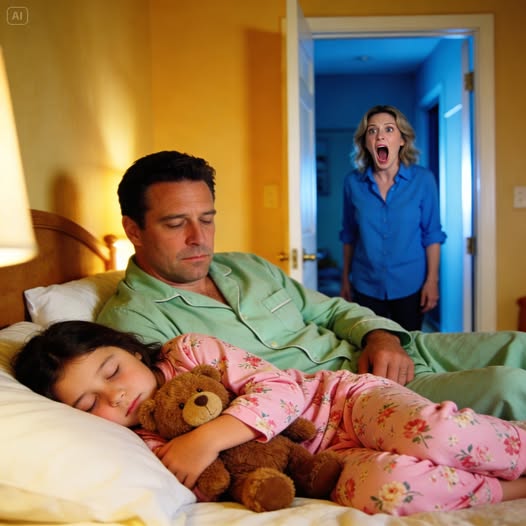
My eight-year-old kept telling me her bed felt “too tight.” At 2:00 a.m., the camera finally showed me why.
Every night, Emily slept alone.
That was the routine.
That was the rule.
And for years, it worked.
Her room was exactly what you imagine a child’s room should be.
A wide bed with a mattress I probably paid too much for.
Books lined neatly on shelves.
Stuffed animals positioned like tiny guards.
A warm amber nightlight that never flickered.
I tucked her in.
I read the story.
I kissed her forehead.
I turned off the lamp.
No nightmares.
No tears.
No issues.
Until one morning.
She padded into the kitchen in socks, toothpaste still clinging to the corner of her mouth. She wrapped her arms around my waist and whispered, half-asleep,
“Mommy… I didn’t sleep good.”
I smiled as I stirred the eggs.
“What happened, sweetheart?”
She paused, brows knitting together like she was searching for the right word.
“My bed felt… smaller.”

I laughed softly.
“Smaller? You sleep alone in a bed bigger than mine.”
She shook her head.
“No. I fixed it.”
I brushed it off. Kids say strange things.
But the next morning, she said it again.
And the next.
And the next.
“I keep waking up.”
“It feels squished.”
“I get pushed.”
Then one night, she asked something that made my stomach drop.
“Mom… did you come into my room last night?”
I knelt in front of her, keeping my voice even.
“No, honey. Why?”
She hesitated, then said quietly,
“…Because it felt like someone was laying next to me.”
I laughed too quickly.
“You were dreaming. Mommy slept with Daddy.”
She nodded.
But her eyes didn’t.
Neither did my body.
I mentioned it to my husband, Daniel. He came home late, exhausted, still carrying the weight of another hospital shift. He waved it off.
“Kids imagine things,” he said. “The house is safe.”
So I didn’t argue.
Instead, I installed a camera.
Small. Silent. Mounted high in the corner of Emily’s room.
Not to spy.
Just so I could sleep again.
That night, everything looked normal.
The bed held only her.
No toys. No clutter.
Just my daughter sleeping in the center of the mattress, breathing slow and steady.
I finally relaxed.
Until 2:00 a.m.
I woke up thirsty and walked into the living room.
Without thinking, I opened my phone.
Checked the camera.
Just once.
And my lungs forgot how to work.
Because the bed wasn’t empty anymore.
And in that moment, I finally understood why my daughter said it felt too small.
At first, I thought it was a glitch in the frame—a smear of shadow where the amber light shouldn’t have reached. But as my eyes adjusted to the small, glowing screen, the shadow moved.
It didn’t climb into the bed. It didn’t emerge from the closet. It was already there, stitched into the very fabric of the mattress.
The Shift
Slowly, the center of the bed began to sink. Not just under Emily’s weight, but on either side of her. Two long, distinct indentations appeared in the duvet, flanking her small body like a pair of invisible bookends.
Then, the “guards” moved.
One by one, the stuffed animals at the foot of the bed were pushed aside by something unseen. They didn’t fall; they were tucked neatly into the corners, cleared away to make room.
The Image
I zoomed in, my hands shaking so violently I nearly dropped the phone.
Emily wasn’t just sleeping; she was being held. Her small frame was pinned in the center of the mattress, her arms tucked tightly against her chest because there was no room to move them. On her left, the blanket was pulled taut, forming the unmistakable silhouette of a shoulder. On her right, a long, pale hand—far too large to be a child’s—rested palm-down on her pillow, just inches from her hair.
There weren’t one, but two figures lying with her. They were pressed so close to her that she was nothing more than a thin sliver of a girl trapped between two crushing weights.
The Realization
I didn’t scream. I couldn’t. I bolted down the hallway, my bare feet slapping against the hardwood. I didn’t wake Daniel. I didn’t grab a weapon. I just threw open her door, expecting to see the intruders, to feel the cold, to find the monsters.
The room was silent.
The air was warm.
The amber light was steady.
Emily lay in the middle of the bed, her eyes snapping open as the door hit the wall. She looked at me, her face pale and exhausted, and she didn’t look scared. She looked relieved.
“Mommy?” she whispered, her voice cracking. “Did you see them? Are they gone?”
I looked at the bed. It was perfectly flat. The stuffed animals were back in their original positions. The indentations were gone.
The Aftermath
I grabbed her and took her to our room. We didn’t go back in there for a week.
The next morning, I went back to the footage, desperate to prove it was a digital artifact or a trick of the light. I rewound the clip to 2:00 a.m. and watched the figures appear again. But this time, I watched past the moment I had run into the room.
On the screen, as I burst through the door in the hallway, the two figures didn’t vanish. They didn’t run.
They both sat up.
They turned their heads in perfect unison toward the camera. They had no faces—just smooth, featureless gray skin where eyes should be. One of them raised a long, spindly finger to where a mouth would be, a universal gesture for shhh.
Then, as the door swung open in real life, they didn’t disappear.
They simply laid back down and sunk into the mattress, becoming the very bed my daughter slept on every night.