A Barefoot Homeless Woman Sat In The Snow — Until A Child Approached And Said, “You Need A Home, And I Need A Mom”
The winter of that year settled over Riverton with a kind of cold that felt personal, as if the wind had learned how to find every place a person could break. Snow fell steadily, not in soft flakes but in sharp, stinging fragments that clung to skin and refused to melt, turning the streets into a quiet, unforgiving landscape.
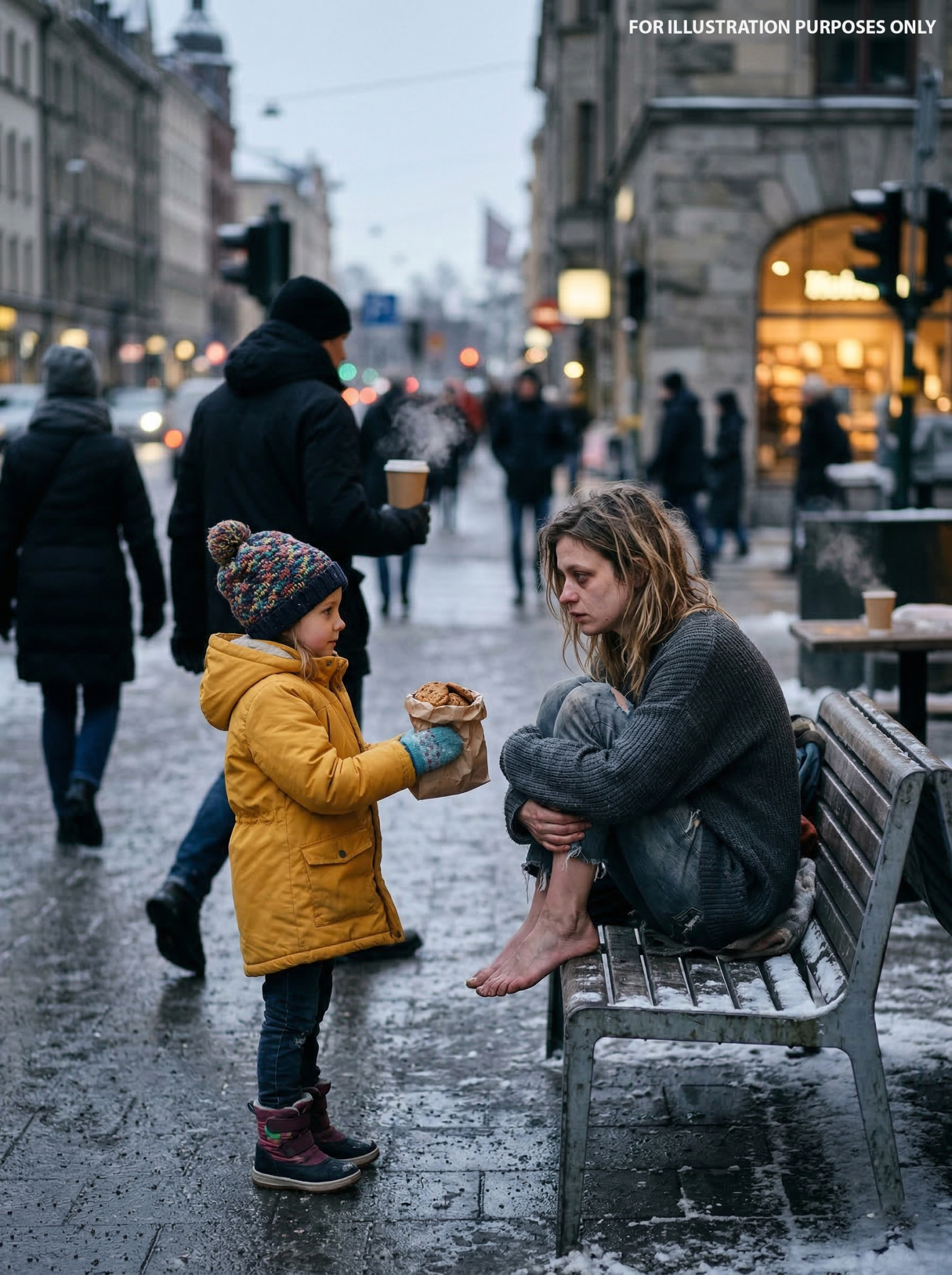
Elena Carter sat alone at a bus stop, her thin sweater pulled tightly around her as if fabric alone could hold back the cold pressing through the metal bench beneath her. The steel had long since lost any warmth, and it seeped into her bones until she could no longer tell whether she was shivering from the temperature or from exhaustion.
At twenty-four, she looked years older.
It had been three days since she had eaten anything that resembled a proper meal. Hunger had dulled into something quieter, less urgent but more dangerous, like a distant echo that never fully disappeared. Yet even that was easier to bear than the deeper ache—the sense of being unseen, of existing in a space where people passed without noticing, where her presence had slowly become irrelevant.
The sidewalk remained busy despite the cold. People moved quickly, boots crunching against the snow, scarves pulled high, hands wrapped around paper cups and shopping bags. They lived inside their own warmth, their own urgency, and no one paused long enough to see the girl sitting just a few feet away.
Elena tucked her bare feet beneath the bench, more out of instinct than hope, trying to hide what had already been exposed. Her skin was red and raw from the cold pavement, but the sensation had faded into numbness, and in some ways, that felt easier than feeling anything at all.
She told herself, as she had every day before, that tomorrow might be better.
The thought had lost its strength over time.
A year earlier, her life had been small but steady. She had worked at a bookstore, lived in a modest apartment, and moved through her days with a quiet sense of stability. It had never been extraordinary, but it had been enough.
Then her mother became ill.
The hospital bills arrived faster than she could manage, each one heavier than the last. Elena had spent everything she had without hesitation, watching her savings disappear in exchange for time she couldn’t hold onto. When her mother finally passed, what remained was not just grief, but emptiness in every sense of the word.
No money.
No home.
No direction forward.
The wind picked up again, cutting through her thoughts, and she pulled her arms tighter around herself, as if she could make herself smaller, less visible, less vulnerable.
That was when a small voice broke through the quiet.
“Are you cold?”
Elena looked up, surprised more by the tone than the words.
A little girl stood in front of her, no older than four, her bright yellow coat vivid against the gray and white of the winter street. Dark curls slipped out from beneath her hat, and in her mittened hands she held a small paper bag.
Elena blinked, unsure whether to smile or apologize for being seen.
“A little,” she admitted softly, though the answer felt insufficient.
The girl tilted her head, studying her with a seriousness that didn’t belong to someone so young. Her gaze moved downward, resting briefly on Elena’s bare feet.
“You don’t look fine,” she said simply.
Before Elena could respond, the girl extended the bag toward her, as though the decision had already been made.
“These are for you.”
Elena hesitated, not because she didn’t want them, but because she had learned to be cautious with kindness.
“What’s inside?” she asked gently.
“Cookies,” the girl replied, her voice bright with quiet pride. “Daddy bought them for me, but you look like you need them more.”
Behind her, a man stood at a distance, watching carefully but without interfering. His presence was calm, steady, as if he understood that this moment did not belong to him.
Elena accepted the bag slowly, her fingers brushing against the warmth that still lingered through the paper. When she opened it, the scent reached her immediately—soft, sweet, familiar in a way that almost hurt.
Chocolate chip cookies.
Still warm.
She took a small bite, and for a moment, everything else faded. The cold, the hunger, the noise of the world around her—it all softened under something simple and human.
When she looked up again, the little girl was still watching her, but her expression had changed. There was thought behind it now, something deeper than curiosity.
“You need a home,” the girl said quietly.
Elena managed a faint smile, one that didn’t quite reach her eyes.
“Maybe someday.”
The child stepped closer, as if distance itself no longer made sense.
“And I need a mom.”
The words settled between them, unexpected and unguarded.
Elena felt her breath catch, not because she didn’t understand, but because she did.
“My name is Sophie,” the girl continued. “My mommy is in heaven. Daddy says she’s an angel.”
Elena swallowed, the weight of the statement landing gently but firmly.
“I’m sorry,” she said.
Sophie studied her for a moment, then asked, “Are you an angel?”
Elena shook her head.
“No,” she answered honestly. “I’m just someone who made a lot of mistakes.”
The girl reached out then, her small mittened hand brushing softly against Elena’s cheek.
“That’s okay,” she said. “Everyone makes mistakes. That’s why people need love.”
The simplicity of it broke something open inside Elena, something she hadn’t realized was still there.
The man finally stepped forward.
“I’m Ethan,” he said, his voice calm but careful. “Sophie’s father.”
Elena introduced herself, suddenly aware of how she must look, how out of place she was standing in front of them.
Ethan’s eyes moved briefly to her feet, then back to her face.
“You shouldn’t be out here tonight,” he said.
She gave a small shrug. “I’ll manage.”
He hesitated, as though weighing something quietly within himself.
“My wife passed away six months ago,” he said. “It’s been hard for her.”
Sophie tightened her grip on Elena’s hand, as if that alone answered everything.
“She’s nice, Daddy,” she insisted.
Ethan exhaled slowly.
“We have a spare room,” he said. “It’s not much, but it’s warm. You’re welcome to stay.”
Elena’s first instinct was to refuse. Experience had taught her that kindness often came with expectations she could not meet.
But Sophie’s hand remained wrapped around hers, small and steady.
“Please,” the girl said.
Elena looked down at the cookies, still warm in her hands, then at the snow continuing to fall around them.
Finally, she nodded.
“Just for tonight.”
The house was close, tucked into a quiet street where the world felt softer somehow. When the door opened, warmth spilled out to meet her, carrying the scent of cinnamon and something that felt like safety.
That single night stretched into another, and then another after that.
No one forced the change.
It simply happened.
Elena began to help in small ways, first out of gratitude, then out of something deeper. She cooked, cleaned, read to Sophie at night, and slowly, without realizing it, she became part of the rhythm of the home.
Sophie accepted it long before anyone said it out loud.
Ethan watched quietly, never rushing her, never asking more than she was ready to give.
When Elena finally told her story—the loss, the debt, the long path that had led her to that bench—he listened without judgment. Instead of focusing on what had gone wrong, he helped her rebuild what could still be made right.
A part-time job at a local library gave her something familiar again, something steady. The smell of books felt like returning to a version of herself she thought she had lost.
Over time, the changes became visible.
Her strength returned.
Sophie’s laughter filled the house again.
And Elena began to feel something she hadn’t felt in a very long time.
Safety.
One evening, as winter softened into spring, Sophie climbed onto the couch beside her, her expression serious in the way only children can manage.
“Are you going to stay forever?” she asked.
Elena looked up, her heart catching on the question.
Across the room, Ethan stood quietly, offering no words, only a small, understanding nod.
Elena opened her arms, and Sophie moved into them instantly, as though there had never been any doubt.
“If you want me here,” Elena whispered, “I’ll stay.”
Sophie held her tightly.
“You’re my mom now.”
This time, when tears came, they carried something entirely different.
Not loss.
But belonging.
And as Elena held her close, she understood something that no hardship had ever been able to teach her before.
Family isn’t always something you’re born into.
Sometimes, it’s something that finds you when you have nothing left—and gives you everything back.