A Bullied Teen Girl Was Humiliated in Silence While a Group of Boys Laughed Around Her Like Nothing Could Stop Them — But When Her Hidden Earbud Carried Everything to Her Biker Brother, The Sound of Engines Rolled In and Forced Every Secret Into the Open
The Call She Never Meant to Make
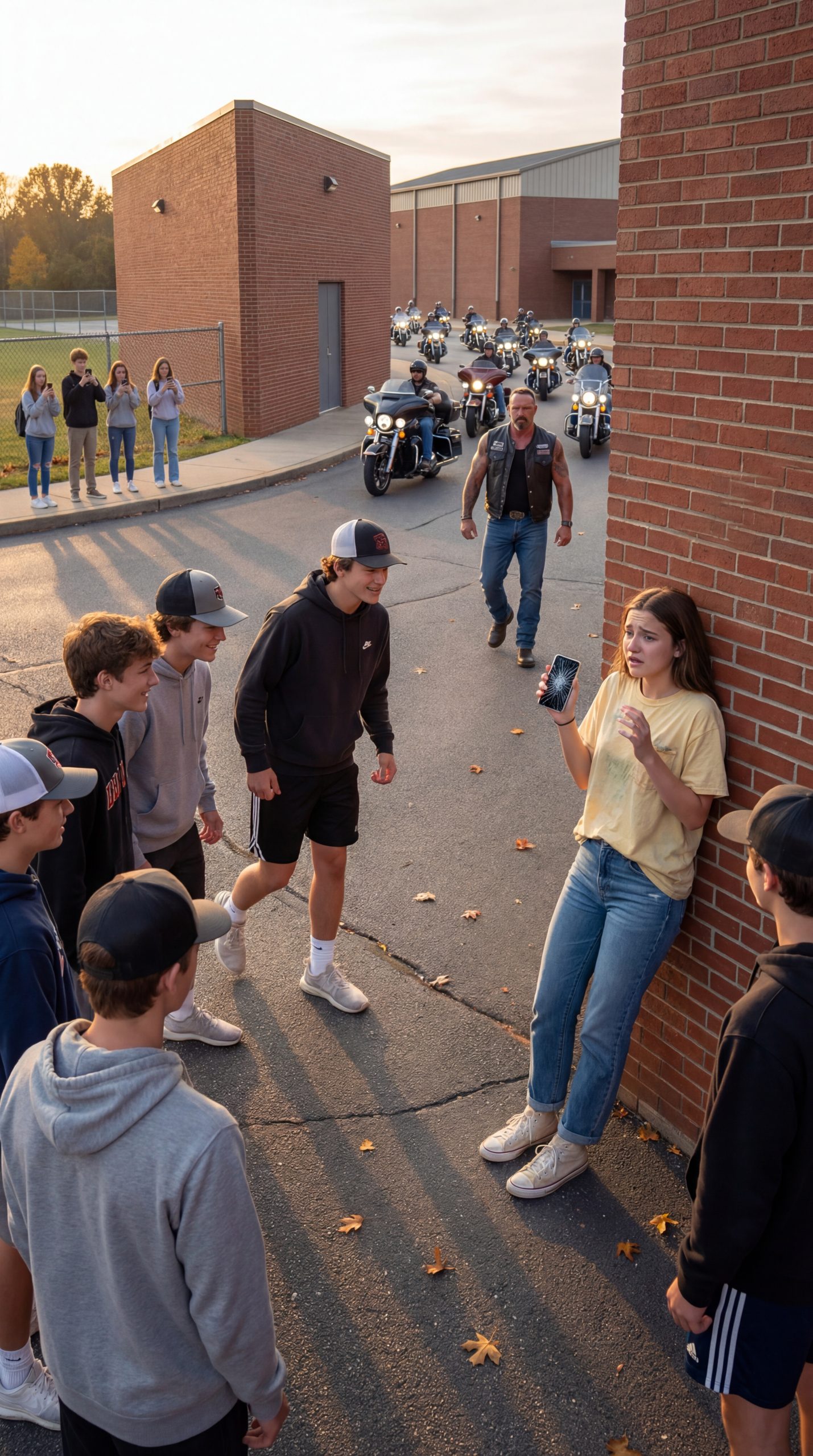
By the time the final bell rang at Briar County High, the parking lot was already glowing under the weak orange light of early evening. The football field sat quiet in the distance, the cheer banners along the fence barely moving in the wind, and the brick side wall of the gym cast a long shadow over the empty service lane behind it.
That was where Tessa Rowan found herself trapped.
She had only gone that way because it was faster. Her bus had already left, her phone battery was nearly gone, and all she wanted was to get home before dark. But Wade Holloway, the star captain of the hockey team, stepped into her path with the kind of careless grin that made her stomach tighten before he even said a word.
His friends closed in behind him, laughing too loudly, feeding off each other the way cruel people often did when they had an audience.
“Look who thinks she can just walk by without saying hello,” Wade said.

Tessa gripped the strap of her backpack tighter. “Please move.”
He tilted his head, pretending to be amused. “You always talk like you’re better than everyone.”
“I never said that.”
“No,” he said, stepping closer, “but your face does.”
One of the boys behind him laughed. Another pulled out his phone as if the whole thing were entertainment. Tessa tried to sidestep them, but Wade blocked her again. When she reached for her phone, he slapped it out of her hand. It hit the pavement hard, the screen breaking into a spiderweb of light.
The crack of it made her breath catch.
“That was stupid,” she whispered.
Wade leaned in, smug and careless. “Call somebody, then. Call your big, scary brother.”
The others laughed harder.
Tessa’s lip stung where he had caught her a moment earlier. She tasted blood and wished more than anything that she could disappear into the wall behind her. Her voice came out smaller than she wanted.
“Just leave me alone.”
He shoved her shoulder back against the brick. “Not until you learn some respect.”
She never made the call.
She did not have to.
Because in one ear, still hidden beneath her hair, one of her wireless earbuds was connected to her brother’s phone.
And he had heard enough.
The Sound of Engines
At first, the noise was so low that none of them understood what they were hearing. It rolled through the alley like distant weather, deep and steady, something too heavy to ignore. Wade’s smile flickered. His friends glanced toward the corner of the building.
Then the motorcycles appeared.
They came slowly, not rushing, not showing off, just arriving with a confidence that changed the air around them. One by one, the bikes turned into the lane beside the gym until the narrow stretch of pavement seemed too small to hold them all.
There were nearly twenty of them.
At the front was her brother.
His name was Nolan Rowan, and though he was still the youngest full member of the Black Crest Riders, he carried himself with a calm that made most men step back before he said a single word. He cut the engine, removed his gloves, and got off the bike without hurry. Behind him, the others followed, leather vests dark under the fading sky, their boots heavy against the pavement.
Wade let go of Tessa so quickly she nearly stumbled.
“Wait,” he said, suddenly unsure. “That’s your brother?”
Nolan did not answer him right away. He looked only at Tessa.
He saw the split at the corner of her mouth. He saw her broken phone on the ground. He saw the fear she had been trying so hard not to show.
When he finally spoke, his voice was quiet.
“You put your hands on my sister.”
The sentence was simple, but it landed harder than a shout.
Wade lifted both hands. “We were joking around. That’s all this was.”
From behind Nolan, a broad-shouldered man with silver at his temples stepped forward. His name was Boone Mercer, president of the club, and his face looked carved from old stone. He did not raise his voice either.
“Funny,” Boone said. “Because she doesn’t look like she’s laughing.”
No one around Wade laughed now.
His teammates, who had been so loud a minute earlier, were already starting to fade back, hoping to disappear without being noticed.
Nolan bent down, picked up Tessa’s shattered phone, and turned it over in his hand. The broken screen reflected the evening light in splintered lines.
“You’re going to replace this,” he said.
Wade nodded too fast. “Yeah. Yes. Of course.”
Nolan looked at him with a steadiness that made the boy’s face drain of color.
“And you’re going to apologize.”
“I said I’m sorry.”
Nolan took one slow step forward. “Not to me.”
Wade looked at Tessa. For the first time since she had known him, he did not look untouchable. He looked young. Small. Frightened of consequences he had never believed would reach him.
“I’m sorry, Tessa,” he said, voice shaking. “I shouldn’t have done that.”
Tessa did not answer. She was still trying to breathe.
What the Cameras Remembered
The club never touched Wade. They did not need to.
Boone told the boys to walk with them to the principal’s office, and somehow every one of them obeyed. The ride from the gym to the administration building took less than two minutes, but by the time they stepped inside, the mood of the entire campus had shifted. Secretaries stood up from their desks. Students in the hallway fell silent. Teachers stared through doorways, trying to understand why nearly twenty riders had arrived at school after hours.
Principal Linda Carver met them outside her office, her expression stern but visibly strained. She was a woman known for keeping control, yet even she looked overwhelmed when Boone explained what had happened and Nolan handed over the audio recorded through Tessa’s earbud connection.
They listened in silence.
Wade’s voice.
The laughter.
Tessa saying please.
The sound of the phone hitting the pavement.
When the recording ended, Principal Carver pressed her hand flat against the desk as if steadying herself.
“This is serious,” she said quietly.
Boone’s eyes stayed on her. “It should have been serious long before today.”
That was when the school security director suggested checking the camera footage behind the gym. Then, because one answer often leads to another, they started checking other recordings too.
What they found was worse than anyone in that room expected.
It was not one incident.
It was a pattern stretching back months.
There was Wade shoving a freshman into a locker while his friends laughed nearby. There was a girl from the art club crying over a project ruined in the cafeteria. There was a smaller student cornered outside the weight room, shoulders tight with the familiar helplessness of someone who had already stopped expecting adults to notice.
Twenty-three separate moments.
Twenty-three times people looked away, dismissed it, or never saw it clearly enough to stop it.
Principal Carver sat back in her chair, pale under the fluorescent lights.
“How did this get this far?” she whispered.
Boone answered before anyone else could.
“Because boys like him learn early that nobody wants trouble with the right last name.”
Everyone in the room knew what he meant.
Wade’s father chaired the school board.
The Father Who Thought He Could Fix It
Roger Holloway arrived fifteen minutes later in a navy suit that looked too expensive for the school’s worn hallway. He came in fast, carrying irritation like it was authority, already prepared to smooth things over before he had even heard the full story.
“I was told this couldn’t wait,” he said sharply. “What exactly is going on?”
Then he noticed the people in the room.
His gaze paused on Nolan, then on Boone, then on Wade sitting stiffly in the corner, eyes red and swollen.
Something in his face changed.
Principal Carver turned the monitor toward him. “You need to watch this.”
He did.
At first, he tried to keep his expression blank, the practiced look of a man used to steering difficult situations into quieter waters. But clip by clip, that control began to crack. He watched his son shove, mock, threaten, and humiliate other students as if he owned the building. He watched Tessa pinned against the wall behind the gym.
When the screen went dark again, Roger adjusted his tie, buying himself a few seconds.
“This behavior is unacceptable,” he said. “Wade will be disciplined. He’ll make a formal apology.”
It was the kind of response meant to sound decisive while protecting as much as possible.
Nolan’s jaw tightened.
“That might have worked yesterday,” he said. “Not today.”
Before Roger could answer, another student was brought into the office by the vice principal. He was a thin sophomore named Eli Barrett, quiet in class, always sitting near the window, the kind of kid most people only remembered after something had gone wrong.
Eli stood near the door with both hands twisted together.
Principal Carver softened her voice. “Eli, you said you needed to tell us something.”
He swallowed hard. “It isn’t just the harassment.”
Roger looked impatient already. “What else could there possibly be?”
Eli kept his eyes on the floor. “The exam files.”
The room went still.
“Wade sold them,” Eli said. “Midterms. finals. Practice packets. He always had them early.”
Roger’s face hardened at once. “That is an outrageous accusation.”
But Principal Carver was already opening another file on the computer.
“We checked the network after concerns were raised last month,” she said. “There were unauthorized downloads from the testing server.”
She turned the screen again.
“The access came through school board credentials.”
Roger stared.
Not at the people in the room.
Not at his son.
Just at the glowing login record in front of him.
For the first time since he arrived, he had nothing to say.
The Weight of a Family Name
Once the truth started moving, it moved quickly.
Eli admitted he had paid for answer keys once, then backed away when the price rose and Wade started threatening students who wanted out. Other names surfaced. More messages were found. A whole quiet network had grown beneath the school’s polished reputation, kept alive by fear, money, and the certainty that the right family could bury almost anything.
Wade had not only been cruel. He had been building power.
He used humiliation to keep people silent.
He used stolen exams to stay eligible.
He used his father’s access without understanding how completely it would all come apart once one person finally spoke.
Roger Holloway sank into a chair and covered his face with one hand. The proud man who had walked in minutes earlier now looked older, smaller, as if the truth had taken visible weight from his shoulders.
Tessa watched all of it in a strange, detached quiet. A part of her still felt like she was standing behind the gym wall, heart pounding, waiting for someone to say it had all been a misunderstanding.
But it was not.
And for the first time, nobody was asking her to make herself smaller so everyone else could stay comfortable.
The Ride Home
By the time the police left and the school had begun its own emergency response process, the sky outside had turned completely dark.
Nolan drove Tessa home in his old pickup instead of on the bike. He knew she needed warmth, not wind. The truck smelled faintly of cedar, gasoline, and the coffee he always forgot to finish. Neither of them spoke much at first. The silence was not empty, only tired.
Finally, Nolan glanced at her.
“You okay?”
Tessa looked out the window at the passing streetlights. “I don’t know yet.”
He nodded, accepting the honesty.
A few minutes passed before she spoke again.
“Why them?” she asked softly. “Why the club?”
He understood the question. She had asked versions of it before, though never like this. Never after seeing them arrive for her.
Nolan rested one hand on the steering wheel, eyes fixed on the road.
“Do you remember Dad’s shop?”
Tessa smiled faintly despite herself. “The hardware store on Milton Avenue.”
“Yeah.”
Their father had been the kind of man who knew customers by first name, who carried lumber to people’s trucks even when his back hurt, who trusted too easily and called it decency. He had built a life out of patience and long hours, and for a while that had seemed like enough.
Then a giant chain moved in two miles away.
Prices dropped.
Suppliers changed.
Permits got delayed.
A complaint appeared out of nowhere.
Then another.
Their father lost the store piece by piece, not in one dramatic collapse, but in a slow wearing down that looked almost polite from the outside. What nobody saw was what it did to him inside his own home. The way he sat quieter at dinner. The way hope left in stages.
“He wasn’t weak,” Nolan said. “But he believed being decent meant people would stop when it got unfair.”
Tessa listened.
“They didn’t stop,” he continued. “And I promised myself I’d never stand there helpless while people I love got crushed by someone who thought power gave them the right.”
He tightened his grip on the wheel for a moment, then let it ease.
“The Black Crest Riders aren’t perfect. I know that. But when they say family matters, they mean it. No one stands alone if they can help it.”
Tessa looked at him then, really looked at him. Not the leather vest. Not the reputation. Just her brother, who had spent years trying to become strong enough to hold the line where others had once failed.
For the first time, she understood that he had not joined them because he loved fear.
He joined them because he never wanted helplessness to win again.
What Changed After
The weeks that followed altered Briar County High in ways no assembly ever had.
Wade Holloway was expelled. His records were reviewed, his leadership roles erased, his carefully built image gone almost overnight. Roger Holloway resigned from the school board before formal removal proceedings could begin. The district opened an investigation into grading access, athletic eligibility, and administrative oversight.
But the deeper change happened in the hallways.
Students started talking.
Not in whispers, either.
They talked about what had happened to them.
What they had seen.
What they had ignored because it felt safer than speaking.
A student-led support group formed before the month was over. Teachers began taking reports seriously, not because the school suddenly discovered its conscience, but because the cost of indifference had finally become impossible to hide.
The Black Crest Riders did something no one expected. They stayed involved, but not in the way gossip predicted. They did not loom around the campus making threats. Instead, they showed up at the district’s anti-harassment forum. They donated materials through their construction company contacts to renovate neglected student spaces. They helped fund a scholarship for students who had endured hardship and kept going anyway.
At one assembly, Boone stood on stage in front of several hundred students, his vest and weathered face making him look more like a storm than a speaker. Yet when he talked, the auditorium was silent.
“Strength isn’t proven by who you can scare,” he said. “It’s proven by who feels safer because you showed up.”
Tessa never forgot that line.
She joined the school paper that spring. Her first article, published without her byline, was about silence—how it spreads, how it protects the wrong people, and how courage usually starts with one voice that shakes but speaks anyway.
Nolan received his full road captain patch that summer. At the gathering afterward, Boone found Tessa standing near the picnic tables with a paper plate in her hand and pride she was still learning how to carry.
“Your brother earned that,” Boone told her. “Not because he’s loud. Not because he wants a fight. Because when the time came, he stood where he was needed.”
Tessa looked across the yard at Nolan, laughing quietly with the other riders, sunlight catching on the back of his vest.
She smiled.
That sounded exactly right.
The Courage That Stays
Almost a year later, Tessa was walking home with a folder pressed to her chest when she noticed a freshman boy being cornered near the baseball field by two older students. The sight turned her blood cold for one quick second, bringing back more memory than she wanted.
But before she could move, a senior from the basketball team crossed the sidewalk and stepped between them.
He did not yell.
He did not shove.
He simply looked at the two boys and said, “That’s enough. Leave him alone.”
And they did.
Just like that.
Tessa stood still, watching the younger boy exhale with visible relief. The senior patted his shoulder and walked him toward the front gate like it was the most ordinary thing in the world.
That was when she understood what had really changed.
It was never only about one bully falling.
It was about a culture losing its grip.
It was about people learning that courage could be borrowed until it became their own.
Her brother had not changed the school by arriving with noise and engines.
He changed it by proving that fear was not the only force that could spread.
Loyalty could spread too.
Protection could spread too.
So could bravery.
And once people saw what it looked like when someone finally stood up, they found it easier to stand up themselves.
True strength had never been about reputation, volume, or the ability to make others shrink. True strength was the quiet promise that nobody under your watch would have to face cruelty alone. Tessa learned that the night her broken voice was answered not just by her brother, but by every value he had chosen to live by. And long after the engines faded, that promise stayed.
True family is not only the people you are born beside, but also the people who choose to stand beside you when your world feels small and frightening.
Real courage does not always arrive with perfect words, because sometimes it arrives simply as presence, as someone showing up and making it clear that your pain will no longer be ignored.
The deepest kind of strength is the kind that protects without needing applause, because it is rooted in love rather than pride.
Many people stay silent because they think their voice will not matter, yet history inside even one small school can change the moment one frightened person finally tells the truth.
What breaks a culture of cruelty is not only punishment, but the steady refusal of ordinary people to keep pretending they do not see what is happening around them.
A person’s character is revealed most clearly in the moments when they could walk away easily but choose instead to stay, help, and carry part of someone else’s burden.
Pain often teaches harsh lessons, yet it can also uncover the people who were willing to protect you long before you understood how much you needed them.
The strongest communities are built when people decide that dignity belongs to everyone, not just to the loud, popular, powerful, or well-connected.
Healing begins the moment fear loses its authority over your voice, and that moment often starts because one loyal heart reminds you that you are not alone.
In the end, what people remember most is not who seemed untouchable for a season, but who used their strength to make life safer, kinder, and more honest for others.