A New Mother Tried to Endure Life Under Her In-Laws’ Rules in Silence — Until One Unexpected Encounter With Her Father Gave Her the Courage to Take Her Life Back
The Day Her Father Saw What She Had Been Enduring
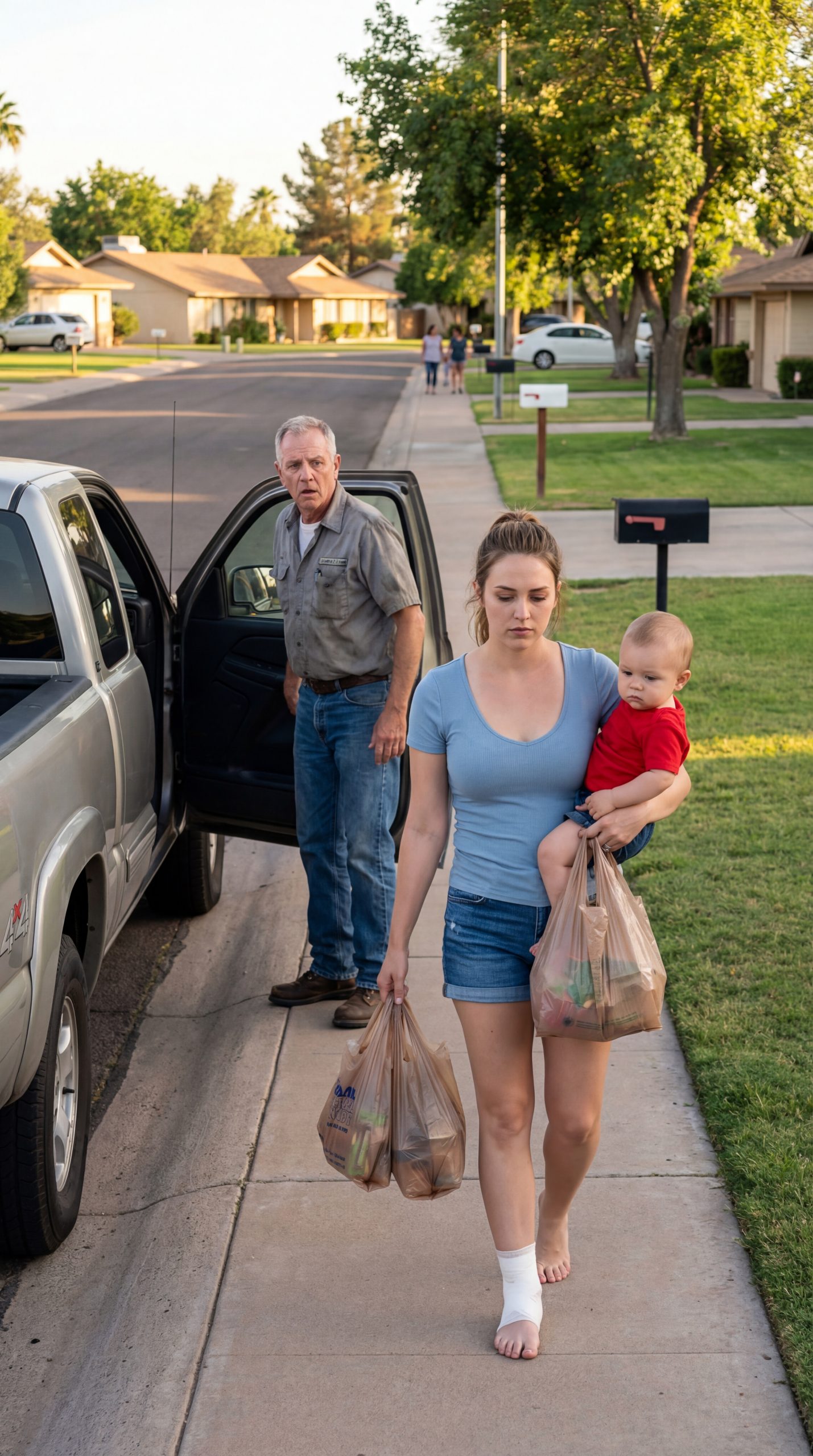
The late afternoon sun hung low over the quiet streets of Chandler, Arizona, turning the sidewalks pale gold and filling the air with dry heat. It was the kind of weather that made even a short walk feel longer than it was. Cars passed now and then, but most people were already inside, hidden behind closed doors and humming air conditioners.
Tessa Holloway kept moving one painful step at a time.
Her left ankle had swollen badly enough that her shoe felt too tight, and every step sent a sharp ache up her leg. In one arm, she held her ten-month-old son, Caleb, against her chest. In the other hand, she carried two grocery bags that kept bumping against her knee. A carton of milk shifted inside one bag, and the plastic handles dug into her fingers until they burned.
Sweat clung to the back of her neck. Loose strands of hair stuck to her face. Caleb’s soft curls were damp too, and though he was quiet for now, Tessa knew that could change at any moment.
She adjusted him gently on her hip and whispered, more to herself than to him, “Just a little farther, baby. We’re almost there.”
But they were not almost there.
Home was still several blocks away.
Her ankle hurt. Her shoulders ached. Her patience was running on nothing but instinct. Still, she kept walking, because stopping would give the thoughts in her head room to grow louder, and she was doing everything she could not to break down in the middle of the sidewalk.
She had become far too good at holding herself together in silence.
A Truck Pulls Alongside Her
The sound of a pickup slowing near the curb made her tense immediately.
For a second, Tessa kept her eyes forward and hoped it would pass. Then she heard a voice she knew better than her own.
“Tessa?”
She stopped.
When she turned, she saw her father sitting behind the wheel of an old silver pickup, his face already changing as his eyes moved from her swollen ankle to the groceries in her hand to the baby in her arms.
“Dad,” she said quietly.
Wes Holloway pulled over so fast his tires brushed the curb. He stepped out before the engine had fully settled. He still wore his work shirt from the plumbing company, sleeves rolled up, sun-darkened forearms marked with years of hard labor. He had always looked like a man who believed problems could be fixed if you were willing to face them directly.
And right then, the look on his face said he already understood that something was very wrong.
He came closer, careful not to alarm Caleb, and lowered his voice.
“Honey, what happened to your ankle?”
Tessa tried to shrug. “It’s fine.”
His eyes narrowed with the kind of quiet disbelief only a parent could give.
“It is not fine,” he said. “Why are you out here walking like this?”
She swallowed. She had told smaller versions of the truth to other people before. A neighbor. A cashier. A friend from church. But standing there in front of her father, exhausted and limping with a baby in her arms, she suddenly felt how impossible it was to keep pretending.
His gaze shifted toward the road. “Where’s your car?”
Tessa looked down.
For a moment, the only sound between them was the rattle of a loose sign somewhere across the street.
Then she answered.
“Ronan’s mother took it.”
Wes stared at her as if he had misheard.
“She took your car?”
Tessa tightened her grip on the grocery bags. “It’s in Ronan’s name on paper, but I’ve been making the payments. She said since we’re staying in their place, she decides who gets to use it.”
The expression on Wes’s face did not become louder. It became stiller, which was worse.
He reached out and gently took the grocery bags from her hand.
Then he opened the passenger door of his truck.
“Get in.”
Tessa hesitated. “Dad, I really don’t want this to turn into something bigger.”
He looked at her with calm, steady eyes.
“Tessa,” he said, “you are carrying a baby in this heat on an injured ankle because somebody wanted control more than they cared about your well-being. This is already bigger than you’ve been allowed to say.”
She felt tears rush toward the surface and blinked them back.
He softened his tone.
“Get in, sweetheart.”
This time, she did.
The Silence on the Way Back
Wes buckled Caleb into the back seat with more tenderness than words could hold. Caleb looked up at him, blinked once, and then smiled. That small smile seemed to shake something loose in Wes’s chest, but he only patted the baby’s knee and closed the door carefully.
When he got behind the wheel, neither of them spoke right away.
The truck moved through familiar streets, past gas stations, trimmed yards, and rows of tan houses that all seemed to blur together. Tessa stared out the window and tried to prepare herself for what might happen next.
She knew her father well. He was not a man who enjoyed conflict. He was a man who stepped into it when silence had gone too far.
After a few minutes, she said softly, “I didn’t tell you because I thought I could handle it.”
Wes kept his hands steady on the wheel. “How long has this been going on?”
Tessa looked down at her hands.
“Long enough that I stopped noticing how bad it felt.”
That answer settled heavily between them.
She let out a breath. “I kept thinking if I stayed calm, if I made fewer problems, if I was patient, things would get easier.”
Wes nodded once, not because he agreed, but because he understood how someone could end up believing that.
“And did they?” he asked.
She gave a tired, humorless smile. “No.”
The truck turned onto the street where she had been living with Ronan and his parents for nearly a year.
Their house stood halfway down the block, carefully maintained, with potted plants near the steps and spotless windows that gave the whole place a polished, respectable look. From the outside, it appeared warm and organized. From the inside, it had become a place where Tessa felt watched, corrected, and slowly reduced.
Wes parked at the curb.
He shut off the engine and looked at her.
“You don’t have to go in there if you don’t want to,” he said.
Tessa wiped under one eye and shook her head. “No. I’m done standing outside my own life.”
A flicker of pride moved across his face.
“Alright,” he said. “Then let’s go.”
The House That Never Felt Like Home
They had barely reached the porch when the front door opened.
Lenora Pike stood there with her arms folded, her expression already sharp with disapproval. She was the kind of woman who carried herself like every room belonged to her the moment she entered it.
Her eyes landed on Tessa first.
“Why are you back so early?” she asked.
Then she noticed Wes.
Something in her face shifted, though not enough to become warmth.
“Can I help you?”
Wes answered evenly. “I’m Tessa’s father.”
Lenora gave a thin smile. “Well. This is unexpected.”
From somewhere behind her, Ronan appeared in the hallway. He looked confused, tired, and not nearly surprised enough.
“What’s going on?” he asked.
Wes stepped forward just enough to make his point clear without raising his voice.
“What’s going on is that my daughter was limping down the road in this heat with her baby in one arm and groceries in the other because someone here decided she didn’t need access to the car she has been paying for.”
The silence that followed was immediate and tight.
Lenora lifted her chin. “They live in my home. There are expectations in this home.”
Wes did not flinch.
“Expectations are one thing,” he said. “Taking away transportation from a young mother with an injured ankle is another.”
Ronan rubbed the back of his neck. “Tessa, we talked about this.”
Tessa turned to him, and for the first time in a long time, her voice did not come out small.
“No, we didn’t,” she said. “You stood there while your mother made a decision and then called that a conversation.”
Lenora gave a short, offended laugh.
“I have been trying to keep order in this family.”
Wes looked straight at her.
“Order is not the same thing as control.”
The words landed hard.
Tessa could feel her pulse in her throat. Caleb stirred in the back seat of the truck and gave a soft fussing sound, as if even he could feel the tension in the air.
Lenora crossed her arms tighter. “If she is unhappy, no one is forcing her to stay.”
Tessa almost laughed at that, because it was the sort of statement that sounded generous only if you ignored everything that had led up to it.
Wes glanced at his daughter, then back at the people in front of them.
“That is exactly the point,” he said.
The Envelope in His Pocket
Then Wes did something none of them expected.
He reached into the inside pocket of his work shirt and pulled out a plain white envelope.
He held it toward Tessa.
She stared at it. “What is that?”
His voice softened when he answered her.
“An apartment application and a copy of a lease. One bedroom. Safe neighborhood. Ten minutes from your job. I spoke with the property manager three days ago after your sister mentioned you sounded worn out every time she called.”
Tessa blinked at him, stunned.
“You already did this?”
Wes nodded. “I didn’t know all the details. I just knew my daughter didn’t sound like herself anymore.”
Ronan frowned. “We can’t afford a place right now.”
Wes turned to him. “She can afford more than you think. She has been contributing money this entire time. What she hasn’t had is the freedom to use her own strength without someone standing over it.”
Tessa felt tears rise again, but this time they came from somewhere deeper than pain. They came from being seen.
Because he was right.
She had been working. Saving when she could. Stretching every dollar. Making excuses for what felt wrong because everyone around her kept treating it like normal. Somewhere along the way, she had begun to confuse endurance with peace.
Wes placed the envelope in her hand.
“I’m not telling you what to do,” he said. “I’m reminding you that you have choices.”
Lenora’s face hardened.
“If she leaves this house,” she said sharply, “she should not expect support from us later.”
To her own surprise, Tessa did not feel fear when she heard that.
She felt relief.
She looked at Lenora steadily and answered with a calm she had not heard in her own voice for months.
“Support should not feel like permission to exist.”
Ronan stared at her as if he were only just meeting the woman he had married.
“Tess…” he said quietly. “I didn’t realize you felt this trapped.”
She looked at him for a long moment.
“That was part of the problem,” she said.
The Moment Her Voice Returned
Caleb started fussing louder in the truck, and Wes walked over to lift him out. The baby immediately settled against his grandfather’s shoulder, small hand clutching the fabric of his shirt.
Wes rocked him once and murmured, “You’re alright, buddy.”
Then he turned back toward the porch.
Tessa looked at Ronan.
He looked torn, embarrassed, and suddenly younger than she had ever seen him. Not in age, but in how much of his life had clearly been spent avoiding the weight of his mother’s influence.
For a second, she pitied him.
Then she remembered the sidewalk, the swelling in her ankle, the groceries cutting into her hand, and the way she had trained herself not to need too much.
She drew a slow breath.
“I am leaving,” she said. “You can decide whether you want to build a life with me or remain a son who never questions anything. But I am done shrinking so everybody else stays comfortable.”
Lenora opened her mouth, but Ronan spoke before she could.
“Mom,” he said, looking at her directly now, “give her the keys.”
Lenora stared at him. “Excuse me?”
“The keys,” he repeated, more firmly this time. “Give them back.”
For a second, nobody moved.
Then, with visible reluctance, Lenora reached into her purse, pulled out the car keys, and tossed them carelessly toward the porch.
They hit the wooden boards and skidded near Tessa’s foot.
Before Tessa could bend, Wes stepped forward, picked them up, and placed them gently in her palm.
His eyes met hers.
“Never let someone throw your own dignity at your feet and call it generosity,” he said quietly.
Tessa closed her fingers around the keys.
Something inside her settled into place.
Ronan looked at his mother, then at Tessa, then at Caleb in Wes’s arms.
When he spoke again, his voice was different.
“I’m coming with you,” he said.
Lenora’s face went pale with shock. “You are not walking out of this house because of one disagreement.”
Ronan exhaled slowly.
“No,” he said. “I’m walking out because it should never have gotten this far.”
The Drive Toward a Different Future
A few minutes later, Tessa was sitting in the driver’s seat of her own car.
Her ankle still hurt. The day had still been humiliating. Nothing had magically become easy.
But the air in her chest felt different.
Lighter.
Real.
Wes strapped Caleb into the back seat and then leaned down beside the open window. The evening light had softened now, laying a gentler color over everything.
He rested one hand on the edge of the door.
“You can always come home,” he told her. “But never stay somewhere that teaches you to disappear.”
Tessa nodded, unable to trust her voice for a second.
Ronan got into the passenger seat and sat quietly, as though he understood this was not the moment to defend himself with half-finished explanations.
Tessa started the engine.
As the car rolled away from the curb, she glanced once into the mirror.
Lenora was still standing in the doorway, but she no longer looked powerful. She looked like someone who had mistaken control for importance and had just learned they were not the same thing.
Tessa turned the corner and kept driving.
She did not know exactly what the next week would look like. There would be boxes to pack, hard conversations to finish, new routines to build, bills to manage, and trust to rebuild if Ronan truly meant what he had said.
But uncertainty no longer felt as frightening as staying had felt.
That was the difference.
That was everything.
For the first time in a long time, she was not driving back toward a life that made her feel smaller. She was driving toward one that might finally have room for her full voice, her full strength, and the quiet kind of peace that did not come with conditions.
That evening did not simply return her car.
It returned her sense of self.
It reminded her that love without respect is not safety, and help that demands silence is not kindness. It showed her that sometimes the turning point in a life arrives not through loud revenge or dramatic words, but through one clear moment when someone who loves you says, enough.
And once she heard that, she could never again pretend that less was enough for her.
A New Door, A New Beginning
Later that night, after Caleb had finally fallen asleep and the air outside had cooled, Tessa stood inside the small apartment her father had found for her.
It was not grand. It did not have polished stone counters or a perfect front lawn. The kitchen was narrow, the living room was simple, and one of the blinds leaned slightly to one side.
But it was quiet in a way that felt gentle instead of heavy.
No one was waiting to question her choices. No one was watching how long she stayed out, what she bought, or whether she had somehow earned the right to rest.
Wes had helped carry in the first few bags. Ronan had brought in the crib without speaking much. There was still a long road ahead, and Tessa was wise enough not to confuse one good decision with a finished story.
Still, when she stood in the middle of that little living room and looked around, she felt something she had not felt in months.
Space.
Space to think. Space to breathe. Space to become visible to herself again.
Her father paused at the door before leaving and said, “You do not have to prove your worth by surviving what should never have been asked of you.”
After he left, Tessa sat on the floor for a while beside Caleb’s crib and listened to the soft rhythm of his breathing.
Then she whispered into the quiet room, “We’re going to be alright.”
And this time, she believed it.
Those words were not a wish.
They were the beginning of a promise.
The next chapter of her life had not started when she reached the apartment.
It had started the moment she stopped calling mistreatment normal.
And from there, everything began to change.
Love should make room for your voice, not ask you to soften it until it disappears. Real support does not come with humiliation attached to it, and real family does not keep score when you are struggling to stand. Sometimes people stay in painful situations not because they are weak, but because they have been taught to call survival gratitude. There comes a moment when a person must understand that peace built on silence is not peace at all, and comfort built on control will always come at the cost of dignity. A parent’s quiet strength can become the mirror that helps a grown child see what they have been enduring for far too long. The first step toward freedom is often not dramatic at all; it is simply the decision to stop pretending that what hurts you is acceptable. No one should have to become smaller just to keep a household calm, because a home without respect is only a place where fear has learned to speak politely. Choosing yourself is not selfish when what you are choosing is safety, stability, and the right to be treated with care. Even when the future feels uncertain, it is still better to walk toward honest difficulty than remain inside familiar pain that keeps stealing pieces of who you are. And sometimes the most life-changing gift is not money, rescue, or perfect advice, but one person who looks at your struggle clearly and reminds you, with love, that your life still belongs to you.