A Poor Girl Opened an Abandoned Fridge… What She Found Inside Changed Two Lives Forever
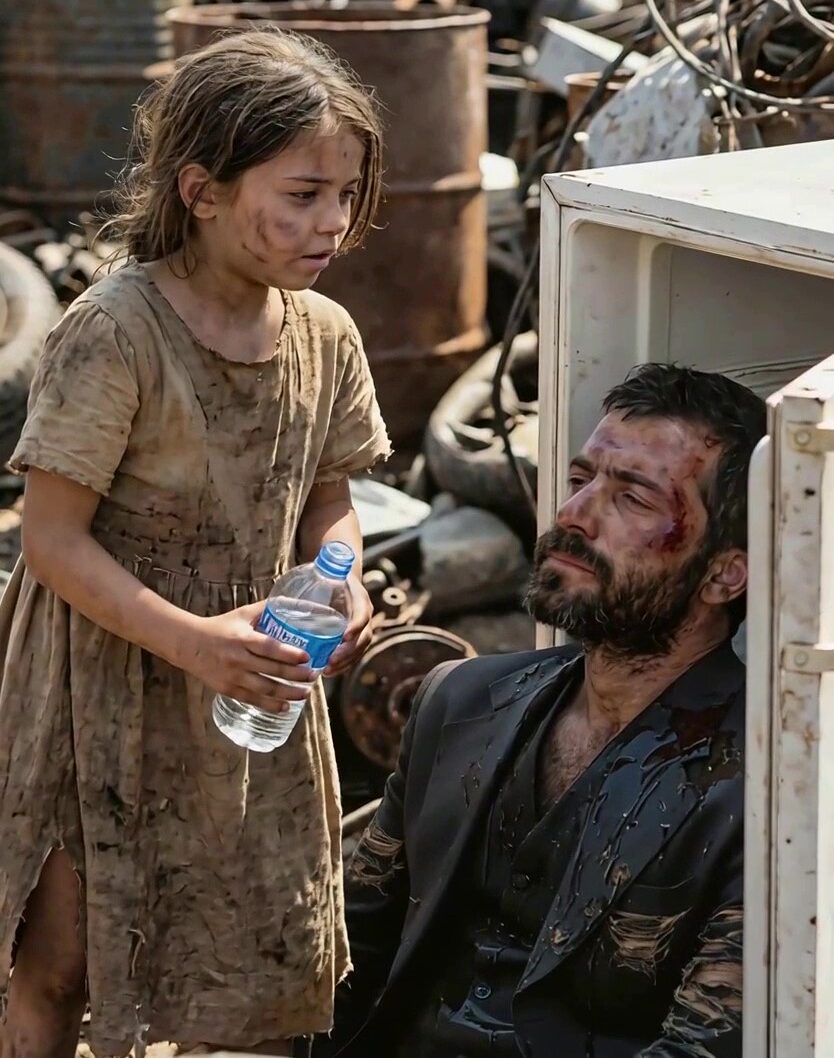
Lupita had learned to tell time without a clock.
Morning came with the pale light stretching across the landfill and the first wave of trucks rumbling in. Noon came when the heat pressed down so hard it felt like the air itself was tired. And evening… evening came when her chest began to ache—not from running or lifting, but from hunger curling tight inside her ribs.
She was eight years old, small and quick, moving through the dump like it was a map only she could read.
She knew which piles were fresh by the warmth of the garbage. She knew which men to avoid by the way their eyes moved. Some searched for scrap. Others searched for people.
Those were the dangerous ones.

That morning, she worked fast, weaving between broken glass and rusted metal, her fingers sorting through plastic and wire with practiced speed. She had already found two bottles and a bent piece of aluminum—enough for a small piece of bread if she was lucky.
Then she heard it.
A sound that didn’t belong.
It was faint. Weak. Like someone trying to breathe through something tight and suffocating.
Lupita froze.
The landfill was never quiet—machines roared, dogs barked, people shouted—but this sound cut through all of it. It wasn’t noise.
It was life.
And it was afraid.
Slowly, carefully, she followed it. Around a pile of broken furniture. Past a stack of doors and cabinets. Until she found it.
A rusted refrigerator, thrown on its side.
It was tied shut with thick rope.
The sound came from inside.
Lupita’s heart started pounding.
Curiosity could get you hurt. That was the first rule she had learned. But something about that sound—desperate, fragile—pulled her closer.
She crouched near the fridge and pressed her eye to a small gap.
Inside, something moved.
Then she saw it.
An eye.
Red. Swollen. Barely open.
A man.
Not like the others she saw in the dump. His clothes—though torn and filthy—had once been expensive. His face was bruised, his lips cracked.
“Please…” he whispered, his voice barely there. “Water…”
Lupita stepped back instinctively.
Her body remembered things her mind tried to forget—hands that grabbed, promises that lied, shelters that weren’t safe. Men were rarely harmless.
“Who are you?” she asked, keeping her distance.
The man swallowed painfully. “Mateo… Mateo Varela.”
The name meant nothing to her.
But his voice… it sounded like it might disappear at any second.
“Please,” he said again. “I’ve been here… too long.”
Lupita looked around.
No one nearby.
The men working metal were far down the hill. A truck was unloading on the other side. The dogs were busy fighting over scraps.
She looked back at the rope.
Whoever had tied it had meant to keep him inside.
That made her chest tighten.
“Don’t move,” she said.
The man let out a weak, almost broken laugh. “I won’t.”
Lupita ran.
Her bare feet flew over dirt and debris as she rushed to the edge of the landfill, where an older woman named Rosa ran a small soup stand. Lupita didn’t have money, but she knew where Rosa kept a bucket of water.
She grabbed a cracked plastic cup and dipped it in.
“Hey!” Rosa shouted. “What are you doing?”
“There’s a man!” Lupita cried. “He’s trapped—in a fridge!”
Rosa blinked in shock.
But Lupita didn’t wait.
She ran back.
When she returned, the man’s breathing was worse. She carefully poured water through the gap. Most spilled, but some reached his mouth.
He closed his eyes as if it were the best thing he had ever tasted.
“Thank you,” he whispered.
Lupita grabbed a sharp piece of metal nearby and started cutting the rope.
Her hands shook. The rope was thick. Her fingers burned as she sawed through it.
“Why are you here?” she asked.
There was a pause.
“I think… someone wanted me gone,” Mateo said quietly.
Lupita nodded, not surprised. “That happens here.”
After several minutes, the rope finally snapped.
She pulled the fridge door open.
A wave of heat and stale air rushed out.
Mateo collapsed halfway out, gasping, his body weak and shaking.
Up close, he looked worse—bruised, exhausted, but alive.
He noticed her staring and slowly removed a silver watch from his wrist.
“Take it,” he said.
She didn’t move.
“For helping me.”
Lupita shook her head. “Someone would steal it. Or hurt me for it.”
Mateo looked at her for a long moment, then lowered his hand.
“Right,” he said softly.
That was when Rosa arrived, along with two men and a teenage boy pushing a cart.
“What in heaven’s name—” Rosa gasped.
They helped Mateo into a truck and rushed him to the clinic.
Lupita climbed into the back without asking.
She sat beside him the whole way, holding the cup of water.
At the clinic, everything changed.
Mateo made a single phone call.
“I’m alive,” he said.
Less than an hour later, black cars filled the yard.
Well-dressed people rushed inside.
A woman with silver hair—his aunt—embraced him like she had been holding her breath for days.
Only then did Lupita learn the truth.
Mateo Varela wasn’t just a man.
He was a millionaire.
Someone powerful enough to have enemies.
Someone who had almost disappeared forever.
And someone who had been saved… by a girl no one noticed.
Later, Mateo asked to see her.
Lupita stepped into the clean, quiet room, unsure of where to stand.
He smiled when he saw her.
“You stayed,” he said.
“I only opened the door,” she replied.
He shook his head gently. “No. You chose not to walk away.”
She didn’t answer.
His aunt stepped forward. “Where is your family?”
“Gone,” Lupita said simply.
“And who takes care of you?”
“No one.”
Silence filled the room.
Mateo looked at her carefully.
“That ends now,” he said.
Her eyes narrowed. “Why?”
“Because someone should have helped you a long time ago.”
She didn’t trust easy words.
But his voice… it didn’t sound like a promise. It sounded like a decision.
“You don’t have to say yes today,” his aunt added softly. “You can take your time.”
For the first time in her life, Lupita realized something strange.
She had a choice.
Over the next weeks, everything moved slowly—but steadily.
The truth about Mateo’s attack came out. A business partner had tried to remove him permanently.
But Mateo recovered.
And he kept coming back to visit Lupita.
Not with expensive gifts.
With fruit. Books. Questions.
“What do you like?”
“Do you want to learn?”
“Have you ever had a birthday party?”
At first, she answered in one-word replies.
Then in sentences.
Then in small stories.
Months later, Lupita moved into a small guest house on his aunt’s property.
Not a mansion.
A home.
She started school.
It was hard.
She didn’t know how to read properly. Other children stared. Some whispered.
But she didn’t run.
And every afternoon, Mateo helped her with homework.
“Why do you care so much?” she asked once.
He smiled. “Because the girl who saved my life deserves a future.”
A year later, Lupita stood on a stage at school, receiving an award.
Her hair was neatly tied. Her dress was clean. Her hands no longer trembled.
When Mateo was invited to speak, he didn’t talk about success or money.
He looked at her.
“My life changed,” he said, “because someone the world ignored chose kindness.”
Not long after, construction began at the edge of the landfill.
A community center.
Jobs. Food. Education. Safety.
A second chance.
On opening day, Lupita stood with Rosa, Mateo, and a crowd of families.
Above the entrance were the words she had chosen:
No one here is forgotten.
Mateo handed her a pair of scissors.
“You ready?” he asked.
Lupita looked at the crowd.
At the place she had once called home.
At the life she had almost never escaped.
Then she smiled.
And cut the ribbon.
The applause rose around her like sunlight.
And for the first time in her life…
The ache in her chest wasn’t hunger.
It was hope.