“ADOPT ME — I CAN HELP YOUR SON WALK AGAIN,”
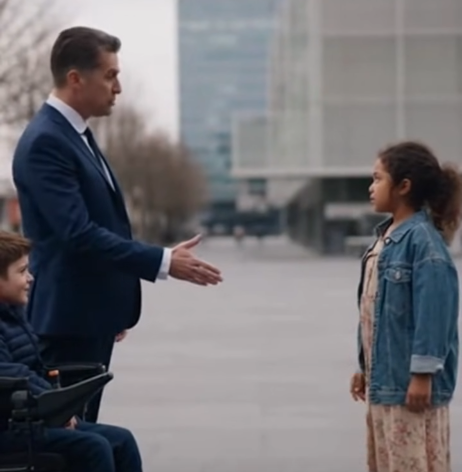
Michael froze. His breath caught somewhere between disbelief and fear. He stared at his son’s leg, hoping it was a trick of the light, a twitch, anything but hope. Hope was dangerous. Hope had broken him before.
“Noah,” he whispered. “Did you feel that?”
The boy swallowed hard. His small hands gripped the arms of the wheelchair.
“I… I think so, Dad,” he said, his voice shaking. “It felt warm. Like when your foot wakes up.”
The girl pulled her hand back slowly, as if she knew exactly how fragile the moment was.
“My name’s Lily,” she said. “I don’t do tricks.”
Michael stood there, surrounded by the noise of the city — honking cars, people rushing past — yet everything felt silent. He had spent over two million dollars chasing moments like this. And now a barefoot child on the sidewalk had given him one for free.
Security finally approached, tense and alert.
“Sir, should we remove her?”
Michael raised a hand without taking his eyes off Lily.
“No. Give us a minute.”
They stepped aside, away from the crowd. Lily sat on the curb, calm, patient, like she’d done this before. That scared him more than anything else.
“Who taught you this?” Michael asked.
“No one,” she replied. “My grandma. Back home. She said some people are born with warm hands. Not many. Just enough.”
Michael let out a dry laugh.
“You’re saying you can fix what doctors couldn’t?”
“I’m saying I can help,” Lily answered. “But not for free.”
There it was.
“How much?” he asked, already bracing himself.
“I want a home,” she said. “A real one. Food. School. And no more sleeping under bridges.”
That night, Michael didn’t sleep. He watched Noah breathe, replaying the moment again and again. In the morning, he made a decision that shocked his lawyers, his board, and half of Chicago.
He brought Lily home.
The house was huge, cold, filled with glass and silence. Lily walked through it barefoot, touching the walls, the furniture, like she was learning a new language. Noah followed her everywhere.
The first week, nothing happened.
Michael felt the old doubt creeping back. The shame of believing. The anger at himself.
Then, one evening, Noah stood up.
Not alone. Not steady. But standing.
Michael dropped the glass in his hand. It shattered on the marble floor. He didn’t care. He was crying too hard.
Days turned into weeks. Weeks into months. With Lily’s quiet presence, Noah began to walk. First with a walker. Then with a cane. Then, one morning, across the living room by himself.
Doctors were baffled. News tried to break the story. Michael shut it all down. This wasn’t a miracle for sale.
Lily started school. She learned fast. She laughed louder. She slept without flinching.
One night, Michael found her sitting on the porch, staring at the stars.
“You saved my son,” he said.
She shook her head.
“No. I just helped. You saved me.”
Michael realized then that wealth had never made him powerful. Love did.
Years later, Noah ran across a football field, strong and smiling. In the stands, Michael stood beside Lily — now his daughter in every way that mattered.
Sometimes miracles don’t come from hospitals or money.
Sometimes they walk barefoot into your life and ask for a chance.
This work is inspired by real events and people, but it has been fictionalized for creative purposes. Names, characters, and details have been changed to protect privacy and enhance the narrative. Any resemblance to actual persons, living or dead, or actual events is purely coincidental and not intended by the author.
The author and publisher make no claims to the accuracy of events or the portrayal of characters and are not liable for any misinterpretation. This story is provided “as is,” and any opinions expressed are those of the characters and do not reflect the views of the author or publisher.