All 146 on board dead as pilot uttered four chilling words and plane crashed into mountain
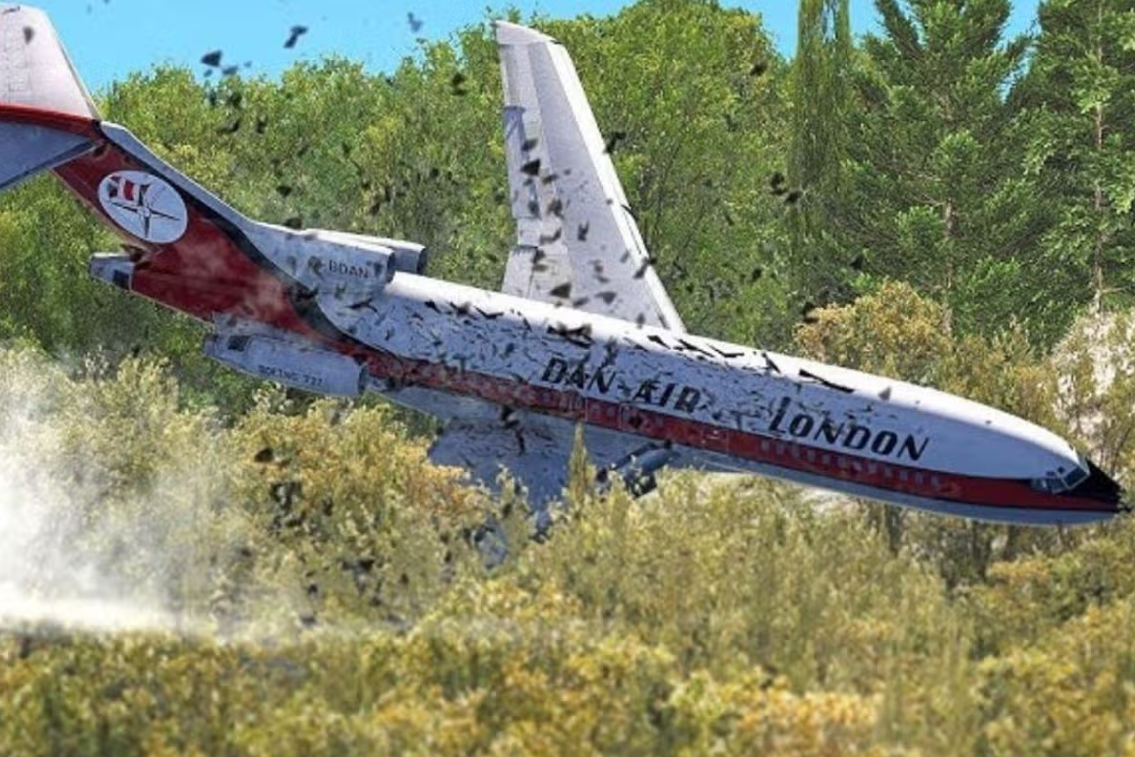
WARNING: DISTRESSING CONTENT The Dan-Air Flight 1008 crashed into a mountain, killing all 146 on board after one simple one letter miscommunication
A pilot facing imminent death uttered some of the most horrifying words before his craft collided into a cliff face, killing all 146 on board.
The Tenerife climate is frequently overcast – occasionally producing limited visibility due to winds sweeping up from the ocean.
During the 1970s and 1980s, British carrier Dan-Air expanded to become the United Kingdom’s largest independent airline. At 9.20am on April 25, 1980, Flight 1008 departed from Manchester Airport bound for Tenerife.
The aircraft was filled with British tourists seeking the sun and sea of the Canary islands, a holiday they would never reach.

Three seasoned pilots were aboard – Captain Arthur Whelan, 50, co-pilot, First Officer Michael Firth, 33 and flight engineer 33-year-old Raymond Carey. Five cabin crew members were also present, totalling 146 occupants on the aircraft.
For three hours, everything went smoothly until the crew started their descent at 1pm local time. Usually the wind came from the Atlantic blowing to the west, but on this day they were blowing from the opposite direction, meaning that a different runway was being used – Runway 12.
Controller Justo Camin, 34, was unable to authorise the standard descent procedure as there was another aircraft ahead also approaching Runway 12 – and the two planes were drawing perilously close to a mid-air collision.
Given there was no radar at the airfield, Camin controlled traffic movements procedurally – directing each aircraft individually to follow a predetermined route.
Shortly after 1.18pm Camin recognised he needed to place the Dan Air crew in a holding pattern while the aircraft ahead could land safely on Runway 12.
However, there was a complication as no holding pattern existed for that runway so Camin had to improvise. He wanted Flight 1008 to enter a left-hand holding pattern and remain in this holding pattern, executing turns until the other flight had cleared the area.
In response to First Officer Firth’s position report, Camin said, “Roger, the er, standard holding pattern overhead Foxtrot Papa is inbound heading one five zero, turn to the left, call you back shortly.”
Upon receiving the message, the captain replied, “Roger” without repeating what Camin had instructed them to do. Had Whelan done this, the looming catastrophe would have certainly been prevented.
When Camin told them: “turn to the left,” he actually intended to say “turns to the left,” indicating the direction the crew were to navigate around the holding pattern. However, without the “s,” this transmission was interpreted by the crew as “turn to the left.”
Camin, who also cleared the flight to a designated altitude of 5,000 feet, had made a minor yet crucial mistake.
Captain Whelan, confused by the sudden unexpected directive to enter a holding pattern not displayed on any of his charts, made a single turn to the left onto a heading of 150 degrees, under the impression that’s what the controller had instructed him to do.
They were now in a mountainous region where the minimum safe altitude is 14,500ft. One minute and six seconds before the crash, one of the pilots is heard remarking, ” Bloody strange hold, isn’t it?” adding, ” It doesn’t parallel with the runway or anything.”
From the cockpit voice recording, it was evident the crew was growing uneasy, but no one questioned the instructions with the controller.
The controller Camin, assuming the plane was over the sea following his improvised holding pattern, permitted the aircraft to descend another thousand feet. He was oblivious to the fact the plane was in the middle of the mountains.
Captain Whelan expressed doubt about Camin’s instruction to his co-pilot in the cockpit. “I don’t like that.
“They want us to keep going more round, don’t they?” his co-pilot responded. At this juncture, the automatic ground alarm was heard in the cockpit sounding “pull up, pull up!”.
In a frantic bid to avoid hitting the mountain, Captain Whelan abandoned his left turn for a sharp right manoeuvre. The captain was convinced he could dodge the terrain by banking right.
Yet the standard response to the alarm would be to “pull up” and climb as high as possible to clear surrounding terrain. Co-pilot Firth, examining the chart, recognised it was the incorrect course of action and offered alternative suggestions to the captain.
“Let’s get out of here,” Flight Engineer Carey is heard saying on the CVR. Captain Whelan persisted in steering the aircraft steeply to the right, sacrificing 300 feet of altitude in the process.
The Spanish investigators subsequently stated this single manoeuvre eliminated any possibility of escape. Flight Engineer Carey was heard cautioning: “Bank angle, bank angle!” And then the CVR cut out.
Dan-Air flight 1008 crashed directly into the side of La Esperanza at an altitude of 5,450 feet, merely 92 feet (28 metres) below the peak.
The collision destroyed most of the aircraft instantly, scattering broken debris across the mountainside. The tail section travelled onwards for several hundred metres before it struck the ground, tumbled into a ravine, and disintegrated.
Small fires ignited from the crushed wreckage and for the second time in just over three years, the dreaded crash alarm rang out at Tenerife North Airport. Within hours, rescue teams made the arduous journey up the mountain, but it was immediately clear that none of the 146 passengers on board had survived the crash.
Not a single intact human body could be found and many of the remains could not be definitively identified. Despite acknowledging the controller’s mistake, Spanish investigators placed all the blame on the Dan Air crew.
The British investigators contended the controller should have recognised sooner the separation between the two planes would pose an issue, allowing him to use a published holding pattern – this would have prevented the crew from becoming confused.
British investigators also stated he should not have issued an unpublished and untested holding pattern, but they conceded that the Dan Air crew did not question the controller’s instructions or ask for clarification.
They also criticised Camin’s decision to allow flight 1008 to descend to 5,000 feet. If the holding pattern had been designed according to official regulations, the minimum altitude should have been 7,000 feet.
After receiving a ground proximity warning, the captain – unable to see due to fog and cloud – decided to make a right turn, which tragically led them directly into the side of the mountain. Typically, crews are expected to ascend and reach as high an altitude as possible – as the alarm instructs.
What is undisputed, however, is that the omission of a single letter in a word triggered the series of events that ultimately resulted in the crash. Had the controller used the term “turns” instead of “turn”, the crash might have been averted.
The crash investigation led to a renewed emphasis on clear, standardised procedures for all flight operations, including holding patterns.
It also underscored the importance of clear communication between air traffic controllers and pilots – and the necessity for pilots to repeat Air Traffic Control instructions to eliminate any potential misunderstandings.
Dan Air managed to recover from the accident and continued its operations until 1992 when it was acquired by British Airways.
Despite being the deadliest incident involving a British airliner, Dan Air Flight 1008 is not as well remembered as it ought to be on its 45th anniversary – and the 146 individuals who tragically lost their lives that day.