An 8-Year-Old Girl Climbed Into Her Father’s Casket During the Wake, But When She Whispered Into His Ear, the Entire Room Froze in Pure Terror.
My 8-year-old daughter hadn’t shed a single tear since the machines in the ICU went flat. She just stood by his casket, staring at his face like she was waiting for a secret signal. But when she finally climbed inside and wrapped her arms around his neck, the room went cold—and then the screaming started.
The air in Cedar Falls, Iowa, usually smells like cut grass and diesel this time of year, but inside my sister’s living room, it was thick with the suffocating scent of lilies and old floor wax. It’s a smell that sticks to the back of your throat, the kind that reminds you that life has stopped even when the clock on the wall keeps ticking. My husband, Thomas, was laying in a mahogany box in the center of the room, looking like a wax version of the man I’d spent fifteen years of my life with. He was only thirty-seven. He was a construction supervisor, a man whose hands were always stained with sawdust and grease, a man who could fix a leaning porch with a hammer and a handful of nails before breakfast. Now, those hands were scrubbed raw, folded over a navy blue suit he’d only ever worn to Easter service. They looked too soft. They looked wrong.
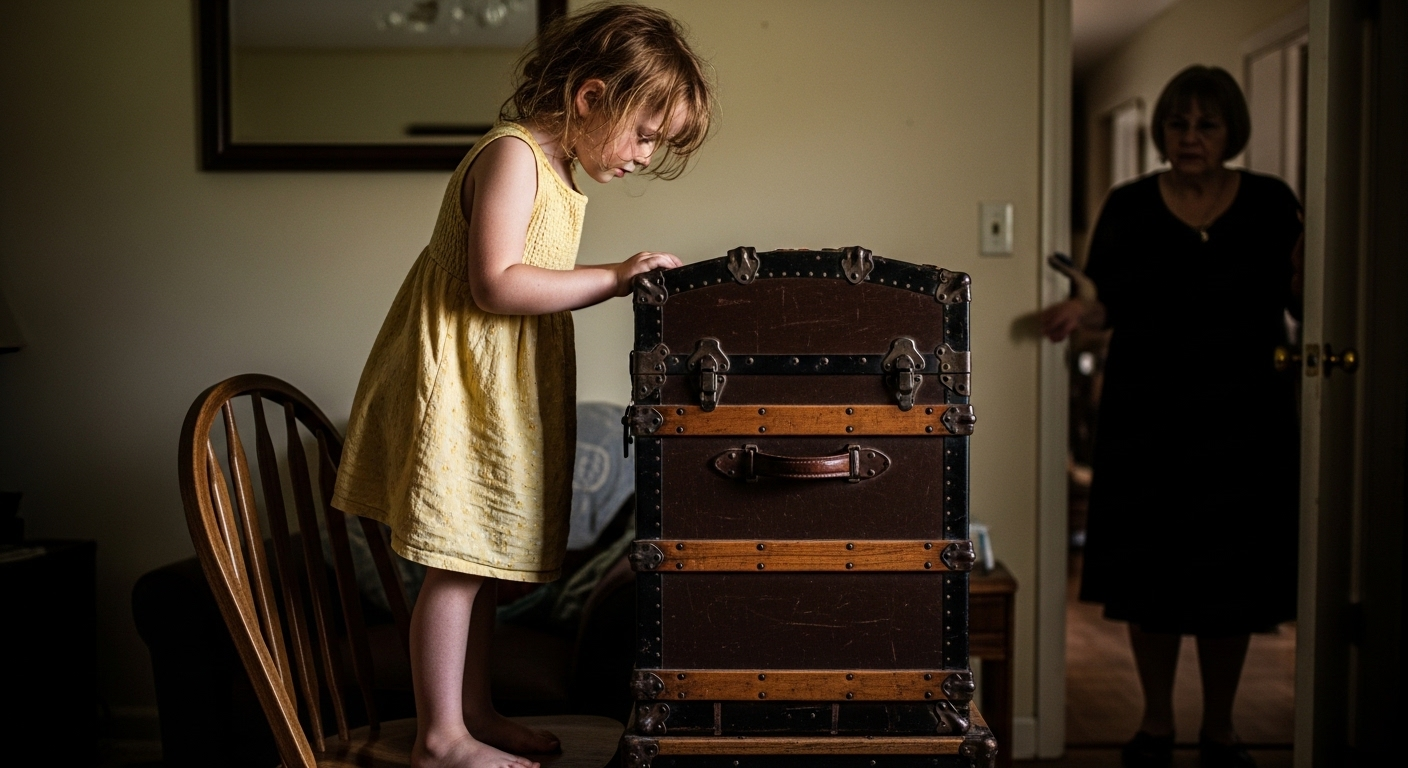
Madison, our eight-year-old, hadn’t moved from his side for six hours. She was wearing a simple yellow sundress, her strawberry-blonde hair tangled at the ends because I hadn’t had the strength to brush it that morning. She didn’t cry. She didn’t scream. She didn’t even ask for a glass of water. She just stood there on her tip-toes, her small fingers gripping the polished edge of the casket until her knuckles turned white. People were starting to whisper. I could hear them in the kitchen, their voices muffled by the sound of the coffee percolator. They said she was in shock. They said I should pull her away, that it wasn’t healthy for a child to stare at a corpse for that long. But how do you tell an eight-year-old to stop looking at the only hero she’s ever known?
“Rachel, honey, you need to eat something,” my mother, Lorraine, whispered, placing a hand on my shoulder. She’s a retired school principal, the kind of woman who handles a crisis with a clipboard and a firm jaw, but even her voice was cracking. “And Madison… she needs to sit down. She’s going to collapse.” I looked at my daughter. She looked like a statue. A tiny, freckled statue that was waiting for the wind to blow. Every time I tried to lead her away, she’d just shake her head, her eyes never leaving Tom’s face. “I’m staying here,” she’d say. It wasn’t a tantrum. It was a mission.
The room was packed with people from town—guys Tom had worked with, neighbors whose roofs he’d patched after the big storm last July without charging them a dime. They shuffled around in their uncomfortable Sunday best, holding paper plates of ham sandwiches and potato salad, looking at their shoes. The humidity was rising as the sun began to set over the cornfields outside, making the air in the house feel heavy and damp. I felt like I was drowning in slow motion. Every few minutes, someone would come up to me, squeeze my hand, and say, “He’s in a better place,” or “He looks so peaceful.” I wanted to scream at them. He didn’t look peaceful. He looked dead. He looked like he was missing the joke, missing the game, missing the life we’d built in our little house on the edge of town.

Around 8:00 PM, Madison finally spoke. She didn’t look at me, but her voice was clear. “I need a chair,” she said. My mother didn’t hesitate; she brought over one of the wooden kitchen chairs and placed it right next to the casket. Madison climbed up on it carefully, adjusting her dress. Now she was tall enough to lean over him. She didn’t touch him yet. She just hovered her face inches from his, her eyes searching his closed lids. The guests in the room went silent. The clinking of silverware stopped. We all watched her, a collective breath held in the lungs of thirty people. There was something unsettling about her focus. It wasn’t the frantic grief of a child; it was the calculated observation of a scientist.
“She’s losing it,” I heard my cousin Sarah hiss in the hallway. “Rachel needs to get her out of there. It’s morbid. It’s going to scar her for life.” I ignored her. Sarah didn’t know Tom like we did. She didn’t know that Tom and Madison had their own language—a series of whistles and hand signals they used when they were out fishing on the Cedar River. They were two halves of the same soul. If Madison needed to stand there until her legs gave out, I was going to let her. I owed her that much. I owed him that much.
By 9:00 PM, the crowd had thinned out. Only the close family remained, scattered around the house in various states of exhaustion. The floorboards creaked as people moved to the porch to catch a breeze. The dim amber lamps cast long, flickering shadows against the walls, making the flowers look like strange, reaching hands. Madison hadn’t moved. She was still on that chair, leaning forward. Her shadow merged with Tom’s in the casket, a dark silhouette that seemed to swallow them both. I sat on the sofa nearby, my head resting against the cool plaster wall, watching her through half-closed eyes. I must have drifted off for a second, caught in that hazy place between a nightmare and reality.
I was startled awake by a sound. A soft, rhythmic scratching. At first, I thought it was a branch against the window, or maybe the dog under the porch. But then I saw Madison. She had reached out and was running her small index finger along the seam of Tom’s navy suit jacket. She was tracing the fabric, over and over. Then, she leaned in even closer, her lips almost touching his ear. She started to whisper. It was too low for me to hear, just a soft hum of vowels and consonants that sent a shiver down my spine.
“Madison?” I called out, my voice sounding raspy and strange in the quiet room. She didn’t answer. She didn’t even flinch. She just kept whispering, her eyes locked on his. My mother walked back in from the kitchen, a fresh pot of coffee in her hands. She stopped dead when she saw Madison. “What is she doing?” she breathed. I shook my head, unable to find the words. We stood there, two generations of women watching the youngest of us commune with the dead.
The clock struck 10:00 PM. The house was unnervingly still. The crickets outside were loud, a frantic chirping that felt like it was counting down to something. Suddenly, Madison’s whispering stopped. She straightened her back, her face going pale under the amber light. She looked around the room, her eyes wide and glassy. For the first time that day, I saw fear in her expression. Not sadness. Fear.
“Mommy,” she said, her voice trembling. “Mommy, he’s not doing it right.” “What, baby? What isn’t he doing right?” I moved toward her, my heart hammering against my ribs like a trapped bird. “He’s supposed to tap back,” she whispered. “We have a code. When one of us is hiding, the other taps three times. I tapped three times on his hand, Mommy. I did it ten times. He’s not tapping back.” “Madison, honey… Dad isn’t hiding,” I said, the tears finally starting to burn my eyes. “He’s… he’s gone. He can’t tap back.”
She looked at me with a sudden, fierce intensity. “No. You don’t understand. I heard him. Before the people came. I heard him breathing.” A cold draft swept through the room, though all the windows were shut tight against the Iowa humidity. My mother dropped the coffee pot. It shattered on the hardwood, dark liquid spreading like an inkblot across the floor. No one moved to clean it up. We were all staring at Madison.
“He’s cold because he’s scared,” Madison said, her voice rising in pitch. “He’s stuck in the dark and he’s scared.” Before I could reach her, before I could grab her waist and pull her back to the world of the living, she moved. With a sudden, desperate burst of energy, she scrambled off the chair and hoisted herself over the edge of the mahogany box.
“Madison, no!” I screamed, lunging forward. But she was already inside. She’d tucked her small body into the narrow space beside Tom’s torso, her arms wrapping tightly around his neck, her face buried in the crook of his shoulder. The casket groaned under the added weight. The satin lining hissed as she settled in. “I’ve got you, Daddy,” she wailed, her voice muffled by his suit. “I’m here! Wake up! Please wake up!”
I reached the casket and grabbed her shoulders, trying to pull her out, but she was holding on with a strength I didn’t know she possessed. She was dead weight, anchoring herself to her father. My mother was behind me, shouting for help, and I could hear the heavy boots of Tom’s construction friends running from the porch. “Get her out of there!” someone yelled. “Madison, let go!” I sobbed, tugging at her.
As I pulled, Madison’s head shifted, and her ear pressed hard against Tom’s chest. She went instantly still. The screaming, the running footsteps, the crashing of the broken glass—it all seemed to fade into a vacuum. Madison’s eyes flew open, staring directly into mine. They weren’t filled with tears anymore. They were filled with a paralyzing, horrific realization.
“Mommy,” she whispered, her voice so quiet it barely broke the silence. “What? What is it?” I asked, my hands trembling on her shoulders. She didn’t move. She didn’t blink. She just stared at me while her arms remained locked around her father’s neck. “He’s not just cold,” she said.
And then, she screamed. Not a child’s scream of sadness, but a high-pitched, soul-shredding shriek of absolute terror. As she screamed, I felt it. A vibration. A subtle, rhythmic thud against the side of the mahogany box. It was coming from inside.
CHAPTER 2: THE THUMP IN THE DARK
The sound was unmistakable. It wasn’t the house settling or the wind against the siding. It was a rhythmic, heavy thud-thud-thud coming from directly beneath my daughter’s chest. The mahogany casket, which had felt like a solid, immovable weight of grief, was now vibrating.
Madison’s scream cut through the air like a serrated blade. She didn’t move away; instead, she gripped Tom’s suit even tighter, her small face buried in the crook of his neck. I felt a cold sweat break across my forehead, my heart hammering so hard I thought it might burst.
“Get her out! Get her out of there now!” my mother shouted from the kitchen doorway. Her voice was high and thin, bordering on a manic break. The heavy footsteps of Tom’s work friends, Big Jim and Miller, thundered across the hardwood floor as they rushed into the room.
Jim reached the casket first, his massive hands shaking as he grabbed Madison’s waist. He pulled with everything he had, but she was like a burr stuck to wool. She was shrieking, a raw, guttural sound that didn’t belong in the throat of an eight-year-old girl.
“He’s moving! Daddy’s moving!” she wailed, her fingers digging into the navy fabric of his jacket. The thumping grew louder, a frantic, desperate drumming against the wood. It sounded like someone trying to kick their way out of a locked closet.
Panic surged through the room like an electric current. People were stumbling over chairs, knocking over vases of lilies that shattered on the floor. The smell of the water, stagnant and metallic, mixed with the overwhelming scent of funeral flowers.
“Is he alive? Is Tom alive?” Miller yelled, his face ashen. He reached for Tom’s wrist, his fingers trembling so much he could barely find the skin. We all froze, waiting for the miracle, waiting for the horror.
Miller’s eyes went wide as he felt the pulse point. He looked up at me, his mouth hanging open, but he didn’t say anything. He just shook his head slowly, his eyes darting back to the rhythmic thumping that was still shaking the casket.
“There’s no pulse, Rachel,” Miller whispered, his voice cracking. “He’s cold. He’s… he’s definitely gone. But the box… the box is moving.”
I shoved my way past Jim and grabbed the edge of the casket. I looked down at my husband. His face was still that same waxy, pale gray. His eyes were closed, his jaw set in that unnatural, stitched-shut stillness of the dead. He wasn’t breathing. He wasn’t moving.
But the thumping was getting faster now. It wasn’t coming from his chest. It was coming from under him. From the space between his back and the satin lining of the casket.
“Madison, baby, look at me!” I grabbed her face, forcing her to turn away from the body. Her eyes were rolled back in her head, her breath coming in short, jagged gasps. “What did you feel? Tell Mommy what you felt!”
She grabbed my wrists, her grip bruising. “The phone,” she choked out. “The phone is talking to him, Mommy. It’s talking inside him.”
I felt the blood drain from my face. Tom’s phone was on the kitchen counter. I had put it there myself three days ago, right next to his wallet and his wedding ring. It had been dead since the accident.
Just as the thought crossed my mind, a muffled, electronic trill cut through the sound of the thumping. It was a ringtone—low, distorted, and vibrating with an intensity that made the mahogany box hum. It was coming from inside the casket.
I reached down, my hands shaking so violently I could barely function. I pushed my hand under Tom’s cold, stiff shoulder, dreading what I might touch. The satin was damp. Not with water, but with something thicker, something that felt like oil.
My fingers brushed against something hard and rectangular tucked beneath his shoulder blade. I pulled it out, and the room went deathly silent. It wasn’t Tom’s smartphone. It was an old, battered burner phone, the kind you buy at a gas station for twenty bucks.
The screen was glowing a sickly, neon green in the dim light of the living room. On the caller ID, there was no name, just a string of zeros. The thumping stopped the second the phone was in my hand.
I stared at the screen, my thumb hovering over the “Accept” button. My mother was sobbing in the background, and Jim was still holding a trembling Madison. Every eye in the room was on that glowing green screen.
I hit the button and pressed the phone to my ear. I didn’t say hello. I couldn’t even breathe. For a long moment, there was nothing but static—a dry, hissing sound like sand being poured over glass.
Then, a voice whispered. It was low, gravelly, and sounded like it was being squeezed through a throat filled with gravel. It wasn’t Tom. But it knew who I was.
“Rachel,” the voice said, the name sounding like a curse. “Tell the girl to stop looking. Some things stay buried for a reason.”
The line went dead. I pulled the phone away and looked at the screen, but it had gone completely black. The battery was gone. The back of the phone was missing, and the internal components were charred as if they had been hit by a blowtorch.
I looked back down at Tom. In the chaos, his head had tilted slightly to the side. His eyes were still closed, but his mouth—which the mortician had sworn was wired shut—was now slightly agape.
And tucked inside his mouth, resting on his tongue like a sick communion wafer, was a small, brass key.
CHAPTER 3: THE SECRET UNDER THE FLOOR
The funeral director, a man named Mr. Henderson who looked like he was carved out of old parchment, arrived thirty minutes later. He was frantic, trying to maintain his professional composure while his hands shook so hard he dropped his briefcase.
“This is impossible,” he kept muttering as he looked at Tom’s mouth. “I personally oversaw the preparation. The jaw was secured. There was nothing… nothing in his mouth.”
The guests had been ushered out by my mother and Big Jim. Only the family remained, huddled in the kitchen while the storm outside finally broke, rain lashing against the windows of the old farmhouse.
I sat at the kitchen table, the brass key sitting in the center of the wood like a spent bullet. It was old, the teeth worn down, with a small tag attached to it by a piece of dirty twine. On the tag, in Tom’s messy, block-letter handwriting, was a single word: FOUNDATION.
“He was a construction supervisor, Rachel,” my mother said, her voice hollow. She was nursing a cup of tea she hadn’t touched. “Maybe it’s just a key to a job site. A shed. Something he forgot to return.”
I looked at her, then back at the key. “He didn’t forget, Mom. He put it in his mouth. Or someone did. And that phone… that phone called him.”
Madison was lying on the sofa in the next room, finally asleep from sheer exhaustion. But even in her sleep, she was twitching, her fingers moving as if she were tapping out a code. I couldn’t get her words out of my head. He’s not just cold.
I stood up, the chair screeching against the linoleum. “I need to check the basement,” I said. My heart was thumping again, mimicking that horrific sound from the casket.
“Rachel, don’t,” my mother pleaded. “Wait for the police. Wait for the morning.”
But I couldn’t wait. Tom had spent the last six months of his life working on a “special project” out near the old quarry. He’d come home late, covered in a strange, red clay that I’d never seen in this part of Iowa. He’d been quiet, distant, his eyes always darting to the windows.
I grabbed a flashlight from the junk drawer and headed toward the cellar door. The air in the hallway felt heavier, colder. As I passed the living room, I glanced at the casket. Mr. Henderson had closed the lid, but the mahogany box seemed to loom in the shadows, a dark monument to things left unsaid.
The basement stairs creaked under my weight. Our basement was typical for a 1920s farmhouse—damp, smelling of limestone and laundry detergent, filled with boxes of Christmas decorations and old power tools.
I made my way to Tom’s workbench in the back corner. It was neat, his tools lined up with military precision. I started pulling out drawers, looking for anything that matched the word FOUNDATION.
I found his blueprints. He had dozens of them, mostly for the new library extension and the high school gym. But at the very bottom of the stack, hidden inside a tube for a generic porch repair, I found something else.
It was a hand-drawn map of our own property. Tom had lived here his whole life; the house had been in his family for three generations. On the map, there was a red ‘X’ marked directly under the living room.
I looked up at the ceiling, at the heavy oak joists that held up the floor where Tom’s body was currently resting. I walked to the spot directly beneath the casket and shone my light upward.
There was a patch of floorboards that looked newer than the rest. The wood was a slightly different shade of pine, and the nails were shiny, not rusted like the others. Tom must have done this recently.
I grabbed a crowbar from the workbench and dragged a step-ladder over. My breath was coming in ragged gasps. I felt like a grave robber in my own home. I jammed the crowbar into the seam and pulled.
The wood groaned and splintered. Dust and old insulation fell into my eyes, stinging them. I pulled again, harder this time, fueled by a frantic, desperate need to know what my husband had been hiding.
The board popped free, and something heavy fell out. It hit the concrete floor with a dull, metallic thud.
It was a small, fireproof lockbox. It was covered in that same red clay I’d seen on Tom’s boots. I climbed down the ladder, my knees shaking, and knelt on the cold floor next to the box.
I took the brass key from my pocket. My hands were sweating so much I almost dropped it. I slid the key into the lock. It turned with a smooth, oiled click.
I held my breath and lifted the lid. Inside, there were no stacks of cash. No letters from a secret lover. There was only a single, heavy-duty digital voice recorder and a handful of polaroid photos.
I picked up the photos first. They were all taken at night, illuminated by the harsh flash of a camera. They showed a hole in the ground—a deep, jagged trench cut into the red clay.
In the center of the trench was something that didn’t look like a foundation. It looked like a door. A heavy, rusted iron door set directly into the earth, with strange symbols etched into the metal.
I picked up the voice recorder and hit ‘Play.’
The static was loud, just like on the phone. Then, I heard Tom’s voice. He sounded terrified. He was whispering, the sound of wind howling in the background.
“Rachel, if you’re hearing this, I’m already gone. I thought I could fix it. I thought if I built over it, if I sealed it with enough concrete, it would stay down. But it’s not just a hole, Rachel. It’s a mouth. And it’s hungry.”
There was a loud, wet tearing sound on the recording, followed by a scream that I recognized instantly. It was the same scream Madison had let out in the living room.
“I can hear them tapping,” Tom’s voice continued, now sobbing. “They tap on the pipes. They tap on the floorboards. They’re trying to tell me that the contract isn’t finished. One life for the foundation. That was the price.”
The recording ended abruptly. I sat there in the dark, the silence of the basement feeling like a physical weight pressing against my chest.
Then, from directly above my head, I heard it.
Tap. Tap. Tap.
Three slow, deliberate knocks on the floorboards of the living room. Directly from inside the casket.
CHAPTER 4: THE MEN IN THE BLACK SUV
I scrambled back from the lockbox, the voice recorder clattering against the concrete. The tapping continued, steady and rhythmic, echoing through the floor joists like a heartbeat.
I didn’t go back up the stairs. I couldn’t. The thought of that mahogany box, and whatever was now making noise inside it, paralyzed me. I huddled in the corner of the basement, the flashlight beam dancing wildly across the walls.
“Rachel?” My mother’s voice drifted down the stairs, sounding small and frightened. “Rachel, honey, are you okay? There’s… there’s someone at the door.”
I wiped the dust from my face and forced myself to move. I shoved the photos and the recorder back into the lockbox, tucked it under my arm, and headed up the stairs. My legs felt like lead.
When I reached the kitchen, the atmosphere had shifted. My mother was standing by the window, her hand clutching the curtain. Outside, the rain was a torrential downpour, but I could see the silhouette of a large vehicle idling at the end of our long driveway.
It was a black SUV, the kind with windows so dark they look like ink. The headlights were off, but the amber running lights gave the vehicle a predatory, watchful look.
“They just pulled up,” my mother whispered. “They haven’t gotten out yet. They’re just sitting there.”
I looked at the clock. It was nearly 1:00 AM. In a small town like Cedar Falls, no one comes calling at one in the morning unless someone is dying or the barn is on fire.
“Where’s Madison?” I asked, my voice barely a whisper.
“Still asleep on the sofa,” Mom said. She turned to me, her eyes fixating on the lockbox under my arm. “What is that, Rachel? What did you find?”
“Something Tom was scared of,” I said. “Something that might have killed him.”
Before she could respond, three doors on the SUV opened simultaneously. Three men stepped out into the mud and rain. They were wearing dark, heavy raincoats and baseball caps pulled low over their eyes. They didn’t look like police. They didn’t look like neighbors.
They moved with a synchronized, chilling efficiency, walking toward our front porch. They didn’t run to avoid the rain; they just marched through it.
“Go to the living room,” I told my mother, my voice trembling. “Get Madison. Take her to the back bedroom and lock the door. Do it now, Mom!”
“Rachel, what’s happening?”
“Just go!” I hissed.
I watched her scurry away, her face a mask of confusion and terror. I stood in the kitchen, the lockbox gripped tight against my ribs. I heard the heavy boots hit the porch. The wood groaned under their weight.
The front door didn’t just knock; it shuddered under the force of a heavy fist. Three times. Thud. Thud. Thud. The same rhythm as the tapping.
I walked to the front door, my heart in my throat. I didn’t open it. I looked through the small peephole.
The man standing in front was tall, with a jagged scar running from his temple to his jawline. He wasn’t looking at the door; he was looking at the living room window, where the casket was visible through the curtains.
“Mrs. Clarke,” the man said. His voice was the same one I’d heard on the burner phone—the gravelly, dry-sand voice. “We’re here for the supervisor’s property. He left some loose ends.”
“My husband is dead,” I shouted through the door, my voice cracking. “Go away or I’m calling the Sheriff.”
“The Sheriff is currently busy with a multi-car pileup on Highway 218,” the man said calmly. “It’s going to be a long night, Rachel. Don’t make it longer. Just give us the box and the key, and we’ll be on our way.”
How did they know? How did they know I had found it?
I backed away from the door, my mind racing. I looked toward the living room. The lid of the casket was still closed, but as I watched, the mahogany box began to tilt. It was shifting on its pedestal, sliding slowly toward the edge.
Something inside was throwing its weight against the side of the casket.
“Rachel!” my mother screamed from the back of the house. “Rachel, she’s gone! Madison isn’t here!”
I spun around, my blood turning to ice. The sofa was empty. The back door, which led to the porch and the dark, rain-soaked fields beyond, was standing wide open.
“Madison!” I yelled, running toward the back door.
But the front door didn’t wait for an invitation. With a deafening crack, the frame splintered as the men kicked it in.
I was trapped between the men in the house and my daughter lost in the storm. And as the men stepped into the foyer, the casket in the living room finally tipped over.
It hit the floor with a bone-jarring crash, the lid popping open. But it wasn’t Tom’s body that rolled out onto the carpet.
It was nothing. The casket was empty.
I looked at the open back door, then at the men, then at the empty box. And then I heard it—a high-pitched, playful whistle coming from the dark cornfields outside. It was the fishing whistle Tom and Madison used.
But Tom was supposed to be dead.
“Find the girl,” the man with the scar commanded his partners. “She has the rest of it.”
I didn’t think. I didn’t scream. I just bolted out into the rain, chasing the sound of a dead man’s whistle.
CHAPTER 5: THE STALKS HAVE EARS
The rain was a cold, relentless sheet that turned the Iowa dirt into a thick, sucking sludge. I ran blindly into the cornfield, the tall, drying stalks slapping against my face like skeletal fingers. The wind was howling, but that whistle—sharp, clear, and impossibly familiar—sliced through the storm.
It was the melody Tom used to call Madison back to the truck when the sun started to set over the river. Two short notes, one long, rising at the end. It was a sound of safety, of home. But hearing it now, coming from the black heart of a midnight storm, made my skin crawl.
“Madison!” I screamed, my voice swallowed by the thunder. My lungs burned as I pushed deeper into the rows. The corn was high this year, a wall of green and gold that turned the world into a claustrophobic maze.
Behind me, I could hear the men. They weren’t shouting; they were moving with a terrifying, silent coordination. Their heavy boots crunched through the mud, a rhythmic thump-thump-thump that matched the heartbeat I’d felt in the casket.
I tripped over a hidden root and went down hard, the lockbox digging into my ribs. The mud filled my mouth, tasting of iron and ancient decay. I scrambled to my knees, gasping for air, and that’s when I saw the light.
A pale, flickering glow was coming from a clearing about fifty yards ahead. It wasn’t a flashlight. It was a soft, pulsating amber, like the light from the lamps in the living room.
I crawled forward, staying low beneath the canopy of corn leaves. As I reached the edge of the clearing, the whistling stopped. The silence that followed was heavier than the thunder.
Madison was there. She was standing in the center of a flattened circle of corn, her yellow dress soaked through and clinging to her small frame. She wasn’t alone.
A figure was sitting on a rusted tractor at the edge of the clearing. It was tall, broad-shouldered, wearing a navy blue suit that looked black in the dim light. His back was to me, but I knew those shoulders. I knew the way he tilted his head when he was thinking.
“Tom?” I whispered, the word barely a breath. My heart felt like it was going to shatter.
The figure didn’t turn. But Madison did. She looked at me, and for the first time since the accident, she smiled. It wasn’t a child’s smile of relief. It was wide, fixed, and utterly vacant.
“He was just hiding, Mommy,” she said. Her voice was crystal clear, unaffected by the wind or the rain. “He said the box was too small. He said he couldn’t breathe in the dark.”
I took a step toward them, but my feet felt like they were sinking into the earth. The ground in the clearing wasn’t mud anymore. It was that red clay from the quarry—soft, pliable, and warm.
“Madison, come here,” I choked out, reaching my hand toward her. “That’s not… that’s not Daddy. Please, baby, walk to me.”
The figure on the tractor began to turn. Slowly. Mechanically. As the face came into the light, I felt a scream build in my throat, but no sound came out.
It was Tom’s face, but it looked like it had been molded out of the red clay. His features were soft, blurring at the edges, and his eyes were just two deep, hollow pits filled with shadows. There were no stitches in his jaw now. His mouth was open wide, a dark void that seemed to pull the very light from the air.
“Rachel,” the thing said. The voice didn’t come from its mouth. It came from the ground beneath my feet. It was a thousand voices speaking at once, a vibration that rattled my teeth.
The men in the black raincoats stepped out from the corn, forming a circle around the clearing. They didn’t look at me. They didn’t look at the lockbox. They looked at the clay figure on the tractor.
“The supervisor is back,” the man with the scar said, his voice devoid of emotion. “But the debt is still outstanding. One life for the foundation. That was the contract.”
He stepped toward Madison, pulling a jagged, rust-covered tool from his pocket. It looked like a surveyor’s spike, but the tip was glowing with a faint, sickly green light.
“No!” I finally found my voice and lunged for my daughter.
But before I could reach her, the ground beneath the tractor split open. A massive, jagged fissure tore through the red clay, and a blast of freezing air erupted from the depths.
The clay figure reached out a hand—a long, tapering limb of mud—and grabbed Madison by the arm.
“It’s time to go to work, Maddy,” the thing hissed.
And then, the earth simply swallowed them both.
CHAPTER 6: THE QUARRY’S MOUTH
I didn’t hesitate. As the ground collapsed and my daughter disappeared into the dark, I dived after her.
I expected a hard impact, a bone-shattering fall into a cavern. Instead, it felt like falling through thick, cold syrup. The air was heavy with the smell of wet stone and something metallic—the scent of the “Foundation” Tom had written about.
I hit a slope of loose shale and tumbled down, the lockbox clattering beside me. I slid for what felt like miles until I finally came to a stop on a flat, stone floor.
I scrambled for my flashlight and clicked it on. The beam cut through a darkness so dense it felt physical. I wasn’t in a cave. I was in a structure.
The walls were made of massive, hand-hewn blocks of limestone, slick with moisture. Above me, the ceiling was reinforced with the same oak joists I’d seen in our basement, but they were covered in strange, pulsing veins of red clay.
“Madison!” I yelled. My voice didn’t echo. It was flat, muffled by the stone.
I picked up the lockbox and the flashlight and began to run down the long, narrow corridor. The air grew warmer, and a low, rhythmic thumping started again—the same sound from the casket, but louder now. Thump. Thump. Thump. It felt like the heartbeat of the earth itself.
I reached the end of the corridor and stepped into a chamber that took my breath away. It was a massive, circular arena, hundreds of feet across. In the center was the iron door from the photos—the one Tom had tried to seal.
It was standing wide open now. A staircase of red clay led down into a pit of pure, swirling shadow.
Madison was standing at the edge of the pit. The clay figure—the thing that looked like Tom—was standing behind her, its hands resting on her shoulders. The men in the raincoats were there, too, lined up along the perimeter of the room like statues.
“Stop!” I screamed, the flashlight beam shaking in my hand. “Take me instead! Whatever the contract is, take me!”
The man with the scar turned to look at me. In the light of the chamber, I could see that his eyes weren’t human. They were flat, gold discs, like the eyes of a hawk.
“You don’t understand the nature of the debt, Rachel,” he said. “The Clarke family has been the supervisors of the Foundation for three generations. Your husband’s grandfather built the first seal. His father reinforced it. And Tom… Tom was supposed to finish it.”
“Finish what?” I demanded, moving slowly toward my daughter.
“The Mouth,” the man said, gesturing to the pit. “It’s a rift. A leak in the world. It requires a constant maintenance of bone and blood to stay closed. Tom tried to cheat. He thought he could use concrete and steel instead of the traditional sacrifice.”
He pointed to the clay figure. “That is not your husband. That is the physical manifestation of his failure. It is the earth reclaiming the debt he tried to avoid.”
The thing that looked like Tom leaned down and whispered into Madison’s ear. She didn’t flinch. She just stared into the pit, her eyes reflecting the swirling shadows below.
“The Foundation needs a new supervisor,” the man with the scar continued. “A child’s soul is pure. It has the strength to hold the seal for another fifty years. If she goes down, the town stays safe. The corn grows. The sun rises.”
“And if she doesn’t?” I asked, my heart freezing.
“Then the Mouth opens fully,” he said. “And Cedar Falls becomes the first place where the dark comes to eat.”
I looked at the lockbox in my hand. I remembered the voice recorder. I thought if I built over it, if I sealed it with enough concrete, it would stay down.
“He didn’t just use concrete,” I said, a sudden realization hitting me. “He left me the key for a reason.”
I dropped the flashlight and began to fumble with the lockbox. I pulled out the voice recorder and the photos, throwing them aside. Underneath the false bottom of the box, I found what I was looking for.
It was a small, glass vial filled with a shimmering, silver liquid. Taped to the vial was a note in Tom’s handwriting: THE FINISHING TOUCH. DON’T LET THEM SEE IT.
The man with the scar saw the vial and his face contorted in rage. “Where did you get that? That’s the Refined Essence! That was lost decades ago!”
He lunged for me, but I was faster. I unscrewed the cap and held the vial over the open pit.
“Let her go,” I threatened. “Or I drop this into the Mouth. I don’t know what it does, but Tom called it a finishing touch. I bet it doesn’t taste very good to whatever is down there.”
The chamber began to shake. The red clay veins on the ceiling started to bleed, thick droplets of crimson liquid splashing onto the floor. The thing that looked like Tom let out a low, mournful howl.
“Give it to me, Rachel,” the man with the scar hissed, his gold eyes glowing. “You have no idea what you’re playing with. You’ll destroy us all.”
“I’m already destroyed!” I yelled. “Give me my daughter!”
The man looked at the clay figure, then at the pit, then back at me. He raised his hand, and the men in the raincoats took a step forward, their surveyor spikes humming with green light.
“You want the girl?” the man said, a cruel smile spreading across his face. “Fine. Take her. But you should know… she’s already started the transition.”
He snapped his fingers. The clay figure pushed Madison.
She didn’t fall into the pit. Instead, she began to sink into the floor itself. The red clay rose up around her ankles, her knees, her waist, hardening instantly into solid stone.
“Mommy!” she finally cried out, the vacant look in her eyes shattering. “Mommy, it’s cold! It’s so cold!”
I ran toward her, the vial gripped tight in my hand. But the men in the raincoats were closing in, and the chamber was beginning to collapse.
I had to choose. The vial, the daughter, or the world.
And as I reached for her, I realized the most horrifying thing of all. The thumping wasn’t coming from the pit anymore. It was coming from inside Madison.
[To be continued…]
CHAPTER 7: THE ARCHITECT’S GAMBLE
The ground was a liquid nightmare, swallowing my daughter inch by agonizing inch. I reached her just as the clay reached her chest. I grabbed her hands, but they felt like they were made of cooling wax—stiff, heavy, and freezing to the touch.
“Hold on, Madison! Don’t let go!” I screamed. I pulled with everything I had, my muscles screaming in protest.
The man with the scar stood just a few feet away, watching with a detached, clinical interest. “You’re fighting the inevitable, Mrs. Clarke. The Foundation has already tasted her. She’s part of the architecture now.”
The other men—the “Collectors,” I realized they must be—formed a wall behind him. They didn’t move to help, and they didn’t move to stop me. They were waiting for the earth to finish its meal.
“The vial!” Madison gasped, her breath coming in shallow, desperate puffs. “Mommy… the silver… put it on the floor!”
I looked down at the small glass vial of shimmering liquid. Tom’s “finishing touch.” If it was the Refined Essence the man had spoken of, it was meant to seal the rift, not save a life. But Tom had left it for me. He knew I would do anything to save her.
“Rachel, if you use that on the floor, you seal the Mouth, but you seal her inside it forever!” the man with the scar warned. “The only way to save the girl is to let the Mouth take the supervisor’s original sacrifice. Give us the boy. Give us the body.”
“The body is gone!” I yelled. “The casket was empty!”
The man laughed, a dry, rattling sound. “The body isn’t gone. It’s just… redistributed. Look up, Rachel.”
I tilted my head back. My flashlight beam hit the ceiling, and I nearly vomited.
The veins of red clay weren’t just clay. They were muscle. They were sinew. Tom’s navy suit was shredded and woven into the oak joists. His ribs were arched across the span of the room like the rafters of a cathedral. He wasn’t dead in the way we understood it; he had been dismantled and used as raw material to patch the leaks in the seal.
His face—the real one, pale and frozen—was embedded in the center of the ceiling, staring down at us with sightless eyes. He was the ceiling. He was the walls. He was the house.
“He gave himself to buy you time,” the man said. “But he wasn’t enough. He was too old, too tired. The Foundation needs the vitality of the young.”
“No,” I whispered. I looked at the vial. Then I looked at the iron door.
I realized then what Tom’s plan had been. He hadn’t just been a construction supervisor. He was an architect of the impossible. He hadn’t left the vial to seal the hole. He had left it to break the contract.
I didn’t pour the liquid on the floor. I didn’t pour it into the pit.
I smashed the vial against Madison’s chest.
The glass shattered, and the silver liquid didn’t spill. It ignited. A brilliant, blinding white light erupted from Madison’s skin, racing through the red clay like wildfire.
The chamber let out a sound that wasn’t a thump—it was a roar. The stone walls groaned, and the muscle-veins on the ceiling began to twitch and pull away from the wood.
“What have you done?” the man with the scar screamed, shielding his eyes. “That’s the Solvent! You’re dissolving the seal!”
“I’m bringing my family home!” I shouted.
The silver light was a physical force. It pushed the collectors back, their raincoats smoking and peeling. The clay around Madison began to soften, turning back into harmless mud. I yanked her upward, and this time, she popped free like a cork from a bottle.
I tucked her under my arm and bolted for the iron door. Behind us, the “Tom” figure on the tractor—the clay manifestation—was melting into a puddle of sludge. The real Tom, the one in the ceiling, began to fall.
Huge chunks of the limestone blocks were tumbling down as the silver light ate through the magical “glue” that held the Foundation together. The entire underground arena was coming apart.
“Run, Madison! Run for the stairs!”
We scrambled up the clay staircase as the pit behind us began to vomit forth a thick, oily blackness. The Mouth was opening, but without the red clay to guide it, it was just an aimless, hungry void.
We reached the surface of the cornfield just as the ground beneath the clearing collapsed entirely. A massive sinkhole, a hundred feet wide, opened up where the tractor had been.
The black SUV was tilted on the edge of the abyss. The man with the scar was standing on the bumper, looking down into the dark with an expression of pure, unadulterated terror.
“It’s open,” he whispered as the SUV slid into the hole. “You’ve let the hunger out.”
I didn’t wait to see him disappear. I grabbed Madison’s hand and ran through the corn, toward the flickering lights of our farmhouse.
CHAPTER 8: THE PRICE OF THE LIGHT
We reached the house just as the sun began to peek over the horizon, casting a pale, bruised purple light over the Iowa fields. The rain had stopped, leaving the world smelling of ozone and wet earth.
The front door was still hanging off its hinges. My mother was sitting on the porch steps, a shotgun across her knees, her eyes red from crying. When she saw us, she dropped the gun and ran, folding us both into a hug so tight I could hear her heart thumping.
But it was a normal heartbeat. Not the rhythmic drumming of the Foundation.
“It’s over,” I told her, though I didn’t believe it. “It’s over, Mom.”
We went inside. The living room was a wreck. The mahogany casket lay on its side, empty and scarred. The flowers were wilted, their petals turned black.
Madison went straight to the kitchen and drank three glasses of water. She didn’t say a word. She just looked out the window at the cornfield, where a thin trail of black smoke was rising from the sinkhole.
I sat at the table and looked at my hands. They were stained with silver and red clay. I tried to wash it off, but the silver had sunk into my skin, turning my veins a faint, shimmering gray.
“Rachel,” my mother said softly, pointing at the living room.
I turned around.
In the center of the room, where the casket had been, a single, perfectly formed ear of corn was growing out of the hardwood floor. It wasn’t yellow or white. It was made of solid, polished mahogany.
I walked over and touched it. It was warm.
Tap. Tap. Tap.
The sound came from the floorboards beneath the corn. Three slow, deliberate knocks.
I knelt down and pressed my ear to the wood. I didn’t hear a monster. I didn’t hear a contract.
I heard Tom.
“Gone fishing,” his voice whispered, a faint, ghostly echo from the world beneath our feet. “Stay out of the deep water, Rae.”
The mahogany corn ear crumbled into dust.
The sinkhole in the field was eventually filled by the county. They called it a natural limestone collapse, a common occurrence in this part of the state. The men in the black SUV were never found. No records of them existed in Cedar Falls or anywhere else.
We sold the farmhouse a month later. I couldn’t live there, not with the memory of Tom’s face in the ceiling. We moved to a small town in Minnesota, as far away from the red clay as I could get.
Madison is ten now. She’s a happy kid, mostly. She likes soccer and drawing. But sometimes, when it rains, she’ll go to the window and whistle. Two short notes, one long.
And sometimes, if the wind is blowing just right, a whistle comes back from the trees.
I know the debt isn’t fully paid. I know the “Mouth” is still down there, somewhere, waiting for the next supervisor to fail. But for now, we have the light.
And in the dark of the night, when the house is quiet, I look at my hands and see the silver shimmer in my veins. I am the seal now. I am the foundation.
And I will never let them take my daughter again.
END