At my college graduation, my grandmother leaned in and casually asked, “So… what have you done with your $3,000,000 trust fund?” I laughed—thinking it was a joke. “What trust fund?” That’s when everything went silent. My parents froze. No smiles. No words. Just panic.
PART 1
The graduation ceremony stretched across the wide emerald lawn of Westbridge State University, where rows of identical folding chairs faced a temporary stage dressed in deep crimson and gold fabric that shimmered under the harsh June sunlight.
I sat somewhere in the middle of the endless sea of caps and gowns, gripping my diploma cover with damp hands while trying to ignore the uncomfortable heat pooling beneath the cheap polyester robe. Behind me, three rows back in the family section, my mother kept checking her phone every few seconds, as if something more important than my graduation might happen at any moment.
The sun pressed down relentlessly, and the smell of sunscreen and nervous excitement lingered in the air while speeches dragged on far longer than anyone wanted.
Then she arrived.

My grandmother, Lorraine Ashcroft, made an entrance that was impossible to overlook even in a crowd of hundreds of people celebrating one of the biggest milestones of their lives.
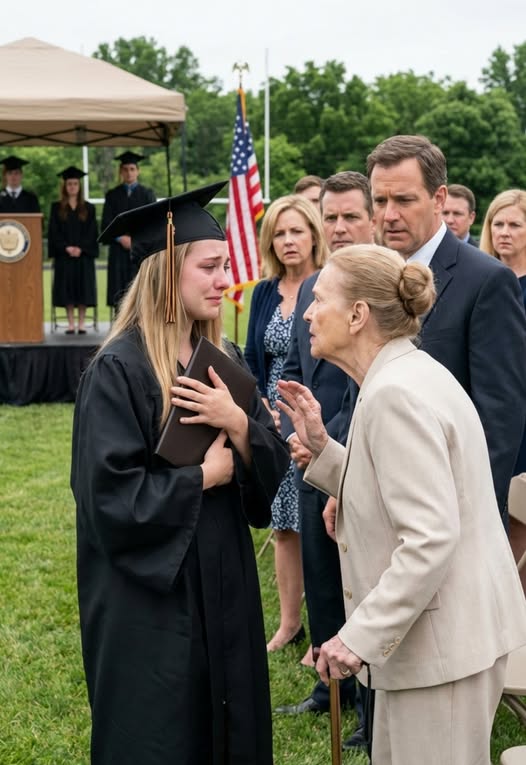
At seventy-eight years old, she carried herself with the quiet authority of someone who had built a commercial real estate empire from nothing but instinct and grit. Her silver hair was styled into a flawless chignon, and her cream-colored suit looked effortlessly expensive, the kind of outfit that did not need to prove its value because everyone could already see it.
She moved through the crowd with a polished cane that functioned more as a symbol than a necessity, and people instinctively made room for her without being asked.
When she finally reached the seat my father had saved, she looked up and caught my eye, then gave me a quick wink that somehow cut through the noise and chaos around me.
That small gesture carried me through the endless procession of names, the forced applause, and the slow shuffle toward the stage.
When they finally called my name, “Olivia Hartwell,” I heard her voice rise above the crowd, loud and proud.
“That’s my granddaughter!”
People nearby laughed softly, some turning toward her with amused smiles, while I felt a strange mix of embarrassment and warmth settle in my chest.
The ceremony ended with the traditional tossing of caps, but I held mine tightly, already thinking about the deposit I would get back if I returned it undamaged.
My parents had reminded me more than once that graduation was expensive enough without throwing away forty dollars for a moment of celebration.
I found them near the refreshment tent, where my grandmother had already gathered a small audience of distant relatives I barely recognized.
She pulled me into a hug that smelled faintly of expensive perfume and peppermint.
“My brilliant granddaughter,” she announced with pride that filled the space around her. “Bachelor of Business Administration, summa cum laude. I always knew you had it in you.”
My mother, Diane Hartwell, stood nearby with a tight smile that never quite reached her eyes. She wore a floral dress I had seen at multiple family events, styled exactly the same way every single time.
My father, Leonard Hartwell, nodded along beside her, adjusting a suit that fit just a little too tightly across his shoulders.
“We should take photos while the lighting is still good,” my mother said quickly, already pulling out her phone.
We posed in different combinations while other families did the same around us, capturing moments that were supposed to represent pride and accomplishment.
My grandmother insisted on several pictures with just the two of us, her arm wrapped around my waist as if anchoring me in place.
“Now tell me everything,” she said once the photos were done. “What are your plans after this, Olivia?”
I launched into the speech I had rehearsed countless times, explaining how I had interviews lined up with several hospitality companies, how I hoped to start in hotel management and work my way up toward regional leadership.
She listened carefully, asking sharp questions about market growth, expansion strategies, and long term scalability.
“And financially,” she asked, her pale blue eyes narrowing slightly. “How are you managing during this transition period?”
“I’m okay,” I replied, though it was not entirely true. “I found a shared apartment in Austin, and I’ve been keeping my expenses low until I start working.”
She tilted her head slightly, a small crease forming on her forehead.
“But surely you have been using your trust fund,” she said casually. “That is exactly what it is for.”
Everything inside me went still.
“I’m sorry,” I said slowly. “My what?”
“Your trust fund, darling,” she repeated, as if it were the most obvious thing in the world. “The one I established for you when you were born. Three million dollars, if I recall correctly.”
The world around me seemed to blur.
My mother’s face turned pale instantly, and my father suddenly found something very interesting on the ground.
“Grandmother,” I said carefully, trying to steady my voice. “I have no idea what you’re talking about.”
She did not look at me.
Instead, she turned her gaze toward my parents, and the warmth in her expression disappeared completely.
“Diane,” she said sharply. “Leonard. Explain this.”
My mother opened her mouth, then closed it again without speaking.
“Perhaps we should discuss this privately,” she said weakly.
“No,” my grandmother replied, her voice cutting through the air like a blade. “We will discuss it right here. Olivia, you truly know nothing about this money?”
I shook my head.
“I’ve never heard about any trust fund. Not once.”
“You were the sole beneficiary,” she said, her voice growing colder. “Your parents were trustees until you turned twenty-one, and you were supposed to receive full access at that time.”
“That was four years ago,” she added.
My father finally spoke, though his voice sounded strained.
“This isn’t the place for this conversation. We should focus on celebrating today.”
“Then let us celebrate properly,” my grandmother said. “Unless there is a reason we cannot.”
Silence spread around us like a shockwave.
I felt eyes turning toward us, conversations fading into the background.
“The trust fund,” my mother said finally, her voice trembling. “There were complications. Investments that didn’t perform well. Legal fees. Taxes.”
“Three million dollars worth of complications?” my grandmother asked, her tone dangerously calm.
I felt something inside me begin to crack.
“How much is left?” I asked quietly.
Neither of them answered.
“Answer her,” my grandmother commanded.
“There were investments,” my father said carefully. “Some of them didn’t work out. We used part of the money to support you during college.”
“I had student loans,” I said, my voice rising despite myself. “Fifty thousand dollars in student loans.”
“We had to make difficult choices,” my mother insisted.
My grandmother let out a short, humorless laugh.
“I paid for her college,” she said sharply. “That money was supposed to secure her future, not fund your lifestyle.”
I looked at my parents, really looked at them, and suddenly everything made sense.
The renovations, the vacations, the car, the designer handbags.
All of it.
“How much is left?” I repeated.
Still, no answer.
My grandmother stepped forward slightly.
“You will provide a full financial accounting within forty-eight hours,” she said. “Every transaction. Every investment. Every dollar.”
“We were trying to help her,” my father insisted. “We wanted to grow the money.”
“You gambled with it,” my grandmother snapped.
“I want to see everything too,” I said. “All of it.”
My mother’s eyes filled with tears.
“You don’t understand how complicated this is,” she said.
“No,” I replied quietly. “I think I understand perfectly.”
PART 2
My grandmother’s voice softened slightly when she turned back to me, though the steel beneath it remained unmistakable and unyielding.
“Olivia, sweetheart, why don’t you go get yourself something to drink,” she said gently, though her eyes never left my parents. “Your parents and I need to have a very serious conversation.”
“No,” I replied, my voice steady despite the storm inside me. “Whatever this is, it involves me directly, and I am not walking away again.”
She studied me for a long moment, then nodded once with approval that carried both pride and grim understanding.
“You are absolutely right,” she said quietly. “You deserve to hear every word of this.”
She turned back toward them, her posture straightening even further, as if preparing for battle.
“I want a complete accounting of everything,” she said slowly and clearly. “Every transaction, every investment, every withdrawal, and I expect it delivered within forty-eight hours without excuses or delays.”
My mother’s voice trembled as she tried to regain control of the situation that had slipped completely out of her hands.
“You are making this into something much worse than it needs to be,” she said, glancing nervously at the growing number of people watching us.
“I have not even begun to make this worse,” my grandmother replied, her tone dangerously calm. “However, I can assure you that I am fully capable of doing so if necessary.”
My father stepped forward slightly, attempting to reassert authority that no longer existed in that moment.
“We will provide the paperwork,” he said, though his confidence had already crumbled. “But you need to understand that everything we did was for Olivia’s benefit.”
“Explain how spending her inheritance on your lifestyle benefits her,” my grandmother demanded without hesitation.
I looked at them, seeing them clearly for the first time in my life without the filter of trust or assumption.
“How much is left,” I asked again, my voice quieter now but far more dangerous.
My mother began to cry softly, her mascara beginning to run as the truth hovered just beyond her ability to speak it aloud.
“We need to go,” she whispered. “Leonard, please, let’s just go.”
“No one is leaving until I receive your agreement to full disclosure,” my grandmother said, her voice cutting through the tension like a knife through glass.
I felt something inside me settle, not into calm, but into a sharp and focused clarity that replaced the confusion and shock.
“I want to see everything too,” I said. “Every document, every record, every single dollar that was ever touched.”
My father hesitated, then nodded slowly, knowing there was no path left that avoided exposure.
“You will have it,” he said quietly.
I drove back to my apartment in a haze, still wearing my graduation gown as if removing it would somehow make everything that had happened more real and irreversible.
The small fourth floor unit felt emptier than ever, stripped of my former roommates and now filled with a silence that pressed in from every direction.
I sat on the thin mattress that served as my bed and stared at nothing, trying to process the number that kept repeating in my mind.
Three million dollars.
It was not just money.
It was opportunity, freedom, security, and choices that had been quietly taken from me while I lived under the illusion of scarcity.
My phone buzzed repeatedly with messages from my parents, relatives, and people who had already begun to piece together what had happened.
I ignored all of them.
Instead, I opened my laptop and began searching for answers, diving into legal definitions and financial responsibilities that I should have never needed to understand this way.
Trustee obligations.
Fiduciary duty.
Misappropriation of funds.
Each term painted a clearer picture of what had happened, and none of them softened the truth.
This was not just mismanagement.
This was theft.
The realization hit with a force that made my chest tighten and my hands tremble, but instead of collapsing into despair, something else took its place.
Anger.
Cold, focused, and purposeful anger that sharpened my thoughts instead of clouding them.
“They stole from me,” I said aloud to the empty room, needing to hear the words to make them real.
Not just money, but years of possibility and the ability to choose my own path without fear.
I thought about the nights I had skipped meals to save money, the internships I had turned down because they were unpaid, the constant anxiety that had followed me through every decision.
All of it had been unnecessary.
All of it had been a lie.
“I want them to pay,” I whispered, the words forming slowly but with absolute certainty.
Dinner at my grandmother’s house that evening marked the beginning of something entirely different from anything I had ever experienced before.
She did not offer comfort in the traditional sense.
Instead, she offered clarity, strategy, and the kind of support that came from someone who understood both business and betrayal intimately.
Documents covered her dining table, organized with precision that reflected decades of experience managing complex financial systems.
“Look at this,” she said, pointing to a statement dated on my twenty-first birthday. “This was the balance at the moment control transferred to your parents.”
I leaned closer, seeing the number clearly for the first time.
3.2 million dollars.
“Six months later,” she continued, sliding another document forward, “it had already dropped significantly.”
The transactions told a story that was both chaotic and deliberate, filled with large withdrawals labeled with vague descriptions that meant nothing without context.
“What were they thinking,” I asked, though the answer was already beginning to form.
“They were thinking about themselves,” she said without hesitation.
She explained my father’s long standing desire to become something more than what he was, his tendency to chase opportunities that promised quick success without understanding the risks involved.
She explained my mother’s background, her fear of returning to the life she had escaped, and the way that fear had twisted into something destructive.
“They convinced themselves it was family money,” my grandmother said. “And family meant they could justify anything.”
“Can we get it back,” I asked, the question feeling both urgent and hopeless at the same time.
“We will try,” she said. “But you need to prepare yourself for the possibility that most of it is gone.”
The words landed heavily, but they did not break me.
Instead, they solidified something that had already begun forming inside me.
“Then we make them pay anyway,” I said.
She looked at me carefully, then nodded once.
“Yes,” she said. “We do.”
The next forty-eight hours changed everything.
My parents delivered the documents as demanded, and what they revealed was worse than anything I had imagined.
Failed investments.
Risky ventures.
Money poured into ideas that had no foundation beyond hope and ego.
The total remaining balance stood at just over two hundred thousand dollars.
The rest had vanished into a trail of decisions that could not be undone.
“They spent nearly everything,” I said, my voice flat with disbelief.
“They wasted it,” my grandmother corrected. “There is a difference, and it matters.”
I looked at the numbers again, forcing myself to understand every detail, every transaction, every choice that had led to this outcome.
“I want to file suit,” I said finally. “Immediately.”
“And you will,” she replied. “We begin first thing in the morning.”
The lawsuit moved quickly, driven by my grandmother’s resources and the undeniable evidence of wrongdoing.
Assets were frozen.
Records were subpoenaed.
The truth was documented with a precision that left no room for interpretation or defense.
My parents hired an attorney who attempted to frame everything as a misunderstanding, a series of unfortunate mistakes made with good intentions.
But the evidence told a different story.
Every document, every transaction, every decision pointed toward a pattern of behavior that could not be explained away.
They had used the trust fund as their personal financial safety net, supporting a lifestyle they could not afford while hiding the truth from me.
“This is not going to end well for them,” my grandmother said during one of our strategy sessions.
“It is not supposed to,” I replied.
The turning point came from an unexpected source.
My aunt, Melissa Carter, reached out to me privately, asking to meet and talk about something important that she could no longer ignore.
We met at a quiet café, and she wasted no time getting to the point.
“Your mother has been lying for years,” she said, her voice filled with both anger and regret. “And I have proof.”
She showed me messages, conversations, and admissions that confirmed everything we suspected and more.
“She knew,” I said, staring at the screen.
“She knew,” Melissa confirmed. “And she expected me to lie for her in court.”
That moment removed any remaining hesitation I might have had.
This was no longer just about money.
It was about truth, accountability, and the complete dismantling of a lie that had shaped my entire life.
“We’re going all the way,” I said.
Melissa nodded.
“And I will help you,” she replied.
The case became airtight.
Fraud charges were added.
Settlement negotiations began quickly after that, as my parents realized that the alternative could include criminal consequences they were not prepared to face.
“They want to settle,” my attorney told me.
“On what terms,” I asked.
“Return of remaining funds and structured repayment over time,” she said.
I thought about it carefully, weighing not just the financial implications but the long term consequences.
“We accept,” I said. “But with conditions.”
“What kind of conditions,” she asked.
“They pay back as much as possible with interest, they issue a public apology, and they never contact me again unless I allow it.”
My grandmother raised an eyebrow, but said nothing.
It was not mercy.
It was control.
And I intended to use it fully.
PART 3
The settlement agreement was signed in a sterile conference room that smelled faintly of coffee and polished wood, where my parents sat across from me looking like diminished versions of the people who had once controlled every aspect of my life.
My father avoided my gaze completely while my mother kept dabbing at her eyes, as if tears could somehow rewrite the past or soften the consequences that had finally arrived.
“This agreement resolves all civil claims,” the attorney explained calmly, sliding the final document across the table. “However, the restitution clause remains binding and enforceable under law.”
My father’s hand trembled slightly as he picked up the pen, hesitating for a moment that seemed to stretch far longer than it actually lasted.
“Olivia,” he said quietly, his voice almost unrecognizable. “Are you sure this is what you want?”
I looked at him without any hesitation, feeling nothing except a distant awareness that this was the moment everything became irreversible.
“Yes,” I replied. “This is exactly what I want.”
He signed.
My mother followed immediately after, her signature shaky but complete, sealing a decade of repayment and the public acknowledgment of everything they had done.
“You will receive the remaining funds within seventy-two hours,” their attorney said. “The monthly payments will begin next month according to the agreed schedule.”
I stood up without another word, gathering my documents with a calm that surprised even me.
“Good,” I said simply. “I look forward to it.”
The public apology was posted two days later, written in carefully measured language that tried to balance accountability with self preservation.
“We acknowledge that we mismanaged funds entrusted to us,” the statement read. “We deeply regret the harm caused and are committed to making amends.”
The reaction was immediate and merciless.
Friends who had once admired them distanced themselves rapidly, while extended family members expressed shock that quickly turned into open condemnation.
“How could they do that to their own daughter,” one comment read.
“This is beyond betrayal,” another added.
Their social circle collapsed almost overnight, revealing how fragile their carefully constructed image had always been.
My father’s employer placed him on administrative leave within a week, citing concerns about professional judgment and ethical conduct.
My mother found herself excluded from gatherings she once considered routine, her invitations quietly disappearing without explanation.
“They are losing everything,” my grandmother observed one evening as we reviewed the fallout.
“They already lost it,” I replied calmly. “Now everyone else just sees it.”
But public humiliation was only the beginning.
I started documenting everything, turning my experience into something structured and deliberate, building a narrative that could not be ignored or dismissed.
The blog launched quietly at first, just a few posts outlining what had happened and how I discovered the truth.
Within days, it began gaining traction.
Within weeks, it went viral.
“Financial betrayal within families is more common than people think,” I said during one of my first interviews. “The difference is that most victims never get the chance to fight back.”
Media outlets picked up the story, drawn to the combination of wealth, deception, and calculated retribution.
I told the story the same way every time, calm, precise, and impossible to refute.
“They took my future,” I said during a podcast recording. “So I made sure they lost theirs.”
My father lost his job three months later.
My mother took a receptionist position at a small medical office, earning a fraction of what they had once spent casually without thought.
They sold their house within six months, unable to sustain the mortgage alongside the restitution payments that now defined their financial reality.
“They moved into a small apartment,” my aunt told me during one of our conversations. “It is nothing like what they had before.”
“They built that life on my money,” I replied. “Now they are living on their own.”
My own life moved in the opposite direction.
The job in Austin turned into a rapid ascent through the ranks of hotel management, where my understanding of financial systems and operational efficiency set me apart quickly.
“You see patterns other people miss,” my supervisor told me during my first promotion. “That is a rare skill.”
“I learned the hard way,” I replied.
I invested carefully, using the remaining funds and the monthly payments as a foundation rather than a shortcut.
My grandmother guided me through every decision, teaching me how to evaluate risk properly and how to build something sustainable.
“Wealth is not about speed,” she told me repeatedly. “It is about consistency and discipline.”
“I understand that now,” I said.
Three years later, I had built something that resembled stability, though it carried the weight of everything that had come before.
The blog had transformed into a full business, with courses, consulting services, and speaking engagements that reached audiences across the country.
I stood on stages telling my story, watching people in the audience recognize pieces of their own lives within it.
“You are not alone,” I told them. “And you are not powerless.”
The message resonated.
The business grew.
My investments expanded.
And the monthly payments from my parents continued like clockwork, a steady reminder of the debt they could never truly repay.
But there was still one move left.
One final piece that would complete the structure I had been building since the day everything collapsed.
My grandmother owned a commercial property in the same neighborhood where my parents now lived, housing a small medical practice where my mother worked.
“I want to buy that building,” I told her one afternoon.
She studied me carefully, recognizing the intent behind the request immediately.
“You want to control the environment around them,” she said.
“I want to control the outcome,” I replied.
The purchase was completed through an LLC, structured in a way that ensured my involvement remained invisible.
The renovation project created new opportunities within the practice, including a management position that my mother eventually applied for.
“She has been working harder,” my aunt reported. “She is trying to rebuild something.”
“Good,” I said simply.
When the practice manager called to discuss the promotion, I responded without hesitation.
“If you believe she is qualified, then you should promote her,” I said.
She got the job.
She never knew who made that decision possible.
Every paycheck she earned contributed indirectly to the revenue stream that flowed back to me, creating a cycle that was both ironic and intentional.
Years passed.
My business expanded further.
My investments multiplied.
My grandmother gradually transferred her portfolio to me, ensuring that everything she had built would continue under my control.
“You have done more with less than most people ever manage with everything,” she told me during one of our final conversations.
“I had motivation,” I replied.
“You had strength,” she corrected.
When she passed away, the loss was profound, but her legacy remained intact within everything she had taught me and everything I had built.
At her funeral, my parents stood at the back, silent and distant, no longer central figures in my life but still bound to it through the consequences of their actions.
They did not approach me.
They did not speak.
They simply existed within the same space, diminished and quiet.
The final payment came exactly ten years after the settlement was signed.
I received the notification while reviewing plans for a new development project, barely pausing as I acknowledged its arrival.
“It is done,” I said quietly to myself.
Not with satisfaction.
Not with relief.
But with a simple recognition that the cycle had completed.
Years later, I reflected on everything that had happened, understanding that revenge had shaped me just as much as resilience had.
I had learned that justice does not always come in the form of forgiveness.
Sometimes it comes in the form of structure, consequence, and the deliberate rebuilding of what was taken.
“They thought they were taking from me,” I said during a final interview. “But they were only creating the foundation for what I would become.”
And in the end, that was the truth.
They had destroyed something.
I had built something greater from it.
And that difference defined everything.