‘Break It… Please Break It…’ — The Night a Silent Boy Raised His Cast Against the Truth, and a Nurse Realized the ‘Injury’ Wasn’t Pain but a Hidden Secret That Could Expose a Father, Unbury a Mother, and Shatter a Carefully Built Lie Forever
I have worked as a pediatric emergency nurse for over a decade, long enough to recognize that silence can be louder than screams. Children cry for many reasons—pain, fear, attention—but there is a kind of silence that chills you to the bone, the kind that feels like a child has learned that making a sound might cost them everything. That night, just after midnight, I met that silence again.
The storm outside rattled the hospital windows as the ER buzzed with its usual chaos. Stretchers rolled, monitors beeped, voices overlapped into an indistinct hum. I had just finished triaging a fever case when the curtain to Bay 3 was yanked open with enough force to make heads turn. A man stepped in, carrying a small boy. He introduced himself as Daniel Carter. His appearance was polished—dark coat, neat hair, controlled posture—the kind of man who looked like he belonged in boardrooms, not emergency rooms.
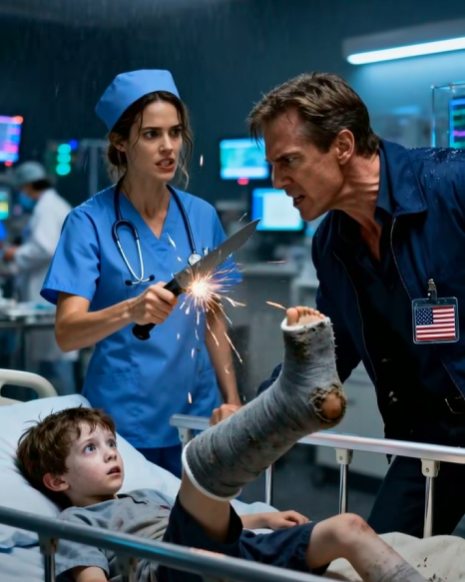
The boy in his arms was named Oliver. He couldn’t have been more than six. His small body seemed swallowed by an oversized hoodie, and his right leg was wrapped in a thick gray cast that stretched from his ankle to his thigh. At first glance, it looked like a routine fracture case. But something about the boy didn’t sit right with me.
“He fell down the back stairs a couple weeks ago,” Daniel explained calmly. Too calmly. “We had it treated at a private clinic. But tonight he’s been… difficult. Complaining, acting out. Says the cast is bothering him.”
Before I could respond, a loud metallic thud echoed through the room.

Oliver had slammed his casted leg against the metal bed rail.
The sound cut through the ER noise like a gunshot.
Then he did it again.
And again.
Each impact was deliberate, forceful, and horrifying.
But what unsettled me most wasn’t the action—it was his face. There were no tears. No screaming. Just clenched teeth, wide eyes, and shallow, controlled breathing. He looked less like a child in pain and more like someone executing a desperate plan.
“Hey, stop that,” Daniel snapped, grabbing the boy’s leg. His grip was tight—too tight. Then he looked at me and smiled, as if switching masks. “You see? He’s throwing a tantrum. Can you give him something to calm down? Maybe something for the itching?”
I stepped closer, placing myself subtly between them. “Hi, Oliver,” I said gently. “I just need to check your leg, okay?”
He didn’t look at me.
His eyes were fixed on one specific spot on the cast.
Then, with sudden urgency, he tried to slam his leg again.
That was when I knew.
Children don’t attack their own broken limbs. Not like that.
This wasn’t a tantrum.
This was intention.
“Sir, I need you to step back,” I said, my tone firmer now.
Daniel hesitated, his eyes narrowing for just a second before he forced another smile. “He’s fine. We’re actually in a bit of a rush.”
“I need to assess circulation,” I replied.
Reluctantly, he let go.
The moment his hands left Oliver, I touched the cast.
It felt wrong.
The surface was uneven, crudely layered, nothing like a professionally done orthopedic cast. As my fingers moved slowly down the length of his leg, I felt it—a hard, unnatural shape beneath the padding.
A small rectangular object.
Hidden.
The instant my hand brushed over it, Oliver froze.
Slowly, he lifted his head and looked directly into my eyes for the first time.
There was no confusion in his gaze. No childish uncertainty.
Only a silent, desperate plea.
He raised his trembling finger and pointed exactly to the spot I had touched.
Then he tapped it. Twice.
My stomach dropped.
He wasn’t trying to scratch an itch.
He was trying to break something.
“I think this cast is too tight,” I said aloud, keeping my voice steady. “I need to remove it immediately.”
Daniel’s expression changed instantly. The calm facade cracked, revealing something sharp and dangerous underneath.
“No,” he said. “We’re leaving.”
“I can’t allow that.”
“You don’t have a choice.”
He reached for Oliver, pulling him off the bed. The boy hit the floor hard, a small gasp escaping his lips—but still, no crying.
Something inside me snapped.
I stepped in front of the exit.
“Security to Bay 3!” I called out.
Within seconds, two guards and the attending physician rushed in.
Daniel froze, calculating. Then, slowly, he raised his hands in surrender.
“Fine,” he muttered. “Do whatever you want.”
I didn’t waste a second.
The cast saw roared to life, its high-pitched whine filling the room. Oliver flinched, but he didn’t pull away. He watched.
Watched like everything depended on it.
Dust filled the air as I cut through the layers.
Then I pried the cast open.
The smell hit first—sweat, infection, neglect.
And then the truth revealed itself.
There was no fracture.
His leg was covered in bruises shaped like fingers.
And embedded into the padding—pressed painfully into his skin—was a small black device.
A transmitter.
Still blinking.
The room erupted into chaos.
Daniel tried to run.
He didn’t get far.
But I barely noticed.
All I could see was Oliver.
All I could feel was the weight of what this meant.
I carefully removed the device and placed it on the tray.
Then I picked up a metal tool.
And smashed it.
The blinking light died instantly.
Silence followed.
A different kind of silence.
Oliver stared at the broken pieces.
Then, slowly, his shoulders relaxed.
For the first time, he exhaled like he had been holding his breath for years.
He reached for me, clutching my uniform tightly.
And then, in a voice so soft it almost didn’t exist, he whispered:
“Can I tell you where she is now?”
My heart stopped.
“Who?” I asked gently.
He pressed his face against me, his voice trembling but clear.
“My mom.”
Outside, the storm raged louder.
But inside that room, something far more dangerous had just begun.
And I knew—whatever came next—there was no going back.
PART 2
The police arrived within minutes, but time seemed to fracture into something slower, heavier, as if the air itself resisted what was about to unfold. Oliver refused to let go of my sleeve, his small fingers gripping the fabric like it was the only thing anchoring him to reality. Detective Laura Hayes, a sharp-eyed woman with a calm but unyielding presence, crouched down in front of him, lowering her voice to something soft and steady. “Oliver,” she said, “I’m here to help you. No one can hear you anymore. That thing is gone.” He didn’t answer right away. His gaze drifted to the shattered remains of the transmitter on the tray, as if confirming for himself that it truly was broken. Then, slowly, he leaned closer to me and whispered again, this time louder, “He put her in the yard… behind the house… under the stones.” The words landed like a thunderclap in the room. Every sound in the ER seemed to fade, replaced by a thick, suffocating silence. Hayes stood up immediately, her expression tightening. Orders were given, radios crackled, and within seconds the case had shifted from suspicion to something far more serious. Daniel Carter was no longer just an aggressive parent—he was now the center of a possible homicide investigation.
But as the officers moved to secure Daniel, he transformed. The composed, articulate man vanished, replaced by something volatile and desperate. He shouted accusations, claimed medical malpractice, insisted I had harmed his son, that the device was planted, that everything was a misunderstanding. His voice grew louder, more frantic, echoing down the hallway, drawing attention from patients, staff, anyone within earshot. And yet, beneath the chaos, there was calculation. I could see it in his eyes. He wasn’t panicking blindly—he was trying to control the narrative, to flood the situation with enough confusion that the truth would drown in it. Meanwhile, hospital administration arrived, faces tense, voices clipped, already worried about liability, about headlines, about reputations. I could feel the pressure shifting toward me. Questions about protocol, about why I had intervened so aggressively, about whether I had overstepped. The old fear crept back in—the one I had buried after past mistakes, after warnings and near-termination. I knew this moment could define the rest of my career. But when I looked down at Oliver, at the bruises, at the silent terror that still clung to him, the doubt hardened into something else. I had already crossed the line. There was no retreat.
Within the hour, we were in the back of a police vehicle, heading toward Daniel’s house on the outskirts of the city. The rain had softened to a steady drizzle, turning the roads slick and reflective, the streetlights stretching into long, distorted lines across the pavement. Oliver sat beside me, unusually still, his small hands folded tightly in his lap. He hadn’t spoken since we left the hospital. Detective Hayes sat in the front passenger seat, glancing back occasionally, as if trying to gauge how much pressure the child could تحمل before breaking. “You’re doing great, Oliver,” she said gently. “Just keep helping us like you did before.” He nodded slightly, but his eyes remained distant. I realized then that this wasn’t just fear—it was conditioning. He had been taught that speaking led to consequences. That truth was dangerous. That silence was survival. And now, for the first time, he was being asked to unlearn all of that in a single night. I reached over and took his hand. “I’m right here,” I whispered. He squeezed back, barely, but it was enough.
The house stood at the end of a quiet street, isolated, almost too perfect in its stillness. A white fence, trimmed hedges, a porch light glowing softly as if nothing in the world was wrong. But the moment we stepped out of the car, something felt off. The air was colder here, heavier. Officers moved quickly, securing the perimeter, their boots crunching against wet gravel. Hayes led us toward the backyard, her flashlight cutting through the darkness. “Where, Oliver?” she asked. He hesitated at the threshold, his body tensing as if crossing an invisible boundary. For a second, I thought he might refuse. But then he stepped forward, slowly, and pointed toward a patch near the edge of the yard, where several large stones were arranged irregularly. “There,” he said, his voice trembling. “He told me not to look… but I saw… I saw her hair.” The words broke something inside me. Hayes signaled to the team immediately. Shovels were brought out, floodlights set up, the quiet backyard transforming into a scene of urgent, controlled chaos. And through it all, Oliver stood beside me, watching.
The digging began cautiously, each movement deliberate, as if the earth itself might protest what was being uncovered. Minutes stretched into an eternity. Mud piled up, the hole deepened, and still—nothing. I felt the tension rising, doubt creeping into the edges of the officers’ expressions. Even Hayes’s posture shifted slightly, her confidence wavering just enough to be noticeable. Behind us, more vehicles arrived—supervisors, additional personnel, the weight of expectation growing heavier with each passing second. And then I heard it—a faint sound, different from the others. The shovel hit something solid, but not stone. The officer paused, brushing away dirt with his hands. The beam of the flashlight focused tighter, sharper. And then… fabric. A dull, faded blue, barely visible beneath layers of soil. Someone whispered, “We’ve got something.” Everything stopped. The world seemed to hold its breath. Oliver gripped my hand so tightly it hurt. I couldn’t look away. Because in that moment, I knew—this wasn’t just the end of a search. It was the beginning of a truth that would change everything, for him, for me, and for everyone who had stepped into this night thinking it was just another case.
PART 3
The moment the first layer of earth was cleared away, the truth rose from the ground with a weight that no one present would ever forget. The blue fabric became clearer, unmistakably part of a dress, tangled with strands of pale, matted hair. No one spoke. Even the officers, trained to face the worst of humanity, moved with a quiet reverence as they carefully expanded the excavation. Oliver buried his face against my side, his small body trembling, but he did not cry. He had already done his grieving in silence long before this night. Detective Hayes removed her hat, her expression hardened but respectful, and signaled for the forensic team to take over. The confirmation came minutes later, clinical and final: an adult female body, consistent with the description of Oliver’s missing mother, Emily Carter. The case that had begun with a “tantrum” in a hospital bed had now unfolded into something undeniable—a hidden crime brought to light by a child who had been forced into silence. And standing there in the cold, watching the officers document the scene, I felt the weight of it settle into my chest. This was no longer just about saving Oliver. It was about justice that had been buried, quite literally, beneath layers of lies.
Back at the station, Daniel Carter’s composure finally cracked for good. The evidence was overwhelming—the falsified medical records, the illegally embedded transmitter, the physical abuse marks on Oliver’s body, and now the discovery of Emily’s remains in his own backyard. During interrogation, he tried one last time to manipulate the situation, spinning stories about accidents, about misunderstandings, about being a misunderstood father trying to “protect his family.” But the narrative fell apart under scrutiny. Piece by piece, the truth emerged: Daniel had been controlling, obsessive, increasingly paranoid that Emily would leave him and take Oliver away. The transmitter hidden in the cast was not just about control—it was about surveillance, about ensuring that Oliver could never reveal what he had witnessed. The night Emily tried to leave, the argument escalated, and in a moment of rage, Daniel had ended her life. What followed was a calculated cover-up—burying her body, isolating Oliver, and creating a prison of fear so complete that the boy believed even his own thoughts were being monitored. When the interrogation finally ended, Daniel sat in silence, his earlier arrogance replaced by something hollow and defeated. Within days, he was formally charged with murder, child abuse, and multiple counts of unlawful surveillance. His fate was sealed long before the trial even began.
For Oliver, the aftermath was quieter, but no less profound. He was placed under protective custody immediately, transferred to a specialized care unit where child psychologists began the long, delicate process of helping him reclaim his voice. At first, he barely spoke. Weeks passed with only whispers, single words, hesitant glances. But slowly, almost imperceptibly, something began to shift. He started asking questions—about his mother, about what would happen next, about whether he was safe. And each time, I was there. Despite the hospital’s warnings, despite the administrative fallout, I visited him whenever I could. Maybe it was unprofessional. Maybe it was reckless. But I couldn’t walk away. Not after everything. One afternoon, nearly a month after that night, he looked at me and said, clearly and without fear, “He can’t hear me anymore, right?” I smiled, though my throat tightened. “No, Oliver,” I told him. “No one is listening unless you want them to.” He nodded, as if confirming a truth he was finally beginning to believe. That was the moment I knew he would survive—not just physically, but emotionally. The silence that had once imprisoned him was beginning to break.
As for me, the consequences came swiftly. The hospital board launched an internal investigation into my actions that night—my decision to override protocol, to block a guardian from leaving, to destroy potential evidence. Technically, they weren’t wrong. I had violated procedures. I had stepped beyond the boundaries of my role. And yet, the outcome complicated everything. The police reports, the testimonies, the undeniable evidence of what had been uncovered—all of it painted a picture that was impossible to ignore. I was suspended temporarily, my license placed under review once again, my future hanging in the balance. But this time, the narrative was different. The same administrators who once saw me as a liability now faced public scrutiny. Media coverage framed the story not as misconduct, but as intervention—as the moment a nurse trusted her instincts and saved a child. Weeks later, the decision came: a formal reprimand, additional training requirements, but no revocation. I kept my license. I kept my career. Not unchanged, not unscarred—but intact. And perhaps more importantly, I kept something else too: the certainty that I had done the right thing, even when it cost me everything.
The trial concluded months later. Daniel Carter was found guilty on all charges, sentenced to life imprisonment without the possibility of parole. There were no dramatic outbursts, no final declarations—just a quiet acceptance of a reality he could no longer control. Emily Carter was laid to rest properly, her story finally acknowledged, her existence no longer reduced to a hidden secret beneath stones. Oliver was placed with a foster family carefully selected for their experience with trauma recovery, a home where patience and kindness replaced fear. Over time, he began to laugh again—softly at first, then freely, the sound of it something so simple yet so extraordinary. As for me, I returned to the ER, the same chaotic, unpredictable environment where it had all begun. But I was not the same person who had walked into that shift. I listened more closely. I trusted the silences more than the noise. Because sometimes, the most important stories are not the ones that are shouted, but the ones that are hidden—waiting for someone willing to hear them. And on quiet nights, when the hospital finally slows and the world seems to pause, I still think about Oliver’s voice, that fragile whisper that changed everything. It reminds me that even in the darkest places, truth has a way of breaking through. All it needs is someone brave enough to listen.