“Dad… My Little Sister Won’t Wake Up. We Haven’t Eaten In Three Days,” A Little Boy Whispered — His Father Rushed Over To Take Them To The Hospital, Only To Discover The Truth About Where Their Mother Had Been
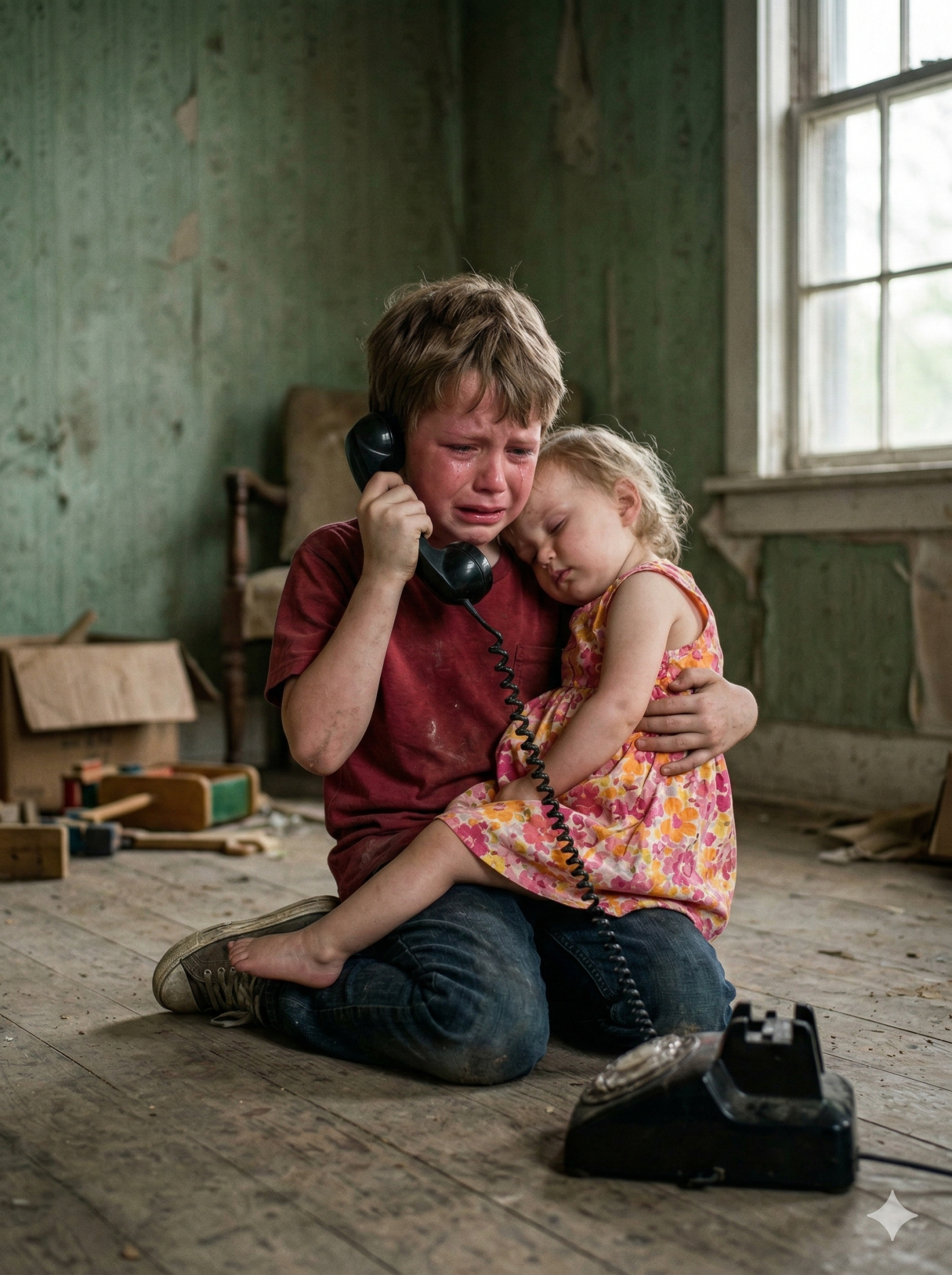
The Call From An Unknown Number
Rowan Mercer had been halfway through a meeting in his Nashville office when his phone lit up with a number he did not recognize, and because he almost let it ring out, assuming it was one more vendor trying to reach him before lunch, he would remember for the rest of his life the strange, ordinary hesitation that came before the moment everything changed.
He answered with a distracted, “Hello?”
For one second there was only static, the faint rustle of movement, and then a little boy’s voice, tight with fear and exhaustion, came through the speaker.
“Dad?”
Rowan was already on his feet before he fully understood what he was hearing. “Micah? Why are you calling me from another phone? What happened?”

The boy sniffed hard, trying to be brave in the way children do when they have already been brave for too long. “Dad, Elsie won’t wake up right. She keeps sleeping and she feels really hot. Mom isn’t here. We don’t have anything left to eat.”
The conference room, the spreadsheets on the screen, the people around the table waiting for him to say something useful, all of it vanished from Rowan’s mind at once. His chair scraped backward so violently that one of his coworkers startled, but Rowan did not explain, did not apologize, did not even grab his jacket. He snatched his keys, his phone, and ran for the elevator while already dialing Delaney.
Straight to voicemail.
He called again.
Voicemail.
Again.
Nothing.
By the time he reached the parking garage beneath his building, his pulse was hammering so hard that his hands shook on the steering wheel. Delaney had told him earlier that week that she was taking the kids to stay at a friend’s lake cabin where service was unreliable, and because they were in the middle of one of their carefully negotiated custody weeks, and because their co-parenting had been tense but manageable for months, he had believed her. Now, as he tore out of downtown traffic and headed toward her rental house in East Nashville, all he could hear was Micah’s thin voice saying they had no food left.
He called Delaney one more time and got the same dead end.
“Come on,” he muttered at the windshield, gripping the wheel so tightly his knuckles blanched. “Come on, Delaney. Pick up.”
She never did.
A House Gone Quiet
He made the drive in less than thirty minutes, blowing through one yellow light and pulling up so fast at the curb that his tires bumped hard against it. The front porch looked wrong before he even got out of the car. No toys. No music from inside. No sign of anyone moving.
He ran to the front door and pounded with both fists.
“Micah, it’s Dad. Open the door.”
There was no answer.
When he tried the knob, the door swung inward.
The silence in the house was so complete that it made his stomach drop. Then he saw Micah sitting on the living room floor with a throw pillow clutched to his chest, his blond hair matted on one side, his cheeks dirty, and his little body carrying that unmistakable, frightening stillness children take on when they have moved past crying and into pure waiting.
Micah looked up and whispered, “I thought maybe you weren’t coming.”
Rowan crossed the room in two strides and dropped to his knees. “I’m here. Where’s your sister?”
Micah pointed toward the couch.
Elsie lay curled beneath a blanket, her face pale and flushed at the same time, her lips dry, her breathing shallow and uneven. Rowan touched her forehead and felt a rush of heat so fierce it made his own chest tighten. He lifted her immediately, and her head fell against his shoulder with too little resistance.
“We’re leaving right now,” he said, forcing calm into his voice for Micah’s sake. “Shoes on. No questions. Stay with me.”
Micah stood so fast he almost stumbled. “Is she sleeping?”
Rowan swallowed. “She’s sick, buddy. We’re going to get help.”
In the kitchen he caught sight of the evidence he would later replay in his mind in cruel detail: an empty cereal box on the counter, a sink full of dishes, one half bottle of ketchup in the refrigerator, no milk, no fruit, no leftovers, nothing a six-year-old could have used to feed himself or his little sister. A child-sized cup sat beside the sink with dried juice stuck to the bottom.
He did not let himself think any further. He carried Elsie out, ushered Micah into the back seat, and drove toward Vanderbilt Children’s Hospital with his hazard lights flashing, one hand on the wheel and the other reaching back every few seconds as if nearness alone could keep both of his children anchored to him.
From the back seat Micah asked, in a voice so small Rowan almost missed it, “Is Mom mad?”
Rowan kept his eyes on the road. “No. Your mom isn’t mad at you. Right now I need you to listen to me, okay? I’ve got you. I’ve got both of you.”
Micah was quiet for a second.
Then he said, “I tried to make Elsie crackers, but she wouldn’t eat.”
Rowan’s throat burned. “You did the right thing by calling me.”
The Bright Lights Of The ER
The emergency room doors slid open, and within seconds a nurse met him with a gurney.
“How old is she?”
“Three,” Rowan answered. “High fever, barely responsive, she hasn’t been eating, and I think they’ve been alone too long.”
The nurse’s expression sharpened at once, but her voice stayed steady. “We’re taking her back now.”
Another nurse crouched near Micah. “Hey there, sweetheart, do you want to stay with your dad while we help your sister?”
Micah grabbed Rowan’s pant leg and nodded without speaking.
Rowan knelt, even as orderlies wheeled Elsie away. “They’re taking care of her. I’m not going anywhere.”
Micah’s eyes filled. “She’s gonna be okay, right?”
Rowan had never made a promise with less certainty and more need behind it. “Yes. She’s going to be okay.”
While doctors worked on Elsie, Rowan gave the registration desk every piece of information he had, then repeated the same story again for a hospital social worker and then for another staff member from pediatric intake. He explained the custody arrangement, Delaney’s message about being away with friends, the unanswered calls, the empty house, the fact that Micah had said this was not the first time she had left them alone, only the first time it had gone on this long.
The social worker, a composed woman with silver glasses and a notepad balanced on her knee, asked, “Do you know where the children’s mother is right now?”
“No,” Rowan said flatly. “I haven’t known since Friday.”
“Are you prepared to take temporary full responsibility while we document this?”
“I’m prepared to do whatever keeps them safe.”
The doctor returned after what felt like a lifetime packed into forty minutes. Elsie had an IV in her arm and color beginning to creep back into her face.
“She’s stable,” the doctor said. “She’s severely dehydrated and has a stomach infection that became much harder on her because she hadn’t been eating properly. We’re keeping her for observation, but you got her here in time.”
Rowan closed his eyes for one second and let out a breath he had not realized he was holding.
Micah looked up at him immediately. “Can I see her?”
The doctor smiled gently. “Soon. She’s resting now, but she’s in good hands.”
Rowan put his hand on the back of his son’s neck and realized Micah was still trembling.
What Happened To Delaney
Two hours later, after Micah had finally eaten crackers, applesauce, and half a turkey sandwich with the stunned concentration of a child remembering hunger, a nurse approached Rowan with a different kind of careful expression.
“Mr. Mercer, another hospital contacted us after we requested information for family notification. Your former partner was admitted to Nashville General very early Saturday morning after a serious car accident.”
Rowan stared at her. “An accident?”
“She came in without identification. She was unconscious and with an adult male who left the scene before staff could get full information. She’s stable now, but she had a head injury and multiple fractures. She’s been sedated.”
Rowan leaned back in his chair and scrubbed a hand over his face. Anger rose first, hot and immediate, because the children had been abandoned. Then, beneath it, came something messier and more reluctant, because Delaney had clearly not walked away from that house expecting to disappear for days. But whatever sympathy existed did not erase what had happened.
He stepped into the hallway and called his attorney, Avery Kline.
“Avery, I need emergency action on custody,” Rowan said the moment she picked up. “The kids were left alone for days. My daughter is in the hospital. Social services are already involved.”
Avery did not waste time. “Send me every report you get. We’ll file first thing in the morning.”
When Rowan returned to Elsie’s room, Micah was sitting beside the bed in a chair too large for him, watching his sister sleep with the grave, exhausted attention of someone who felt responsible for keeping the world from collapsing again.
“Dad?” he asked. “Can I stay with you all the time now?”
Rowan crouched beside him. “Starting now, you stay with me as much as you need.”
The Weight A Child Should Never Carry
They spent that night in the hospital. Micah eventually fell asleep on a foldout chair under a thin blanket, and Rowan sat between his children, listening to the rhythm of Elsie’s IV drip and the muffled sounds of nurses trading shifts just outside the door.
In the morning a pediatric therapist from the hospital met with him.
She spoke quietly, but there was no softness in the truth of what she was saying. “Your son took on far too much responsibility. He did something incredibly brave, but it also means he is likely carrying fear that does not belong to a child. Your daughter is likely to cling to him because he became her source of safety. We need to begin support now, not later.”
Rowan nodded, absorbing every word like instructions for survival. “Tell me what they need.”
“Routine. Predictability. Calm. Honest explanations without adult details. No promises you can’t keep.”
That part landed hardest, because until that moment Rowan had thought love would be enough if he only gave enough of it, fast enough. Now he understood that love had to look like breakfast on time, bedtime stories, laundry folded, medicine measured, and sitting on the floor at two in the morning when a six-year-old woke up crying.
When Elsie opened her eyes later that afternoon, weak and confused but clearly present, Micah burst into tears for the first time since Rowan had arrived at the house.
He climbed carefully onto the edge of the bed and whispered, “I missed you.”
Elsie reached for him with a tired little hand. “I was sleepy.”
Rowan smoothed both their hair back and said, “You’re both safe now.”
The Visit Across Town
The next day, after arranging for a trusted neighbor to sit with the children for two hours, Rowan drove to Nashville General to see Delaney.
She was sitting up in bed when he entered, her left arm in a cast, bruising along her cheekbone, hair tied back in a careless knot that made her look younger and more defeated than he remembered. For a long moment she did not meet his eyes.
Rowan stood at the foot of the bed.
“The kids are alive,” he said, and the sharpness in his own voice surprised him.
Delaney closed her eyes briefly. “I know.”
“What happened?”
Her answer came slowly, as if she had to drag each piece of it up through shame. She had gone out with a man she had been seeing, expecting to be gone only a few hours, she said. She had been overwhelmed, exhausted, desperate to feel like a person instead of a machine running on work and childcare and loneliness. Then there had been drinking, an argument in the car, a wreck, darkness, and after that nothing until she woke in the hospital.
When Rowan said, “You left a six-year-old and a three-year-old alone with almost no food,” there was nothing dramatic in his tone. That was what made it harsher.
Tears slid down Delaney’s face, but he did not step closer.
“I know,” she whispered. “I know what I did.”
“Micah thought his sister might not make it through the night.”
Delaney covered her mouth with her good hand and bent forward.
Rowan let a long silence sit between them before he spoke again. “I’m filing for full temporary custody.”
She looked up, broken and exhausted. “Are you taking them away from me forever?”
He shook his head once. “I’m protecting them. What happens after that depends on what you do next.”
To her credit, she did not argue. She did not accuse. She did not reach for easy excuses. She only asked, after another long silence, “How are they?”
“Elsie is recovering. Micah saved her by calling me.”
That sentence seemed to crush whatever was left of Delaney’s defenses. She cried quietly, without theatrics, and Rowan understood then that remorse was real even when it came too late to prevent harm.
Before he left, she said, “I’m starting therapy. I already asked.”
He rested one hand on the doorframe. “Good. Keep going.”
Learning A New Shape Of Family
The first weeks at Rowan’s house were rough in ways he had never fully imagined. Micah woke from sleep calling for both parents at once. Elsie refused to be in a room alone, even for a minute, and shadowed her brother so closely that Rowan sometimes found them both standing outside the bathroom door waiting for each other. Rowan burned grilled cheese twice, shrank two sweaters in the wash, forgot a permission slip, and learned that a child can ask the same fearful question in ten different ways before bed.
But he stayed.
He packed lunches, sat through therapy sessions, left work early, turned down evening events, and began to build days sturdy enough for his children to lean against. Somewhere inside that exhausting routine he discovered that fatherhood, when stripped of every performance and reduced to what mattered, was not grand at all. It was repetitive, humble, and holy in its own way.
Delaney, meanwhile, followed every requirement given to her. She attended therapy, cooperated with the court, found a small apartment of her own, ended contact with the man from the accident, and began supervised family visits at a county center with a therapist present.
At first the visits were painfully awkward.
Micah stood close but reserved. Elsie hid behind him and studied Delaney as if trying to decide whether she was real. Delaney did not force hugs or beg for forgiveness. She read books, colored quietly, brought old family photos, and showed up every single time.
That mattered.
Children notice consistency the way flowers notice light.
The Hearing
By early summer, the family court hearing arrived.
Rowan wore a navy suit and carried a file full of medical records, therapy notes, and social worker reports. Delaney sat across from him in a simple cream blouse, looking healthier than she had in months, though still cautious, as if she knew one wrong step could undo everything she had struggled to repair.
The judge reviewed the reports and listened to both attorneys. Delaney’s counsel emphasized her progress, her treatment compliance, her housing, her sobriety, her commitment. Rowan’s attorney detailed the original neglect and the children’s trauma but also acknowledged the visible improvement in supervised reunification.
When the judge asked Rowan directly for his position, he stood and answered without embellishment.
“My children need safety first. They also love their mother. If the professionals believe gradual contact is healthy, I won’t stand in the way of that. I just need the pace to match what the kids can handle.”
The judge nodded. A temporary plan was approved: continued primary placement with Rowan, progressive visitation with Delaney, close therapeutic oversight, and a review in three months.
Delaney turned to Rowan in the hallway afterward and said quietly, “Thank you for not making this uglier.”
He looked past her toward the waiting room where Micah sat drawing beside Elsie.
“This was never about winning.”
Two Houses, One Promise
The changes came slowly, which was exactly why they lasted.
Saturday visits became weekday dinners. Weekday dinners became afternoons at Delaney’s apartment with a therapist checking in. Delaney’s apartment was modest but warm, with a reading corner she made for Elsie and a shelf of card games Micah loved. She learned how to move gently, how to listen more than explain, how to let trust return on the children’s timeline rather than her own.
One evening, after a supervised visit at her place, Micah asked Rowan in the car, “Can Mom come to my school play if I want both of you there?”
Rowan glanced at him in the rearview mirror. “Of course she can.”
Another night, Elsie climbed into Rowan’s lap with a drawing of two little houses joined by a rainbow.
“This is us,” she announced. “We live in two places, but we go together.”
Rowan looked at the picture for a long time before saying, “Yeah, sweetheart. We do.”
Months later, at the final review hearing, the judge invited Micah and Elsie to speak for themselves in the simple, careful way family courts sometimes allow when children have been well prepared.
Micah said, “I like it when nobody fights and everybody tells the truth.”
Elsie handed over another drawing, this one showing four figures holding hands in a park beneath a huge yellow sun.
The judge smiled, signed the revised shared custody order, and said, “It seems to me that this family has worked very hard to learn a better way forward.”
Outside the courthouse, the afternoon air was bright and almost cool for early fall. Micah immediately asked for ice cream. Elsie wanted sprinkles. Rowan and Delaney exchanged the kind of look that held history, fatigue, humility, and something steadier than affection.
Not romance.
Not restoration of the old life.
Something more honest.
Partnership in its plainest, hardest form.
They walked to the corner shop together, their children running a little ahead of them, and for the first time Rowan realized that the goal had never been to rebuild what had broken exactly as it was before. The goal had been to build something safer, truer, and strong enough to hold all four of them without pretending the past had not happened.
Later that night, after the children were asleep and the quiet of his house had become ordinary rather than frightening, Rowan stood in the hallway looking at two bedroom doors left slightly open. He thought about that unknown number lighting up his phone, about the empty kitchen, the hospital bracelets, the court forms, the therapy rooms, the small brave choices repeated week after week until they began to look like healing.
He had nearly lost the shape of his family.
Instead, through terror, consequence, humility, and work, they had found a new one.
And although it was not perfect, although it would probably never be easy, it was finally real.