Everyone Whispered About the ‘Reaper’ in the Coffee Shop — Until a Battered Child Chose Him for Safety and Exposed What the Smile Behind the Counter Was Hiding.
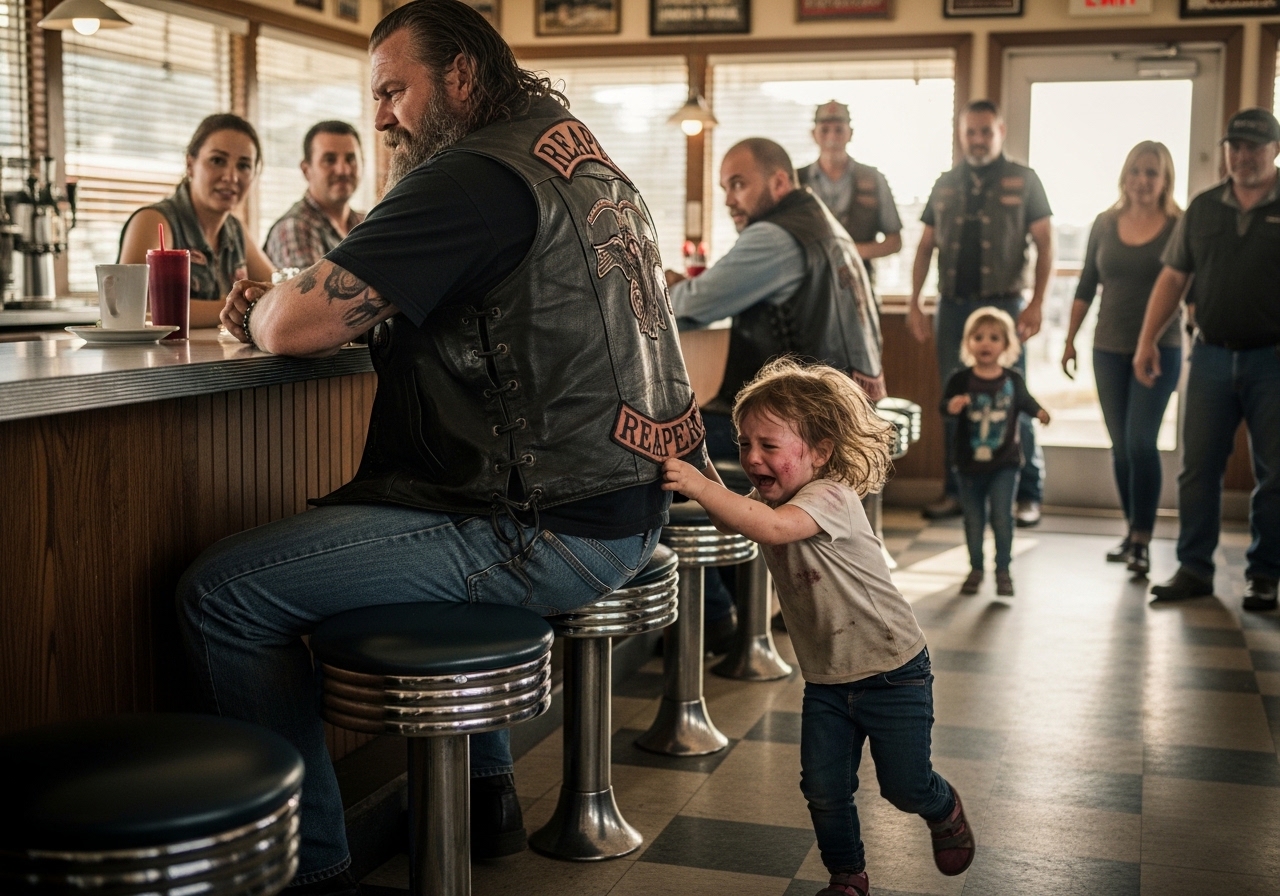
CHAPTER 1: The Reaper in the Room
The bell above the door of Peggy’s All-American Diner didn’t just chime; it announced an invasion.
When Silas Vance stepped through the threshold, the conversation didn’t taper off—it was severed. It was the kind of silence that felt heavy, loaded with judgment and that specific brand of small-town fear that acts like it’s better than you.
Silas was used to it. He was six-foot-five of pure, road-hardened muscle, wrapped in a leather cut that hadn’t seen a cleaner in a decade. The bottom rocker on his back read NOMAD, and the center patch was a grinning skull that most polite folks only saw in their nightmares. He smelled like high-octane gasoline, stale tobacco, and the miles he’d put between himself and his past.
He didn’t look at the patrons. He didn’t need to. He knew exactly who was sitting in those red vinyl booths.

To his left, a couple in their Sunday best. The husband tightened his grip on his coffee mug, shifting his body slightly to shield his wife, as if Silas was going to snatch her purse just for sport.
To his right, three local cops taking a lunch break. Their hands didn’t move to their holsters, but their eyes did. Hard stares. Assessing the threat level. Calculating if he was worth the paperwork.
Silas ignored them all. He walked to the counter, his heavy engineer boots thudding against the checkered linoleum floor like a death march. He took the stool at the far end, away from the families, away from the law.
“Coffee. Black,” Silas rumbled. His voice sounded like gravel grinding in a cement mixer.
The waitress, a woman named Brenda according to her nametag, hesitated. She was pretty in a faded, tired way, with too much blue eyeshadow and a smile that didn’t reach her eyes. She wiped her hands on her apron, eyeing the tattoos creeping up Silas’s neck.
“Just coffee, hon?” she asked, her voice pitched an octave too high. Fake nice. The kind of nice people use when they’re talking to a wild animal they hope won’t bite.
“Just coffee,” Silas confirmed, staring at the napkin dispenser.
He could feel the eyes boring into his back. Trash. Thug. Criminal. He could hear their thoughts louder than the sizzling bacon on the grill. They saw the leather, the beard, the grime, and they wrote his story for him. They didn’t know he was a veteran. They didn’t know he spent his weekends rebuilding houses for vets who’d lost their way. They just saw the Reaper on his back and assumed he was the devil.
That was the thing about America these days. People liked to think class was about money. It wasn’t. It was about optics. You could be the most corrupt soul in the county, but if you wore a suit and went to church, you were a pillar of the community. You could be a saint, but if you rode a Harley and didn’t shave, you were garbage.
Brenda slid the mug across the counter. Coffee sloshed over the rim. She didn’t apologize.
“Five bucks,” she said.
Silas raised an eyebrow. The menu on the wall said two-fifty. He didn’t argue. He just pulled a crumpled five-dollar bill from his pocket and slapped it on the counter. The “Asshole Tax.” He paid it in every town.
He lifted the mug, blowing away the steam, just wanting five minutes of peace before he got back on the interstate. He was tired. His bones ached.
CRASH.
The front door didn’t open; it exploded inward.
The silence in the diner shattered instantly, replaced by a collective gasp. Silas didn’t flinch, but he shifted his gaze to the mirror behind the counter.
A child.
A little girl, maybe five or six years old. She was wearing a dirty pink dress that was two sizes too big. Her hair was a matted bird’s nest of blonde tangles. But it was her skin that made Silas’s stomach clench.
She was covered in dirt, yes. But beneath the grime, purple and yellow bruises bloomed on her bare arms like sick flowers. There was a fresh cut on her cheek, oozing red.
She was hyperventilating, her chest heaving so hard it looked like her ribs might snap. Her eyes—wide, blue, and terrified—darted around the room like a trapped animal.
The diner froze.
The cops in the corner booth started to stand up, their instincts kicking in. “Hey there, sweetheart,” one of the officers started, putting on his ‘friendly policeman’ voice. “Are you okay?”
The mother in the Sunday-best booth gasped, “Oh my god, look at her face.”
The little girl didn’t look at the cop. She didn’t look at the mother. She didn’t look at Brenda, the waitress.
Her eyes locked onto Silas.
For a second, Silas thought she was looking at him with fear. He was the scariest thing in the room, after all. A monster. A giant.
But then, she moved.
She didn’t run to the police. She didn’t run to the nice lady in the dress.
She sprinted. A dead sprint, her little sneakers squeaking on the linoleum. She bolted past the booths, past the staring faces, past the judgment.
She slammed into Silas.
It hit him with the force of a freight train, not physically, but emotionally. She scrambled up onto the stool next to him and practically dove into his lap. She buried her face into his leather vest, her tiny hands clutching the rough material so hard her knuckles turned white. She curled into a ball, shaking violently, trying to make herself disappear inside his shadow.
The diner went dead silent again. But this time, the silence wasn’t judgmental. It was confused.
Why would a terrified child run to the monster?
Silas sat frozen for a heartbeat, his coffee cup suspended halfway to his mouth. He slowly set it down. He looked down at the trembling bundle of pink and dirt in his lap. He could smell her—fear, sweat, and something chemical, like chloroform or antiseptic.
Slowly, carefully, Silas raised one of his massive hands. It hovered over her head for a second, then gently, ever so gently, landed on her hair.
“Easy, little bit,” he rumbled, his voice dropping to a register that was almost a purr. “I gotcha.”
“Hey!”
The shriek came from behind the counter. Brenda, the waitress.
Brenda came rushing out from behind the register, her face flushed. But Silas, who had spent a lifetime reading people in high-stakes situations, noticed something the others didn’t.
She wasn’t worried. She was panicked. And not the ‘concerned adult’ kind of panic. The ‘caught with a hand in the cookie jar’ kind.
“Get away from him, Lily!” Brenda shouted, rushing toward them. She reached out, her fingers hooked like claws, aiming for the girl’s arm.
The girl—Lily—let out a whimper that broke Silas’s heart in two. She shrank further into Silas’s chest, shaking her head against his leather. “No, no, no,” she sobbed, her voice muffled.
Silas moved.
It was a subtle shift, but it was enough. He rotated his torso, putting his massive shoulder between Brenda and the child. Brenda’s hand grabbed empty air.
“Excuse me,” Brenda snapped, her ‘nice waitress’ mask slipping. Her eyes were hard, darting toward the kitchen door, then back to the cops. “Sir, you need to let go of her. She’s my niece. She’s… she’s having an episode. She’s autistic. She doesn’t know what she’s doing.”
The explanation was smooth. Too smooth. It was the kind of lie people practiced in the mirror.
The cop stood up fully now, hitching up his belt. He walked over, his hand resting casually on his handcuffs. He looked at Silas, his eyes cold.
“You heard the lady, son,” the cop said, his voice carrying the weight of authority. “Hand the girl over. We don’t want any trouble here.”
The dynamic in the room shifted instantly. The ‘Good Citizens’ aligned against the ‘Bad Biker.’
“Look at him,” the woman in the booth whispered loudly. “He’s probably hurting her.”
“Disgusting,” her husband muttered. “Coming into a family place like this.”
Brenda seized the momentum. She put on a tearful face, looking at the cop. “Officer, she ran out of the back. She’s been hurting herself all morning. Look at those bruises! I was trying to get her to the doctor and she just bolted. And now she’s… she’s with him.” She said ‘him’ like it was a slur.
She reached for the girl again. “Come here, baby. Come to Auntie Brenda. That man is dirty. He’s bad.”
Lily screamed. A raw, piercing sound of pure terror. “HE’S NOT BAD! YOU ARE!”
The room wavered.
Silas felt the girl’s heart hammering against his chest like a trapped bird. He looked down at her. She lifted her head, just an inch. Her tear-streaked eyes met his. In that split second, a silent communication passed between them. The kind that only happens between two people who have seen the darkness of the world.
She wasn’t crazy. She wasn’t having an episode. She was escaping.
Silas looked up. He looked at the cop, who was now unsnapping his holster. He looked at the patrons, sneering in their self-righteousness. And finally, he looked at Brenda.
He saw the sweat beading on her upper lip. He saw the scratch marks on her forearms that she tried to hide with her sleeves. He saw the way she kept glancing at the back exit.
Silas stood up.
He rose to his full height, eclipsing the light from the window. He lifted Lily effortlessly with one arm, holding her high against his shoulder like she weighed nothing, shielding her completely.
“Sit down, Brenda,” Silas said. His voice wasn’t a rumble anymore. It was a command.
“Excuse me?” Brenda stepped back, shocked by the authority in his tone. “Officer! He’s kidnapping her!”
The cop stepped forward, hand on his gun. “Sir! Put the child down on the counter. Now! Or I will drop you.”
“You might want to check her pockets before you draw that weapon, Deputy,” Silas said, his eyes never leaving Brenda’s face.
“What?” The cop paused.
“The girl,” Silas said. “Check her pockets. Or better yet, check the trunk of the Honda Civic parked out back with the engine running. The one Brenda here has the keys to in her apron.”
Brenda’s face went paper-white. “He’s crazy! He’s on drugs! Look at him! He’s a biker!”
“I am a biker,” Silas agreed, his voice cutting through the diner like a blade. “I’m also a father who lost a daughter ten years ago. And I know what a terrified kid looks like.”
He took a step toward Brenda. She scrambled back, hitting the pie display case.
“And I know what a seller looks like,” Silas growled.
The room gasped. The word hung in the air. Seller.
“She didn’t run to me because she likes leather, Officer,” Silas said, turning his gaze to the cop. “She ran to me because when I pulled into the lot five minutes ago, I saw this woman talking to a guy in a cargo van behind the dumpster. I saw money change hands.”
Silas gently patted the girl’s back.
“She ran to me,” Silas continued, his voice dropping to a dangerous whisper, “because five minutes ago, outside that window, this woman told the guy in the van: ‘Wait ten minutes, then come in the back. I’ll have her ready.’”
Silas looked at the waitress, whose knees were shaking.
“She ran to the ‘Grim Reaper’,” Silas said, pointing to the patch on his chest, “because she knew the Devil was wearing a pink uniform and serving coffee.”
CHAPTER 2: The Wolf in Shepherd’s Clothing
The word “Seller” didn’t just hang in the air; it sucked the oxygen right out of the room. It was an ugly word. A dirty word. The kind of accusation that, in a polite society, was worse than a physical slap.
For a heartbeat, the only sound in Peggy’s All-American Diner was the hum of the refrigerator unit and the soft, terrified whimpering of the girl—Lily—buried against Silas Vance’s chest.
Then, Brenda exploded.
“You liar!” she shrieked, her voice cracking into a register that grated against Silas’s eardrums like broken glass. She slapped her hands against the counter, sending the napkin dispenser skittering. “You dirty, lying psychopath! Officer Miller, are you hearing this? He’s crazy! He’s trying to take my niece!”
Deputy Miller, the older cop with the salt-and-pepper mustache and a gut that strained against his uniform, didn’t look at Brenda. He looked at Silas. And in Miller’s eyes, Silas saw the familiar wall coming down. The wall of prejudice.
To Miller, the equation was simple. On one side, a local waitress who’d poured his coffee for five years. A woman he saw at the grocery store. A woman who looked like them. On the other side, a stranger. A giant. A man wearing a cut that screamed ‘outlaw,’ with knuckles scarred from a thousand fights and eyes that looked like they’d seen hell and decided to stay there.
Bias is a funny thing. It doesn’t need evidence. It just needs a feeling. And Silas Vance made people feel unsafe.
“Sir,” Miller said, his voice hardening. He unclipped the retention strap on his holster. The click was loud in the silence. “I’m not gonna ask you again. Put the child down. Step away from the counter. Hands where I can see ‘em.”
“She’s shaking, Miller,” Silas said, his voice low and steady, a rumble of thunder against the high-pitched panic of the room. He didn’t move. He didn’t raise his hands. He kept one massive palm cupped protectively over the back of Lily’s head, shielding her eyes from the scene. “Feel her. She’s vibrating like a tuning fork. You really think she’s scared of me?”
“I think she’s scared of the man holding her hostage,” Miller barked, stepping forward. The two younger cops flanked him, hands hovering over their Tasers.
“He’s got a knife!” the woman in the Sunday dress screamed suddenly from her booth. “I saw something shine! He’s got a knife!”
Silas closed his eyes for a second. Of course. It was a spoon on the counter reflecting the sun, but in their minds, he was already armed and dangerous. The narrative was writing itself.
“I don’t have a knife,” Silas said calmly. “And I’m not a hostage taker. I’m a witness.”
“You’re a disturbin’ the peace is what you are,” Miller countered. “Now, last chance. Put. Her. Down.”
Silas looked down at Lily. She was clinging to his t-shirt so hard he could feel her fingernails digging into his skin through the cotton. “Don’t let me go,” she whispered. It was barely a breath. “Please. The Bad Man is coming.”
The Bad Man.
Silas looked up, locking eyes with Miller. “Did you check the van, Deputy? The black Ford Econoline behind the dumpster? No plates on the front. Mud on the back ones.”
“I ain’t checkin’ no van based on the word of a drifter,” Miller spat.
“He’s right outside,” Silas pressed, his urgency leaking through his calm facade. “Brenda knows him. Ask her his name.”
Silas turned his gaze to Brenda. The waitress was trembling, but not from fear—from adrenaline. She was cornered, and cornered animals bite.
“I don’t know what he’s talking about!” Brenda cried, tears streaming down her face now. A masterful performance. “There’s nobody! He’s hallucinating! He’s probably high on meth! Look at his eyes! Just shoot him, Miller! Before he hurts her!”
Shoot him.
The escalation was text-book. Dehumanize the target. Escalate the threat. Justify the force. Silas had seen it in war zones, and he was seeing it now in a diner in rural Ohio.
“Get on your knees!” Miller shouted, drawing his weapon. The Glock 17 leveled at Silas’s chest. The black bore looked infinite.
The patrons screamed and scrambled under their tables. The air smelled of burnt coffee and impending violence.
Silas didn’t kneel. If he knelt, he lost leverage. If he knelt, they took Lily. If they took Lily, she disappeared into a van, and ten years from now, she’d be a statistic on a poster that nobody looked at.
“I can’t do that, Deputy,” Silas said softly.
“I will fire!” Miller warned, his hands shaking slightly.
“Then you better not miss,” Silas said, “because if you hit this kid, her blood is on your soul, not mine.”
It was a standoff. A stalemate of perception.
And then, the bell above the door chimed again.
Ding-ding.
The sound was cheerful, absurdly normal given the tension in the room.
“What is going on here?” a voice boomed.
Every head turned.
Standing in the doorway was a man. He was the antithesis of Silas. He was wearing a beige cashmere sweater, dark slacks, and polished loafers. He was clean-shaven, handsome in a bland, corporate way, with glasses perched on a straight nose. He looked like a youth pastor, or maybe a successful real estate agent. He radiated respectability.
Brenda’s eyes widened. A flash of relief, then terror, then calculation crossed her face.
“Daddy!” Brenda yelled. “Oh thank God! He’s got her! He’s got Lily!”
The man—let’s call him The Suit—blinked, assessing the room in a microsecond. He saw the gun. He saw the biker. He saw the girl.
He didn’t panic. He didn’t scream. He put on a face of heartbroken concern.
“Lily?” The Suit called out, his voice trembling with practiced emotion. “Oh my god. Officer, please! That’s my daughter! Is she okay? What is that man doing to her?”
The dynamic in the room shifted so violently it was almost palpable. The doubt that had been creeping into Deputy Miller’s mind vanished. Here was the father. The respectable, well-dressed, clearly frantic father.
“Sir, step back,” Miller said to The Suit, but his tone was respectful. “We’re handling it.”
“Handling it? He has my child!” The Suit took a step forward, hands out imploringly. “Please. I just turned my back for a second at the gas station down the road. She ran off… she has these fits… oh god, Lily, come to Daddy.”
Silas felt Lily go rigid against him. It wasn’t the stiffness of fear; it was the stiffness of death. She stopped breathing.
“She doesn’t know you,” Silas said. His voice was no longer a rumble. It was a growl. A predator recognizing another predator.
Silas saw what the others didn’t. He saw the way The Suit’s eyes didn’t look at Lily’s face to see if she was okay; they checked her wrists and ankles, checking for damage to the merchandise. He saw the faint outline of a concealed carry holster under the cashmere sweater—at the small of the back, professional style, not the sloppy hip-carry of a civilian permit holder.
“Excuse me?” The Suit looked at Silas with a mix of disgust and confusion. “I’m her father. Who are you? Some kind of… gang member?”
“He snatched her up when she came in!” the woman in the booth chimed in again, eager to be part of the hero’s story. “The poor girl was running to the waitress and this… this beast grabbed her!”
“You hear that, scumbag?” Miller shouted, emboldened. “The dad is here. The gig is up. Let the girl go to her father.”
Silas looked at The Suit. “If you’re her father,” Silas said, his voice cutting through the noise, “what’s her middle name?”
The Suit paused. Just for a fraction of a second. “It’s Marie,” he said smoothly. “Lily Marie.”
“Wrong,” Silas lied. He didn’t know her name. But he knew a liar when he heard one. “And what’s the scar on her shoulder from?”
“She fell off a swing,” The Suit shot back instantly. “Look, Officer, I don’t have to answer trivia questions from a criminal holding my daughter hostage. I want him arrested! I want my daughter back!”
“You heard him!” Miller advanced. “Last warning!”
Silas looked down at the top of Lily’s head. “Lily,” he whispered, so low only she could hear. “Is this your daddy?”
The girl was shaking so hard her teeth chattered. She turned her face into his chest, pressing her eyes tight shut. “No,” she whimpered. “That’s the Buying Man. He hurts. He hurts bad.”
The Buying Man.
Rage, pure and white-hot, flooded Silas’s veins. It was the kind of rage that had kept him alive in the sandbox overseas. The kind that made time slow down.
He looked at the room. The cop with the gun. The waitress with the lies. The townspeople with their prejudice. And The Suit—the monster in human skin standing by the door, blocking the exit.
Silas realized then that truth didn’t matter here. Evidence didn’t matter. Not to these people. Not right now. They saw a monster and a savior, and they had the roles reversed.
If he handed her over, she was gone.
“Okay,” Silas said loudly. “Okay. Everyone calm down.”
He slowly started to stand up from the stool.
“Stay seated!” Miller yelled.
“I’m just standing up to hand her over, Deputy,” Silas lied. He rose to his full height, six-foot-five of looming threat. He kept Lily clamped to his left side, his right hand free.
“Bring her here,” The Suit said, holding out his arms. A cruel, triumphant glint sparked in his eyes behind the glasses. “Come here, sweetie.”
Silas took a step. Not toward the cop. Toward The Suit.
“You know,” Silas said, his voice conversational, masking the coiled tension in his muscles. “It’s funny.”
“What’s funny?” Miller asked, gun still trained on Silas’s back.
“How a father,” Silas took another step, closing the distance to ten feet, “parked a cargo van behind a diner instead of the family SUV out front.”
The Suit’s smile faltered.
“And it’s funny,” Silas continued, five feet away now, “how a father smells like industrial cleaner and latex gloves instead of Old Spice.”
Silas was close now. Too close for The Suit’s comfort. The Suit reached into his waistband, his pretense dropping.
“Back off!” The Suit snarled.
“And it’s really funny,” Silas said, his voice dropping to a terrifying whisper, “how you think you’re walking out of here with her.”
The Suit drew his gun. A compact SIG Sauer.
But he was fast in the way a firing range target shooter is fast. Silas was fast in the way a man who has wrestled death in the mud is fast.
Before The Suit could level the weapon, Silas moved. It was a blur of motion—violent, efficient, and brutal.
With his right hand—the size of a dinner plate—Silas slapped the gun barrel down and to the side. CRACK. The gun discharged into the floor, blowing a hole in the linoleum.
The diner erupted in screams.
Silas didn’t stop. He stepped in, using his momentum to drive his elbow into The Suit’s solar plexus. The man folded like a lawn chair, the air rushing out of him in a wheezing gasp.
Silas grabbed The Suit by the collar of his expensive cashmere sweater and hurled him. Not pushed—hurled. The man flew backward, crashing into the table where the judgmental couple sat. Coffee cups and silverware went flying. The Suit hit the ground hard, groaning.
“He’s shooting!” Miller screamed, diving behind the counter. “Shots fired! Shots fired!”
“He didn’t shoot!” Silas roared, turning back to the cop, Lily still tucked securely under his left arm. “That was his gun! The ‘Daddy’ just pulled a piece on an unarmed man!”
Silas kicked the SIG Sauer across the floor, sliding it under the jukebox.
“Look at him!” Silas pointed at the groaning man on the floor. “Look at his ankle!”
The force of the fall had pulled The Suit’s pant leg up. There, strapped to his ankle, wasn’t a sock garter. It was a knife sheath. And protruding from his pocket was a roll of duct tape.
“Who brings duct tape to lunch with their daughter?” Silas yelled at the room. “Wake up!”
The room was in chaos. The couple was scrambling away from The Suit. Brenda was trying to crawl out the back door.
“Miller!” Silas barked, his voice commanding the chaos. “Stop the waitress! If she gets out that door, this girl disappears!”
Miller poked his head up from behind the counter, looking from Silas to the groaning man, to the duct tape, to the fleeing waitress. Confusion warred with training.
“Brenda?” Miller called out.
Brenda froze at the kitchen door, her hand on the swing latch. She looked back, her face a mask of twisted hate.
“You idiots!” she screamed. “You stupid, hillbilly idiots! He was paying twenty grand! Twenty grand!”
The confession hung in the air, clearer than any evidence.
The Suit, groaning on the floor, suddenly scrambled to his feet. He wasn’t done. He pulled the knife from his ankle sheath—a wicked, serrated blade. His glasses were gone, his eyes wild.
“Give me the girl,” The Suit hissed, lunging at Silas. “Now!”
Silas didn’t retreat. He looked at the knife, then at the man holding it. He smirked. A cold, terrifying smirk that belonged to the Reaper on his back.
“Big mistake,” Silas whispered.
He set Lily down on the counter, putting his big body between her and the blade. “Cover your eyes, little bit. Count to ten.”
Lily covered her eyes.
Silas cracked his knuckles.
“Let’s dance.”
CHAPTER 3: Blood on the Linoleum
“One…” Lily whispered, her tiny hands pressed tight over her eyes.
The air in the diner didn’t just shift; it tore open.
The man in the cashmere sweater—The Suit—didn’t fight like a desperate father. He didn’t swing wildly like a drunk at a bar. He moved with the terrifying, silent precision of a man who had killed for a living long before he started trading children for profit.
He lunged.
The serrated blade, a wicked six inches of matte black steel, slashed through the air where Silas’s throat had been a fraction of a second before. The sound was a sharp hiss, like a viper striking.
Silas didn’t back up. That was the mistake most people made in a knife fight—they tried to create distance. But distance was a lie when you were six-foot-five and in a narrow diner aisle. Distance just gave the other guy room to aim.
Silas stepped in.
He absorbed the second slash on his left forearm. The leather of his cut—thick, road-worn cowhide—took the brunt of it, but the blade bit through, slicing into the skin beneath. A line of hot pain seared up Silas’s arm.
“He’s cutting him!” the woman in the booth screamed, clutching her pearls. Her husband, the man who had looked at Silas with such disdain earlier, was now cowering under the table, using a laminated menu as a shield.
Silas ignored the pain. He ignored the scream. He focused on the wrist.
The Suit feinted low, aiming for the gut, then snapped the knife up toward Silas’s face. It was a move designed to disembowel or blind. A professional move.
Silas caught the wrist mid-air.
It sounded like a gunshot—meat slapping against meat. Silas’s grip, forged by decades of turning wrenches and gripping handlebars, clamped down on The Suit’s wrist like a hydraulic press.
The Suit’s eyes widened. For the first time, the veneer of the civilized businessman cracked, revealing the panicked animal underneath. He tried to yank his hand back. He couldn’t.
“You like hurting kids?” Silas growled, his face inches from The Suit’s. “You like making them scared?”
“Let go!” The Suit spat, lashing out with his free hand, driving a fist into Silas’s jaw.
Silas didn’t even blink. He took the punch like it was a lover’s caress.
“My turn,” Silas whispered.
He twisted.
There was a sickening crunch—the sound of wet celery snapping. The Suit screamed, a high, undulating sound that didn’t belong in a man’s throat. His wrist was bent at a ninety-degree angle that nature never intended. The knife clattered to the floor, sliding through a puddle of spilled coffee.
But Silas wasn’t done. The rage in him was a cold, dark ocean, and the tide was coming in. This wasn’t just about the knife. It was about Lily. It was about the bruises on her arms. It was about the way she had counted to ten because she was used to hiding from monsters.
Silas head-butted him.
It was a brutal, ugly move. Forehead to nose. Cartilage exploded. Blood sprayed across the pristine beige cashmere sweater, turning it a ruined crimson.
The Suit stumbled back, blinded, choking on his own blood. He crashed into the counter, knocking over a display of fruit pies. Cherry filling and glass shattered everywhere, mixing with the blood on the floor.
“Stop it! Stop it!” Brenda was screaming from the kitchen doorway, her voice hysterical. “You’re killing him! He’s a businessman! He’s a respected man!”
Silas turned to look at her, his face smeared with The Suit’s blood. He looked like a demon rising from the pit.
“He’s a peddler,” Silas said, his voice flat. “And you’re the storefront.”
“Six…” Lily whispered from the counter, her voice trembling. She hadn’t looked. She was still counting.
Deputy Miller, who had been frozen in a state of cognitive dissonance behind the counter, finally seemed to reboot. He looked at the shattered man on the floor. He looked at the knife. He looked at the duct tape. And he looked at Silas—the man he had been ready to shoot two minutes ago—standing guard over the little girl.
“Brenda,” Miller said, his voice shaking but gaining strength. “Brenda, step away from the door.”
“You don’t understand!” Brenda wailed, her eyes darting frantically to the back exit. “I have debt! They said it would be easy! Just a hand-off! Nobody was supposed to get hurt!”
“Nobody except the kid, right?” Silas shot back.
“She’s a nobody!” Brenda shrieked, her mask falling away completely, revealing the ugly desperation of a woman who had sold her soul for a quick payout. “She’s a foster kid! Nobody wants her! The system threw her away! Why shouldn’t I get paid for cleaning up the trash?”
The silence that followed was absolute.
Even the cowering husband under the table stopped breathing. The mother in the booth looked at Brenda with horror, her hands covering her mouth.
“Trash,” Silas repeated.
He walked over to where Lily sat. He gently placed a hand on her back. “You can stop counting, little bit. Seven is enough.”
Lily lowered her hands. She looked at the blood on the floor. She looked at the man groaning in the pile of cherry pie and glass. She didn’t cry. She just looked at Silas.
“Did you win?” she asked softly.
“We’re winning,” Silas corrected.
“Officer!” The Suit gasped from the floor, trying to push himself up. His nose was flattened, his eyes swelling shut. “Arrest him! Assault! Battery! I’ll sue this entire town into the ground! Do you know who I am?”
“Yeah,” Miller said. He walked out from behind the counter. He didn’t holster his gun. He kept it low, but his eyes were clear now. “I know who you are.”
Miller walked past Silas. He walked past the terrified patrons. He stopped in front of The Suit.
“You’re the guy with the knife,” Miller said. “And the duct tape.”
“I was defending myself!” The Suit gargled blood.
“Shut up,” Miller said. He looked at Silas. “You said there’s a van?”
“Black Econoline. Back alley. No front plates,” Silas said. “Engine running.”
“Stay here,” Miller ordered Silas. It wasn’t a threat anymore. It was a request. “Watch the girl. Don’t let Brenda leave.”
“She ain’t going nowhere,” Silas promised.
Miller moved toward the kitchen door, stepping over the debris. He keyed his radio. “Dispatch, this is Unit 4. I have a 10-10 in progress at Peggy’s. Possible kidnapping ring. Need backup. ASAP. Ambulance and… hell, send everybody.”
Miller pushed through the swinging kitchen doors.
Silas turned his attention back to the room. The patrons were starting to emerge from their hiding spots. The fear of him was gone, replaced by a sort of awe mixed with shame. They realized, slowly, painfully, that they had been rooting for the villain because he dressed like them, and fearing the hero because he didn’t.
“Here,” the woman in the booth said. She stood up, her legs shaky. She grabbed a napkin and walked toward Silas. “Your arm. You’re bleeding.”
Silas looked at his arm. The blood was dripping onto his boots.
“It’s fine,” he grunted.
“It’s not fine,” the woman said. She was trembling, but she reached out and pressed the napkin to his wound. “Thank you. For… for what you did. We thought…”
“I know what you thought,” Silas said gently. He didn’t pull away.
“Is she okay?” the woman asked, looking at Lily.
“She will be,” Silas said.
Suddenly, a massive crash echoed from the kitchen.
Then a gunshot.
BOOM.
Not a handgun. That was the deep, thunderous roar of a shotgun.
Then silence.
“Miller?” Silas shouted.
No answer.
Brenda, who had been cowering by the soda machine, suddenly lit up. A sick, twisted smile spread across her face.
“He’s here,” she whispered. “You think The Suit works alone? You think this is a one-man operation? You idiot.”
The kitchen doors swung open slowly.
It wasn’t Miller who walked out.
It was a man the size of a vending machine. He wore tactical gear—vest, knee pads, combat boots. His face was covered by a balaclava. In his hands was a sawed-off Remington 870 shotgun.
And he was dragging Deputy Miller by the collar of his uniform. Miller was limp, a streak of blood on his forehead where he’d been pistol-whipped (or shotgun-whipped).
The gunman threw Miller onto the floor like a sack of garbage. The deputy groaned, barely conscious.
The gunman racked the slide of the shotgun. CH-CHK.
The sound was the universal language of death.
“Nobody moves,” the gunman said. His voice was muffled by the mask, but it was calm. Professional. “Nobody screams. Or I turn this diner into a slaughterhouse.”
He looked at The Suit, who was still trying to crawl away.
“Get up, Vance,” the gunman said to The Suit. “You’re embarrassing the organization.”
Then he looked at Silas.
The gunman’s eyes narrowed behind the mask. He assessed Silas—the size, the cut, the blood.
“Biker,” the gunman said. “Step away from the product.”
Silas stood in front of Lily. He was unarmed. His arm was wounded. There was a shotgun pointed at his chest from twenty feet away. The deputy was down. The patrons were helpless.
“Product has a name,” Silas said.
“Don’t care,” the gunman said. “You have three seconds to move, or I blow a hole through you and take her anyway.”
“One,” the gunman counted.
Silas looked around. No weapons. Just coffee cups and silverware.
“Two.”
Silas felt a small hand slip into his back pocket. Lily.
“Three.”
“Duck!” Silas roared.
He didn’t dive away. He grabbed the heavy metal napkin dispenser from the counter and hurled it with the force of a major league pitcher.
At the same instant, the gunman pulled the trigger.
BOOM.
The buckshot shredded the pie display case next to Silas, showering him and Lily in glass and pastry.
The napkin dispenser hit the gunman square in the chest, staggering him but not stopping him. He racked the slide again. CH-CHK.
“Bad move,” the gunman growled.
He raised the shotgun again.
But then, a low, mechanical rumble started outside. It grew louder. And louder.
It wasn’t a police siren.
It was the sound of thunder.
Fifty engines. V-twins screaming in unison.
The sound vibrated the windows. It shook the coffee in the mugs. It drowned out the hum of the refrigerator.
The gunman paused, glancing at the front window.
Through the plate glass, the parking lot was suddenly filling up. Not with police cars.
With motorcycles.
Dozens of them. Harleys, Indians, choppers. Big, loud, American iron.
They swarmed the lot like a colony of angry hornets. Riders in leather cuts were hopping off their bikes before the kickstands were even down. Some held tire irons. Some held chain locks. Some just held massive fists.
Silas grinned. It was a bloody, broken grin.
He looked at the gunman.
“You should have checked my patch,” Silas said.
The gunman looked at Silas’s chest. He saw the ‘Reaper’ patch. But then he looked closer at the small patch over the heart.
PRESIDENT.
“I didn’t come alone either,” Silas said.
The front door of the diner burst open.
It wasn’t a polite entry. A boot kicked the door so hard the glass shattered.
A man stepped in. He was almost as big as Silas, with a grey beard braided down to his chest and a crowbar in his hand.
“Yo, Prez,” the newcomer said, looking at the gunman, the shotgun, and the wreckage. “We heard you were having lunch. Thought we’d join you.”
Behind him, twenty more bikers filled the entrance, blocking out the sun. They looked like a Viking horde transported to the 21st century.
The gunman with the shotgun took a step back. He looked at his weapon (one shell left). He looked at the twenty angry men with blunt objects.
“Drop it,” the grey-bearded biker said, tapping the crowbar against his palm. “Or we feed it to you.”
The gunman hesitated.
“Do it,” Silas said softly. “Please. Give them a reason.”
CHAPTER 4: The Judgment of the Road
The tension in Peggy’s All-American Diner wasn’t just thick; it was solid enough to choke on. On one side, a lone gunman in tactical gear, clutching a sawed-off Remington 870 with white-knuckled desperation. On the other, the entrance was blocked by a wall of leather, denim, and bearded fury.
The Reapers had arrived.
Silas Vance stood in the middle of the storm, his left arm dripping blood onto the checkered floor, his massive frame shielding the little girl, Lily. He didn’t look at the gunman anymore. He looked at his brothers.
“Prez,” the grey-bearded giant at the front—Tiny, the club’s Sergeant at Arms—nodded at Silas. He tapped the crowbar against his open palm again. Clack. Clack. “We got a pest problem?”
The gunman, whose tactical discipline was quickly eroding in the face of twenty angry bikers, made a fatal miscalculation. He assumed fear worked the same on everyone. He assumed that waving a boomstick made you the alpha.
“Back off!” the gunman screamed, swinging the barrel toward Tiny. “I’ll drop every one of you!”
Tiny didn’t flinch. He just smiled, revealing a missing incisor. “Son, you got one shell left. There’s twenty of us. Do the math.”
“I’ll kill him!” the gunman yelled, swinging the gun back toward Silas.
“Wrong answer,” Silas said calmly.
In the fraction of a second it took for the gunman to pivot, the diner exploded into motion. It wasn’t the cinematic, choreographed fighting of a movie. It was the brutal, chaotic violence of a barroom brawl.
A beer bottle, thrown with pinpoint accuracy by a biker named Grease in the back, sailed over the booths and shattered against the gunman’s tactical helmet. It didn’t knock him out, but it rang his bell. The shotgun wavered.
That was all the opening Tiny needed.
He didn’t swing the crowbar. He threw it. The heavy steel bar cartwheeled through the air and struck the gunman’s wrist with a sickening crack. The shotgun clattered to the floor, sliding under a table.
“Get him!” Tiny roared.
The floodgates opened. Five bikers surged forward, leaping over tables and sliding across the linoleum. The gunman, trained in military tactics but unprepared for the sheer ferocity of a motorcycle club protecting its own, tried to draw a sidearm. He never got the chance.
Grease tackled him around the waist, driving him into the pie counter. Glass shattered. Cream filling exploded. Then three more Reapers piled on. Fists flew. Boots stomped. It was ugly, efficient, and over in ten seconds.
The gunman was dragged out from the pile, his tactical mask ripped off, revealing a young, terrified face—bloodied and bruised. He was zip-tied with his own restraints before he could catch his breath.
“Secure him,” Silas ordered, his voice cutting through the noise. “Don’t kill him. We need names.”
“Got it, Prez,” Tiny grunted, hauling the man up by his vest.
Silas turned immediately. His eyes scanned the room. The Suit—the “father”—was gone.
“Where is he?” Silas barked.
The woman in the booth—the one who had handed him the napkin, the one who had screamed about the knife—pointed a trembling finger toward the kitchen. “He… he ran through the swinging doors! With the waitress!”
Silas cursed. “Tiny, watch the girl. Don’t let anyone near her. Not even the cops unless I say so.”
“She’s safe as houses, boss,” Tiny said, stepping in front of Lily. He looked down at the terrified little girl and softened his expression. “Hey there, munchkin. You like Harleys?”
Lily, wide-eyed, looked at the giant bearded man, then at Silas. Silas nodded. She stayed put.
Silas sprinted. He hit the kitchen doors with his shoulder, bursting into the chaotic back-of-house.
The kitchen was empty of staff—the cook had likely bailed the moment the shotgun came out. Steam hissed from a pot of boiling water. A fryer alarm was beeping incessantly.
The back door was swinging shut.
Silas didn’t slow down. He kicked the back door open and burst into the alleyway behind the diner.
The bright sunlight blinded him for a second. The smell of rotting garbage and exhaust fumes filled his nose.
There, twenty yards away, The Suit was shoving Brenda toward the black Ford Econoline van. The engine was idling with a low, ominous rumble.
“Get in!” The Suit was screaming, panic stripping away his refined accent. “Get in the damn van, you stupid cow!”
“My money!” Brenda was sobbing, clutching her apron. “You said twenty grand! I’m not leaving without it!”
“You’re leaving with your life!” The Suit shoved her hard. She stumbled, hitting her head against the door frame, and scrambled into the passenger seat.
The Suit ran around to the driver’s side. He yanked the door open.
Silas was fast, but he was twenty yards away. The distance was too great.
He saw a heavy metal trash can lid lying against the dumpster.
Silas didn’t think. He acted. He scooped up the lid like a discus thrower and launched it. It wasn’t an elegant throw, but it had the weight of righteous fury behind it.
The lid sailed through the air, rotating like a jagged frisbee.
The Suit was halfway into the driver’s seat when the lid smashed into the side mirror of the van, shattering it and careening into his shoulder.
The Suit yelped, stumbling but not falling. He dove into the seat and slammed the door.
“No, you don’t,” Silas growled.
He sprinted the last ten yards as the van’s tires squealed, rubber burning against the asphalt. The van lurched forward.
Silas leaped.
He didn’t go for the door handle—it would be locked. He went for the running board.
His boots found purchase on the metal step. His left hand—the wounded one—grabbed the side mirror bracket. His right hand smashed through the driver’s side window.
Glass shattered inward. The Suit screamed as safety glass sprayed his face.
“Pull over!” Silas roared, the wind whipping his beard.
“Get off!” The Suit shrieked, swerving the van violently to the left, trying to scrape Silas off against the brick wall of the diner.
Silas saw the wall coming. Red brick rushing toward him at thirty miles an hour.
He didn’t let go. He pulled himself tight against the door, lifting his leg just as the van scraped the wall. SCREEEEEECH. Sparks flew. Metal groaned. The side of the van crumpled, pinning Silas’s leg, but the leather of his chaps held.
The pain was blinding, but Silas channeled it. He reached through the broken window, his hand searching blindly. He found hair.
He grabbed a fistful of The Suit’s expensive haircut and yanked his head back against the headrest.
“Stop. The. Van.”
The Suit, blinded by pain and panic, slammed on the brakes.
The van skidded, fishtailing on the gravel of the alley, and came to a violent halt inches from a telephone pole.
Silas was thrown forward by the momentum, rolling off the running board and hitting the ground hard. He groaned, the breath knocked out of him. His wounded arm throbbed like it was on fire. His leg felt like it had been through a meat grinder.
The driver’s door flew open. The Suit fell out, coughing, bleeding from a dozen glass cuts. He tried to crawl away.
Silas forced himself up. He wasn’t a young man anymore. His knees popped. His back seized. But the adrenaline—and the image of Lily’s bruised arms—pushed him forward.
He walked over to The Suit. He didn’t run. He stalked.
The Suit rolled onto his back, looking up at the towering biker. The arrogance was gone. The superiority was gone. There was only the primal fear of prey looking at a predator.
“Please,” The Suit whimpered, holding up his hands. “I have money. I have… I have accounts. Cayman Islands. Crypto. I can give you half a million. Right now.”
Silas stopped. He looked down at the man. He spat a glob of blood onto the asphalt next to The Suit’s head.
“You think this is about money?” Silas asked, his voice dangerously quiet.
“Everyone has a price,” The Suit desperate. “Everyone! You’re a biker! You need cash! I can set you up for life!”
Silas reached down, grabbed The Suit by the throat, and lifted him off the ground. He slammed him against the side of the van.
“My price,” Silas whispered, leaning in close, “is seeing men like you rot.”
He didn’t hit him. He didn’t need to. The Suit was broken.
“The back,” Silas said. “Open it.”
“There’s nothing in there,” The Suit choked out. “Just supplies.”
“Open it.”
Silas dragged The Suit to the rear doors. Brenda was still in the passenger seat, sobbing, too terrified to move.
Silas forced The Suit’s trembling hand to the latch. The doors swung open.
The smell hit them first.
It wasn’t supplies. It was the smell of unwashed bodies, stale urine, and fear.
The van was modified. The cargo area had been stripped and fitted with dog cages. Three of them.
Two were empty.
One was not.
Huddled in the far corner of the largest cage, wrapped in a filthy blanket, was a boy. Maybe seven years old. He didn’t move. He didn’t make a sound. He just stared at the open doors with hollow, dead eyes.
Silas felt his heart stop.
He looked at The Suit. The rage that filled him now was beyond physical. It was spiritual. It was the wrath of God.
“Supplies?” Silas asked.
The Suit didn’t answer. He just squeezed his eyes shut, waiting for the blow.
But Silas didn’t strike. He dropped The Suit to the ground like a sack of dirt.
“Don’t move,” Silas commanded.
He climbed into the van. The boy flinched, curling tighter into a ball.
“Hey, buddy,” Silas said, his voice instantly changing. The growl was gone, replaced by that soft, rumbling purr he had used with Lily. “It’s okay. I’m not gonna hurt you. I’m getting you out.”
The boy didn’t speak. He just pointed a trembling finger at the cage lock.
Silas didn’t have the key. He didn’t need it.
He grabbed the padlock. He grabbed the bars of the cage. He braced his boots against the floor. He pulled.
Veins popped in his neck. His biceps tore against the sleeves of his shirt. The metal groaned.
With a roar that echoed down the alley, Silas ripped the hinge of the cage door straight out of the frame.
He reached in and scooped the boy up. The kid was light. Too light. Bones and skin.
Silas carried him out of the van, stepping over The Suit, who was now weeping on the ground.
As Silas stepped back into the sunlight, sirens finally wailed in the distance. The real police. State Troopers. The cavalry that always arrives ten minutes late.
He walked back toward the kitchen door, carrying the boy.
Tiny was waiting at the door, holding Lily’s hand. The little girl looked up, saw the boy in Silas’s arms, and her eyes widened.
“Tommy?” she whispered.
The boy in Silas’s arms lifted his head. “Lily?”
They knew each other. Siblings? Or just fellow prisoners in the same hell?
Silas looked at Tiny. The big biker’s face was grim, a single tear tracking through the dirt on his cheek.
“Call the cops, Tiny,” Silas said, his voice heavy with exhaustion. “Tell ’em we got two.”
“Already here, Prez,” Tiny said, nodding toward the street.
Blue and red lights flashed against the brick walls. Doors slammed. Voices shouted.
Deputy Miller stumbled out the back door, holding a handkerchief to his bleeding head. He looked at Silas. He looked at the boy. He looked at The Suit on the ground.
Miller didn’t say a word. He walked over to The Suit, pulled his handcuffs out, and ratcheted them onto The Suit’s wrists so tight the man yelped.
“You have the right to remain silent,” Miller said, his voice thick with concussion and anger. “But I really hope you keep talking so I can add another charge.”
Miller looked up at Silas. The animosity was gone. The prejudice was gone.
“You okay, Vance?” Miller asked.
“I’ve been better,” Silas grunted, shifting the boy’s weight.
“That arm needs stitches,” Miller noted.
“I’ll superglue it later,” Silas said.
“Vance,” Miller said, pausing. “Thank you.”
Silas didn’t smile. “Don’t thank me, Miller. Just do your job next time. Don’t look at the patch. Look at the person.”
Miller nodded, shame coloring his cheeks. “I will.”
Silas walked back into the kitchen, then into the diner.
The scene inside was surreal. The patrons—the “good citizens”—were helping the bikers. The woman in the Sunday dress was pouring water for Grease, who was wiping blood off his knuckles. Her husband was helping right a tipped-over table.
When Silas walked in carrying the second child, the room went silent again.
But this silence was different. It wasn’t judgmental. It was reverent.
Lily ran to Silas, wrapping her arms around his leg. The boy, Tommy, looked down at her and managed a weak smile.
“Is the Bad Man gone?” Lily asked.
Silas looked out the window where the troopers were hauling The Suit and Brenda into the back of a cruiser.
“Yeah, little bit,” Silas said. “The Bad Man is gone.”
“Are you the Good Man?” the boy asked, his voice raspy.
Silas looked at his reflection in the pie case. Blood on his face. Tattoos on his neck. Skull on his chest.
“No,” Silas said honestly. “I’m not a good man. I’ve done a lot of bad things.”
He looked at the crowd. At the people who had judged him.
“But I’m the man who stopped him,” Silas said. “And sometimes, that’s enough.”
The woman in the booth walked up to him. She had tears in her eyes. She reached out and touched the “Reaper” patch on his chest.
“You’re an angel,” she whispered. “A dark angel, maybe. But an angel.”
Silas snorted. “Lady, don’t let the church folks hear you say that.”
“I don’t care,” she said fiercely. “You saved them. We… we just watched.”
“That’s the problem with the world,” Silas said, his voice loud enough for the room to hear. “Too many watchers. Not enough doers.”
He set the boy down on a booth seat next to Lily.
“Tiny,” Silas called out.
“Yo.”
“Get the bikes ready. We escort the ambulance to the hospital. Nobody touches these kids until they’re signed over to Child Protective Services. And make sure it’s a social worker we trust. Call Sarah.”
“On it,” Tiny said.
Silas sat down heavily on a stool. The adrenaline was fading, and the pain was rushing in like a tidal wave. He needed a cigarette. He needed a drink.
But then he felt a small hand on his knee.
Lily was standing there. She reached into her pocket—the one he had told the cop to check.
She pulled out a crumpled, dirty sticker. It was a gold star. The kind teachers give out for good behavior.
“For you,” she said, pressing it onto his leather chaps, right next to a grease stain.
Silas Vance, the President of the Reapers MC, a man who had stared down guns and knives and war, felt a lump form in his throat the size of a baseball.
He touched the gold star.
“Thanks, kid,” he choked out.
“It’s because you were brave,” she said.
Silas looked at the star. Then he looked at the flashing lights outside.
The battle was over. But the war? The war against men like The Suit? That never ended.
And as he looked at the ledger Miller was bringing in from the van—a thick black book full of names and dates—Silas knew this ride wasn’t over.
It was just beginning.
CHAPTER 5: The Devil in the Details
The adrenaline crash was beginning to set in. It’s a specific kind of exhaustion that hits you only after the violence stops—a chemical hangover that leaves your hands shaking and your vision swimming at the edges.
Silas Vance sat on the back bumper of the ambulance, a lit cigarette dangling from his lips, watching the EMTs check Lily and Tommy. The smoke curled up into the humid Ohio afternoon, mixing with the smell of diesel and antiseptic.
Deputy Miller walked over, holding the black ledger in a plastic evidence bag. He looked like he’d aged ten years in the last hour. His uniform was torn, his forehead bandaged where the gunman had pistol-whipped him, and his eyes were wide with a terror that had nothing to do with physical pain.
“Vance,” Miller said, his voice dropping to a conspiratorial whisper. “You need to see this.”
Silas didn’t look at the book. He looked at Miller. “I don’t read other people’s mail, Deputy. That’s your job.”
“This isn’t mail,” Miller hissed, stepping closer to block the line of sight from the gathered State Troopers. “This is a guest list.”
Silas took a drag, blowing the smoke away from the open ambulance doors. “For what?”
“For the auction,” Miller said. The word hung heavy in the air. “There are names in here, Vance. Local names. People who sit in the front pew at First Baptist. People who run the zoning board. A judge.”
Silas felt a cold knot form in his stomach. He snatched the bag from Miller, ignoring the protocol. He flipped the book open.
It wasn’t just a list of names. It was a catalog. Dates. Payments. Descriptions of “assets”—children—labeled by age, hair color, and… compliance level.
And next to the entry for ‘Boy, 7, Caucasian, Non-Verbal’—Tommy—was a name that made Silas’s blood turn to ice.
Councilman Sterling.
“Sterling,” Silas muttered. “The guy running for State Senate on a ‘Family Values’ platform?”
“The very same,” Miller said, looking over his shoulder nervously. “If this gets out…”
“If this gets out?” Silas laughed, a harsh, barking sound. “Miller, this is getting out if I have to nail every page to the courthouse door myself.”
“You don’t understand,” Miller said, sweat beading on his upper lip. “These people… they own the town. They own the precinct. Hell, half the troopers standing over there probably had their campaigns funded by Sterling’s PAC.”
Silas looked at the State Troopers. They were professional, efficient, securing the scene. But now, through the lens of that ledger, they looked different. Who knew? Who was on the payroll? Who was just following orders that came from a poisoned well?
“They aren’t safe here,” Silas said, standing up abruptly. He tossed the cigarette to the ground and crushed it with his boot.
“The ambulance is taking them to St. Jude’s Medical,” Miller said. “It’s standard protocol.”
“Standard protocol is what got them in that van,” Silas growled. “Who’s the attending physician? Who’s the social worker on call?”
“I don’t know,” Miller admitted. “Dispatch handles the rotation.”
“Dispatch,” Silas repeated. “Operated by the county. Funded by the Council.”
Silas walked over to Tiny, who was leaning against his custom Road King, cleaning his fingernails with a combat knife.
“Mount up,” Silas ordered.
“Where we goin’, boss?” Tiny asked, snapping the knife shut.
“Hospital run,” Silas said. “But we ain’t just visiting. We’re the security detail.”
Tiny grinned. “Official?”
“Moral,” Silas corrected. “Form a phalanx. Two bikes in front of the meat wagon, two behind. The rest of the pack flanks the sides. Nobody gets within ten feet of that ambulance unless they have wings and a halo.”
“Copy that,” Tiny yelled. “REAPERS! SADDLE UP!”
The roar of twenty V-twin engines firing up at once was a sound that usually terrified this town. It was the sound of trouble. The sound of chaos.
But today, as the convoy pulled out of the diner parking lot, it felt different.
The ambulance pulled out, lights flashing but siren silent. Silas took point, his massive black chopper leading the way.
As they rolled down Main Street, something shifted.
Usually, people locked their doors when the Reapers rode through. Mothers pulled their kids closer. Store owners flipped their signs to ‘Closed.’
But word travels fast in a small town. The gossip chain—usually a weapon of destruction—had turned into a herald of truth.
The bikers saved the kids. The waitress was the monster. The Suit was the devil.
Silas saw people stopping on the sidewalks. An old man in a John Deere cap took off his hat and held it over his heart as the ambulance passed. A group of teenagers, usually quick to jeer, stood silent, filming with their phones.
They weren’t looking at a gang. They were looking at a guard of honor.
Silas didn’t wave. He kept his eyes scanning the rooftops, the alleys, the parked cars. Paranoia was a survival trait.
They hit the county road, picking up speed. The wind whipped Silas’s beard. His arm throbbed, the makeshift bandage soaking through with fresh blood, but he focused on the rear-view mirror.
The ambulance was secure. Lily and Tommy were safe inside.
But for how long?
ST. JUDE’S MEDICAL CENTER – EMERGENCY ENTRANCE
The convoy rolled into the ambulance bay like a thunderstorm making landfall.
Security guards—rent-a-cops in ill-fitting uniforms—stepped out, hands on their belts, looking nervous. You don’t usually see twenty outlaw bikers escorting a pediatric emergency.
“Clear the bay!” Tiny bellowed, parking his bike diagonally across the entrance to block any other vehicles.
The back doors of the ambulance swung open. The EMTs lowered the stretchers.
Lily was sitting up. She looked small, fragile, wrapped in a foil shock blanket. When she saw Silas dismount, her face lit up.
“Mr. Grim!” she called out. It was a nickname. Grim Reaper.
Silas walked over, ignoring the hospital staff swarming around. “I’m here, Lily. I’m right here.”
“Sir, you can’t be here,” a nurse with a clipboard said, stepping in front of him. “This is a sterile transfer area. Family only.”
Silas looked at the nurse. “I’m the one who pulled her out of a cage while her ‘family’ was counting the cash. I’m staying.”
The nurse hesitated, looking at the wall of leather-clad men behind Silas.
“Let him through,” a doctor said, stepping out of the ER doors. He was older, tired-looking, with kind eyes. Dr. Aris. Silas knew him. Aris had stitched up a few Reapers over the years without asking too many questions about how they got the knife wounds.
“Thanks, Doc,” Silas nodded.
“Bring them to Trauma 4 and 5,” Dr. Aris ordered the team. “And get security to stand down. These men are… escorts.”
They moved into the hospital. The fluorescent lights hummed. The smell of rubbing alcohol was overpowering.
They got the kids settled in adjoining rooms. Silas stood in the doorway, arms crossed, watching. Tiny and Grease stood guard at the main ER doors.
It was quiet for about twenty minutes. Dr. Aris examined the kids, cataloging the bruises, the malnutrition, the dehydration. He shook his head constantly, muttering curses under his breath.
Then, the clicking of heels.
Fast, sharp, authoritative clicks on the linoleum.
Silas turned.
Walking down the hallway was a woman who looked like she’d been cut out of a corporate magazine. sharp grey suit, hair pulled back in a severe bun, rimless glasses, and a briefcase that looked like it cost more than Silas’s bike.
She was flanked by two uniformed police officers—not Miller. These were new faces. Young. hard-jawed.
“Dr. Aris?” the woman called out, her voice projecting authority.
“I’m busy, Miss Halloway,” the doctor said without looking up from Tommy’s chart.
“I understand,” she said, stopping at the nurses’ station. “I’m Cynthia Halloway, regional director for Child Protective Services. I’ve been notified of the situation. I have an emergency order to take custody of the minors immediately.”
Silas stepped out of the room. He filled the hallway.
“Custody?” Silas asked.
Cynthia Halloway looked him up and down. Her lip curled slightly—a micro-expression of disgust she quickly masked with professional indifference.
“And you are?” she asked.
“The guy who found them,” Silas said.
“Ah. Mr. Vance,” she said, pulling a file from her briefcase. “The… motorcyclist. The police report says you interfered with a federal investigation, assaulted a suspect, and are currently trespassing in a medical facility.”
“I saved two kids from being sold like cattle,” Silas corrected.
“Vigilantism is not child welfare, Mr. Vance,” Halloway said coldly. “These children are wards of the state. I have a transport team en route to take them to a secure facility in Columbus.”
“Columbus is two hours away,” Silas said. “They need medical attention here. Now.”
“They will receive care at the facility,” Halloway said. “Officers, please remove this man. If he resists, arrest him.”
The two young cops stepped forward. “Sir, let’s go. Don’t make this hard.”
Silas didn’t move. He looked at Halloway. Something was wrong.
CPS didn’t move this fast. Not on a Sunday. Not for two random foster kids in a rural county. Usually, it took six hours just to get a caseworker on the phone. Halloway was here in forty-five minutes, with a transfer order already signed?
“Who signed the order?” Silas asked.
“That is none of your concern,” Halloway snapped.
“It is if the signature belongs to Judge Reynolds,” Silas said. “Or maybe Councilman Sterling?”
Halloway’s eyes flickered. Just for a second. It was the same look Brenda had given him right before she bolted.
“Officer!” Halloway shrieked. “Arrest him now! Obstruction of justice!”
One cop reached for Silas’s arm—the wounded one.
Silas reacted on instinct. He didn’t strike. He simply shifted his weight and clamped his good hand over the cop’s wrist, freezing the motion.
“Don’t,” Silas warned low.
“Let him go!” the second cop yelled, reaching for his Taser.
“Whoa, whoa, whoa!”
The shout came from the ER entrance.
Tiny and the Reapers were blocking the door, but they parted to let someone through.
A woman. But not a suit. She wore jeans, a battered leather jacket, and combat boots. She had wild curly hair and carried a laptop bag covered in stickers—Support Our Troops, Legal Aid, Fight the Power.
Sarah Jenkins. The Reapers’ heavy hitter. Not a biker, but a lawyer who specialized in cases the system wanted to bury.
“Nobody is arresting anybody,” Sarah announced, walking straight up to Halloway.
“Who is this?” Halloway demanded.
“I’m the attorney of record for Mr. Vance,” Sarah said, slamming her bag onto the nurses’ station counter. “And I’m also the court-appointed Guardian ad Litem for these two children, as per the emergency motion I just filed with the State Supreme Court five minutes ago.”
Halloway scoffed. “You can’t file a motion on a Sunday.”
“You can when you know the Clerk of Courts personally and wake him up from his nap,” Sarah smirked. She pulled a tablet out and shoved it in Halloway’s face. “Judge Patterson signed it. Temporary custody remains with St. Jude’s Medical until a full hearing on Tuesday. No transfers. No ‘secure facilities.’ They stay right here.”
Halloway stared at the screen. Her face went pale, then red.
“This is ridiculous,” Halloway hissed. “These children are in danger! There are… elements… targeting them.”
“We know,” Silas said, stepping closer. “That’s why we’re here. To protect them from the ‘elements.’”
He looked pointedly at her briefcase.
“You’re making a mistake,” Halloway said, her voice dropping to a venomous whisper. “You have no idea who you’re playing with, Vance. These aren’t just local thugs. You’re kicking a hornet’s nest that goes all the way to the Governor’s mansion.”
“I like honey,” Silas smiled. It wasn’t a nice smile.
Halloway snapped her briefcase shut. “Officers, stand down. We’re leaving.”
“But ma’am,” one cop said, confused. “The order…”
“The order is superseded!” she snapped. She turned on her heel and marched out, the clicking of her heels sounding like gunfire.
Silas watched her go. He turned to Sarah.
“You actually get a judge on a Sunday?” Silas asked.
Sarah grinned. “Hell no. I Photoshopped that order in the car on the way here. But it bought us time.”
Silas chuckled. “You’re crazy.”
“I learned from the best,” she winked. Then her face got serious. “But Silas, she’s right about one thing. Halloway? She’s not regional director. I looked her up. She’s a private contractor. ‘Risk Management’ for a firm called Aegis Solutions.”
“Mercenaries,” Silas said.
“Fixers,” Sarah corrected. “They clean up messes for rich people. And those kids? They’re a massive mess.”
“The ledger,” Silas said. “That’s why they want them. The kids can identify the buyers. The ledger proves the sales. They need to erase the connection.”
Suddenly, the lights in the hallway flickered.
Then they went out.
Total blackness, except for the red glow of the emergency exit signs.
The hum of the ventilation system died. The electronic locks on the doors clicked open—safety fail-safe.
“Tiny!” Silas roared in the dark.
“I’m on the door!” Tiny shouted back. “We got movement outside! Two SUVs, blacked out, no plates!”
“They cut the power,” Sarah whispered, grabbing Silas’s arm.
“They’re coming for the ledger,” Silas said. “And the kids.”
He grabbed a flashlight from the nurses’ station and clicked it on. The beam cut through the gloom.
“Dr. Aris!” Silas shouted. “Get the kids under the beds! Now!”
He turned to the two young cops who were still standing there, confused and terrified in the dark.
“You boys have a choice,” Silas said, his voice booming in the silent corridor. “You can be cops who follow orders from a lady in a suit who just left you to die, or you can be men who protect children.”
The cops looked at each other. They looked at the Reapers pulling flashlights and knives. They looked at the terrified nurses.
The older of the two cops drew his weapon. He didn’t point it at Silas. He pointed it at the ER doors.
“We hold the line,” the cop said.
Silas nodded. “Good choice.”
Glass shattered at the front entrance. Smoke canisters rolled across the floor, hissing, filling the air with thick, white fog.
“Gas!” Grease yelled. “Mask up if you got ’em! Wet rags if you don’t!”
Silas tied a bandana around his face. He pulled the heavy wrench he kept on his belt loop. He didn’t have a gun—he was a felon, he couldn’t carry. But a wrench in the hands of a mechanic who had been fighting since he was twelve was weapon enough.
Through the smoke, shadows moved. tactical teams. Night vision goggles. Silenced weapons.
This wasn’t a street fight anymore. This was a hit.
“Reapers!” Silas bellowed. “This is our house! Nobody touches those kids!”
“NOBODY!” the club roared back as one.
The first shadow stepped through the smoke.
Silas didn’t wait. He charged into the fog, swinging.
CHAPTER 6: The Reaper’s Promise
The hallway of St. Jude’s Medical Center had become a kill box.
Smoke from the gas canisters swirled in the red glow of the emergency lights, turning the corridor into a scene from a nightmare. Silas Vance couldn’t see the tactical team—Aegis—but he could hear them. The scuff of combat boots. The click of weapon safeties. The mechanical breathing of gas masks.
He didn’t have night vision. He didn’t have a gun. He had a twenty-four-inch pipe wrench and a lifetime of fighting men who thought they were tougher than him.
“Stay low!” Silas roared to the Reapers behind him. “Swing at anything that doesn’t smell like motor oil!”
A shadow lunged from the fog. A black-clad figure, sleek and armored, aimed a silenced MP5 at Silas’s chest.
Silas didn’t try to dodge the bullet; he dodged the aim. He stepped into the guard, swinging the heavy wrench in a brutal underhand arc.
CRACK.
The wrench connected with the mercenary’s wrist. The bone shattered audible even over the chaos. The submachine gun clattered to the floor.
Silas followed through with a shoulder check that sent the mercenary flying backward into a gurney, overturning a tray of surgical instruments.
“Contact front!” a digitized voice shouted from the smoke. “Target is hostile! lethal force authorized!”
“Lethal force?” Silas spat, grabbing the fallen mercenary by the vest and using him as a human shield. “You think you’re the only ones who know how to dance?”
Three suppressed shots thwip-thwip-thwip impacted the mercenary’s vestplate. The man groaned, the wind knocked out of him.
“Tiny!” Silas yelled. “The fire suppression system!”
“On it!” Tiny’s voice boomed from the nurses’ station.
A second later, Tiny smashed the glass of the emergency alarm with the butt of his knife.
WHOOSH.
The overhead sprinklers erupted. But it wasn’t just water. It was a deluge of cold, high-pressure spray that instantly mixed with the smoke, creating a heavy, wet soup.
For the mercenaries with night vision goggles, it was blinding. The infrared flared out against the wall of water. The tactical advantage was gone.
“Now!” Silas screamed. “Get ’em!”
The Reapers charged.
It was medieval. Twenty bikers, armed with chains, tire irons, and sheer brute strength, crashed into the high-tech tactical team. The hallway became a brawl of mud and blood.
Silas dropped his human shield and pushed forward toward the room where the kids were. He slipped on the wet floor, recovered, and ducked a swinging baton.
He reached the door to Trauma 4.
Inside, the two young cops were crouched behind an overturned bed, guns drawn, shaking but holding the line. Dr. Aris was on top of Lily and Tommy, shielding them with his own body.
A mercenary was cutting through the window glass from the outside courtyard.
“Hey!” Silas shouted.
The mercenary on the sill turned, raising a pistol.
The young cop—Officer Davis—didn’t hesitate this time. He fired. BANG.
The glass shattered completely. The mercenary took a round to the shoulder and fell backward into the bushes outside.
“Nice shot, kid,” Silas grunted, kicking the door shut and jamming a chair under the handle.
“They’re coming through the ceiling tiles!” Dr. Aris yelled, pointing up.
Silas looked up. The drop ceiling was shaking.
“Give me the ledger,” Silas demanded, holding out his hand to Aris.
“It’s evidence!” Aris argued.
“It’s a target!” Silas snapped. “As long as it’s in this room, these kids are in the crosshairs.”
Aris reached into his lab coat and handed over the black book.
Silas shoved it into his leather vest, zipping it tight against his chest.
“I’m drawing them off,” Silas said. “Davis, protect this door with your life.”
“Where are you going?” Davis asked, eyes wide.
“To finish it,” Silas said.
He grabbed a discarded oxygen tank from the corner. He hefted it onto his shoulder like a bazooka.
He kicked the chair away and burst back into the hallway.
The battle was raging. Tiny had a mercenary in a headlock. Grease was using a cafeteria tray to fend off a knife attack.
“Clear the hall!” Silas bellowed.
The Reapers saw the oxygen tank and scrambled.
Silas hurled the tank down the corridor, bowling it like a massive steel pin toward the cluster of mercenaries near the exit.
Then, he drew back his wrench and threw it.
It was a one-in-a-million shot. The wrench cartwheeled through the air and struck the valve of the spinning oxygen tank.
HISSSSSSS-BOOM.
The valve sheared off. The tank became a missile. It rocketed down the hallway, slamming into the tactical team with the force of a car crash, knocking three men through the double doors of the waiting room.
The distraction was massive. But it wasn’t enough.
A laser sight dotted Silas’s chest.
He froze.
At the end of the hall, the team leader—a man in a grey tactical suit, no mask—stepped out. He held a high-caliber pistol leveled at Silas’s heart.
“End of the road, biker,” the leader said. His voice was calm. Corporate. “Give me the book.”
Silas stood tall. He was bleeding from three different wounds. His breath came in ragged gasps. He looked like the Reaper on his patch.
“Come get it,” Silas said.
“I don’t have to,” the leader said. “I kill you. I take the book. I burn the hospital. Tragic accident. Gas leak.”
“You’ll have to kill twenty witnesses,” Silas said, gesturing to his brothers.
“We’re Aegis,” the leader sneered. “We don’t leave witnesses.”
He tightened his finger on the trigger.
“Wait!”
The voice came from the ceiling speakers. Not the fire alarm. The hospital PA system.
“You might want to check your phones, gentlemen,” Sarah’s voice echoed through the hospital. “And the lobby television.”
The leader frowned. He glanced at the wall-mounted TV in the waiting room behind him.
The screen flickered. The static cleared.
It wasn’t the news. It was a livestream.
It was a shaky, vertical video, shot from a phone. The angle showed the hallway. It showed the mercenaries. It showed the leader pointing a gun at an unarmed man.
And in the corner of the screen, a view counter was ticking up furiously.
15,000 viewers. 22,000 viewers. 50,000 viewers.
“Say cheese,” Sarah’s voice taunted over the intercom. “You’re live on Facebook, YouTube, and TikTok. Courtesy of the hospital’s security network, which I just routed through my hotspot.”
The leader’s face went pale.
“Abort,” his earpiece crackled. “Operation compromised. exposure imminent. Abort. Abort.”
He looked at the camera lens in the ceiling corner. He looked at Silas.
“This isn’t over,” the leader hissed.
“It is for you,” Silas said.
The sound of sirens—real sirens, dozens of them—welled up from outside. Not just local cops. The heavy, rhythmic thump-thump-thump of a helicopter rotor shook the building.
“Feds,” Silas smirked. “Looks like someone saw the stream.”
The tactical leader cursed. “Pull back! Extraction point Alpha! Now!”
The mercenaries didn’t fight. They didn’t argue. They turned and ran. They smashed through the back exits, disappearing into the night like cockroaches when the kitchen light snaps on.
The Reapers cheered, a raw, guttural sound of victory.
Silas didn’t cheer. He slumped against the wall, sliding down until he hit the wet floor.
The adrenaline was gone. The pain was back.
The double doors burst open.
FBI agents in “POLICE” windbreakers swarmed in, rifles raised.
“Federal Agents! Drop your weapons!”
Tiny dropped his knife. “Don’t shoot! We’re the good guys, damn it!”
An agent approached Silas, gun trained on him. “Hands where I can see them!”
Silas slowly raised his hands. The ledger fell out of his vest, landing on the floor with a heavy thud.
“Read it,” Silas rasped. “Page forty-two.”
The agent kicked the book away, securing Silas’s wrists in plastic cuffs. “You’re under arrest for assault, destruction of property, and inciting a riot.”
Silas laughed. It was a wheezing, painful sound. “Worth it.”
TWO DAYS LATER
The cell was grey and smelled of bleach. Silas sat on the cot, staring at the concrete wall.
He’d been processed, fingerprinted, and thrown in holding. No bail.
The door buzzed and clanked open.
“Vance. You made bail.”
Silas stood up, confused. “I don’t have bail money.”
“You didn’t post it,” the guard said, a strange look on his face. “Come on.”
Silas walked out into the precinct lobby.
He stopped dead.
The lobby was full. Not with cops. With people.
Hundreds of letters were taped to the glass partition. Flowers were piled on the front desk.
Sarah was standing there, holding a briefcase and grinning like a shark who just ate a surfer.
“What is this?” Silas asked.
“This,” Sarah said, sweeping her arm around the room, “is the ‘Defense Fund.’ The livestream went viral, Silas. global viral. #TheBikerAndTheAngel was trending number one on Twitter for twelve hours straight.”
She handed him his cut. It had been cleaned and stitched.
“The charges?” Silas asked, pulling on the heavy leather.
“Dropped,” Sarah said. “The Governor stepped in personally after the FBI raided Councilman Sterling’s estate this morning. They found the other ledger. The one matching the book you saved.”
“Sterling?”
“In cuffs,” Sarah said with satisfaction. “Along with three judges, a senator, and the entire board of Aegis Solutions. It’s the biggest trafficking bust in Ohio history.”
“And the kids?” Silas asked. That was the only question that mattered.
“Outside,” Sarah said.
Silas pushed through the doors of the precinct into the bright afternoon sun.
A roar greeted him.
Not engines. People.
A crowd had gathered. Townspeople. Bikers from other chapters. Strangers who had driven all night. They were holding signs. Thank You Silas. Protect Our Kids.
But Silas didn’t see the crowd.
He saw a black SUV parked at the curb. The door opened.
A woman stepped out. She looked professional, kind. A real social worker.
And then, two small figures jumped out.
Tommy looked clean, dressed in new jeans and a superhero t-shirt. He was smiling.
And Lily.
She wore a new pink dress. Her hair was braided. The bruises on her arms were fading, yellow and green now instead of purple.
She didn’t run this time. She walked. confident. Safe.
She walked right up to Silas, who dropped to one knee on the sidewalk, ignoring the pain in his bad leg.
“Hey, little bit,” Silas whispered.
“Hi, Mr. Grim,” she said.
“You okay?”
“I’m going to a new home,” Lily said. “With Tommy. Together. Sarah made sure.”
“That’s good,” Silas swallowed the lump in his throat. “That’s real good.”
“Are you coming?” Lily asked.
Silas shook his head. “I can’t, kiddo. I got… things to do. Roads to ride.”
Lily looked sad for a moment. Then she reached into her pocket.
She pulled out a marker. A permanent black sharpie.
“Can I sign your cast?” she asked, pointing to the fresh plaster on his broken arm.
Silas smiled. “Go ahead.”
She uncapped the marker and drew carefully on the white plaster. She bit her lip in concentration.
When she stepped back, Silas looked down.
She hadn’t written her name.
She had drawn a stick figure of a big man holding a little girl’s hand. And above it, she wrote one word in wobbly block letters:
DAD.
Silas Vance, the man who didn’t cry, felt a single tear track through the dust on his cheek.
He pulled her into a hug, burying his face in her hair. “You be good, Lily. You be brave.”
“I don’t have to be brave anymore,” she whispered in his ear. “Because the monsters are gone.”
She pulled away and ran back to the car. Tommy waved. They got in.
The SUV drove away.
Silas stood there for a long time. The crowd cheered, but the sound was distant.
Tiny walked up beside him, handing him a lit cigarette.
“So,” Tiny said, looking at the departing car. “What now, Prez?”
Silas took a drag. He looked at the gold star sticker still clinging to his chaps. He looked at the drawing on his cast.
He looked at the road. It stretched out, long and grey and endless. But for the first time in ten years, it didn’t look like an escape route.
It looked like a patrol beat.
“Now?” Silas said, exhaling a plume of blue smoke. “Now we find the next van.”
He threw his leg over his Harley. He kicked the starter.
The engine roared to life—a sound of thunder, of judgment, of salvation.
“Reapers!” Silas shouted, his voice strong and clear. “Wheels up!”
And as the pack thundered down the highway, passing the “Welcome” sign of the town that had once hated them, Silas Vance didn’t look back.
He rode toward the horizon.
The Reaper was hunting. And God help the wolves.
[THE END]