He Built an Empire to Protect His Daughter’s Future—But When Laughter Replaced the Silence in His Mansion, His Entire World Began to Shift
Ashton Caldwell steered his black sedan through the wrought-iron gates of his estate in Silverwood Park just as the sky faded from pale amber to a heavy slate gray. His shoulders ached beneath the weight of his tailored navy suit, and his thoughts were still tangled in the final conference call of the evening—figures, contracts, negotiations, expectations that never seemed to rest.
He stepped out of the car without sparing a glance at the manicured hedges or the marble fountain that had once filled him with pride. He carried his leather briefcase like a shield, bracing himself for what usually awaited him at the end of every day: silence. Perfect, immaculate, expensive silence that echoed off cathedral ceilings.
But that afternoon, the silence was gone.
Before he reached the center of the living room, he heard laughter—bright, unfiltered, undeniably joyful laughter. A child’s laughter. Beneath it floated the gentle strum of a guitar—soft, warm, slightly imperfect in a way that made it unmistakably real.
Ashton stopped in his tracks.
For a brief, disorienting second, he wondered if he had stepped into the wrong house.
A Scene He Didn’t Recognize
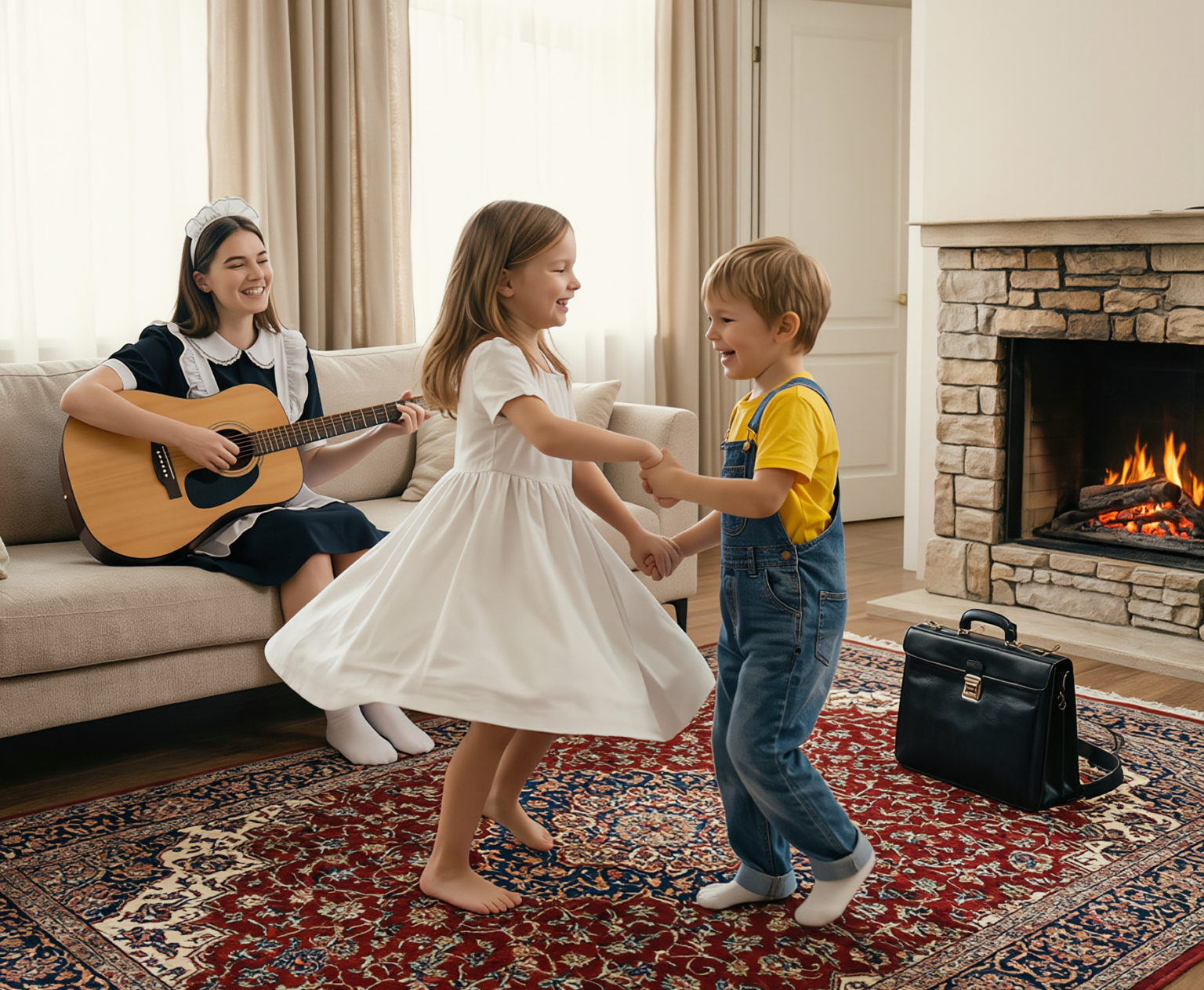
On the wide oriental rug before the stone fireplace, his five-year-old daughter, Clara, spun in slow circles. Her white dress flared around her like a page torn from a catalog. Her cheeks were rosy with excitement, her curls bouncing as she turned.
Holding her hand was a boy about her age. He wore worn but neatly washed denim overalls and scuffed sneakers. He tried earnestly to match her rhythm, concentrating as though their dance were a serious task he could not afford to fail.
Clara laughed freely, as if her entire world existed within that small circle of movement.
On the couch sat Marisol Bennett, the housekeeper who had worked in his home for nearly a year. Still dressed in her simple black-and-white uniform, she held a guitar in her lap. She wasn’t playing absentmindedly. She played with intention—carefully, tenderly—like someone who remembered another version of herself from before she polished marble floors and dusted chandeliers.
Near the tall bookshelf stood Daniel Harper, Ashton’s longtime driver and most trusted employee. His arms were crossed loosely as he observed the scene with calm assurance, as though he had known all along that this moment would unfold.
No one noticed Ashton standing there.
His briefcase slipped from his hand and struck the hardwood floor with a sharp, echoing thud.
The music stopped.
A Daughter’s Embrace
Clara froze for half a heartbeat. Then her face lit up.
“Daddy! You’re home!”
She ran straight toward him.
Ashton bent down instinctively and lifted her into his arms. Her small body pressed warmly against his chest. He inhaled the faint scent of strawberry shampoo and sunshine clinging to her hair. Her arms wrapped tightly around his neck, as though she hadn’t seen him in months.
And in that instant, something settled heavily inside him.
She hugged him as if she had been waiting forever—though he had only been gone a few hours.
The boy stood very still now, his hands clasped nervously in front of him. His brown eyes were wide and cautious, almost apologetic, as though he had been caught trespassing.
Marisol gently set the guitar aside and rose quickly, smoothing her uniform with trembling fingers.
“Mr. Caldwell… I didn’t expect you back so early. I’m sorry. I just—”
Ashton lifted a hand softly.
He didn’t want apologies—not yet.
He wanted to understand what was happening inside his own home.
“Because I Was Alone Again”
Clara leaned close to his ear and whispered, her voice filled with secret delight.
“Daddy, this is Oliver. He’s my friend. He came to play with me because I was alone again.”
Again.
The word landed quietly—but with force.
Ashton knew Clara spent far too many hours alone in this vast house. Tutors rotated in and out. Babysitters changed weekly. Expensive toys gathered dust in pristine playrooms. He worked fourteen-hour days, convincing himself he was securing her future.
Her mother had left when Clara was still an infant. A short note. No explanation that ever truly made sense. Ashton had swallowed his pride, his anger, his heartbreak—and buried himself in work. Success became his armor.
But success did not sit cross-legged on the rug and laugh with his daughter.
He looked more closely at Oliver. There was something in the boy’s posture that didn’t belong to a child his age—a quiet alertness, as if he had already learned to prepare himself for disappointment.
Marisol stepped forward, her voice low and steady despite the tension in her shoulders.
“Sir… Oliver is my son. His sitter fell ill today. I couldn’t miss work. You asked me to prepare the house for tomorrow’s dinner. I told him to stay in the service quarters and be quiet, but Clara heard him. She asked if he could play.”
She stood braced for reprimand, perhaps even dismissal.
Daniel spoke gently from behind them.
“She’s one of the best workers we’ve had, sir. I vouch for her.”
Ashton barely registered the words.
Eleven months. Marisol had worked in his home for eleven months. And he knew nothing about her life. Nothing about her struggles. Nothing about her child.
He had called it professional distance.
Now it felt like something far colder.
A Question He Had Never Asked
“How long have you been here?” Ashton asked quietly.
“Eleven months, sir.”
“And in all that time… have I ever asked about your family?”
Marisol hesitated before shaking her head.
Heat rose to Ashton’s face.
“And Oliver’s father?”
She lowered her eyes.
“He left when I was four months pregnant. We haven’t heard from him since.”
The air shifted again.
Not the same story—but the same kind of absence.
Clara ran back to Oliver and squeezed his hand.
“He can stay for dinner, right, Daddy? I promise I’ll eat all my vegetables.”
In the past, Ashton would have said no. There were rules. Boundaries. Appearances to maintain.
But the light in his daughter’s eyes was something money had never purchased.
He crouched down until he was level with Oliver.
“Do you like soccer?”
Oliver swallowed.
“A little, sir.”
“There’s a ball in the backyard that hasn’t been used in a long time. I think you two should play before dinner.”
Clara squealed with delight and pulled Oliver toward the patio doors, as though permission had unlocked the entire world.
The adults were left standing in silence.
A Different Kind of Decision
Marisol discreetly wiped at her eyes.
“You don’t have to do this, sir.”
“I’m not doing anything extraordinary,” Ashton replied. “I’m realizing I should have been paying attention sooner.”
She hesitated before speaking again.
“My rent is behind. The school keeps sending notices. I… I didn’t know what else to do.”
Ashton glanced toward Daniel, who respectfully lowered his gaze.
At the far edge of the property stood a small guest cottage, empty for years.
The idea formed quickly—and felt undeniably right.
“There’s a cottage at the back of the grounds,” Ashton said. “It’s been vacant. You and Oliver can live there. No rent. And starting tomorrow, your salary will double.”
Marisol took a step back.
“I can’t accept that. It’s too much.”
“It isn’t,” he answered firmly. “It’s long overdue.”
Daniel cleared his throat.
“I’ll help get the place ready this weekend.”
Marisol’s eyes filled again—but this time, there was no shame in them. Only relief.
“Thank you,” she whispered.
That evening, for the first time in years, four plates were placed on the long dining table.
Laughter replaced echo.
Ashton did not feel powerful.
He felt present.
A House That Learned to Breathe
The cottage was repaired. Marisol and Oliver moved in with two suitcases and several cardboard boxes. Clara treated their arrival as though new family members had joined them.
Gradually, the house changed.
Ashton began leaving the office earlier—not out of obligation, but desire. He returned home to the sound of Clara struggling through beginner guitar chords while Oliver kicked a soccer ball across the lawn. He noticed Marisol humming softly while cooking.
One afternoon, he walked into the kitchen and found flour dusting nearly every surface.
“Daddy, come help!” Clara called.
He hesitated only a moment before removing his jacket and rolling up his sleeves.
He cracked eggs clumsily. Oliver showed him how to do it without crushing the shell. Marisol laughed gently.
The cake burned slightly around the edges.
No one cared.
Later, with frosting smeared on her cheek, Clara asked,
“Can Marisol always eat with us?”
Marisol immediately protested that it wouldn’t be appropriate.
But Ashton interrupted kindly.
“I think it would be wonderful. This house has been too quiet for far too long.”
Marisol cried again—but the tears were different this time.
Love, Quiet and Unplanned
Months passed.
Ashton learned that Marisol had once dreamed of finishing school. That she read novels late at night. That beneath her quiet professionalism lived intelligence, resilience, and courage.
One evening on the terrace, after the children had fallen asleep, he confessed,
“I was afraid of being happy. I thought if I focused only on work, no one could hurt me again.”
Marisol looked at him without judgment.
“You deserve happiness, Mr. Caldwell. And you’re trying.”
With a gentle, almost fearful clarity, he realized he was falling in love.
When he told her, she trembled.
“People will talk. I was your employee.”
“Let them,” he said softly. “I’ve lived too long worrying about appearances. I want to live for what feels real.”
Their kiss was slow and careful, as if asking permission from fate itself.
There were whispers. Raised eyebrows.
But Ashton held her hand in public.
And whenever doubt crept in, Clara would simply say,
“I like our family this way.”
A Different Definition of Wealth
Years later, when someone asked Ashton about his greatest investment, he did not mention companies or real estate.
He looked at Clara and Oliver—now older, arguing like siblings and defending each other like siblings.
He watched Marisol singing softly in the kitchen.
And he replied,
“The afternoon I came home exhausted… and heard music where there used to be silence.”
Because that day, he had dropped a briefcase—
and picked up an entire life.
True wealth is not measured by the size of an estate, but by the warmth that fills a living room when people feel safe enough to laugh.
A child’s loneliness cannot be replaced with expensive toys, because what they crave most is presence—not presents.
Sometimes the most important turning points begin with a moment of discomfort that forces us to look honestly at ourselves.
Professional distance should never harden into emotional indifference toward the humanity of those who stand beside us each day.
Offering dignity is often more powerful than offering money, because dignity restores something hardship quietly erodes.
Love does not always arrive with grand gestures; sometimes it slips quietly into a flour-dusted kitchen beside an imperfect cake.
Fear of being hurt can build impressive walls—but those same walls can imprison the heart that built them.
Children remind adults what truly matters when they speak simple truths without calculation or pride.
Family is not defined solely by blood, but by the choice to show up, to care, and to stay when walking away would be easier.
The day you choose connection over control may become the day your life truly begins.