He fired the nanny for letting his kids play in the mud… Then he discovered the truth that changed everything…
Silver Oak Estates, Monterey, California.
Late-afternoon sunlight poured across the perfectly manicured lawn like liquid gold. When the iron gates slid open, the sleek black Tesla rolled into the driveway, its surface reflecting the sky like polished glass.
Nathaniel Reed finally exhaled.
He had just closed the biggest investment deal of the year. The headlines would call it brilliant. Visionary.
Yet sitting alone in the driver’s seat, he felt nothing.

Then he heard it.
Laughter.
Not polite giggles.
Not the restrained, “inside voices” kind.
Real laughter. Loud. Wild. Unfiltered.
Nathaniel looked toward the garden — and froze.
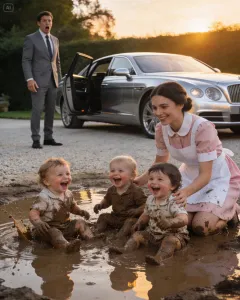
His three children were drenched in mud, stomping through a wide puddle that had swallowed part of his flawless lawn. Water splashed over trimmed hedges and stone walkways.
Kneeling beside them, her beige uniform soaked and streaked brown, was their nanny — Eliza Monroe.
She was smiling as if she were witnessing something holy.
Nathaniel’s jaw tightened.
“Reeds don’t behave like that,” his father’s voice echoed in his mind. “We are disciplined. Controlled.”
He stepped out of the car. The scent of wet soil hit him — earthy, raw. His four-year-old twin boys, Caleb and Connor, were shrieking with joy as they helped each other balance in the slippery puddle.
Their older sister, Madeline, hair plastered to her cheeks, laughed freely — dimples deep, eyes shining.
Eliza clapped her hands.
“Work together! If one falls, the other helps!”
Nathaniel noticed traffic cones and stacked garden pots forming some kind of obstacle course. The once-pristine yard looked like chaos.
With each step forward, he mentally calculated the damage: imported grass, stone tiles, image, order.
Control.
“Eliza,” he called, sharper than intended.
The laughter softened, but didn’t die.
Eliza turned calmly, mud streaked across her knees. She met his gaze without fear.
Nathaniel stopped at the edge of the puddle.
Between his polished Italian shoes and the muddy water lay an invisible boundary — the same boundary he had lived behind his entire life.
On the other side stood his children.
And her.
“What exactly is going on here?” he asked coldly.
Silence settled, broken only by dripping water.
Eliza rose slowly.
“They’re learning,” she said evenly.
“Learning?” Nathaniel gestured toward the mess. “This looks like disorder.”
“Look closer,” she replied. “No fighting. No tears. When one slips, another pulls him up. They’re practicing teamwork. Resilience. Confidence.”
Nathaniel frowned.
“This is negligence.”
Eliza didn’t flinch.
“They can get dirty,” she said quietly. “Their character won’t. Not if they’re allowed to fail safely.”
The words struck deeper than he expected.
Memories surfaced — starched uniforms, spotless shoes, no outdoor play. Mistakes met with silence or disappointment.
He shoved the thought away.
“You’re here to follow structure,” he snapped. “Not rewrite it.”
“And you’re here to be their father,” she replied softly. “Not just their financier.”
Time paused.
His children stared at him — hopeful, uncertain.
A drop of mud splattered onto his shoe.
He looked down at it as if it were an insult.
Then he turned and walked back inside.
Behind him, laughter rose again — echoing through the house like something he had never been permitted to keep.
That evening, the marble floors amplified every step as he walked past framed family portraits — all posed, immaculate, distant.
He stopped at a photo of himself at age nine.
Straight-backed.
Perfect suit.
No smile.
Later, Eliza approached him in the study.
“Mr. Reed, may I speak?”
He didn’t look up from his tablet.
“Discipline without warmth creates fear,” she said gently. “Fear creates distance. Distance breaks families.”
He set the tablet down slowly.
“I didn’t hire you to evaluate me.”
“I know,” she said. “But caring sometimes means saying what’s uncomfortable.”
The words unsettled him more than anger would have.
“You don’t learn love by staying spotless,” she added quietly.
That night at dinner, crystal glasses clinked in silence. No laughter. No stories.
Across the table sat his father, Charles Reed — sharp suit, sharper eyes.
“I hear the nanny encourages chaos,” Charles remarked.
“She believes children learn through mistakes,” Nathaniel said carefully.
Charles’ smile was thin.
“Mistakes are for other families. We are not other families.”
The sentence landed heavy — just as it always had.
“Dismiss her,” Charles said calmly.
Nathaniel saw fear flicker across Madeline’s face.
The same fear he had once carried.
The next morning, gray clouds pressed low over the estate. Nathaniel held the termination letter while Eliza braided Madeline’s hair outside.
“This arrangement isn’t working,” he said stiffly. “They need stricter guidance.”
Eliza nodded.
“I understand.”
Madeline’s voice trembled.
“Is she leaving?”
Nathaniel couldn’t answer.
Eliza knelt before the children.
“Promise me something,” she whispered. “Don’t be afraid to get messy learning something beautiful. Mud washes off. Fear doesn’t.”
The twins clung to her, leaving small handprints on her coat. She laughed softly.
“Now I carry part of you with me.”
Before stepping through the gate, she turned once more.
“Raising children isn’t about preserving perfection,” she said. “It’s about teaching them how to begin again.”
That night, rain pounded against the windows.
Nathaniel couldn’t sleep.
Regret and memory tangled in his chest.
A sudden sound jolted him awake.
The twins’ beds were empty.
His heart pounded as he rushed outside.
There they were.
Barefoot in the storm.
Laughing in the mud.
“We wanted you to learn how to laugh too, Daddy,” Caleb said.
Connor slipped — Caleb grabbed his arm.
“I’ll protect you.”
Nathaniel dropped to his knees. Mud soaked his hands. Rain blurred his vision.
He pulled them close, feeling something crack open inside him — something rigid and long-held.
Behind him, his father’s voice cut through the storm.
“You’ll ruin them.”
Nathaniel looked up calmly.
“No,” he said. “I’m saving them.”
The rain washed over him — over years of restraint, inherited fear, and quiet emptiness.
By morning, muddy boots lined the doorway.
And laughter filled the garden again.
Days later, Nathaniel called Eliza.
When she returned, he met her at the gate.
“You were right,” he admitted. “I forgot how to be a father.”
She smiled gently.
“The children reminded you.”
As Caleb and Connor raced across the grass and Madeline chased them barefoot, Nathaniel understood something he had never been taught:
Success builds houses.
But love builds homes.
And sometimes, what looks like a mess… is the beginning of freedom.