He Lost His Whole Family in a Fire — Then the River Gave Him a Son
The fire took them on a Tuesday.
My wife Tessa. My three-year-old son Michael. One hour they were reading bedtime stories, Michael clutching his blue truck against his pajamas. The next hour, I was standing on the sidewalk in my warehouse parka, watching orange light eat through every window of our house.
The firefighters wouldn’t let me back in.
“Sir, you need to step back.”
“My family is in there!”

Two of them held me. I fought. Screamed until my voice shredded. Didn’t matter.
They were gone.
The funeral was four days later. I stood at the front of the church and didn’t say a word. Couldn’t. My mouth opened, but nothing came out except a sound that made people look away.
Pastor Pierce caught me at the door afterward. Gray-haired man, calm eyes.
“Don’t turn right or left,” he said. “Just walk straight.”
I wanted to hit him. Wanted to grab his collar and ask what kind of God lets a three-year-old burn. But I didn’t. I just walked to my truck and drove.
Maren showed up three days later. Tessa’s younger sister. She didn’t knock. Just left a pan of lasagna on the porch and sat on the steps.
I watched her through the window for twenty minutes before I opened the door.
“You don’t have to talk,” she said. “But you do have to eat.”
I ate. Not because I was hungry. Because the look in her eyes told me she’d lost something too, and I didn’t have the right to make it worse.
The nights were hell. The fridge hummed. The water heater clicked. Every sound reminded me that this apartment was built for silence now.
I kept two things. Tessa’s wooden recipe box on the kitchen counter—her grandmother’s, filled with cards in her handwriting. And Michael’s blue truck on the mantle. I couldn’t touch either one. But I couldn’t move them either.
Six weeks crawled by. I worked the night shift at the frozen food warehouse. Twelve-hour stretches in sub-zero storage rooms, stacking pallets, letting the cold numb everything from the neck down.
My supervisor, Gary, pulled me aside one night.
“Brennan, you’ve been here fourteen hours.”
“I’m fine.”
“You’re not fine. Go home.”
“Home” was four walls and ghosts. But I clocked out.
Then one Thursday changed everything.
I was driving the back road under the Route 9 bridge, heading home after another shift. Fog hung low. My headlights cut yellow beams through it.
Hazard lights.
A dark sedan pulled over near the guardrail. A man in a gray sweatshirt stood at the bridge railing. He looked left, looked right.
Then he lifted something over the railing and threw it.
A wooden box. It tumbled through the air, hit the water with a flat crack.
My foot slammed the brake.
I don’t remember getting out of the truck. Don’t remember the embankment. Just mud sucking at my boots, branches whipping my face, cold air burning my lungs.
The box was already in the current. Spinning. Drifting toward the bend where the water got fast.
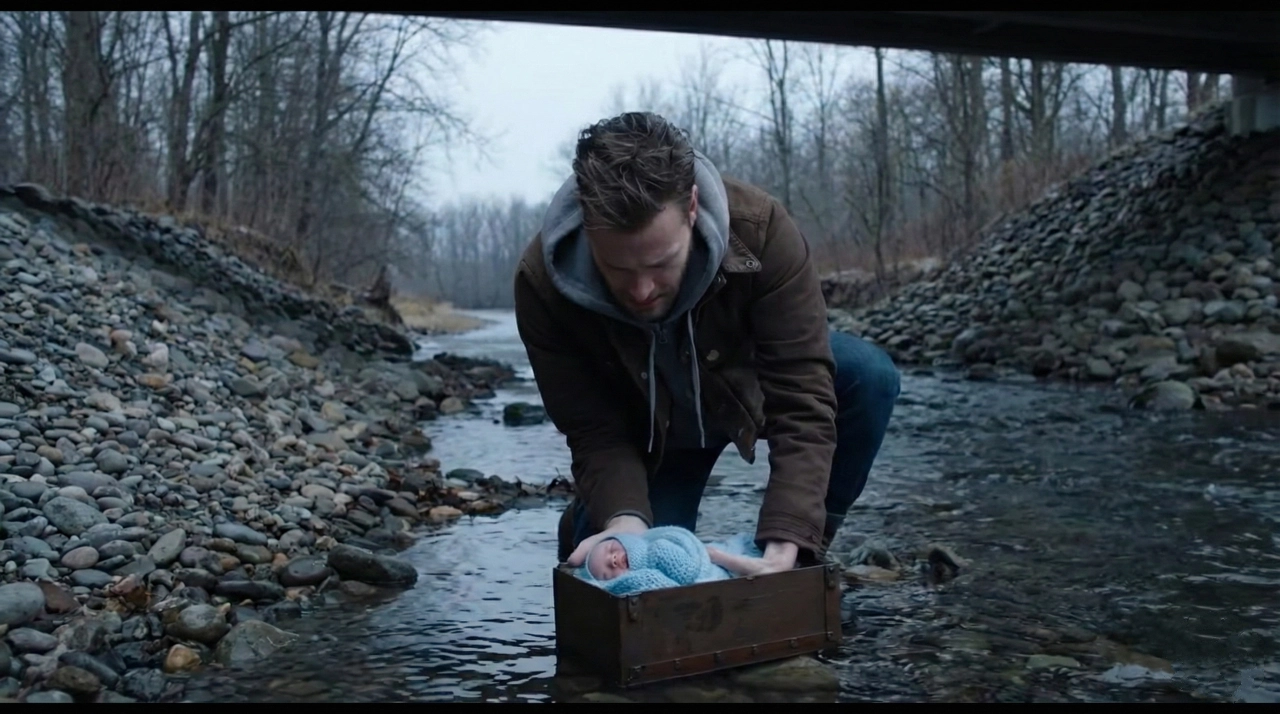
I waded in. The river hit my thighs like a wall of ice. My boots slipped on rocks. I went under for a second, swallowed water, came up coughing.
The box bumped against a fallen tree branch. I lunged, grabbed the edge.
Hauled it onto the rocks.
Pried the lid open.
Inside—a baby. A newborn. Lips blue. Eyes half-open, glassy. Wrapped in a stained towel.
But breathing.
“Jesus Christ.”
My hands shook so hard I almost dropped him. I pulled him out, pressed him against my chest, stumbled up the embankment.
The man in the gray sweatshirt was gone. The dark sedan was gone.
I got to my truck. Cranked the heat to max. Held the baby against my body, skin to skin under my jacket. His heartbeat was faint, fast, fluttering against my ribs like a trapped moth.
“Come on, come on… stay with me, buddy.”
The hospital was twelve minutes away. I made it in eight. Ran through the ER doors holding a wet, blue-lipped newborn.
“I found him in the river,” I told the triage nurse. “He was in a box. Someone threw him off the bridge.”
They took him. Calm, efficient hands. Monitors. Warming blankets. An incubator wheeled down the hall at speed.
I stood in the waiting room in soaked jeans and a torn jacket, shaking. Not from cold. From something else.
An hour later, a doctor came out. Young woman, tired eyes.
“He’s stable. Severely hypothermic, but responsive. He’s going to make it.”
“What happens to him now?”
“Child Protective Services. Foster care, most likely. We’re short on infant placements.”
“Can I see him?”
She hesitated. “Are you family?”
“I pulled him out of the river.”
She let me in.
He was in a clear bassinet under heat lamps. A newborn. His fists curled near his face. An oxygen tube looped under his nose.
I stood there for a long time.
A social worker named Janet found me in the hall an hour later. Short woman, glasses, clipboard.
“Mr. Brennan?”
“Yeah.”
“You saved his life tonight.”
“Someone tried to end it.”
She nodded. “I need to ask you something. Would you consider temporary emergency foster placement? We don’t have an available infant home right now, and you’ve already been cleared for—”
“Yes.”
She blinked. “You don’t want to think about it?”
“No.”
Two days later, I brought him home. Hospital records listed him as Lucas. No last name.
Lucas cried the first night. Not a hungry cry or a wet cry—a lost cry. A sound that came from somewhere deeper than his lungs.
I walked circles in the living room, his small weight on my shoulder, and something cracked open inside my chest. Not the grief. Something underneath it. Something I thought the fire had burned away.
“It’s okay,” I whispered. “I’ve got you.”
He quieted. His breathing slowed. His fist gripped my shirt and held on.
I didn’t sleep. Just sat in the rocking chair I’d bought at a thrift store that afternoon, holding him, watching the clock until morning.
Maren came over at seven a.m. She stopped dead in the doorway.
“Whose baby is that?”
“Mine. Temporarily.”
“What?”
“I pulled him out of the river, Maren. Someone threw him off the Route 9 bridge in a box.”
She stared. Then she walked across the room and looked down at Lucas.
“He’s beautiful.”
“His mother died. Childbirth complications at home. That’s what Janet told me. She bled out before anyone could get to her.”
“And his father?”
“Threw him in the river.”
Her jaw clenched. “Tell me they caught him.”
“Not yet. Police are working the bridge cameras.”
She pulled a chair next to the bassinet. “What do you need?”
“Diapers. Formula. A crash course in everything.”
“Done.”
Maren was there every day after that. Mornings before her shift at the clinic, evenings after. She showed me how to hold his head, how to test the bottle temperature on my wrist, how to swaddle him tight enough that he felt safe.
“You’re a natural,” she said one night, watching me rock him.
“I’m terrified.”
“Tessa was terrified too. First month with Michael, she called me crying every other night.”
I looked up. “She never told me that.”
“She didn’t want you to worry.” Maren smiled. “She figured it out. You will too.”
Three weeks in, Janet called.
“The grandparents want to meet you.”
“Grandparents?”
“The baby’s mother was identified. Raina Eldridge, twenty-two. Her parents—Celeste and Gordon Eldridge—they’ve been looking for her. They didn’t know about the pregnancy.”
“Are they going to take him?”
Pause. “Let’s just meet first.”
Celeste and Gordon sat across from me in Janet’s office the next morning. Celeste was mid-fifties, silver hair, red-rimmed eyes. Gordon was tall, quiet, hands gripping his knees like he was holding himself together.
“Our daughter,” Celeste started. Her voice broke. She tried again. “Raina was troubled. She’d been with this man—Zayn Kinder—for about a year. We begged her to leave him. He was controlling. Volatile.”
“She hid the pregnancy from everyone,” Gordon said. “Even us.”
“She delivered at home,” Celeste continued. “Alone. By the time a neighbor called 911, she’d already—” She stopped.
“I’m sorry,” I said. “Truly.”
Gordon looked at me. “You saved our grandson’s life.”
“I was just driving by.”
“No.” Gordon shook his head. “You went into that river in the dark. Don’t minimize that.”
Celeste leaned forward. “Mr. Brennan, we need to be honest with you. We want Lucas to be safe. That’s all we care about. But Zayn has been calling us. Threatening us.”
“Threatening how?”
“He wants money. Says he’ll fight for custody if we don’t pay.”
“He threw a baby into a river.”
“We know. But he’s claiming he panicked. That he was going to come back for him.”
Janet cut in. “The police are building a case. We have partial bridge camera footage. But Zayn hasn’t been arrested yet.”
“Why the hell not?”
“Footage is being enhanced. It takes time. But it’s coming.”
“And in the meantime?”
“In the meantime, Lucas stays with you.”
Four days later, someone pounded on my front door at nine p.m. Lucas was asleep in the next room.
I looked through the peephole. A man. Late twenties. Wiry build. Gray sweatshirt.
I opened the door. Kept my body in the frame.
“You’re Zayn.”
“Damn right. Where’s my kid?”
“He’s not here.”
“Bullshit. I know he’s here. I talked to the hospital. I got rights.”
“You threw him off a bridge.”
His eyes flickered. Just for a second. “I don’t know what you’re talking about.”
“I pulled him out of the water myself. Watched you throw that box.”
“That’s your word against mine, pal.”
I stepped forward. He stepped back.
“You’ve got three seconds to get off my porch.”
“Or what?”
“Or the police get here before you reach your car. I’ve already dialed.”
I held up my phone. Screen lit. 911 on the display.
Zayn’s jaw worked. His hands balled into fists. For a moment, I thought he was going to swing.
Then he pointed at me. “This ain’t over. I’m getting a lawyer. That’s my blood.”
“Your blood was drowning in a river.”
He left. Peeled out of the parking lot so fast his tires screamed.
I locked the door. Walked to Lucas’s room. He was still asleep, one fist curled against his cheek.
My hands were shaking. Not from fear. From rage.
I called Janet. Then I called Detective Morris.
“He showed up at my house.”
Morris was calm. “Did he make threats?”
“Implied them. I’ve got a doorbell camera.”
“Send me the footage. Tonight.”
I sent it.
Two days later, Morris called back.
“Bridge camera footage came through. Clear shot. Zayn Kinder lifting the box over the railing. Timestamp matches. He’s in custody.”
I sat down on the kitchen floor. Lucas was in his bouncer, kicking his legs, making sounds.
“Thank God.”
“Arraignment is Friday. DA is charging attempted murder of a minor.”
“Good.”
“Mr. Brennan? You did good. All of it.”
The preliminary hearing was three weeks later. I sat in the second row with Maren on one side and Celeste on the other. Gordon sat behind us, stone-faced.
Zayn’s lawyer—public defender, young, nervous—tried everything. Temporary insanity. Postpartum crisis by proxy. Grief-induced psychosis.
The prosecutor played the bridge footage. Grainy but clear. Zayn checking both directions. Lifting the box. The throw. Walking back to his car. No hesitation. No panic. Deliberate.
“Your Honor,” the prosecutor said, “this was not a man in crisis. This was a man disposing of evidence. His girlfriend was dead. The baby was a complication. He chose murder.”
Zayn sat at the defense table, jaw tight, staring at the wall.
Judge Henley looked at him. “Mr. Kinder, I’ve reviewed the footage, the medical reports, and the testimony. You placed a living newborn in a sealed container and threw it into a river in November. The water temperature was forty-one degrees.”
The courtroom was silent.
“There is no version of these facts that constitutes anything other than deliberate attempted homicide.”
Zayn didn’t react.
“Six years. State penitentiary. No parole eligibility for four.”
The gavel cracked.
Celeste grabbed my arm. Maren exhaled. Gordon closed his eyes and nodded once.
I looked across the courtroom at Zayn as the officers cuffed him. He looked back at me. No remorse. No shame. Just resentment.
I didn’t flinch.
The adoption process started the following week. Janet fast-tracked the paperwork.
“Given the circumstances,” she said, “and the grandparents’ written consent, the court is likely to approve expedited.”
“How long?”
“Eight weeks, roughly. Home study, background check, judge’s review.”
Eight weeks. I could do eight weeks.
Celeste and Gordon came to my apartment the night before the hearing. We sat at my small kitchen table. Lucas slept in his bassinet two feet away, his chest rising and falling.
Celeste folded her hands. “Gordon and I talked about this for a long time.”
“And?”
“We’re not young,” Gordon said. “My knees. Her hip. We can’t chase a toddler.”
“But he’s your grandson.”
Celeste shook her head. “He’s your son. He has been since the river.”
Gordon looked at me. “The one who matters isn’t the one who shares blood. It’s the one who shows up.”
“Raina would have wanted this,” Celeste said. “A father who’d jump in a river for him.”
“We want to be his grandparents,” Gordon added. “Sunday dinners. Birthdays. Holidays. If you’ll have us.”
“Of course,” I said. “He should know where he comes from. All of it.”
Celeste reached across the table and squeezed my hand. Her eyes were wet but steady.
“Thank you,” she said. “For giving us a reason to keep going too.”
The adoption hearing lasted forty-two minutes.
The courtroom was small. Wood-paneled. An American flag behind the bench. Janet was there. Maren. Celeste and Gordon. Even Gary from the warehouse, sitting in the back row in his cleanest flannel.
Judge Henley—same judge who’d sentenced Zayn—looked at me over his glasses.
“Mr. Brennan, tell me why you want to adopt this child.”
I looked at Lucas in the carrier beside me. His dark eyes were open, watching the ceiling fan with intense concentration.
“Because I already am his father, Your Honor. I have been since the night I pulled him out of that water. I didn’t choose it. But it chose me. And I’m not letting go.”
The judge reviewed his papers. Flipped a page. Another.
“The court notes that Lucas Brennan would not be alive without the actions of the petitioner. The court further notes the written consent of the maternal grandparents, the recommendation of Child Protective Services, a clean home study, and the absence of any competing custody claim.”
He looked up.
“Adoption granted.”
The gavel came down.
Maren grabbed my hand. Celeste covered her mouth. Gordon’s hand landed heavy on my shoulder.
Lucas made a sound—a small, curious “ah”—and the courtroom laughed. Even Judge Henley cracked a smile.
“Congratulations, Mr. Brennan. Take good care of him.”
“I will, Your Honor.”
“I know you will.”
That night, I sat on the apartment terrace. Lucas asleep in my arms. City fog rolling in below, softening the lights into halos. Stars barely visible, but there.
Maren sat beside me. Close. Her shoulder against mine.
“You okay?” she asked.
“Yeah.” I looked down at Lucas. “I still miss them. Every day. Tessa. Michael.”
“I know. Me too.”
“But this—” My voice caught. I swallowed. “I didn’t think I’d feel this again.”
“Feel what?”
“Like my life has weight. Like it matters that I wake up tomorrow.”
Maren was quiet for a moment. Then: “It always mattered.”
“Didn’t feel like it.”
“I know.” Her hand found mine. “But it did.”
Inside, Tessa’s recipe box still sat on the counter. Michael’s blue truck still stood on the mantle. But now Lucas’s bottles lined the drying rack. His small socks tumbled in the dryer. His soft breathing filled every silence.
I wasn’t replacing what I’d lost. That was impossible. You don’t replace people. You just keep making room.
Celeste and Gordon came every Sunday after that. Celeste brought photo albums of Raina—baby pictures, school plays, her college graduation. Stories of her laugh, her stubbornness, her kindness.
“She volunteered at the animal shelter every Saturday,” Celeste told Lucas, even though he couldn’t understand. “She’d come home smelling like dog and say it was the best perfume in the world.”
Gordon taught me how to make Raina’s favorite breakfast. Blueberry pancakes with lemon zest.
“Raina used to drown them in syrup,” he said. “Drove Celeste crazy.”
“Ruined perfectly good pancakes,” Celeste confirmed.
These people had lost their daughter. Their only child. And instead of collapsing, they’d found a way to pour what they had left into Lucas. Into me.
I didn’t deserve it. But I took it. Because Lucas did.
Maren stayed close through all of it. Some nights she showed up with groceries. Other nights she just sat on the couch while Lucas slept between us.
One night, after Lucas was down, she stood in the kitchen drying dishes. I was putting the last bottle on the rack.
“Can I ask you something?” she said.
“Yeah.”
“Do you ever think about—” She stopped. Shook her head. “Never mind.”
“What?”
She put the towel down. Looked at me. “Tessa was my sister. I loved her more than anyone.”
“I know.”
“And I’d never try to replace her. You know that.”
“Maren—”
“But I’m here. I’ve been here. And I need you to know it’s not just because of Tessa anymore.”
The kitchen was quiet except for the hum of the fridge.
“I know,” I said.
“You do?”
“Yeah. I’ve known for a while.”
“And?”
I put down the bottle. Walked around the counter. Stood in front of her.
“I’m not ready to say everything I want to say. Not yet. But I’m not going anywhere. And neither are you.”
She nodded. “Okay.”
“Okay.”
Her hand found mine again. And we stood there in the kitchen, Lucas asleep down the hall, the world outside quiet and still.
Six months later, Lucas laughed for the first time.
Not a baby gurgle. A real laugh. Full-body, eyes-squeezed-shut, pure-joy laugh.
I was making a stupid face. The one where I cross my eyes and puff out my cheeks. Michael used to lose his mind at that face.
Lucas erupted.
I called Maren immediately. “He laughed. A real laugh.”
“What did you do?”
“The face.”
“The face?” She was already laughing. “I’m coming over.”
She got there in fifteen minutes. I did the face again. Lucas shrieked with delight, arms flailing.
Maren’s eyes glistened. “Tessa would have loved him so much.”
“Yeah.” I kissed Lucas’s head. “She would have.”
The grief didn’t vanish. Some mornings I still woke up reaching for Tessa’s side of the bed. Still heard Michael’s voice in the hallway, calling “Daddy, truck!” the way he used to.
But the pain had shifted. It wasn’t a knife anymore. It was a stone—heavy, permanent, but something I could carry. Something that reminded me what love costs. And why it’s worth it anyway.
At eleven months, Lucas took his first steps.
Toward me.
Arms outstretched. Trust absolute. Three wobbling steps across the living room floor.
“Come on, buddy,” I said, crouching low. “You got this.”
He crashed into my chest. I caught him, lifted him, held him tight.
“There you go. There you go.”
Maren was filming from the doorway. Crying and filming. Celeste would watch that video forty times before the week was out.
That night, after we put Lucas down together, Maren and I stood in his doorway watching him sleep.
“You’re good at this,” she said quietly.
“I’m terrified every single day.”
“That’s exactly what makes you good at it.”
We stood there, shoulder to shoulder.
“Thank you,” I said. “For not letting me disappear after the fire.”
“You’re family.” She looked up at me. “You’ve always been family.”
I kissed her forehead. She closed her eyes.
“So have you,” I said.
Two years after I pulled Lucas from that river, we drove to the cemetery. All of us. Celeste and Gordon in the back seat. Maren beside me. Lucas in his car seat, chattering away about trucks and dogs and birds.
I knelt beside Tessa’s headstone. The letters were clean—I’d come last week with a brush.
TESSA MARIE BRENNAN. BELOVED WIFE AND MOTHER.
And next to her, the smaller stone.
MICHAEL JAMES BRENNAN. DADDY’S LITTLE BUDDY.
Lucas stood beside me, holding my hand. He looked at the stones with serious two-year-old concentration.
“This is your Aunt Tessa,” I told him. “She made the best chocolate chip cookies you’ve ever had. And this is Michael. He loved trucks. You two would’ve been best friends.”
Lucas touched Michael’s stone. Gentle. Like he knew.
“We miss them,” I said. “But we’re okay.”
Maren’s hand found my shoulder. Gordon stood with his arms folded, chin trembling. Celeste pressed a small bouquet against Raina’s headstone across the path—they’d had her moved here, close, so we could visit everyone together.
Lucas tugged my hand. Looked up at me with those dark eyes.
“Home, Daddy?”
First time he’d said it. Daddy.
My throat closed. My eyes burned. I picked him up and held him against my chest, his arms around my neck, his heartbeat steady against mine.
“Yeah, buddy,” I managed. “Home.”
We walked back to the car. Lucas between Maren and me, holding both our hands, swinging himself forward with every step the way kids do when they trust that the hands holding them won’t let go.
And I felt it. The thing Pastor Pierce had talked about on the worst day of my life.
Not happiness. Not the absence of pain.
But purpose. Direction. Weight that means something.
I’d lost everything once. Wife. Son. Home. Stood on a sidewalk and watched my whole life turn to ash.
But I kept walking. Not right. Not left. Straight.
And on the other side, I found a wooden box in a river. A baby with blue lips and a heartbeat that refused to quit. A family I never expected—grandparents who chose me, a sister-in-law who became something more, and a boy who called me Daddy.
You don’t recover from grief. You don’t get over it. You walk through it, one day at a time, and you carry what you’ve lost with you because that’s what love does—it stays.
And sometimes, on the far side of the worst thing that ever happened to you, life hands you something you didn’t earn, didn’t expect, and don’t deserve.
Not a replacement. Not a do-over.
A second chance.
Lucas squeezed my hand as I buckled him into his car seat.
“Daddy, truck?” He pointed at the blue toy on the dashboard—Michael’s blue truck. I’d started keeping it there. Felt right.
“That’s Michael’s truck,” I said. “But he’d want you to play with it.”
Lucas took it. Held it carefully with both hands. Smiled.
I closed the door. Maren was leaning against the hood, watching me.
“Ready?” she asked.
“Yeah.” I took her hand. “Let’s go home.”