Hope Is the Most Dangerous Thing
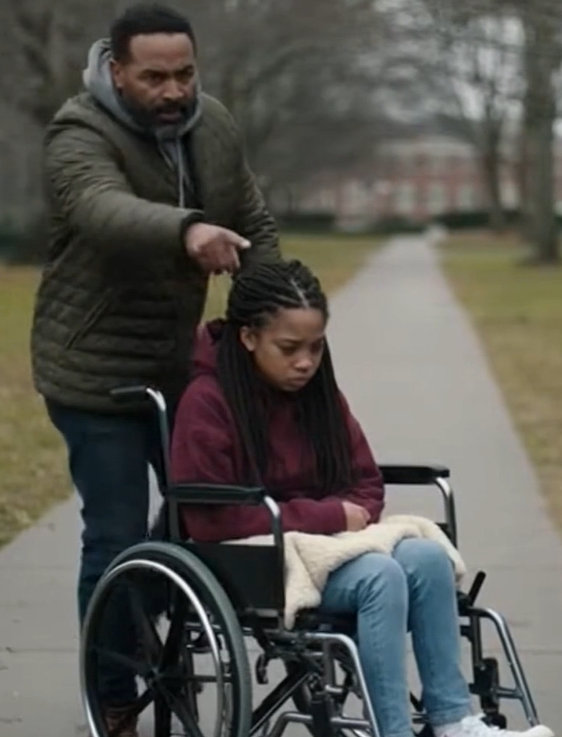
No one ever noticed the wheelchair first.
They noticed Lily’s smile.
It was too bright for a nine-year-old who hadn’t walked in three years—too stubborn, too alive. The kind of smile that insisted on existing, even when it didn’t make sense.
She sat near the curb outside a modest park in downtown Phoenix, the late afternoon sun stretching shadows across the pavement. A pink blanket covered her legs, still and quiet, while her fingers fidgeted against the metal arms of her chair.
Lily watched other children race past—shoes pounding the ground, laughter flaring and fading like sparks. She didn’t look away.
Her father stood beside her.
Mark Wilson didn’t smile.
He kept his arms folded, posture rigid, eyes constantly moving. He looked like a man who had learned—too thoroughly—that danger didn’t announce itself. At thirty-six, he carried himself like someone in control: clean clothes, squared shoulders, calm expression. Only the sleepless tension beneath his eyes gave him away.
This was their ritual.
Every Sunday.
Same park. Same corner.
Lily liked observing the world.
Mark liked pretending the world hadn’t already hurt them.
They’d been there a short while when Lily spotted the boy.
At first, he lingered across the street near a bus stop, half-hidden. Ten, maybe eleven years old. His clothes were too big and too worn, as if borrowed from someone who’d never get them back. Torn knees. Mismatched shoes. One held together with tape.
He wasn’t asking for anything.
He was watching.
Lily leaned forward. “Dad,” she murmured.
Mark followed her gaze and stiffened immediately.
The boy crossed the street carefully, each step measured, like he knew sudden movements made adults uneasy. Up close, Mark saw a thin face, sharp features, eyes dulled by exhaustion and sun.
Great, Mark thought. Another kid with a story.
The boy stopped a few feet away.
Lily noticed something odd—he wasn’t looking at her legs. People usually did. Or they avoided them entirely. This boy did neither.
He looked at her face.
“Hi,” Lily said before her father could intervene.
“Hi,” the boy replied, barely above a whisper.
Mark stepped in front of her at once. “We don’t have money,” he said flatly. “You should go.”
“I’m not here for that,” the boy said.
That alone set Mark on edge.
“Then what do you want?”
The boy glanced past him at Lily. His voice dropped. “I think I can help her.”
Mark let out a short, bitter laugh. “Help her how?”
The boy moved closer.
Mark shoved him.
Not hard enough to knock him down—just enough to warn him. The boy stumbled back but stayed upright.
“Stay away from my daughter,” Mark snapped. “You don’t get to mess with her.”
People nearby slowed. Watched. Lily’s hands tightened around the armrests.
“Dad—” she started.
The boy straightened, brushing dirt from his sleeve. He looked more sad than scared.
“I can help her walk again,” he said.
The world seemed to stop.
Lily’s heartbeat roared in her ears. Mark stared at the boy, shock hardening into fury.
“What did you say?”
“I can make her walk again.”
Tears welled instantly in Lily’s eyes—silent, overflowing. Not from sadness. From the kind of hope that hurt to touch.
Mark crouched until they were face-to-face, his voice trembling with restrained anger. “Doctors couldn’t,” he said. “Specialists. Surgeons. Years of therapy. And you think you can?”
The boy nodded.
“Yes.”
That was it.
“You don’t know her,” Mark snapped. “You don’t know what she’s lost.”
“I know enough.”
“Oh yeah? What’s her diagnosis?”
The boy hesitated.
“They said my spinal cord was bruised,” Lily whispered. “Incomplete.”
“That’s why you still feel tingling sometimes,” the boy said gently. “Like pins.”
Lily froze.
“How do you know that?”
Mark felt cold creep up his spine.
“It didn’t break,” the boy said. “It just went quiet.”
“That’s enough,” Mark said sharply, turning the wheelchair away. “We’re leaving.”
“Please!” Lily cried.
Behind them, the boy called out. “Five minutes. I don’t want anything else.”
Mark kept walking.
“I’ve seen it before,” the boy said desperately.
Mark stopped.
“Seen what?”
“People told it was over,” the boy said. “And it wasn’t.”
Lily looked up at her father, tears streaking her face. “What if he’s right?”
Mark knelt beside her, voice breaking. “We’ve heard this before.”
“I know,” she whispered.
“And it always hurts more when it’s not real.”
Behind them, the boy said softly, “It is.”
Mark turned back, exhausted and angry. “Whatever story you’re selling—”
The boy reached into his pocket.
Mark tensed. “Don’t.”
A photograph emerged—old, folded, fragile.
“My sister,” the boy said. “She couldn’t walk either.”
The picture showed a young girl in a wheelchair… and another image taped beside it. The same girl. Standing.
Lily gasped.
“Where is she?” Mark asked quietly.
“She’s gone,” the boy said. “But she walked first.”
Silence settled heavy and dangerous.
Mark wanted to reject it. Wanted to scream.
Because hope didn’t feel foolish anymore.
It felt terrifying.
Part Two
The photograph passed into Lily’s trembling hands.
“It proves nothing,” Mark said weakly.
“I know,” the boy replied. “I wouldn’t believe me either.”
“Then why do this?”
“Because she looks like my sister,” he said. “The way she watches people walk.”
“What’s your name?” Mark asked.
“Eli.”
Mark studied him. “You don’t get to say things like that to a child.”
“That’s why I waited,” Eli said. “For her to decide.”
Lily squeezed Mark’s sleeve. “Please.”
Hope—careful, bruised hope—shone in her eyes.
“Five minutes,” Mark said. “That’s all.”
They moved to the grass. Eli kept his distance.
“I won’t touch her,” he said. “Unless she says yes.”
“Do you feel your feet?” Eli asked Lily.
“A little,” she said.
“That means they’re listening.”
Mark scoffed. “Doctors said that.”
“I’m not one,” Eli replied.
“Then what are you?”
“Someone who didn’t accept losing his sister.”
Lily closed her eyes as instructed.
“Your legs didn’t forget you,” Eli said softly. “They’re just afraid.”
Warmth spread. Heaviness. Awareness.
“I felt something,” Lily whispered.
Mark’s heart pounded.
“Try your toes,” Eli said.
Nothing moved.
Then—
“I felt it,” Lily said urgently.
Eli smiled faintly. “That’s how it begins.”
Mark forced him to stop.
The moment ended.
“What happened to your sister?” Mark asked.
“People didn’t let her finish,” Eli said. “Belief scared them.”
Lily clutched her father’s hand. “Please don’t send him away.”
Mark hesitated.
“Where do you sleep?” he asked.
“Anywhere.”
“We’ll talk tomorrow,” Mark said finally.
Eli’s eyes widened.
Mark didn’t know if he’d just protected his daughter—
Or opened the door to the most dangerous thing of all.
Hope.