I Forced A Student To Remove His Gloves During A Drug Sweep. The Police Dog Whimpered Before I Even Saw The Horror Underneath.
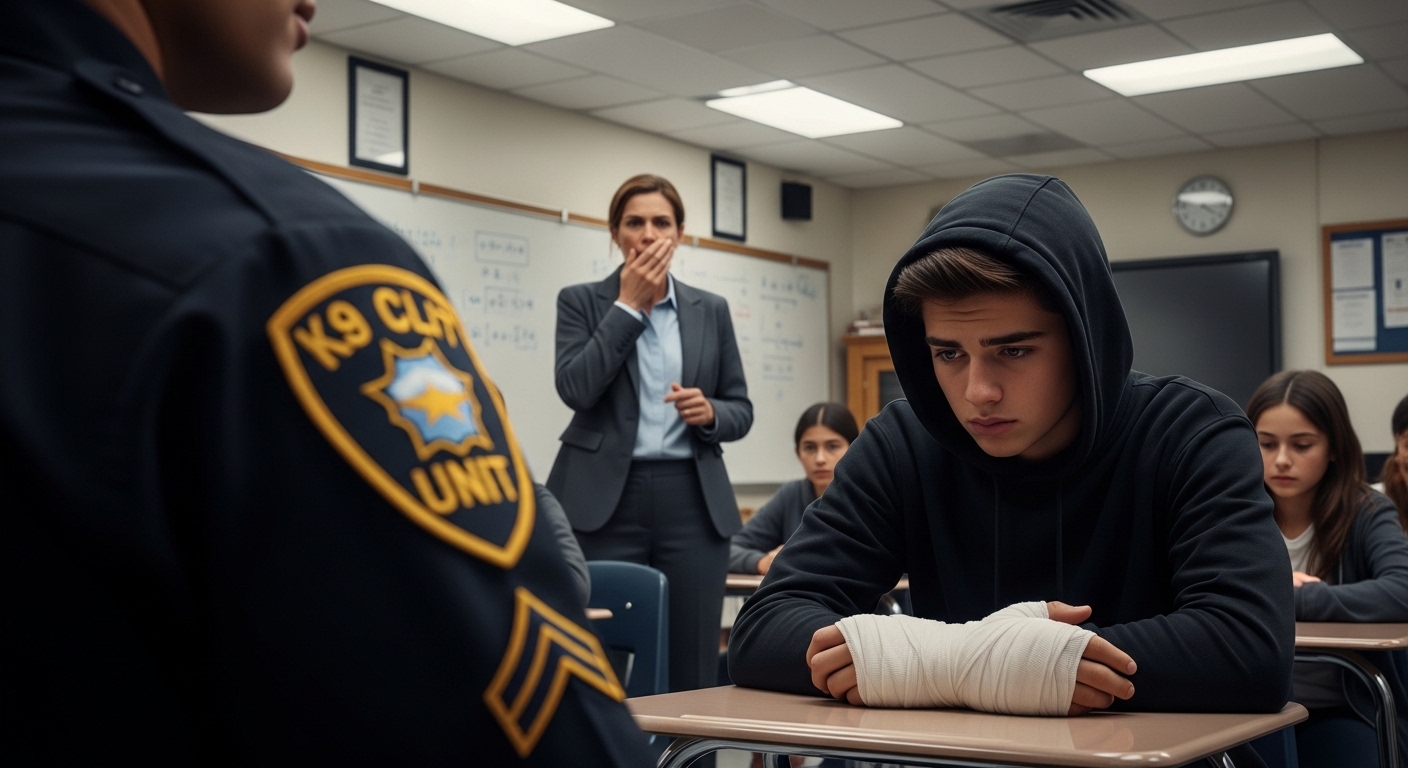
Chapter 1: The Sweaty Palms of Oak Creek
It was supposed to be a routine administrative search. That’s what we call them to avoid the legal headache of the word “raid.”
The principal, Mrs. Gable, called it a “necessary intervention.”
I called it a waste of taxpayer money and a great way to make teenagers hate cops even more than they already do.

It was a Tuesday in mid-May at Oak Creek Middle School, a sprawling brick complex in the suburbs of Ohio.
The air conditioning in the D-Wing had been busted for three days.
The hallways smelled like a potent mix of Axe body spray, floor wax, and teenage hormones.
I’m Officer Mark Miller. I handle the K9 unit for the district.
My partner is a three-year-old Belgian Malinois named “Radar.”
Radar is trained for narcotics and gunpowder. He’s a good boy. Usually.
That morning, Radar was acting strange before we even got out of the cruiser.
He was pacing in his cage, letting out these low, vibrating whines that usually mean he senses a thunderstorm coming.
But the sky was clear blue.
“Easy, buddy,” I muttered, clipping the leash onto his vest. “Just a few lockers. Then we get a burger.”
We walked into the main office, and the tension was thick enough to cut with a knife.
Mrs. Gable was pacing. She’s one of those administrators who treats a middle school like a maximum-security prison.
“Officer Miller,” she clipped, checking her watch. “You’re three minutes late. We have intel that the eighth graders are moving product during second period.”
“Product?” I asked, raising an eyebrow. “You mean weed vapes, Linda? Let’s call it what it is.”
“Illegal narcotics,” she corrected sharply. “We are starting with Mr. Henderson’s homeroom. I have a list of suspects.”
I hate lists. Lists mean targeting. Targeting means lawsuits.
“I go where the dog goes,” I told her, tightening my grip on Radar’s leash. “If he doesn’t hit, we don’t search. That’s the deal.”
She huffed, her heels clicking aggressively against the linoleum as she led the way to D-Wing.
The heat hit us as soon as we passed the double doors.
It was easily eighty degrees in that hallway.
Kids were sluggish, leaning against lockers, dragging backpacks that weighed half as much as they did.
When they saw the uniform and the dog, the mood shifted instantly.
Chatter stopped. Eyes dropped to the floor.
It’s the “Blue Hush.” I’m used to it, but I hate it.
We marched into Room 304. Mr. Henderson looked like he was about to have a stroke.
He was a young guy, maybe second year teaching, and he looked terrified of Mrs. Gable.
“Alright, everyone freeze!” Gable announced, her voice echoing off the whiteboard. “Backpacks on the desks. Hands where we can see them. Now!”
The kids groaned. A few rolled their eyes.
I walked Radar down the first row.
Sniff. Nothing.
Sniff. Nothing.
Radar was distracted. He kept pulling toward the back of the room, ignoring the backpacks entirely.
“He’s catching a scent,” Gable whispered excitedly. “Who is it?”
“Hold on,” I said, frowning.
Radar wasn’t doing his drug alert. He wasn’t sitting or scratching.
He was doing something he’d never done on duty.
He was tucking his tail between his legs.
He was pulling me toward the corner of the room, near the radiator.
That’s where I saw him.
The kid was small for an eighth grader. Scrawny.
He was wearing a black hoodie with the hood up, despite the sweltering heat.
His head was down, staring at the desk.
“Leo,” Mr. Henderson whispered to me. “He’s… he’s a quiet one. Good kid. Doesn’t talk much.”
I looked at Leo’s hands.
They were resting on the desk, clenched into fists.
He was wearing gloves.
Thick, knitted, gray wool gloves. The kind you wear to shovel snow in January.
It was eighty degrees in the room.
“You,” Gable barked, pointing a manicured finger at Leo. “Hood down. Gloves off.”
Leo didn’t move. He didn’t even flinch.
It was like he had turned to stone.
“Leo, son,” I said, trying to keep my voice calm, the “Officer Friendly” tone I practiced. “You gotta listen to the principal. Just take the gloves off so we can see you aren’t holding anything.”
Radar let out a sound that chilled my blood.
It wasn’t a growl. It was a high-pitched keen, like a puppy in pain.
Leo shook his head. Just a fraction of an inch.
“I said take them off!” Gable marched over to his desk.
The rest of the class was dead silent. You could hear the hum of the overhead lights.
“No,” Leo whispered.
It was the first time he spoke. His voice was raspy, dry.
“Excuse me?” Gable’s face turned a dangerous shade of purple. “This is defiance. This is probable cause. You are hiding drugs in those gloves, young man.”
“I don’t have drugs,” Leo said, his voice trembling now.
“Then take them off!”
“I can’t.”
“Why not?”
Leo looked up then. His eyes were dark, rimmed with red. He looked exhausted.
“Because it hurts,” he said.
Gable scoffed. “Don’t give me that drama. Officer, assist me.”
I stepped forward, but I didn’t feel good about it.
“Leo,” I said softly. “Look, if you have a vape or something, just give it up. We can work it out. But you can’t wear winter gloves in a search.”
“Please,” Leo begged. He looked at me, and I saw genuine terror. “Don’t make me.”
“He’s stalling!” Gable yelled. “He’s probably got a blade in there!”
She reached out and grabbed Leo’s left wrist.
Leo screamed.
It wasn’t a defiant scream. It was a scream of pure, unadulterated agony.
He tried to yank his hand back, but Gable held on tight.
“Stop resisting!” she shouted.
“Let go!” Leo shrieked. “Please!”
Radar was going crazy now, barking his head off, but not at Leo. He was barking at Gable.
“Mrs. Gable, let him go,” I said, stepping in. “Back off!”
“I will not!” she snapped. “I am confiscating whatever is in this glove!”
She grabbed the fingertips of the gray wool glove with her free hand.
“No! No! NO!” Leo was hyperventilating, tears streaming down his face.
“Mrs. Gable, stop!” I yelled, reaching for her arm.
I was too late.
She yanked the glove hard.
It didn’t slide off.
It was… stuck.
There was a wet, tearing sound. Like Velcro being ripped apart slowly.
Or like tape being pulled off cardboard.
Leo’s scream cut off into a silent gasp, his eyes rolling back in his head.
Gable stumbled back, holding the glove.
For a second, nobody moved.
Then, the smell hit us.
It was the copper tang of old blood, mixed with the sickly sweet rot of infection.
I looked at the glove in Gable’s hand.
The inside of the wool wasn’t gray. It was black and crusted.
Then I looked at Leo’s hand.
Mr. Henderson, the teacher, vomited immediately onto his own shoes.
A girl in the front row started screaming, a high-pitched wail that wouldn’t stop.
Leo’s hand… it wasn’t a hand anymore.
It was a piece of raw meat.
The wool hadn’t just been covering his hand. It had fused to the open wounds.
When Gable pulled the glove, she didn’t just remove the fabric.
She took the skin with it.
But that wasn’t what made my knees buckle.
It was the fingertips.
There were no fingernails.
Not torn. Not bitten.
They had been surgically, precisely removed. The nail beds were raw, weeping sores.
And in the center of his palm, carved deep into the flesh, was a symbol I recognized from my time in the Gang Unit.
But this wasn’t a gang sign.
It was a brand.
Leo slumped forward, his forehead hitting the desk with a thud. He was out cold from the pain.
Mrs. Gable dropped the glove. She was shaking, her face pale as a sheet.
“I… I didn’t…” she stammered.
Radar was howling now, a mournful sound that echoed through the silent school.
I grabbed my radio, my hands slick with sweat.
“Dispatch!” I roared into the mic, forgetting all codes. “I need an ambulance at Oak Creek Middle! Now! We have a… we have a torture victim.”
I looked down at the boy, passed out in a pool of his own sweat and blood.
I realized then that the drugs, the vapes, the school drama—none of it mattered.
Because whatever Leo was hiding from, it was worse than anything we could have found in a locker.
And we had just exposed him to the world.
I dropped to my knees beside him, trying to find a pulse on his uninjured wrist.
He stirred slightly, his eyes fluttering open.
He looked at his mangled hand, then at me.
“He’s coming,” Leo whispered.
“Who?” I asked, leaning in close. “Who is coming, Leo?”
He smiled. A broken, bloody smile.
“Daddy,” he said.
And then the fire alarm went off.
Chapter 2: The Devil in the Hallway
The fire alarm was the worst thing that could have happened.
In a school shooting or a lockdown, we want silence. We want locked doors and lights out.
But a fire alarm triggers a primal instinct: Run.
The strobe lights on the wall began to flash, slicing the room into jagged frames of terror.
A chaotic strobe-lit nightmare.
“Everyone out! Now! Go to the football field!” Mr. Henderson screamed, his voice cracking.
The students didn’t need telling twice.
They scrambled over desks and chairs, a stampede of terrified sneakers and dropped backpacks.
But I didn’t move. I couldn’t.
I was kneeling in a pool of Leo’s blood, trying to stabilize a hand that looked like it had been through a meat grinder.
“Gable!” I roared, snapping the principal out of her trance. “Call 911! Not the school line! Get paramedics here now!”
She stared at the bloody glove on the floor, her mouth opening and closing like a fish.
“I… I have to fill out an incident report…” she mumbled, her brain clearly broken by the shock.
“Forget the damn report!” I grabbed her shoulder and shook her hard. “This is a crime scene! Get on the radio and clear a path for EMS!”
She blinked, then nodded jerkily, fumbling for her walkie-talkie.
I turned back to Leo.
He was conscious, but barely. His skin was gray, clammy to the touch. Shock was setting in fast.
“Leo, stay with me, buddy,” I said, ripping open a trauma packet from my belt.
I couldn’t bandage the hand directly. The wool fibers were fused into the raw flesh. If I tried to clean it now, he’d bleed out.
I grabbed a sterile gauze pad and wrapped it loosely around the entire mess, just to keep the air off it.
Leo hissed, a sound of pure agony through clenched teeth.
“I know, I know,” I soothed him. “I’m sorry.”
Radar was pressed against my leg, his body rigid.
He wasn’t looking at Leo anymore. He was staring at the classroom door.
His hackles—the fur along his spine—were standing straight up.
He let out a low, vibrating growl that I felt in my own bones.
“What is it, boy?” I whispered.
Radar never growled at students. He was trained to take down felons, not scare kids.
“He’s here,” Leo whispered again. His eyes were wide, fixed on the ceiling.
“Who is here, Leo? Your dad?”
“No,” Leo wheezed. ” The burning man.”
The fire alarm continued to blare, a deafening BEEP-BEEP-BEEP that made it impossible to think.
I scooped Leo up in my arms. He was terrifyingly light.
“We’re moving,” I told him. “I’m taking you to the nurse’s office. It’s closer to the loading dock for the ambulance.”
I kicked the classroom door fully open.
The hallway was a sea of bodies.
Six hundred kids were trying to squeeze through the double doors at the end of the D-Wing.
“Make a hole!” I shouted, my command voice booming over the alarm. “Police! Move!”
Usually, the uniform parts the crowd like the Red Sea.
But panic makes people stupid. They were shoving, screaming, ignoring everything.
I held Leo tight against my chest, shielding his mangled hand with my own arm.
Radar took the lead. He didn’t bite, but he barked—a ferocious, deep-chested bark that cut through the noise.
The kids scattered away from the dog, creating a narrow path.
We were halfway down the hall when the fire alarm stopped.
It didn’t fade out. It was cut.
Instantly.
The sudden silence was heavier than the noise.
The students froze. They looked around, confused. Usually, an alarm rings until the Fire Marshal resets it.
Then, the PA system crackled to life.
But it wasn’t the secretary’s voice. And it wasn’t Mrs. Gable.
It was a synthesized voice. Deep, distorted, digital.
“Leo…”
The name echoed through the hallways.
Every single student stopped moving. The silence was absolute.
“You took off the glove, Leo.”
I felt Leo stiffen in my arms. He started shaking so hard his teeth rattled.
“Rule number four, Leo: Never show the mark.”
I looked around frantically. The speakers were in the ceiling. The voice could be coming from anywhere.
“Who is that?” a student whispered nearby.
“Now everyone has to see,” the voice continued, smooth and cold. “Now everyone has to burn.”
Click.
The PA went dead.
“Officer Miller!”
I spun around. It was the school nurse, running toward us from the stairwell, carrying a red emergency bag.
“I heard the call,” she gasped, looking at the bloody bundle in my arms. “Is that…?”
“Don’t look at it,” I warned her. “Just get the doors open. We need to get him out.”
“We can’t,” she said, her face pale.
“What do you mean, we can’t?”
“The doors,” she pointed toward the exit. “The magnetic locks. They engaged.”
“Fire alarms release the locks,” I said. “That’s code.”
“They didn’t release,” she said, her voice rising in panic. “They engaged. We’re sealed in.”
I looked at the double doors at the end of the hall. The red “EXIT” sign was dark.
The mag-locks, usually used to keep shooters out, had been triggered to keep us in.
I shifted Leo’s weight and grabbed my radio.
“Dispatch, this is Unit 4-Alpha. We have a hostage situation. Suspect has control of the school’s security system. All exits are sealed. I have a critical casualty.”
Static.
“Dispatch?”
Nothing but white noise.
“My phone,” Leo whispered. “Check my pocket.”
I balanced him carefully and reached into the front pocket of his hoodie.
I pulled out a cheap, burner smartphone. The screen was cracked.
There was a text message open. It had been received one minute ago.
It wasn’t a text. It was a live video feed.
I stared at the tiny screen, and my stomach dropped.
The camera angle was high up. High and grainy.
It was looking down at us.
It was a feed from the school’s security cameras.
But the camera wasn’t just watching us. It was zooming in.
On the screen, I saw the top of my own head. I saw Leo.
And then, in the corner of the video frame, I saw something the naked eye couldn’t see in the chaos.
At the far end of the hallway, standing perfectly still in the crushing crowd of students, was a figure.
He was wearing a heavy firefighter’s turnout coat. Yellow and black stripes.
But he wasn’t a firefighter.
He was wearing a gas mask. A vintage, World War II style mask with a long, rubber hose.
And in his hand, he wasn’t holding a hose.
He was holding a flare gun.
I looked up from the phone, scanning the crowd in real life.
“Get down!” I screamed.
I saw him.
Fifty feet away. The crowd parted around him like water around a rock.
He raised the orange flare gun and pointed it directly at us.
“Radar, attack!” I shouted, releasing the leash.
Radar launched himself like a missile.
But the man in the mask didn’t flinch.
He didn’t fire at me.
He fired at the ceiling.
Straight into the fire sprinkler sensor.
The flare hit the sensor with a wet thwack.
The sprinkler didn’t spray water.
A thick, yellowish mist hissed out of the nozzle, raining down on the screaming students below.
It wasn’t water.
The smell hit me a second later.
Gasoline.
Chapter 3: The Spark and the Vapor
The smell was instant and overwhelming.
It wasn’t the stale smell of a gas station pump. It was raw, chemical, and suffocating.
“Gasoline!” I screamed, my voice tearing at my throat. “Don’t shoot! Nobody shoot!”
My hand hovered over my holster, shaking.
I had a clear shot at the man in the gas mask.
He was standing right there, framed by the panicked stampede of eighth graders.
But if I pulled the trigger, the muzzle flash would ignite the vapor.
We would all be incinerated in a fireball before the bullet even hit him.
He knew it.
The man in the yellow turnout coat tilted his head. The glass eyes of his vintage gas mask reflected the chaotic strobe lights.
He didn’t run. He didn’t hide.
He just stood there, bathed in the mist of fuel raining down from the rigged sprinkler head.
“Radar!” I choked out, covering Leo’s face with my uniform shirt. “Heel! Get back!”
But Radar was a missile that had already been launched.
The Malinois hit the man in the chest with eighty pounds of muscle and fury.
The man staggered back, his heavy boots skidding on the slick, gas-covered linoleum.
Radar went for the arm holding the flare gun.
Crunch.
I heard the sound of teeth hitting heavy canvas and Kevlar.
The man didn’t scream. He didn’t even drop the gun.
He swung his arm with unnatural strength, lifting my dog off the ground.
He smashed Radar against the metal lockers.
BANG.
Radar yelped—a sharp, pained sound that cut through the screams of the students.
“No!” I roared.
I scooped Leo up, ignoring the burning sensation of gasoline soaking into my own uniform.
“Mr. Henderson!” I shouted at the teacher who was cowering near a water fountain. “Grab the kids! Get them into the Science Wing! The doors are fire-rated!”
Henderson looked at me with wild, unseeing eyes. He was hyperventilating.
“Move your ass, Henderson!” I kicked the wall next to him.
That snapped him out of it. He grabbed two sobbing girls by the backpacks and shoved them toward the double doors of the science corridor.
I looked back at the attacker.
Radar was back on his feet, growling low, blood dripping from his muzzle. He was limping.
The man in the mask raised the flare gun again.
He wasn’t aiming at us this time.
He was aiming at the floor.
At the pool of gasoline spreading toward the students’ feet.
“Run!” I screamed.
I turned and sprinted, Leo’s dead weight bouncing against my chest.
I hit the double doors of the Science Wing with my shoulder, bursting through.
“Radar, come!”
My partner scrambled through the doors just as I kicked them shut.
I slammed the deadbolt home.
Through the reinforced glass window of the door, I watched the hallway we had just left.
The man in the mask stood alone now. The students had scattered into classrooms or trampled each other to the far exits.
He looked at me. Right at me.
He raised the flare gun.
He pulled the trigger.
Fwoosh.
It wasn’t an explosion. It was a wave.
A wall of orange and blue fire erupted instantly, consuming the oxygen in the hallway.
The glass of the door I was leaning against grew hot against my back in a split second.
I threw myself and Leo to the floor, covering his head.
The fire roared like a jet engine on the other side of the door.
The fire-rated doors would hold for maybe twenty minutes. Maybe less with an accelerant like that.
But the smoke… the smoke would kill us first if the ventilation wasn’t shut off.
“We need a room,” I coughed, my eyes stinging. “An interior room with no vents.”
I looked down at Leo.
He was awake. His eyes were wide, reflecting the orange glow of the fire through the door window.
He wasn’t looking at the fire, though.
He was looking at his hand.
The gauze I had wrapped around it was soaked through with blood.
“He missed,” Leo whispered.
“What?” I asked, dragging him down the science hallway.
“He missed the floor,” Leo said, his voice eerily calm. “He aimed for the vents.”
I stopped. The blood in my veins turned to ice.
I looked up at the ceiling tiles.
The HVAC system in this school was old. It connected every room in the D-Wing.
If he fired into the intake…
A low rumble started above our heads.
Then came the sound.
Whoosh. Whoosh. Whoosh.
It sounded like a dragon breathing inside the walls.
Black smoke began to curl out of the ceiling vents, thick and oily.
“He’s not burning the school down,” I realized, horror dawning on me. “He’s smoking us out.”
“No,” Leo said. He reached up with his good hand and gripped my collar. “He’s herding us.”
“Herding us where?”
“To the furnace,” Leo said.
And then the lights went out.
Total darkness.
Except for the orange glow of the fire behind us, and the red light of the emergency exit sign at the far end of the hall.
“Come on,” I grunted, hoisting him up again. “Lab 4. It has an emergency shower and an eye-wash station. We can use the water to soak towels for the door.”
We stumbled into the Chemistry Lab.
I slammed the door and shoved a heavy teacher’s desk against it.
“Radar, guard,” I commanded.
Radar limped over to the door and lay down, facing the wood. He was hurt, but he was still on duty.
I laid Leo on the black slate of a lab table.
I pulled out my flashlight and clicked it on.
The beam cut through the darkness, illuminating Leo’s face.
He looked like a ghost. Pale, sweaty, eyes sunken.
“Okay,” I said, trying to keep my hands steady. “We’re safe for a minute. Let me see the hand.”
I reached for his wrist.
“Don’t,” he said, pulling back.
“Leo, you’re bleeding out. I need to put a tourniquet on if the bleeding hasn’t stopped. Let me see.”
He hesitated, then slowly extended his arm.
I shined the light directly on the palm.
The blood had washed away some of the dried gore.
I could see the “brand” clearly now.
It wasn’t just a burn. It was a carving.
Intricate. Precise.
It looked like a map.
“What is this?” I whispered. “Is this a gang sign?”
Leo laughed. A dry, hacking laugh that turned into a cough.
“You think a gang did this?” he rasped. “Officer Miller, gangs want money. Or turf.”
“Then who did this?”
“The Family,” Leo said.
“What family?”
“The one that owns this town,” he said. “The one that owns you, even if you don’t know it.”
My radio crackled suddenly.
I grabbed it, desperate for a voice.
“Dispatch! This is Miller! Do you copy?”
Static.
Then, a voice cut through. But it wasn’t dispatch.
It was the same distorted voice from the PA system.
“Officer Miller…”
I froze.
“You have something that belongs to us. Bring the boy to the boiler room.”
“Go to hell,” I spat into the radio.
“If you don’t,” the voice continued, amused. “We won’t just burn the school.”
A pause.
“We’ll burn your house. With your wife inside. Sarah is home today, isn’t she? Nursing a migraine?”
I dropped the radio. It clattered on the floor.
How did he know my wife’s name? How did he know about her migraine?
I looked at Leo.
He was crying silently.
“I told you,” Leo whispered. “They own everything.”
I grabbed the boy by the shoulders.
“Who are they, Leo? Tell me right now or I swear to God I can’t help you.”
Leo looked at the door.
Smoke was starting to seep underneath it, curling like fingers reaching for us.
“They are the Fire-Eaters,” Leo said. “And we are the fuel.”
Chapter 4: The Anatomy of a Brand
“Fire-Eaters?” I repeated, the name tasting like ash in my mouth.
It sounded like something out of a comic book or a bad horror movie.
But the smell of gasoline and the heat radiating through the floor were very real.
“It’s not a cult,” Leo said quickly, seeing the skepticism in my eyes. “It’s a business. A really old business.”
I grabbed a roll of paper towels from the lab dispenser and soaked them in the sink.
“Hold this on your hand,” I ordered, pressing the wet wad against his palm. “Keep pressure. And keep talking.”
I moved to the door, shoving my jacket into the crack at the bottom to slow the smoke.
“They traffic things,” Leo said, his voice getting stronger as the shock wore off and the adrenaline kicked in. “Not drugs. People. Organs. Skin.”
I stopped. “Skin?”
“High-end grafts,” Leo said. “For rich people who get burned. Or want to look younger. They harvest it.”
I felt bile rise in my throat. I looked at his hand again. The missing fingernails. The raw dermis.
“Is that… is that why?” I pointed to his hand.
“No,” Leo shook his head. “This was punishment. I tried to steal a ledger. A list of names.”
“Where is the list, Leo?”
He tapped his temple. “Memorized. That’s why they didn’t kill me yet. They need the codes.”
I paced the small lab. This was insane.
If what this kid was saying was true, we weren’t just dealing with a school shooter. We were dealing with a syndicate.
And they had trapped us in a burning building.
“Okay,” I said, trying to think like a cop again. “My radio is compromised. My cell is jammed. We need a hardline.”
I looked at the teacher’s desk. There was a landline phone.
I picked up the receiver.
Dead tone.
“They cut the lines first,” Leo said. “Standard protocol.”
I slammed the phone down.
“We can’t stay here,” I said. “The smoke is getting thicker. We need to get to the second floor. The windows there open to the roof.”
“The stairwells will be trapped,” Leo warned.
“We don’t use the stairs,” I said, looking at the ceiling. “We use the maintenance ladder in the janitor’s closet next door.”
“How do we get next door?”
“We break the wall.”
I walked over to the shared wall between the Chemistry Lab and the prep room. It was drywall, probably cheap contractor grade.
I grabbed a heavy metal stool.
“Cover your face,” I told Leo.
I swung the stool with everything I had.
CRACK.
The drywall crumbled. Dust exploded into the air.
Radar sneezed but stood his ground.
I swung again. And again.
Within a minute, I had a hole big enough to crawl through.
“Go,” I told Leo. “Radar first.”
We scrambled through the hole into the dark prep room.
It smelled of formaldehyde and preserved frogs.
I found the janitor’s closet door. Locked.
I kicked it. Once. Twice. The cheap wood splintered.
Inside, a metal ladder bolted to the wall led up to a hatch in the ceiling.
“That goes to the roof access,” I said. “Up. Now.”
Leo climbed one-handed, gritting his teeth against the pain.
I boosted Radar up, carrying eighty pounds of dog on one shoulder as I climbed.
We pushed the hatch open and spilled out onto the roof of the school.
The fresh air hit me like a drug. I gulped it down, coughing up soot.
It was mid-afternoon, bright and sunny.
From up here, the nightmare seemed distant.
Until I looked at the parking lot.
Police cruisers were everywhere. Lights flashing.
But they weren’t coming in.
They had established a perimeter almost a mile back.
“Why aren’t they coming?” I yelled, waving my arms. “We’re right here!”
“They can’t,” Leo said.
I looked down at the main entrance.
A tanker truck—an 18-wheeler fuel hauler—was jackknifed across the main gates.
And strapped to the side of the tank were blocks of what looked very much like C4.
“Hostage situation,” I realized. “They’re holding the perimeter with a bomb threat.”
We were on the roof. We were visible.
“Get down!” I hissed, tackling Leo behind an HVAC unit.
A bullet chipped the concrete right where his head had been a second ago.
CRACK.
The sound of the shot came a full second later.
“Sniper!” I yelled. “Where is he?”
I scanned the treeline bordering the football field.
There. A glint of sunlight on a lens.
The water tower.
“We’re pinned,” I said. “We can’t go down. We can’t stay up.”
Radar was whining, pawing at a vent on the roof.
“What is it, boy?”
Radar wasn’t looking at the sniper. He was looking at the vent that led down into the gymnasium.
He was growling deep in his chest again.
“Someone is coming up,” Leo whispered.
I looked at the roof access hatch we had just come through.
I heard boots on the metal ladder.
Heavy boots.
“Miller!” A voice boomed from the hole. It wasn’t the digital voice. It was deep, human, and angry.
“I know you’re up there, Mark.”
I froze. I knew that voice.
It was the voice of the man who trained me.
My former Sergeant.
“Sergeant Wilkins?” I called out, confused. “Is that you? We need help! There’s a guy with a flamethrower—”
“I know,” Wilkins said, his head popping up through the hatch.
He wasn’t wearing his uniform. He was wearing tactical gear. No badge.
And he was holding a suppressed MP5 submachine gun.
He climbed out onto the roof, aiming the gun directly at my chest.
“Put the dog down, Mark,” Wilkins said, his face emotionless. “And hand over the kid.”
My world tilted on its axis.
The man who taught me how to shoot. The man who came to my wedding.
“Wilkins?” I stammered. “What are you doing?”
“Cleaning up a mess,” he said. “The kid stole from the wrong people. And you looked where you shouldn’t have.”
“You’re one of them?” I asked, my hand creeping toward my holster.
“Don’t,” Wilkins warned. “I’ll drop you before you clear leather. I don’t want to kill you, Mark. Just give me the boy. We’ll say he died in the fire. Heroic tragedy.”
I looked at Leo. He was huddled against the HVAC unit, terrified.
I looked at Wilkins.
“You know I can’t do that, Sarge,” I said softly.
Wilkins sighed. “I was afraid of that.”
He tightened his finger on the trigger.
“Radar!” I screamed. “Kill!”
But before Radar could move, Leo did something impossible.
He reached into his pocket and pulled out the lighter I hadn’t seen him steal from the lab.
He flicked it.
He held the flame over the open vent leading down to the gym.
“The fumes!” Leo screamed. “The gym is full of gas fumes!”
Wilkins’ eyes went wide. “Kid, don’t!”
“Back off!” Leo yelled, his hand shaking. “Or I blow the whole roof!”
We were standing on top of a bomb. If he dropped that lighter, the gas buildup in the gym below would explode upwards.
We would all die.
Wilkins hesitated. The gun wavered.
“You’re bluffing,” Wilkins sneered.
Leo smiled. It was the scariest smile I had ever seen on a child.
“My dad cut my fingers off,” Leo said. “Do you think I care about dying?”
He let go of the lighter.
I watched it fall in slow motion toward the dark vent.
Chapter 5: The Devil You Know
The lighter tumbled through the air, spinning end over end.
Time didn’t slow down. It stopped.
I saw the tiny flame flicker as it caught the draft from the vent.
I saw Sergeant Wilkins’ eyes widen in genuine terror—a look I hadn’t seen on him even when we were pinned down in a drug raid three years ago.
“Down!” I screamed.
I didn’t tackle Wilkins. I tackled Leo.
I threw my body over the kid, slamming him onto the gravel roof just as the lighter disappeared into the darkness of the shaft.
For a heartbeat, there was nothing. Just the wind and the distant sirens.
Then, the roof buckled.
WHUMP.
It wasn’t a movie explosion. There was no fireball mushrooming into the sky.
It was a pressure wave. A massive, concussive hiccup from the bowels of the building.
The gas in the gym hadn’t filled the whole room yet; it had pooled near the ceiling. When the lighter hit it, it ignited a flashover.
The metal vent cover we were standing next to blew off like a champagne cork.
A column of blue and orange fire roared out of the hole, shooting thirty feet into the air.
The heat was instantaneous and blistering. It singed the hair on my arms and melted the rubber soles of my boots.
“Aaaagh!”
Wilkins screamed. He had been standing right over the vent.
The blast wave knocked him backward, his tactical vest smoking. He slammed into the brick chimney of the incinerator and slumped over, the MP5 skittering across the roof.
“Move!” I yelled, hauling Leo to his feet. “Before the roof collapses!”
The structural integrity of the gym was gone. I could hear steel beams groaning and snapping below us. The gravel under our feet was shifting like sand.
“Radar! Go!”
We scrambled away from the inferno, coughing in the thick, black smoke that was now pouring out of the hole.
“Where are we going?” Leo shouted, clutching his mangled hand.
“The library!” I pointed to a glass skylight dome about fifty yards away. “It’s over the concrete annex. It won’t burn as fast!”
We sprinted. The sniper on the water tower took another shot.
PING.
The bullet struck the HVAC unit right next to my hip.
“Zig-zag!” I ordered.
We reached the skylight. It was reinforced glass with wire mesh.
“Stand back!”
I drew my service pistol—my Glock 17. I had two magazines left.
I fired three rounds into the corners of the glass frame.
Crack. Crack. Crack.
The glass shattered but held together by the wire.
“Radar, stay!” I commanded.
I jumped up and stomped on the center of the dome with both feet.
The wire mesh gave way.
I fell.
It was a twelve-foot drop.
I hit a wooden study table, crashing through it and landing on the carpeted floor in a shower of glass and splinters.
Pain exploded in my ribs. I rolled, gasping for air.
“Jump!” I yelled up at the hole.
Leo dropped down next. He was lighter, landing in a crouch, but he let out a whimper as his bad hand jarred against the floor.
“Radar! Come!”
My dog hesitated at the edge of the jagged glass.
“Come!”
He leaped. A blur of fur and muscle. He landed gracefully, slipping slightly on a loose book but recovering instantly.
We were in the library.
It was silent here. Eerily silent.
The air conditioning was off, and the smell of smoke was faint. Dust motes danced in the shafts of light coming from the broken skylight.
“We need to barricade the doors,” I said, struggling to my feet. My side felt like it was on fire—probably a cracked rib.
We pushed a heavy oak checkout counter against the double doors.
Then I turned to Leo.
“Talk,” I said, my voice shaking with rage and adrenaline. “Fast.”
Leo was leaning against a stack of biographies, sliding down to the floor. He looked drained.
“Wilkins…” Leo panted. “Is he dead?”
“I don’t know. Maybe. But the sniper isn’t. And neither is the guy in the gas mask.” I grabbed Leo’s shirt. “Why did Wilkins want you? Why did he turn on me?”
Leo looked up, his eyes old and tired.
“Because I’m the key,” he said.
He held up his mutilated hand.
“The brand,” I said. “You said it was a map?”
“It’s a biometric key,” Leo corrected. “My father… he’s paranoid. He built a vault. A server room. But he didn’t trust passwords or fingerprints. He trusted flesh.”
I stared at the raw, carved pattern on his palm.
“He carved the key into your hand?”
“Into the muscle,” Leo whispered. “The scar tissue forms the ridges. It has to be scanned by a specific reader. If the hand is dead… if there’s no pulse… the scanner locks down. That’s why they need me alive.”
I felt sick. “What’s in the vault, Leo?”
“The Client List,” Leo said. “Senators. Judges. Police Chiefs. Anyone who bought skin. Anyone who bought organs.”
He looked at me.
“And Wilkins is on it.”
“Wilkins bought organs?” I asked, confused. “He’s on a cop’s salary.”
“No,” Leo said. “Wilkins didn’t buy. He sold.”
My blood ran cold.
“Sold what?”
“Confiscated goods,” Leo said. “From the raids. You thought you were seizing drugs? Sometimes. But mostly, you were seizing leverage. And sometimes… you seized people.”
I thought back to the raids we had done. The undocumented immigrants we detained who were “transferred to federal custody” and never heard from again. The runaways.
“Oh my God,” I whispered.
“They’re not just Fire-Eaters,” Leo said. “They’re body brokers. And the school… this school… isn’t just a school.”
“What is it?”
“It’s a distribution center,” Leo said. “Why do you think the basement is so big? Why do you think the boiler room has extra generators?”
I looked around the library. The books. The motivational posters. “Read to Succeed.”
It was a facade. A mask over a slaughterhouse.
Suddenly, the PA system clicked on again.
But this time, it wasn’t the distorted voice.
It was Wilkins.
His voice was ragged, wet. He was hurt, but he was alive.
“Miller…”
The sound echoed through the library stacks.
“You broke my leg, Miller. That wasn’t nice.”
I motioned for Leo to be silent. I drew my gun.
“The negotiator is on the line,” Wilkins wheezed. “I told them you snapped. I told them you shot the kid. I told them you have a bomb.”
I closed my eyes. He was framing me.
“They authorized a tactical entry,” Wilkins laughed, a gurgling sound. “SWAT is five minutes out. They have orders to shoot on sight. ‘Neutralize the threat.’ That’s you, Mark.”
I looked at my watch. Five minutes.
If SWAT came in, they would kill me. They would kill Leo. And Wilkins would walk away a hero who tried to stop a “rogue cop.”
“We have to leave,” I whispered.
“Where?” Leo asked. “The exits are blocked.”
“Not all of them,” I said, looking at the floor plan on the wall near the checkout desk.
“You said the basement is a distribution center,” I said to Leo. “That means there has to be a loading dock. A way to get the ‘product’ out.”
“There is,” Leo nodded. “The tunnel. It leads to the old storm drain system.”
“Can you open it?”
Leo looked at his hand. “Only if we get to the vault.”
“Where is the vault?”
“Sub-level 2,” Leo said. “Under the boiler room.”
“Then we’re going down,” I said. “Into the belly of the beast.”
Chapter 6: The Harvest Room
Getting to the basement wasn’t easy.
The hallways were filled with smoke now—a thick, acrid gray fog that stung the eyes and burned the throat.
We moved like ghosts, sticking to the walls.
Radar led the way. His nose was twitching constantly, filtering the scents of smoke, fear, and enemy sweat.
We bypassed the main stairwell—it was a death trap.
Instead, we used the dumbwaiter shaft in the cafeteria kitchen.
It was a tight squeeze. I had to slide down the cables, my gloves burning from the friction, with Leo clinging to my back.
We landed in the sub-basement.
It was cooler down here. And quiet. The roar of the fire above was just a dull rumble.
But the smell was different.
It didn’t smell like a school. It smelled like a hospital. Antiseptic. Bleach. And underneath it all… copper.
“This way,” Leo whispered.
He led me down a concrete corridor lined with heavy steel doors.
“What are these rooms?” I asked, aiming my flashlight at a small viewing window.
I looked inside.
It wasn’t a classroom.
It was a cell.
A single cot. A metal toilet. And shackles bolted to the wall.
“Holding cells,” Leo said matter-of-factly. “For the inventory.”
I felt a surge of rage so intense my vision blurred.
I had walked these halls for years. I had high-fived kids in the cafeteria. I had given speeches about safety.
And beneath my feet, people were being caged.
“We’re close,” Leo said. “The vault is at the end of the hall.”
We turned a corner and stopped dead.
The door to the boiler room was open.
But it wasn’t the boiler room I knew.
The old rusty furnaces were gone. In their place were gleaming stainless steel tables. Bright surgical lights.
And drains in the floor.
“The Harvest Room,” Leo whispered, trembling.
Standing in the center of the room was a figure.
It wasn’t Wilkins.
It was the man in the yellow turnout coat. The Gas Mask.
He was waiting for us.
He held a fire axe in one hand. The blade was polished to a mirror shine.
He tapped the axe against a steel table. Ting. Ting. Ting.
“Radar,” I whispered. “Quiet.”
The man turned his head. The snout of the gas mask pointed directly at us.
He didn’t speak. He didn’t have to.
He reached up and unbuckled the straps of his mask.
With a wet suction sound, he pulled the mask off.
I gasped.
Half of his face was beautiful. Handsome, even.
The other half was a ruin.
Melted skin. Exposed teeth. No eyelid.
It was a burn scar. Old and deep.
“You like it?” the man rasped. His voice was the one I had heard on the PA system—the distortion wasn’t electronic. It was his ruined vocal cords.
“Who are you?” I demanded, raising my gun.
“I’m the first,” he said, smiling with the half of his mouth that still had lips. “The first one Leo’s father saved. Or… repurposed.”
He took a step forward.
“I was a firefighter, Officer Miller. I got burned in a collapse. They said I would die. But Mr. Henderson… he made me an offer.”
“Henderson?” I frowned. “The teacher?”
The man laughed. “No. The father. The Principal is just a pawn. Leo’s father is the Architect.”
Wait. Leo’s last name wasn’t Henderson. It was…
I looked at Leo.
“Gable,” Leo whispered. “Mrs. Gable isn’t just the principal. She’s my aunt. My dad… is the Superintendent.”
Superintendent Vance. The man who hired me. The man who gave me the K9 unit funding.
The man in the half-burned face raised the axe.
“He wants his son back, Miller. But he said I can keep the dog. I need a new pair of eyes.”
He lunged.
He was fast. Inhumanly fast.
I fired. Bang! Bang!
The bullets sparked off the steel table he flipped over for cover.
“Radar, attack!”
Radar shot forward, aiming for the man’s legs.
The man swung the axe low.
“No!” I screamed.
Radar twisted in mid-air, a move we practiced a thousand times. He dodged the blade by an inch and clamped his jaws onto the man’s good wrist.
The man roared—a sound of pure animal fury.
He dropped the axe.
But he didn’t stop. He grabbed Radar by the throat with his burned hand.
He squeezed.
Radar yelped, thrashing.
“Let him go!” I charged, holstering my empty gun and drawing my baton.
I swung for the man’s head.
He caught the baton. With his bare, burned hand.
He didn’t even flinch.
He backhanded me.
It felt like getting hit with a brick.
I flew backward, crashing into a surgical cart full of scalpels.
I lay there, dazed, blood pouring from my nose.
The man stood over me. He had thrown Radar across the room. My dog was motionless.
“Now,” the man wheezed, picking up a scalpel. “I’m going to take your face, Miller. I think it will fit me nicely.”
He raised the blade.
CLANG.
A metal tray hit the man in the back of the head.
He stumbled forward.
Leo was standing there. He was holding a heavy surgical tray with his good hand.
“Run, Mark!” Leo screamed.
The man spun around, his eyes locking on Leo.
“You ungrateful little brat,” he snarled.
He grabbed Leo by the throat and lifted him off the ground.
Leo kicked, his face turning purple.
“Let… go…” Leo gasped.
He raised his mangled hand. The one with the brand.
He slammed his palm directly onto the man’s melted face.
The man screamed.
Not in anger. in shock.
“The scanner!” Leo yelled at me. “The door!”
I looked past them.
Behind the surgical tables was a massive vault door.
And on the wall next to it… a biometric scanner.
Leo wasn’t attacking the man. He was distracting him.
“Mark! Shoot the tank!” Leo choked out.
I looked. Next to the vault was a tank marked “Liquid Nitrogen.”
I was on the floor. My gun was empty.
No. One round in the chamber. I always kept one in the chamber.
I fumbled for my gun.
The man tightened his grip on Leo’s throat.
I aimed. My hands were shaking.
If I missed, the bullet would ricochet.
If I hit the tank…
“Do it!” Leo screamed.
I pulled the trigger.
Chapter 7: The Cold Burn
I didn’t hear the gunshot.
I felt the recoil in my bruised ribs, and then I heard the sound of the world cracking open.
The bullet struck the valve of the liquid nitrogen tank perfectly.
It wasn’t an explosion of fire. It was an explosion of cold.
A cloud of white vapor, dense and heavy, erupted from the tank with a scream like a jet engine.
It engulfed the Burned Man instantly.
He didn’t have time to let go of Leo. He didn’t have time to scream.
The temperature in the room dropped a hundred degrees in a split second.
The nitrogen hit the man’s back, his legs, his arm holding Leo.
I watched, horrified, as the man’s movement simply… stopped.
He stiffened. His skin, already ruined by fire, turned a ghostly, crystalline white.
“Leo! Drop!” I roared.
Leo kicked his legs, his sneakers slipping on the freezing floor.
He dead-weighted himself, dropping toward the ground.
The man’s grip didn’t loosen. His muscles were frozen solid.
But the sheer weight of Leo’s body was too much for the brittle, frozen arm.
SNAP.
It was the sickest sound I have ever heard. Like a dry tree branch breaking in a storm.
The man’s forearm, frozen to the bone, snapped off at the elbow.
Leo fell to the floor, gasping for air, the frozen hand still clutching his throat.
The Burned Man staggered back, staring at his stump. No blood flowed. The veins were cauterized by the cold.
He tried to take a step toward me.
But his boots were frozen to the floor.
He shattered.
He fell forward, and when he hit the steel table, his body didn’t bounce. It cracked.
I didn’t wait to see the pieces.
“Radar!” I whistled.
My dog was limping, favoring his left hind leg, but he was alive. He scrambled over the icy floor to me.
I grabbed Leo, prying the frozen fingers from his neck. They crumbled like chalk.
“The vault,” Leo wheezed, pointing to the massive steel door. “We have to… scan.”
We stumbled to the door. The liquid nitrogen fog was spreading, burning my lungs with cold.
Leo lifted his hand. His real hand. The one with the brand.
He was shaking so hard he could barely aim.
He pressed his palm against the bio-scanner.
Beep. Beep. Beep.
“Access Granted,” a pleasant robotic voice chirped.
The heavy tumblers of the vault clicked. The door swung open with a pneumatic hiss.
We fell inside and I slammed the emergency seal button.
The door locked, sealing out the deadly cold and the shattered remains of the monster outside.
I looked around.
It wasn’t just a server room.
It was a trophy room.
Rows of glass cabinets lined the walls. Inside them, floating in clear preservative, were patches of skin.
Tattoos. Scars. Birthmarks.
And labels.
“Judge Roberts – Donor.” “Senator Klein – Recipient.”
“Oh my god,” I whispered. “They keep the old skin? Like souvenirs?”
“Collateral,” Leo said, his voice hollow. “Proof of purchase. Blackmail.”
He walked over to a terminal in the center of the room.
“I need to upload this,” Leo said. “The entire database. If I send it to the cloud… it goes to everyone. The press. The FBI. The dark web.”
“Do it,” I said, leaning against the door to listen for sounds outside.
Leo typed with one hand. His fingers flew across the keyboard.
“Uploading…”
The progress bar crawled across the screen.
20%… 40%…
“Come on,” I urged.
Suddenly, the lights in the vault flickered.
“They’re cutting the power!” Leo yelled. “If the power goes, the upload fails!”
“How much left?”
“80%!”
The lights died. The room plunged into pitch blackness.
Except for the screen. It was running on a backup battery.
90%…
95%…
I held my breath.
“Upload Complete,” the screen flashed green.
Then the monitor died too.
“We did it,” Leo whispered in the dark.
“Not yet,” I said, clicking on my flashlight. “We still have to survive.”
I shined the light on the back wall of the vault.
There was a heavy iron wheel. A hatch.
“The tunnel,” Leo said. “It leads to the river. It’s the only way out.”
I spun the wheel. It groaned, rust flaking off.
It opened.
The smell of damp earth and sewage hit us.
“Ladies first,” I said, gesturing to Leo.
He didn’t smile. He just climbed in.
I followed, dragging Radar behind me.
We crawled through the muck for what felt like miles.
My knees were bleeding. My ribs were screaming.
But finally, I saw light.
Moonlight.
We reached the end of the drain pipe. An iron grate barred the exit.
I kicked it. It was loose.
With one final shove, the grate fell away, clattering onto the rocks of the riverbank.
We tumbled out into the cool night air.
The river rushed by, black and fast. The sounds of the burning school were miles away now.
“We made it,” Leo sobbed, collapsing onto the grass.
“Yeah,” I said, looking up at the stars. “We made it.”
Then floodlights blinded us.
Six of them. High-powered LEDs mounted on SUVs.
They were parked in a semi-circle around the drain exit.
Standing in the center, silhouetted against the bright lights, was a man in a pristine charcoal suit.
He held a phone in one hand and a pistol in the other.
“Hello, Leo,” Superintendent Vance said.
Chapter 8: The Father’s Love
I shielded my eyes, trying to see past the glare.
There were four other men with Vance. Private military contractors. They had assault rifles leveled at us.
“Dad,” Leo whispered. He didn’t stand up. He curled into a ball.
“You’ve been a very naughty boy,” Vance said smoothly. “Do you know how much inventory you just destroyed? The liquid nitrogen tank alone was worth fifty grand.”
“It’s over, Vance!” I shouted, stepping in front of Leo. “The data is out! We uploaded the list!”
Vance chuckled. It was a dry, soulless sound.
“Officer Miller,” he sighed. “The internet is a big place. misinformation is easy. By tomorrow morning, that list will be debunked as a deep-fake conspiracy theory created by a disgruntled, drug-addicted cop.”
He pointed the gun at me.
“That’s you, by the way. The drug-addicted cop who snapped, burned down the school, and kidnapped my son.”
“You sick son of a bitch,” I spat. “He’s your son!”
“He’s an investment!” Vance roared, losing his composure for a split second. “I made him! I carved him! I gave him a purpose!”
He took a step closer. The mud squelched under his Italian loafers.
“Give me the boy, Miller. And I’ll make it quick. You can die a hero. I’ll plant a gun on you. Say you died protecting him.”
I looked at Leo. He was staring at his father with a look of pure hatred.
I looked at Radar. He was growling, but he was weak. He couldn’t take down five men.
I looked at my belt.
I had nothing. No gun. No radio.
Just my body camera.
I reached up and tapped the device on my chest.
“You think a camera scares me?” Vance laughed. “We’ll delete the footage before the coroner arrives.”
“I’m not recording,” I said, my voice steady. “I’m streaming.”
Vance froze.
“What?”
“The new body cams,” I lied. “They upload directly to the precinct server in real-time. But I didn’t patch it to the precinct.”
I smiled. A bloodied, broken smile.
“I patched it to the local news Facebook page. We’ve been live for ten minutes.”
Vance’s face went pale. He looked at his men. They looked nervous.
“Check the feed!” Vance screamed at one of the guards.
The guard pulled out his phone. His eyes went wide.
“Sir… it’s… it’s everywhere. 50,000 views. The comments… they’re calling the FBI.”
“Kill them!” Vance shrieked. “Kill them all! Now!”
The guards hesitated. They were mercenaries, not suicide bombers. They knew killing a cop on a live stream was a death sentence.
“I said fire!” Vance raised his own pistol.
He aimed at Leo.
“No!” I lunged.
BANG.
The bullet hit me in the shoulder. It spun me around.
I fell hard.
Vance walked over to Leo. He pointed the gun at his son’s head.
“I brought you into this world,” Vance whispered. “I can take you out.”
Leo looked up. He didn’t flinch.
“Do it,” Leo said.
But Vance never pulled the trigger.
Because eighty pounds of Belgian Malinois hit him from the darkness.
Radar hadn’t been standing next to me. He had circled around.
He hit Vance from the blind side.
His jaws locked onto Vance’s gun hand.
CRUNCH.
Vance screamed—a high, terrified shriek. The gun flew into the river.
Radar dragged him down into the mud, shaking him like a rag doll.
“Get it off! Get it off!” Vance wailed.
The mercenaries looked at each other. They looked at the streaming camera on my chest. They looked at the sirens wailing in the distance—real sirens this time. Federal sirens.
They dropped their rifles.
They ran.
I crawled over to Vance.
Radar had him pinned. The Superintendent was sobbing, clutching his mangled hand.
“Radar, out!” I commanded.
Radar released him, but stood over him, teeth bared, dripping saliva onto Vance’s expensive suit.
I leaned over Vance. My shoulder was burning, but I felt strangely calm.
“You wanted a brand?” I whispered.
I pointed to the bite marks on his hand.
“Now you have one.”
Epilogue: The Scar
It’s been six months.
The trial was the biggest thing to hit Ohio in fifty years.
The “Fire-Eater” scandal took down a Senator, two judges, and half the school board.
Vance is in a federal supermax, awaiting sentencing. He’ll never see the sun again.
I retired. The shoulder injury gave me a full pension, but honestly, I was done anyway.
Radar retired too. He spends his days sleeping on my porch and chasing squirrels with a slight limp.
I visited Leo yesterday.
He’s living with a foster family now—the Hendersons. Yeah, the teacher. It turns out he was one of the good ones after all.
Leo was sitting on the porch, reading a book. He wasn’t wearing gloves.
His hand is still scarred. The doctors did what they could with grafts, but the “brand” is still faintly visible—a map of a place that doesn’t exist anymore.
“Hey, Officer Miller,” he said, smiling. It was a real smile this time.
“Call me Mark,” I said, sitting down next to him.
“How’s the arm?” he asked.
“Stiff when it rains,” I said. “How’s the hand?”
He looked at his palm. He traced the lines of the scar.
“It hurts sometimes,” Leo said softly. “But at least it’s mine.”
We sat there in silence for a while, watching the sun go down.
We didn’t need to say anything else.
We both knew the truth.
The fire was out. The smoke had cleared.
But we would both carry the burns for the rest of our lives.
And that was okay. Because burns mean you survived the fire.
END