I Gave My Last $40 to a Stranded Elderly Woman. Hours Later, a Notorious Biker Gang Leader Called the Diner Looking for Me…
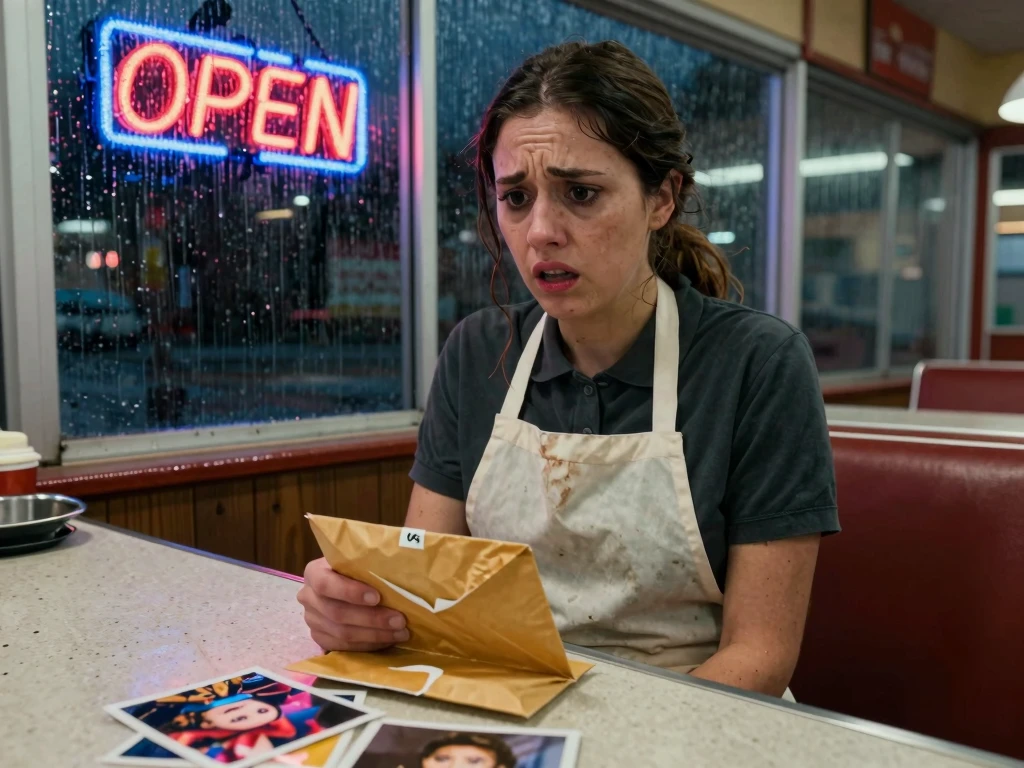
I was just a broke waitress trying to keep my sick mom alive. Giving my last $40 to a stranded, trembling old woman was supposed to be a simple act of kindness. But it became a terrifying, life-altering mistake. Because three hours later, the diner’s phone rang, and the notorious biker on the other end knew exactly who I was.
The rain was coming down in sheets, hammering against the greased-stained windows of Rusty’s Diner like a handful of gravel. It was a miserable Tuesday in November, the kind of damp, bone-chilling Ohio evening that makes your joints ache. I wiped down the cracked vinyl of Booth 4, my lower back screaming in protest. I was on hour eleven of a double shift, fueled by nothing but lukewarm tap water and the sheer, blinding panic of crushing medical debt.
My phone vibrated in my apron pocket. I didn’t need to look at the screen to know it was an automated text from the pharmacy. Mom’s insulin was ready for pickup. Total cost: $40. My current checking account balance: $42.50. It was a terrifyingly thin tightrope, but as long as I didn’t buy groceries or gas for the next three days, my mother would survive the week. I shoved the phone away, forcing a smile as I turned to top off the mug of a grumpy long-haul trucker at the counter.
That’s when the bell above the door chimed, a cheerful, out-of-place sound cutting through the gloomy diner.
The woman who walked in looked like she had just survived a shipwreck. She was elderly, frail, and soaked to the bone. Her silver hair was plastered to her forehead, and her oversized, moth-eaten wool coat hung heavy with rainwater. She stood by the entrance, clutching a battered leather purse to her chest, her pale blue eyes darting around the room with raw, unfiltered terror.
People stared. A couple of teenagers in the corner snickered. The trucker beside me let out a low, impatient grunt. But my heart instantly shattered. She looked so much like my own mother on her bad days—lost, vulnerable, and completely at the mercy of a world that didn’t care.
I put the coffee pot down and practically sprinted to the door. “Ma’am? Let’s get you out of the cold,” I said softly, gently guiding her by the elbow. She flinched at my touch, her whole body vibrating with a violent shiver.
“I… I think I’m lost,” she whispered. Her voice was thin and reedy, trembling violently. “It’s so dark out there.”
I guided her to the warmest booth, right next to the radiator, and rushed to get a towel and a mug of steaming hot water with lemon. When I returned, she was aggressively rubbing her gnarled, arthritis-swollen hands together. I sat across from her, ignoring the dirty looks from my manager wiping down the grill.
“My name is Grace,” I said, keeping my voice low and steady. “You’re safe here. Can I get you something to eat? A bowl of soup?”
She shook her head frantically. “No, no dear. Just the hot water. I don’t… I don’t have any money on me.” A deep flush of shame crept up her wrinkled neck. “My nephew was supposed to pick me up from the bus station. We were having a family reunion. But he never showed. My cell phone died. I started walking, and then the rain…”
She choked on a sob, burying her face in her hands. She had walked over three miles in a freezing downpour. I asked her where she was staying. She named Pinegrove Assisted Living, a facility a solid twenty minutes out of town, nestled deep in the wooded suburbs. It was a notoriously expensive place, which made her current abandoned state even more confusing.
“I’ll call you an Uber,” I said without thinking.
Her head snapped up. “Oh, heavens no. It’s too far. It will cost a fortune. I couldn’t possibly burden you, Grace. I’m just a stranger.”
I pulled out my phone and checked the app. With the rain surge pricing, the ride to Pinegrove was exactly $38.75.
My breath caught in my throat. If I paid for this ride, I wouldn’t have enough for Mom’s insulin. I would have to beg the pharmacist, or call my predatory landlord for an extension on rent, or sell something. The panic flared hot and heavy in my chest. But looking at this freezing, abandoned woman staring at me with such desperate, pleading eyes… I knew I couldn’t let her walk back out into that storm. I’d figure the insulin out. I always did.
“It’s already done,” I lied smoothly, forcing a bright smile. “The car is on its way. My treat.”
Tears spilled over her eyelashes, mixing with the raindrops on her cheeks. “You are an angel, Grace. A true angel. My son… he tries to take care of me, but he’s mixed up in things. Bad things. I thought seeing my nephew today would remind me of better times. But family…” She trailed off, a dark, haunted look crossing her face.
Fifteen minutes later, the headlights of the Uber washed over the diner windows. I helped her up and walked her to the door. Just before she stepped out into the rain, she stopped and grabbed my wrist. Her grip was shockingly strong, almost painful.
She shoved her hand into her damp coat pocket and pulled out a thick, sealed, heavy manila envelope. The edges were worn, and it looked like it had been carried around for years.
“Take this,” she commanded, her voice suddenly dropping its fragile tremor. It was firm. Urgent. “Do not open it until you absolutely have to. When the time comes, it will save your life. Just like you saved mine.”
Before I could process what she was saying, she climbed into the back of the car and was gone, swallowed by the stormy night.
I stood there like an idiot, holding the heavy envelope. It felt thick. Like a stack of photographs, or cash, or… something else. I shoved it deep into my apron, my stomach twisting into tight knots. The rest of my shift was a blur of anxiety. I was broke. I was exhausted. And I had a creepy envelope burning a hole against my thigh.
By 11:00 PM, the diner was dead. I had flipped the neon “OPEN” sign to dark and was sweeping up the last of the salt packets from the floor. The only sound was the rhythmic thrum of the rain and the humming of the old refrigerator.
Then, the diner’s landline phone rang.
It was a harsh, jarring sound that made me jump out of my skin. Nobody called the diner this late. Ever. My manager had already left out the back. I was completely alone.
I walked over to the counter, my hand shaking as I picked up the heavy plastic receiver. “Rusty’s Diner, we’re closed.”
“Is this Grace?”
The voice on the other end made my blood run cold. It was deep, gravelly, and carried an undercurrent of raw menace. In the background, I could hear the distinct, deafening roar of a motorcycle engine being revved, followed by the clinking of bottles and men shouting.
“Who is this?” I demanded, my heart hammering against my ribs.
“You helped my mother tonight,” the man said. The noise in the background quieted down, as if he had stepped into an alleyway. “She called me from Pinegrove. Told me a waitress gave up her last forty bucks to get her home.”
I swallowed hard. “It was nothing. I’m just glad Ruth is safe.”
“In my world, nothing is nothing,” the voice growled. “People don’t do favors without expecting something in return. My name is Johnny. But the cops and the streets call me ‘The Angel’.”
My knees practically buckled. Everyone in a fifty-mile radius knew who The Angel was. He was the president of the local chapter of the most violent, ruthless outlaw motorcycle club in the state. They ran the drug routes on the interstate. They were ghosts to the police and nightmares to everyone else. And I had just put myself directly on his radar.
“I don’t want anything,” I practically begged, my voice cracking. “Please. I was just helping an old lady.”
“Too late, Grace,” Johnny said, his voice dropping to a terrifyingly calm whisper. “My mother told me she gave you the envelope.”
My hand flew to my apron pocket. The envelope felt suddenly scorching hot against my skin.
“Listen to me very carefully,” Johnny continued, the revving of the motorcycle engine roaring back to life behind him. “Do not let that envelope out of your sight. Lock your doors. Do not call the police. I am riding into town tomorrow to collect it, and to repay my debt to you. If anyone else finds out you have it before I get there… you’re dead.”
The line went dead with a sharp click.
I stood there in the dimly lit diner, the dial tone buzzing in my ear like an angry hornet. My hands were shaking so violently I dropped the phone. It clattered against the linoleum floor.
I was suffocating. I couldn’t breathe. I locked the front door of the diner with trembling fingers, pulling the metal grate down with a loud crash. I leaned against the counter, sliding down until I hit the floor, pulling the heavy manila envelope from my pocket.
Do not open it until you absolutely have to. I couldn’t wait. I was dealing with a cartel-level biker gang. I needed to know what I was holding. With shaking, sweaty fingers, I tore the seal off the envelope and dumped the contents onto the floor.
I gasped, slamming my hand over my mouth to stifle a scream.
It wasn’t money. It wasn’t drugs.
It was a stack of high-definition surveillance photographs. And the person in the photographs… was me.
Pictures of me taking out the trash at the diner. Pictures of me walking into the pharmacy. Pictures of me sleeping in my own bed, taken through my second-story bedroom window.
And on the back of the final photo, written in thick, smudged red marker, were three words: WE FOUND HER.
Chapter 2
The cold linoleum of Rusty’s Diner felt like ice against my legs. I couldn’t tear my eyes away from the glossy photos scattered across the floor. My hands shook so violently that when I tried to pick one up, it slipped right back down. “We found her.” The words burned into my retinas. Thick, red marker. Smudged on the edges, like it had been written in a rush. Or in a rage.
I forced myself to look at the other pictures. My breath came in shallow, ragged gasps. The first photo was of me taking out the heavy trash bags behind the diner. The timestamp in the bottom corner read October 12th. That was three weeks ago. The next photo was me standing in the fluorescent glare of the pharmacy, arguing with the tech about the price of Mom’s insulin. Timestamp: October 18th.
But it was the third photo that made my stomach violently heave. It was a shot of my bedroom window. The blinds were partially open. I was asleep, curled up under my faded blue quilt. The angle of the shot meant the photographer had to be standing on the roof of the abandoned laundromat next door to my apartment building. Someone had been watching me sleep. Someone had climbed a decaying building in the middle of the night just to photograph me in my most vulnerable state.
Why? I was a twenty-four-year-old waitress drowning in medical debt. I drove a beat-up Honda Civic that stalled at red lights. I owned exactly three pairs of jeans and lived off diner scraps. There was nothing special about me. There was nothing worth stalking.
Unless this wasn’t about me at all.
My mind raced back to the old woman, Ruth. “Do not open it until you absolutely have to. When the time comes, it will save your life.” How was a stack of stalker photos supposed to save my life? Had she given me the wrong envelope? Or was this a warning?
“I am riding into town tomorrow to collect it,” Johnny had said on the phone. The Angel. A man whose name made local cops sweat. He was coming for this. If he found out I had opened it, if he knew that I knew they were watching me… I didn’t want to finish that thought.
I scrambled backward, my back hitting the base of the counter. I had to get out of here. The diner suddenly felt like a glass box, exposed to the dark, stormy street. Every headlight that swept past the rain-streaked windows felt like a spotlight. I frantically gathered the photos, my fingers fumbling, and shoved them back into the torn manila envelope. I tucked it into the inner pocket of my worn denim jacket and zipped it all the way up to my chin.
I grabbed my keys from behind the register and sprinted toward the back exit. The alleyway was pitch black, the solitary streetlamp having burnt out months ago. The rain was a torrential downpour now, instantly soaking through my thin jacket. I didn’t care about the cold. I only cared about the shadows.
I pressed my back against the brick wall of the diner, peering down the alley toward where I had parked my Honda. The street was empty. No motorcycles. No menacing black SUVs. Just the overflowing dumpsters and the sound of rushing water plunging into the storm drains. I took a deep breath, clutching my keys between my knuckles like makeshift brass knuckles, and ran.
My worn sneakers splashed through ankle-deep puddles. I reached my car, yanking the door handle. It was locked. I fumbled with the key, dropping it twice into the muddy asphalt before finally jamming it into the lock. I threw myself into the driver’s seat and slammed the door, immediately hitting the manual lock button.
I sat there in the dark, panting, wiping the rain from my eyes. I turned the key in the ignition. The engine sputtered, coughed, and died. “No, no, no, please,” I begged the steering wheel. “Not tonight. Please, not tonight.” I pumped the gas pedal and turned the key again. The old engine wheezed, then roared to life with a shaky, rattling hum.
I didn’t turn on my headlights until I was a block away from the diner. I took the back roads, avoiding the main drag of our small Ohio town. Every pair of headlights in my rearview mirror made my heart skip a beat. Was it him? Was it one of his guys? I took four random turns through a quiet residential neighborhood just to make sure I wasn’t being followed.
By the time I pulled into the crumbling parking lot of my apartment complex, my nerves were completely frayed. The building was a depressing, three-story brick structure with peeling paint and a security door that hadn’t locked properly since 2018. I parked under the flickering glow of the only working sodium lamp, killed the engine, and sprinted for the entrance.
I bounded up the stairs to the second floor, taking them two at a time. The hallway smelled faintly of boiled cabbage and stale cigarette smoke. I reached apartment 2B, unlocking the deadbolt, the chain, and the handle lock in rapid succession. I slipped inside and immediately locked them all behind me, leaning my full weight against the cheap wooden door.
“Grace? Is that you?”
The frail voice drifted from the tiny living room. I took a deep, shaky breath, trying to steady my racing heart. I couldn’t let Mom see me like this. I shoved the damp jacket with the envelope into the closet and walked into the living room.
Mom was propped up on the sagging floral sofa, a knitted blanket pulled up to her chest. The soft glow of the television illuminated her pale, sunken face. The illness had aged her ten years in the span of two. Her breathing was shallow, and her hands trembled as she reached for a glass of water on the coffee table.
“Hey, Mom,” I said, forcing a cheerful tone. I walked over and helped her guide the glass to her lips. “I’m home. Sorry I’m a little late. The rain really slowed things down.”
“Did you work a double again, sweetheart?” she asked, her eyes filled with that familiar, crushing guilt. “You’re working too hard. You shouldn’t have to carry all this.”
“It’s fine, Mom. Really. We had a great dinner rush. Lots of tips.” It was a lie. I had literally given away the last of our cash to a woman whose son was currently hunting me. The thought made a fresh wave of nausea wash over me. I needed to get her insulin tomorrow. I had absolutely no idea how I was going to do it.
“You look pale, Gracie,” Mom murmured, reaching up to touch my cheek. Her fingers were ice cold. “Are you coming down with something?”
“Just tired,” I deflected, gently squeezing her hand. “Let’s get you to bed. You need your rest.”
I helped her up, bearing most of her weight as we shuffled down the short hallway to her bedroom. I tucked her into bed, making sure her emergency call button was within reach on the nightstand. I kissed her forehead and turned off the lamp, leaving the door cracked just an inch so I could hear her if she needed me.
Once I was alone in the cramped kitchen, the facade crumbled. I sank into one of the wobbly dining chairs and buried my face in my hands. I was terrified. The envelope in the closet felt like a ticking time bomb. I needed to look at it again. I needed to see if I had missed something.
I retrieved my damp jacket and pulled out the manila envelope. I spread the photos out on the sticky kitchen table under the harsh overhead light. I examined every single one, looking for a clue. A reflection in a window. A license plate in the background. Anything that could tell me who took them and why.
That’s when I noticed the envelope itself. It felt unusually heavy for just a dozen photographs. I picked it up and squeezed the edges. There was something stiff lodged in the bottom corner. Something the tearing of the seal hadn’t revealed.
I grabbed a butter knife from the drying rack and carefully sliced the bottom seam of the envelope open. A small, black plastic rectangle fell out, clattering against the table.
It was a USB flash drive.
My pulse pounded in my ears. Why would Ruth give me a flash drive? Why would Johnny the Angel be coming to collect it? And what did it have to do with the photos of me?
I rushed to my bedroom and dug my ancient, heavy laptop out from under my bed. It was a dinosaur, practically held together by duct tape, but it still worked. I plugged it into the wall and waited an agonizing three minutes for it to boot up. The cooling fan whirred loudly in the quiet apartment.
I inserted the flash drive into the USB port. A notification popped up on the cracked screen: “Removable Disk (E:) detected.”
I clicked on the folder. There was only one file inside. It was an audio recording, titled simply “The Deal.mp3”.
I hovered my finger over the trackpad. If I clicked play, there was no going back. Whatever was on this drive was dangerous enough to warrant surveillance, dangerous enough to involve an outlaw motorcycle gang, and dangerous enough that an old woman believed it could save my life.
I took a deep breath and double-clicked the file.
The media player opened. There was a few seconds of static, followed by the sound of ice clinking in a glass. Then, a voice spoke. It was deep and gravelly. It was Johnny.
“I don’t care what it costs,” Johnny’s voice echoed from my laptop speakers. “I want her watched. Every hour. Every movement.”
Another voice replied. A man’s voice, smooth and professional. “My guys have been on her for three weeks, Angel. She’s a nobody. Just a waitress. She works, she goes home, she takes care of the sick mother. There’s no money there.”
“You’re not looking hard enough,” Johnny snapped. The sound of a fist slamming against a wooden table made me flinch. “You think I’m doing this for fun? You think I’m tracking a broke girl in Ohio for the hell of it?”
“Then why?” the smooth voice asked. “What’s the play here?”
There was a long, terrifying pause on the recording. I leaned closer to the laptop, holding my breath.
“Because,” Johnny’s voice dropped to a low, lethal whisper. “She doesn’t know who she really is. And more importantly, she doesn’t know what her mother stole from us twenty-four years ago. If the cartel finds her before we do, they’ll skin them both alive.”
The audio cut out. The file ended.
I sat frozen in my desk chair, the blood draining from my face. My mother? Stole from a motorcycle gang? From a cartel? Twenty-four years ago… the exact year I was born. My mother, the fragile, sweet woman sleeping in the next room, who baked cookies for the neighbors and cried over sad commercials.
It was impossible. It had to be a mistake. A case of mistaken identity.
But the photos. They were of me. They knew exactly where we were.
I stood up, pushing the chair back so hard it crashed to the floor. I had to wake Mom up. I had to demand answers. I had to know if my entire life was a lie, and if we were about to be murdered in our sleep.
I took exactly two steps toward my bedroom door.
Then, I heard it.
It was a soft, metallic scraping sound. It came from the front of the apartment. I froze, my bare feet rooted to the cheap carpet. I strained my ears over the sound of the rain beating against the windows.
There it was again. Scrape. Click.
Someone was picking the locks on my front door.
Chapter 4
The man blocking my car wasn’t just a random thug. Up close, in the harsh, flickering amber light of the broken streetlamp, he looked like a nightmare carved out of muscle and bad intentions. He wore a heavy leather cut over a soaked gray hoodie, the water pooling on his broad shoulders. A massive, wicked-looking hunting knife rested easily in his right hand.
The blade caught the dim light, practically glowing against the pitch-black backdrop of the storm. “Going somewhere, little bird?” his voice boomed over the deafening roar of the rain. It was a cruel, mocking sound that sent a fresh wave of ice-cold panic straight down my spine. “The Angel said you had something of ours. Hand over the envelope, and maybe I let your sweet old mother live.”
My mother let out a pathetic, high-pitched whimper, her knees buckling completely. If I hadn’t hooked my arm under her armpit, she would have collapsed face-first into the freezing mud. She squeezed my arm so hard her fingernails dug painfully into my flesh through my wet denim jacket. She was hyperventilating, her chest heaving in violent, jagged spasms.
“Grace,” she whispered, her voice a fragile, broken thread that barely reached my ears over the howling wind. “Do exactly what he says. Please, baby. Just give it to him.”
“No,” I growled, a primal, irrational rage suddenly replacing the suffocating terror in my chest. I had spent my entire adult life playing by the rules, working myself to the absolute bone, drowning in crushing medical debt just to keep us afloat. I had skipped meals so she could have her medication. I had endured double shifts on swollen feet.
I wasn’t going to die in a muddy, garbage-strewn alleyway. I tightened my two-handed grip on the heavy cast-iron skillet I had grabbed from the kitchen. I quickly calculated the distance between us. He was about ten feet away, blocking the only path to the driver’s side door of my beat-up Honda Civic.
If I threw the envelope at him, he would catch it. And then he would butcher us anyway. That’s how these things worked in the real world. I had consumed enough true crime podcasts to know you never give up your only piece of leverage, and you never, ever let them take you to a secondary location.
“I don’t have it on me!” I screamed back, taking a protective step in front of my trembling mother. “It’s inside! I left it on the kitchen table! You have to go up there to get it!”
The biker paused, his dark eyes narrowing under his hood as he weighed the lie. His gaze flicked upward toward the second-story window we had just climbed out of. In that split second of hesitation, that single moment where his focus shifted, I made my move. I didn’t turn and run away from him.
I charged directly at him.
He let out a bark of surprised laughter, his eyes snapping back to me as he raised the massive knife to slash at my face. But I didn’t aim for his head or his broad chest. I dropped low, my knees hitting the slick, wet asphalt, sliding through the freezing puddles like a baseball player desperate to steal home.
I swung the heavy cast-iron skillet with every ounce of adrenaline-fueled strength I possessed, putting my entire body weight behind the arc. The solid iron smashed directly into his left kneecap with a sickening, wet CRACK. The sound of bone shattering was louder than the thunder rolling overhead.
The man let out an agonizing, blood-curdling scream that tore through the stormy night. His leg buckled instantly, bending at a completely unnatural angle. He collapsed violently into the mud, dropping the hunting knife as his massive hands flew to clutch his ruined joint. I didn’t wait to see if he was getting back up.
I scrambled to my feet, my sneakers sliding in the muck, and kicked his dropped knife hard under the undercarriage of my car. I yanked the passenger door open, the rusty hinges groaning in protest. “Get in! Get in right now!” I screamed at Mom, physically shoving her frail body onto the worn fabric seat.
I slammed her door shut and sprinted around the front hood of the Honda, slipping twice in the treacherous mud. I threw myself behind the wheel, pulling the door shut behind me, and immediately slammed the heel of my hand onto the manual lock button. The man with the shattered knee was already crawling toward my side of the car, his face twisted in pure, homicidal rage.
He was leaving a thick, dark trail of blood in the rainwater. I jammed my key into the ignition, my hands shaking so violently I missed the slot twice. I finally forced it in and aggressively twisted it forward.
Click. Click. Click. Whirrr.
“No, no, no, please,” I shrieked, slamming my fist against the steering wheel. The battery was struggling against the cold dampness. Or the ancient starter was finally failing. Or the universe just actively wanted me dead.
The injured biker reached my car. He slammed a muddy, bloody hand against my driver’s side window, smearing crimson across the glass. His face pressed against the window, his mouth open in a feral scream, but I couldn’t hear the words over the sound of my own panicked sobbing and the pouring rain. He pulled his fist back and slammed it against the glass.
A spiderweb crack appeared right at eye level.
I twisted the key again, pumping the gas pedal frantically with my wet sneaker. The engine sputtered, choked on the cold air, and finally roared to life with a deafening backfire that shook the entire chassis. I didn’t even check the rearview mirror. I slammed the gearshift down into drive and stomped on the gas pedal with everything I had.
The bald tires spun wildly in the mud, shrieking as they fought for traction. For a terrifying second, we didn’t move. Then, the rubber caught the broken asphalt. The car violently jerked forward, the rear bumper clipping the crawling biker and sending him spinning away into the darkness.
I didn’t look back to see where he landed. I tore out of the apartment complex parking lot, my tires squealing loudly as I fishtailed onto the slick, rain-swept main road. I drove like a complete maniac, my foot practically glued to the floorboard.
I ran three solid red lights in a row, the horn of a passing delivery truck blaring as I narrowly avoided a T-bone collision. I nearly side-swiped a massive semi-truck as I forced my way onto the on-ramp for Interstate 95 South. I didn’t know where I was going. I just knew I had to put as much distance between us and that apartment as humanly possible.
I merged onto the dark, empty highway, pushing the dying Honda to eighty-five miles an hour. The steering wheel shook violently under my white-knuckled grip, the whole car vibrating as if it were about to shake itself apart. The rain lashed against the windshield, my wipers struggling to clear the deluge on their highest setting.
For thirty agonizing minutes, the only sounds in the car were the rhythmic, frantic slapping of the windshield wipers and my mother’s ragged, wheezing breaths from the passenger seat. The massive spike of adrenaline that had kept me moving was finally beginning to burn off. It left behind a cold, nauseous dread that settled heavy in my stomach.
My teeth began to chatter uncontrollably. My soaked clothes clung to my freezing skin. I stared at the hypnotic, flashing yellow lines of the highway, trying to process the absolute insanity of the last hour.
None of it made sense. The photos. The biker gang. The violent break-in.
“Mom,” I said, my voice eerily calm, contrasting with the chaotic storm outside. I kept my eyes locked on the road ahead. “I listened to the USB drive tonight. The one hidden inside the envelope that old woman gave me.”
She froze. I could see her silhouette stiffen completely in my peripheral vision. She didn’t turn to look at me. She just stared straight ahead into the darkness, her trembling hands tightly clutched in her lap.
“They said you stole something,” I continued, my grip on the steering wheel tightening until my joints ached. “Twenty-four years ago. They said if the cartel found us before the bikers did, they would skin us alive. What the hell did you do, Mom? Who are you?”
A long, agonizing silence filled the small cabin of the car, broken only by the roar of the highway underneath our tires. I waited. I wanted her to laugh. I wanted her to tell me it was a ridiculous misunderstanding, a cruel prank, or a case of mistaken identity.
But when she finally spoke, her voice wasn’t the sweet, frail, apologetic tone of the sick woman I had taken care of for five exhausting years. It was hard. It was remarkably cold. And it was utterly defeated.
“My real name isn’t Sarah,” she whispered into the dark car, pulling her wet, moth-eaten coat tighter around her shivering shoulders. “It’s Elena. And twenty-four years ago, before you were born, I was the head accountant for the Jimenez Cartel.”
I slammed both feet onto the brakes.
The car violently swerved onto the muddy, gravel-covered shoulder of the highway. The anti-lock brakes ground loudly as we skidded to a chaotic, terrifying halt, the back end of the car sliding perilously close to the deep drainage ditch. I threw the gearshift into park, the transmission grinding in protest, and turned to stare at her.
My jaw was practically on the floor. My brain completely short-circuited.
“You were a cartel accountant?” I yelled, the sheer absurdity of the words burning my throat like acid. “You bake snickerdoodles for the Methodist church bake sale! You cry when the dog dies in television commercials! You’re telling me you washed drug money for mass murderers?”
“I fell in love with a monster, Grace,” she sobbed, finally turning to look at me. The streetlights from the highway illuminated the tears streaming down her pale, wrinkled face. “Your father… he wasn’t just a lieutenant. He was their top enforcer. He was incredibly abusive, and he was deeply involved with the local outlaw motorcycle clubs. Including Johnny’s.”
She took a ragged, desperate breath, wiping her nose with the back of her trembling hand. “He was going to pull you into that violent, bloody life the exact second you were born. He told me he was going to raise you to run his distribution lines. I couldn’t let that happen to my baby. I couldn’t let him turn you into a monster too.”
“So you just ran away?” I demanded, my mind spinning out of control.
“You don’t just ‘run away’ from the cartel, Grace,” she laughed, a bitter, hollow sound that chilled me. “They own the police. They own the borders. If I just left, they would have found me in a week and put a bullet in my head. I needed leverage. So, I took something. Something they desperately, desperately needed to survive.”
“What did you take?” I asked, my voice dropping to a horrified whisper.
“The master ledger,” she confessed, her eyes wide with a twenty-four-year-old terror. “The digital bank accounts, the offshore shell companies, the routing numbers, the passwords. I took the access codes for over four hundred million dollars in illicit cartel funds.”
I felt the blood drain completely from my face. Four hundred million dollars. I had been skipping meals to afford forty-dollar insulin for a woman who was sitting on nearly half a billion dollars in cartel blood money.
“I stole it, I wiped their local servers, and I ran,” she continued, her words pouring out in a frantic rush. “I bought us fake identities. I moved us to Ohio. And I hid that master ledger somewhere they would never, ever find it. It was my insurance policy. As long as I had it, they couldn’t kill me without losing their entire empire.”
My entire existence was a fabricated lie. My name, my childhood, my struggles—all built on top of a mountain of stolen, dirty money. I pressed the heels of my hands into my eyes, trying to stop the world from violently spinning.
“Then what the hell is on the flash drive?” I asked, suddenly remembering the black plastic rectangle sitting heavy in my jacket pocket. “If you hid the ledger twenty-four years ago, what did Ruth give me at the diner?”
I unzipped my jacket, reached in, and pulled out the small USB drive. I held it up in the dim light of the car’s dashboard.
“I don’t know,” my mother said, her brow furrowing in genuine confusion. “I’ve never seen that drive in my life, Grace. The ledger I stole was on an old encrypted floppy disk. I haven’t touched it in decades.”
I stared down at the small piece of plastic resting in the palm of my trembling hand. If it wasn’t the ledger, why did Johnny want it so badly? Why did Ruth tell me it would save my life? I turned the drive over, running my thumb across the smooth, black casing.
The ambient light from a passing semi-truck washed over the interior of the car, briefly illuminating us in a harsh white glow. And in that split second of light, I saw something embedded deep within the plastic casing of the flash drive. Something that made my heart stop completely in my chest.
It was a microscopic, steadily pulsing red light.
Blink. Blink. Blink.
My stomach dropped into a bottomless abyss. It wasn’t just a flash drive containing a scary audio file. It was a live, active GPS tracker.
Ruth hadn’t given me a gift to save my life. She had given me a tracking device. She had turned me into a walking beacon for her son’s violent motorcycle club. And I had led them straight to my mother.
I slowly, mechanically raised my eyes to the rearview mirror.
Half a mile back down the dark, desolate, rain-slicked stretch of highway, three pairs of high-beam headlights suddenly clicked on in perfect unison. They weren’t the wide-set lights of a car. They were the tight, aggressive clusters of massive, heavy-duty motorcycles.
They shifted into a higher gear, the deep, guttural roar of their engines echoing across the empty fields, audible even through the sound of the storm. They were moving incredibly fast. And they were coming right for us.
END