I Married a Paralyzed 20-Year-Old Millionaire I Cared for to Save My Daughter – After the Wedding, He Gave Me an Envelope with Her Name on It and Said, ‘This Was Why I Really Needed You’
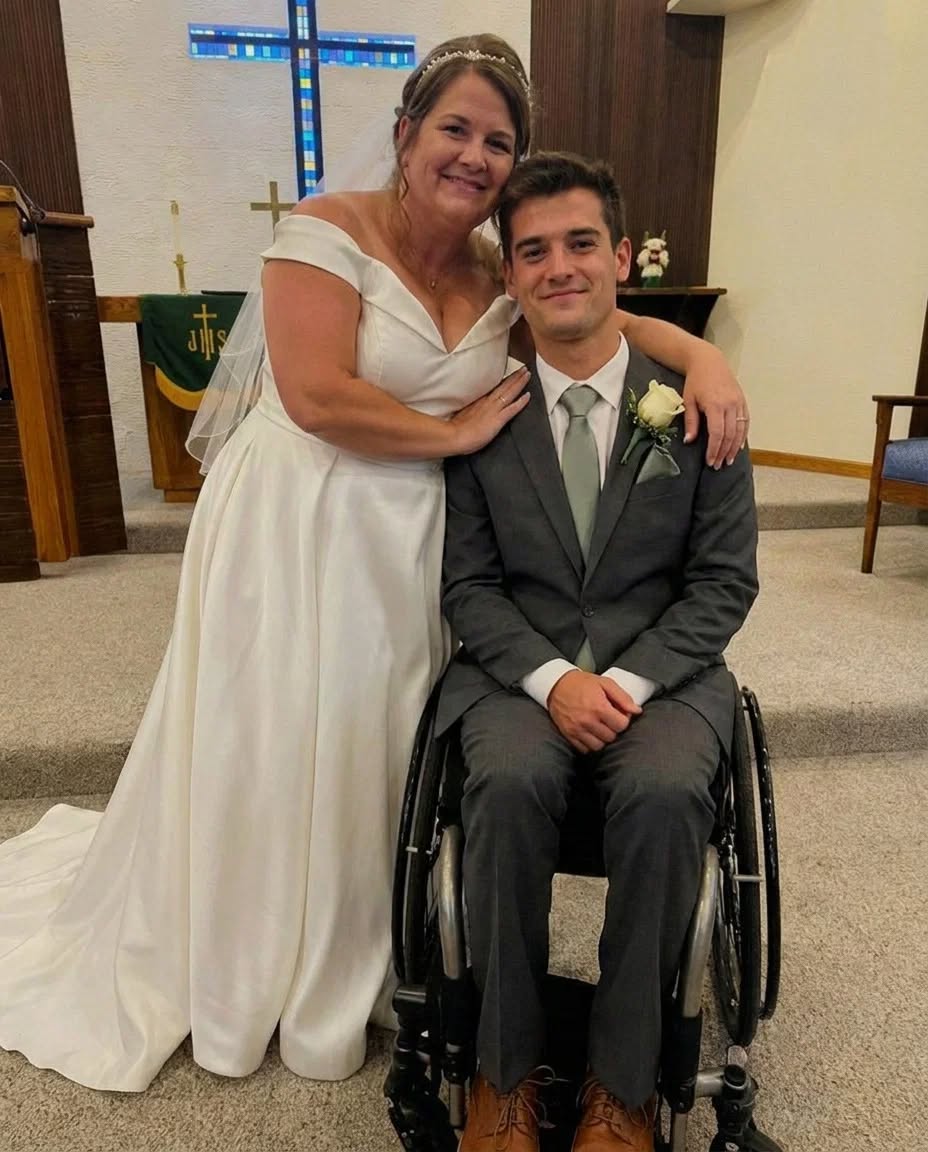
I married Adrian to save my daughter’s life, even though I knew people would judge me for it. But on our wedding night, he handed me an envelope with Lisa’s name on it, and what I discovered inside changed everything I believed about his family, my daughter, and the accident.
I married the twenty-year-old millionaire I cared for because my daughter was running out of time, and I had already run out of every other option. But on our wedding night, he gave me a crimson envelope with Lisa’s name on it and said, “This was why I really needed you.”
I kept telling myself I was not a terrible mother for accepting. I told myself there were worse things than being judged by strangers. There were hospital bills. There were doctors speaking in careful voices. There was my daughter, Lisa, lying motionless in a bed while time kept slipping away.
But on our wedding night, Adrian handed me a crimson envelope with Lisa’s name written across the front.
“Open it,” he said.
I stared at him.
My comatose daughter’s name was in my new husband’s pocket.
“Adrian,” I said, “why is my daughter’s name on that?”
His fingers tightened around the envelope. “Because there is no way back now, Kirsten. There is no way out of this.”
That morning, I had been sitting beside Lisa’s hospital bed, smoothing her dark hair over one shoulder. Even in a coma, she was still my girl, the one who hated having tangles in her hair. Still nineteen. Still mine.
Dr. Evans stood in the doorway with a folder pressed against his chest.
“Kirsten,” he said, “we need to talk about the neuro-rehab program.”
“I paid what I could yesterday, Dr. Evans. I can bring more on Monday.”
“The deposit is due next Friday. Without it, they will release her spot.”
I gripped Lisa’s hand. “Then hold it until Friday. Please.”
“I can’t.”
“You mean billing won’t bother trying.”
His expression softened. “If the deposit isn’t paid, we can continue basic support until a long-term care transfer is arranged.”
“Basic support,” I repeated. “That’s what people say when they want mothers to stop fighting for their children.”
“It’s not giving up.”
He looked at Lisa, then back at me. “Do what you can, Kirsten. That program is her best chance.”
By noon, I was back in Adrian’s cold mansion kitchen.
Adrian sat in his wheelchair, glaring at oatmeal.
The first week I worked for him, he told me not to call him sir because he was “twenty, not a retired judge.”
I told him he glared like one.
That made him laugh for the first time.
Most people treated him as if the wheelchair had swallowed his voice. They talked over him, around him, or at him in slow, cautious tones that made his jaw tighten.
I pushed the bowl closer. “Eat.”
“It tastes like wet cardboard, Kirsten.”
“I’ll add honey tomorrow.”
“Then I’ll hate it tomorrow.”
His mouth twitched.
“You don’t pity me, do you?” he asked.
“Honey, I feel for you, and I’m here to help. But pity? I don’t have the time.”
That became our rhythm. He snapped. I snapped back. Eventually, he let me help.
One afternoon, while I repaired the brake on his chair, he asked, “Was Lisa in college?”
“Community college. She loved it.”
“What did she study?”
“Everything. Nursing, design, psychology, then accounting because numbers made sense. She was still choosing.”
He almost smiled.
“She once bought a yellow raincoat keychain because she said it looked emotionally supportive. She would have argued with you like crazy, Adrian.”
He dropped his spoon.
His face had gone pale. “A yellow raincoat?”
I stared at him. “Yes.”
“Was it hanging from her car mirror?”
My hand froze on the chair brake.
“Adrian, how did you know that?”
He turned his chair toward the window. “Lucky guess.”
“No,” I said. “Nobody guesses a yellow raincoat keychain hanging from a car mirror.”
The hospital called before he answered.
Just like that, Adrian got to keep his secret a little longer.
I stepped into the hallway.
Dr. Evans’ voice came through low and careful. “Lisa’s rehab spot can only be held until tomorrow morning.”
I closed my eyes. “You said Friday.”
“I tried to extend it.”
“Then tell me what happens if I can’t pay.”
“She’ll be transferred to a lower-level long-term care facility.”
My hand tightened around the phone. “So she stays alive, but loses the program that might help her wake up.”
“I wish I had another answer.”
“So do I,” I said.
I hung up before I cried in Adrian’s hallway.
The next morning, I arrived at his house with my hands shaking so badly I burned his toast.
“You’re smoking up the kitchen,” Adrian said.
“I’ll make more.”
“Kirsten. You’re crying.”
He rolled closer. “Is it Lisa?”
That broke me.
“They’re moving her,” I said. “Not to rehab, like I hoped. Somewhere that can keep her stable, but not give her what she needs.”
“How much?”
“Don’t.”
“How much, Kirsten?”
“Too much. More than I can make. More than I can borrow. More than I can beg without losing the last piece of myself.”
Adrian looked down at his hands.
Then he said, “Marry me.”
I stared at him. “Excuse me?”
“Marry me, Kirsten.”
“That isn’t funny.”
“I’m not laughing.”
“You’re twenty.”
“I know.”
“I’m forty-three. I’m your employee.”
“I can hire someone else.”
“You are grieving, injured, lonely, and angry at oatmeal. That is not a proposal. That is panic with paperwork.”
His jaw flexed. “I’m not asking for romance.”
“That makes it worse, honey.”
“Vivian controls most of my trust until I’m twenty-one. She refuses what she calls emotional spending.”
“Lisa isn’t emotional spending.”
“I know.” His voice dropped. “My personal medical account and household fund are separate from the main trust. Vivian can delay almost anything I request alone. But if I’m married, my spouse can co-sign emergency medical expenses with me. She can still fight it, but she cannot bury it quietly.”
I stepped back. “No.”
“Kirsten.”
“No. I won’t marry a man for money, especially one with his entire life ahead of him. You deserve more, Adrian. You deserve to live.”
“You wouldn’t be using me.”
“Yes, I would.”
“Then use me.”
He said it as if the words cost him something. As if he already knew I would hate him for offering.
“Use the money. Use the name. Use whatever gets Lisa into that program.”
“Don’t talk about my daughter like she is a bill.”
“I’m talking about her like she is alive.”
That silenced me.
He looked at my phone on the counter. “If you leave here unmarried, what happens tomorrow?”
I looked away.
“They move her,” I whispered.
“And if you marry me?”
I hated him for placing my pride against Lisa.
“Why would you do this?” I asked.
His eyes flickered toward the window. “I can’t tell you everything yet.”
“Then my answer is no.”
“Please, Kirsten. I need one day of trust.”
My phone buzzed again. Hospital billing.
I thought of Lisa lying still while strangers decided what kind of chance she deserved.
Then I closed my eyes.
“Fine,” I whispered. “I’ll marry you. But if you are hiding something that hurts my daughter, I will never forgive you.”
Adrian looked at me like I had already wounded him.
“I know,” he said.
The courthouse wedding took eleven minutes.
The clerk asked if we were entering the marriage willingly.
Adrian said yes. Then she looked at me.
I thought of Lisa’s hand in mine, warm but still, and forced the word out.
“Yes.”
There was no music and no joyful witness, only a wilted gas station bouquet his driver had bought on the way.
When the clerk pronounced us married, Adrian did not try to kiss me. He only tightened his cold fingers around mine and squeezed.
“Lisa gets the transfer?” I whispered.
“Tonight,” he said. “I’ll do it myself.”
Back at the mansion, Adrian dismissed the nurse, the housekeeper, and the driver.
“Everyone out.”
The nurse glanced at me. “Are you sure?”
I looked at Adrian. His face was pale, but firm.
“Go,” I said.
When the door closed, he pulled out the crimson envelope.
“Open it.”
My stomach twisted.
Across the front was one name.
Lisa.
“Why do you have that?”
“Because this is why I really needed you.”
I tore it open.
The first page was an accident report.
Adrian’s name. His parents, deceased at the scene. Then, under surviving parties, Lisa.
“No.”
“Keep reading.”
I flipped the page and saw Lisa’s blue Honda under emergency lights. Rain shone across the crushed hood. From the mirror hung the yellow raincoat keychain.
My knees weakened. “She was there.”
Adrian’s voice broke. “Yes.”
“My daughter was in your crash.”
“Our crash.”
I turned on him. “You knew.”
“Not when we met.”
“But before today.”
He did not answer.
“Say it.”
“Yes.”
“You let me marry you before telling me Lisa was tied to the night your parents died?”
“I thought you would refuse the help.”
“Then you knew I deserved the truth.”
His eyes filled. “Yes.”
I pulled out another page. “What’s this?”
“Transfer records.”
“You went to a private trauma center?”
“My family’s emergency plan moved me there.”
“And Lisa went to County General.”
He looked down. “Yes.”
Two survivors. Two separate worlds.
He had been carried into money. Lisa had been carried into a waiting room.
The final page held Vivian’s signature.
“No further contact with Lisa’s family is recommended. Further contact may create unnecessary liability. Matter closed.”
“Matter closed?” My voice cracked. “My daughter was a matter?”
“Vivian handled everything while I was unconscious.”
“She knew Lisa survived? She knew I existed? And she never called?”
“Yes.”
I pressed the memo to my chest. “For six months, I begged strangers while your family signed my child away.”
“I didn’t know.”
“But now you do. So why marry me?”
“Vivian would block direct help. As my wife, you can co-sign the emergency petition and force her to answer in front of the trustee board. The money goes straight to Lisa’s care. You’re her mother.”
“Don’t make this noble, Adrian.” I stepped back. “You cornered me.”
“I know,” Adrian said.
“You gave me a wedding ring and called it mercy.”
“I was wrong.”
“My daughter isn’t your forgiveness project.”
His voice softened. “No. She’s Lisa.”
Before I could answer, the bedroom door opened.
Vivian stood there in a cream suit, her eyes fixed on the envelope.
“So,” she said. “He told you.”
I stepped in front of Adrian. “Get out.”
Her smile was thin. “You forget whose house this is.”
“No. You forgot my daughter was a person.”
Adrian gripped his wheels. “Vivian, leave.”
She ignored him and looked me over. “A paid caregiver marries a vulnerable young man, and I’m supposed to believe this is love?”
I held up the memo. “A wealthy woman saw a nineteen-year-old girl in a hospital bed and called her a closed matter to avoid a lawsuit. I’m supposed to believe that is protection?”
Her face hardened. “Your daughter’s tragedy does not entitle you to my nephew’s future.”
“No,” I said. “But your money never entitled you to erase her from his past.”
For one second, she had no answer.
Then she lifted her chin. “I’ll challenge this marriage.”
“Good,” I said. “Then bring the memo.”
The next morning, Adrian’s attorney met us at the dining table.
“The funds go directly to Lisa’s rehab program if the board approves the emergency petition?” I asked.
“Yes,” the attorney said. “And Adrian’s counsel will document every payment.”
“And I stay Lisa’s only medical decision-maker?”
“Yes.”
I looked at Adrian. “No guilt money.”
“No guilt money,” he said.
Only then did I sign.
By the end of the week, Vivian tried to humiliate me at a private foundation luncheon.
“This woman took advantage of my nephew,” she announced.
I walked to the front.
“No,” I said. “My daughter was treated like paperwork.”
I held up Lisa’s graduation photo. “This is Lisa. No one caused the storm. But what happened after was a choice.”
Then I read Vivian’s memo aloud.
“No further contact with Lisa’s family is recommended. Further contact may create unnecessary liability. Matter closed.”
A man at the nearest table turned pale. “Vivian, is that real?”
“For six months, I sat beside my daughter while doctors asked me to be realistic and billing offices asked me for money I didn’t have. And the whole time, someone in this family knew Lisa had been on that road too. Someone knew she had a mother. Someone knew she was alive. They just decided she was easier to close than to face.”
Adrian rolled beside me. “It’s real.”
Vivian whispered, “I was protecting you.”
“No,” he said. “You were protecting my wealth. I know you were preparing to argue I was not stable enough to manage my own medical fund.”
His attorney stood. “Pending review, Vivian is removed from discretionary medical approvals.”
Vivian looked at me. “You think you won?”
I looked at Lisa’s photo.
“No,” I said. “Lisa did.”
Three weeks later, Lisa entered rehab.
One afternoon, her finger twitched in my hand.
“Baby,” I whispered, “squeeze if you hear me.”
Her fingers curled weakly around mine.
Adrian stopped in the doorway, his eyes wet.
Lisa hadn’twoken overnight. The road ahead was still long.
But she’d answered me.
And for the first time since I slipped Adrian’s ring onto my finger, I stopped feeling like a woman who had sold herself to save her child.
I was Lisa’s mother.
And the woman who had called her a closed matter had to stand there while the whole room said her name.