I Screamed at a Homeless Boy for Touching My Rolls-Royce, But When I Saw the Rusty Chain Around His Neck, I Fell to My Knees in the Snow.
Chapter 1
The heater in the Rolls-Royce was set to exactly seventy-two degrees, but I still felt a chill in my bones. It was the kind of cold that expensive wool and Italian leather couldn’t fix.
“We’re not moving, Marcus,” I snapped, checking my watch for the third time in a minute. “The merger meeting starts in twenty minutes. If I’m not there, the board eats me alive.”
Marcus, my driver of fifteen years and perhaps the only man in Chicago who tolerated my temper, caught my eyes in the rearview mirror. “Gridlock, Mr. Vance. Someone spun out on the bridge. We’re stuck.”
I let out a groan of frustration, pressing my forehead against the cold tint of the window. Outside, the city was a grey, miserable sludge. Snow had been falling for three days straight, turning the streets into a mixture of ice and exhaust fumes.

I hated this city in the winter. Actually, I hated it most of the time. But winter was worse. It was ten years ago, in a winter just like this, that my life effectively ended.
The wealth I’d accumulated since then—the skyscrapers with my name on them, the private jets, this car—it was all just insulation. Layers I put between myself and the world so I wouldn’t have to feel anything.
Thwack.
A wet, grey slap against the windshield made me jump.
I looked up. A rag, dripping with filthy brown slush, smeared across the pristine glass right in front of my face.
“Oh, for God’s sake,” I hissed.
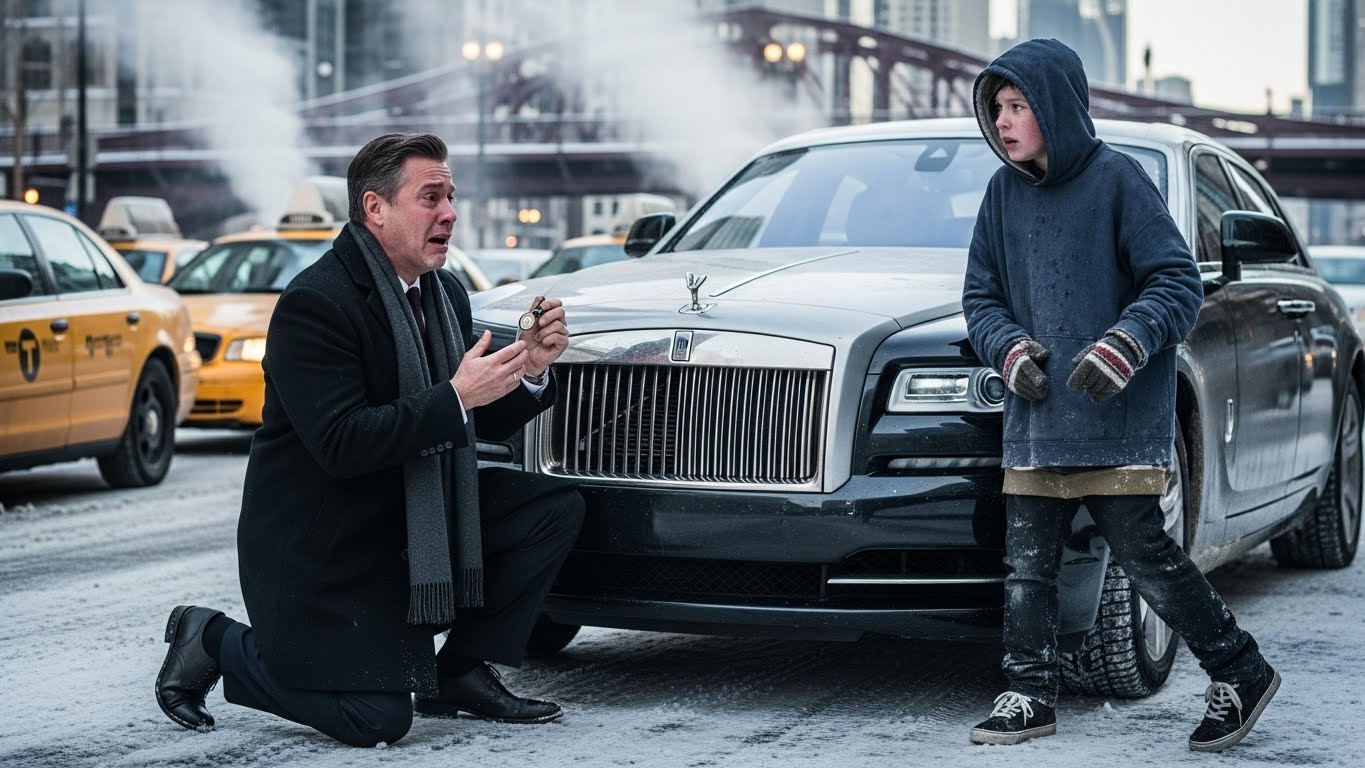
It was one of those squeegee kids. He looked small, maybe eleven or twelve, drowning in a faded navy hoodie that was three sizes too big. He was shivering, his movements frantic as he rubbed the dirty rag over the glass, making it worse, not better.
He wasn’t cleaning it. He was just looking for a handout.
“Marcus, get him away,” I ordered.
“Sir, he’s just a kid trying to make a buck—”
“I don’t care if he’s the Pope. He’s scratching the glass with that grit. Honk the horn.”
Marcus hesitated. That hesitation sparked a fury in me that had been simmering all morning. The stress of the merger, the anniversary of the kidnapping approaching, the endless grey sky—it all boiled over.
“Fine,” I growled. “I’ll do it myself.”
I threw the door open. The biting wind hit me like a physical slap, carrying the smell of diesel and wet garbage.
“Hey!” I shouted, stepping out into the slush. My expensive loafers sank into two inches of freezing mud. “Get away from the car!”
The boy froze. He was mid-wipe, his hand raised. He turned to look at me, and for a second, I was struck by how pale he was. His skin was translucent, his lips a pale shade of violet from the cold. But his eyes were sharp. Alert. Like a feral cat cornered in an alley.
“I said, get away!” I marched toward him, my voice booming over the sound of idling engines. “You’re scratching the paint! Do you have any idea what this costs?”
The boy flinched, pulling the squeegee back to his chest like a shield. “I was just… just trying to clean it, mister. Five bucks. That’s all.”
“I don’t have five bucks for extortion,” I spat, reaching out to shove him away from the hood. I didn’t mean to hurt him, I just wanted him gone. I wanted the reminder of poverty, of cold, of vulnerability to vanish from my sight.
I grabbed his shoulder. The material of his hoodie was damp and smelled of mildew.
“Let go!” the boy yelped, twisting away.
As he twisted, the zipper of his hoodie snagged. The fabric pulled open at the neck.
Something swung out.
It hit the metal of the car hood with a tiny, metallic clink.
Time didn’t just stop; it shattered.
I froze. My hand was still gripping the damp fabric of his shoulder, but I couldn’t feel the cold anymore. I couldn’t hear the honking horns or the wind.
All I could see was the object swinging from a rusty chain around the boy’s neck.
It was a silver locket. Not round, but shaped like a mockingbird in flight.
My heart hammered against my ribs so hard I thought it might crack them. I knew every scratch on that silver bird. I knew the tiny dent on the left wing where I had dropped it the day I bought it.
I had bought that locket for my wife, Sarah. And she had put it around our son’s neck, Ethan, the day before he was taken. “To watch over him,” she had said.
Ethan was three when he vanished from the park. The police found his mittens. They found his toy truck. They never found the locket.
And they never found Ethan.
My breath came out in a ragged, painful gasp. “Where…” My voice failed me. I tried again, gripping the boy tighter, not out of anger now, but out of a desperate, terrifying hope. “Where did you get that?”
The boy looked down at the locket, then back up at me. The terror in his eyes spiked. He thought I was accusing him of stealing it.
“I didn’t steal it!” he cried, his voice cracking. “It’s mine! Let me go!”
“No,” I whispered, my vision blurring. I reached out with a trembling hand to touch the silver bird. “Let me see it. Please. Is there… is there an inscription on the back?”
If it was the same one, the back would say: ‘Always come home.’
The boy saw the look in my eyes—the manic intensity—and he panicked. He stomped hard on my foot with his worn-out sneaker.
Pain shot up my leg, breaking my trance for a split second.
“Get off me!” he screamed.
He wrenched himself free. The rusty chain snapped.
The boy stumbled back, clutching the broken chain and the locket in his fist. He looked at me one last time, and I saw something that haunted me more than the locket.
I saw a familiarity in the shape of his jaw. The way his left eyebrow quirked up when he was scared.
“Ethan?” I choked out.
The name hung in the freezing air.
The boy didn’t answer. He spun around and bolted. He darted between a yellow taxi and a delivery truck, disappearing into the maze of gridlocked traffic.
“No! NO!”
I tried to run after him, but my leather soles slipped on the ice. I went down hard, my knees smashing into the dirty slush.
“Ethan!” I screamed, my voice tearing at my throat. “Wait!”
Marcus was by my side in an instant, hauling me up. “Mr. Vance! Arthur! What is it? Are you hurt?”
I shoved Marcus aside, my eyes frantically scanning the sea of cars. A flash of a blue hoodie. A small figure jumping over a guardrail toward the lower streets.
He was gone.
“The boy,” I gasped, grabbing Marcus by the lapels of his uniform. “Did you see the necklace, Marcus? Did you see it?”
“Sir, you’re in shock. Get back in the car.”
“It was Sarah’s locket,” I sobbed, the tears finally spilling over, hot and stinging against my freezing cheeks. “It was Ethan’s locket. That was him, Marcus. That was my son.”
Marcus went still. He looked at the empty spot where the boy had stood, then back at me. He didn’t tell me I was crazy. He didn’t tell me it was impossible. He knew the obsession that had consumed me for a decade.
“Get in the car, Arthur,” Marcus said, his voice dropping to a serious, dangerous tone I rarely heard. “We aren’t going to the merger.”
I looked at him, wiping the slush from my pants, my hands shaking uncontrollably.
“No,” I said, my voice hardening into steel. “We’re going to find him. I don’t care if we have to tear this city apart brick by brick. That boy is mine.”
I looked down at the snow where I had fallen. There, half-buried in the grey sludge, was something small.
The boy had dropped something in his panic.
I reached down and picked it up. It wasn’t the locket. He had taken that.
It was a laminated ID card, likely for a library or a school, but it was old and cracked. The photo was faded, but the name was legible.
Leo. Foster ID #8940.
I clenched the card in my fist until the edges dug into my skin.
“Leo,” I whispered.
I wasn’t Arthur Vance, the billionaire CEO, anymore. I was a father who had just seen a ghost. And I wasn’t going to let him disappear again.
Chapter 2: The Ghost in the System
The ID card burned a hole in my palm. Leo. Foster ID #8940.
My phone was vibrating violently in the breast pocket of my coat. It was the Board of Directors. It was my lawyer. It was the end of the merger, the deal of the century, the defining moment of Vance Industries.
I took the phone out, looked at the screen flashing ‘Chairman Sterling’, and powered it off.
“Marcus,” I said, my voice eerily calm despite the storm raging inside me. “Call Ray. Tell him to meet us at the address listed on this card. Now.”
Marcus looked at me through the rearview mirror. He saw the mud on my knees, the wild look in my eyes. He didn’t argue. He just nodded and engaged the privacy partition, giving me the only thing I needed right now: silence.
As the Rolls-Royce crawled through the gridlock, forcing its way toward the South Side, I stared at the faded photo on the card. The boy—Leo—looked younger in the picture. Maybe eight or nine. His hair was buzz-cut, his expression hollow. It was the face of a child who had already learned that smiling got you nothing but trouble.
I closed my eyes and saw Ethan.
Ethan had been a sunbeam. Blond curls, a laugh that sounded like bubbles popping. He loved blueberries and hated socks. He was the center of my universe, and when he was taken, the universe collapsed. Sarah, my wife, held on for two years. She withered away in that big, empty house, her heart simply too broken to keep beating. She died of “natural causes” on the death certificate, but I knew the truth. She died of grief.
I had been alone for eight years. I thought I had buried them both. But that locket…
The mockingbird.
“To watch over him.”
My thumb traced the plastic edge of the ID card. If this boy—Leo—had the locket, there were only two possibilities. Either he found it, or… or he was him.
But Ethan would be thirteen now. Leo looked small. Malnourished. The math was messy, but my gut was screaming louder than logic.
We arrived at the address forty minutes later. The scenery had changed from the steel-and-glass canyons of downtown to the crumbling brick and boarded-up windows of the forgotten districts.
The address on the card belonged to a place called “St. Jude’s Group Home for Boys.” It was a narrow, three-story Victorian house that had once been grand but was now rotting like a bad tooth. The paint was peeling in long, grey strips. The porch sagged.
A black sedan was already parked out front. Ray was leaning against it, smoking a cigarette.
Ray was an ex-detective who had been fired for breaking too many rules. He was the best PI money could buy, provided you didn’t ask how he got his information.
I stepped out of the car. The wind here felt sharper, cutting through the alleyways.
“You look like hell, Arthur,” Ray said, tossing his cigarette into a snowbank. He didn’t care about my money or my status. “And you missed a meeting that’s currently all over the news. Stock’s dropped four points.”
“I don’t care about the stock,” I said, shoving the ID card into his chest. “Who is he?”
Ray looked at the card, then back at the house. He sighed, a plume of white smoke escaping his lips. “I ran the number while I waited. Leo. Last name unknown. Found abandoned at a bus station in Jersey when he was four. Bounced around the system for years. Landed here six months ago. Ran away two weeks ago.”
“Four,” I whispered. “Ethan was three when he was taken. The timeline… it fits.”
Ray’s expression softened, just a fraction. He knew the history. “Arthur, don’t do this to yourself. A lot of kids get lost. It doesn’t mean—”
“He had the locket, Ray,” I interrupted, stepping closer, invading his space. “Sarah’s locket. The silver mockingbird.”
Ray went still. He knew about the locket. He was the one who had spent three years chasing leads on pawn shops across the Midwest for me.
“Are you sure?” Ray asked, his voice low.
“I saw the dent on the wing.”
Ray cursed under his breath. He turned and looked at the rotting house. “If he ran away two weeks ago, Mrs. Halloway inside isn’t going to be happy to see us. She collects checks for heads in beds. Missing kids is bad for business.”
“Break the door down if you have to,” I said, walking past him up the crumbling steps. “I want answers.”
Mrs. Halloway was a woman who looked like she was made of dried leather and resentment. She opened the door wearing a stained floral apron, the smell of boiled cabbage and stale cigarettes wafting out behind her.
When she saw me—my tailored suit ruined by mud, my face set in stone—and Ray looming behind me, she didn’t look intimidated. She looked annoyed.
“We ain’t buying nothing,” she rasped, moving to slam the door.
Ray caught the door with a heavy boot. “We’re not selling. We’re looking for a runaway. Leo.”
Mrs. Halloway’s eyes narrowed. “I already told the cops. He’s gone. Good riddance. Kid was a thief and a liar.”
“I’m not the cops,” I said, stepping into the dim hallway. The floorboards creaked under my weight. The house was freezing; they were keeping the heat low to save money. “I’m Arthur Vance. And I’m going to ask you once: Where did he go?”
Her eyes flickered when she heard the name Vance. She knew the money. Greed replaced annoyance instantly.
“Mr. Vance?” She wiped her hands on her apron, forcing a grotesque smile. “Oh, I didn’t recognize… well, come in. But like I said, the boy is trouble. A bad seed.”
We stood in a living room that smelled of mold. A TV blared in the corner. Three or four boys, ranging from six to sixteen, sat on a sagging couch, staring at us with guarded, empty eyes. They looked like soldiers who had seen too much war.
“Tell me about him,” I demanded, ignoring her attempt to offer me tea.
“Quiet. Weird,” Halloway huffed, crossing her arms. “Hoarded food under his mattress. Never spoke to nobody. And the stealing… caught him with a watch, a ring. He said he ‘found’ them.”
“Did he have a necklace?” I asked. “A silver locket?”
“He had some junk he kept hidden in a sock,” she shrugged. “I tried to take it—contraband, you know—but he bit me. Little animal. bit me right on the hand. After that, he took off. Climbed out the window.”
My hands curled into fists. The image of my son—my gentle, sweet Ethan—biting a woman to protect his mother’s locket tore me apart. He had been fighting. All this time, while I sat in boardrooms and drank scotch, he had been fighting to survive.
“Where would he go?” Ray asked, scanning the room. He was watching the other boys.
“Hell if I know. The sewers? The underpass on 5th? That’s where the rats usually congregate.”
I wanted to burn this house down. I wanted to buy the building just to evict her. But I didn’t have time for vengeance. Not yet.
I turned to leave, disgusted, when I felt a tug on my coat.
I looked down. A small boy, maybe seven years old, with glasses held together by tape, was looking up at me. He was trembling.
“Hey, Toby, get back to your room!” Halloway barked.
“Leave him,” I snapped at her. I knelt down, ignoring the pain in my bruised knees. “What is it, son?”
The boy, Toby, whispered so quietly I almost missed it. “He didn’t steal it.”
I leaned closer. “The locket?”
Toby nodded. “He talked to it. At night. When he thought we were asleep.”
My heart stopped. “What did he say to it?”
Toby looked at Halloway, terrified, then back at me. “He said… he said, ‘I’m coming, Mom. I promise.’”
The air left the room.
‘I’m coming, Mom.’
Sarah was gone. But he didn’t know that. He was still talking to her.
I pulled out my wallet. I didn’t look at what was inside; I just grabbed a thick stack of hundred-dollar bills—probably two thousand dollars—and shoved it into Toby’s small hand.
“Hide that,” I whispered. “Don’t let her see it. Buy food. Buy a way out.”
I stood up and turned to Ray. “The underpass on 5th. Let’s go.”
Night had fallen completely by the time we reached the 5th Street Underpass. It was a place the city pretended didn’t exist—a concrete cavern beneath the highway where the homeless built tent cities out of tarps and cardboard.
It was dangerous. Drug deals happened in the shadows. The wind howled through the tunnel like a dying train.
“Arthur, you stay near the car,” Ray warned, reaching under his jacket to check his shoulder holster. “This isn’t a boardroom.”
“I’m coming,” I said.
We walked into the darkness. Fires burned in oil drums, casting long, dancing shadows against the graffiti-covered walls. People huddled in sleeping bags, turning away from us as we passed. They knew better than to make eye contact with men in suits and leather jackets.
“Leo?” I called out.
“Keep it down,” Ray hissed. “You don’t want to attract the wrong attention.”
“I don’t care,” I shouted louder. “Leo! I just want to talk!”
A group of men warming their hands by a fire looked up. One of them, a giant of a man with a scarred face, stepped forward.
“You looking for the kid?” the man grunted.
Ray stepped in front of me. “Maybe. Who’s asking?”
“He owes me,” the man spat. “Little rat stole a blanket from my spot.”
“He didn’t steal it,” I said, stepping around Ray. My anger was returning, cold and sharp. “He was cold. Where is he?”
The man laughed, revealing missing teeth. “He’s gone, rich boy. Run off to the tracks. But if you want to pay his debt…” He pulled a knife. A rusty, jagged blade.
Ray didn’t flinch. He just opened his coat, revealing the Glock 19 holstered at his side. “Put the toothpick away.”
The man hesitated, then backed down, spitting on the ground. “The railyard. North end. He sleeps in the old boxcars. Says it’s safer than here.”
We didn’t wait. We moved toward the railyard.
The snow was falling harder now, turning into a blizzard. Visibility was near zero. The railyard was a graveyard of rusted metal, abandoned trains sitting on overgrown tracks.
“Leo!” I screamed against the wind.
“Arthur, look,” Ray pointed with his flashlight.
In the distance, a small flicker of light. A candle? A fire? Inside one of the rusted boxcars.
I ran. I slipped on the ballast stones, scraping my hands, ruining my coat, but I kept running.
I reached the open door of the boxcar and pulled myself up.
“Leo?”
The boxcar was empty of people. But in the corner, a small pile of straw and old newspapers was arranged like a nest. A single candle burned in a tin can, shielding it from the wind.
And there, pinned to the wooden wall of the train car with a rusty nail, was a drawing.
I walked over to it, my breath trembling in white puffs.
It was a drawing done in charcoal and crayon. It showed a house. A big house with tall pillars and a fountain in the front.
My house. The house I lived in ten years ago.
And standing in front of the house were three stick figures. A tall man. A woman with long hair. And a small boy holding hands with them.
Underneath the drawing, in crude, shaky letters, was a single word.
HOME.
He remembered.
He wasn’t just a random boy with a stolen necklace. He was Ethan. He was alive. He was here.
And I had just missed him again.
“Ray,” I choked out, clutching the drawing to my chest. “He was here. He drew this.”
Ray climbed up behind me. He looked at the drawing, and for the first time, the cynical detective looked shaken. “Okay. Okay, Arthur. We find him. We don’t stop until we find him.”
Suddenly, a noise outside. The crunch of snow under boots. Small, fast steps running away.
I spun around and looked out the boxcar door.
Through the curtain of falling snow, I saw him. The oversized blue hoodie. He was watching us from behind a stack of railway ties, his eyes wide reflecting the beam of Ray’s flashlight.
“Ethan!” I screamed, jumping down from the train car. The drop jarred my spine, but I lunged forward.
“Wait!” the boy yelled back. His voice was high, terrified, but clear. “Stay back!”
“I’m not going to hurt you!” I held up my hands, walking slowly through the snow. “I saw the drawing. I saw the locket. Ethan, look at me. It’s Dad.”
The boy froze. The wind whipped his hood back, revealing his face fully for the first time. The dirt was gone from his cheeks, washed away by the snow or tears.
He looked at me, really looked at me. And I saw the recognition war with the fear. He remembered the face, but he didn’t trust it. Ten years of hell had taught him not to trust.
“My dad is dead,” the boy said, his voice trembling. “They told me he died. They told me nobody was looking for me.”
“They lied,” I sobbed, taking another step. “I never stopped looking. Never. Not for a single day.”
The boy took a step back, poised to run. “Prove it.”
“The locket,” I said quickly. “Inside… inside there’s a picture. But it’s not of me and your mom. It’s a picture of a dog. A golden retriever named Buster. You loved him more than us.”
The boy’s hand went to his chest, clutching the broken chain I knew was in his pocket. His eyes widened.
He knew. Only he would know that.
“Buster?” he whispered.
“Yes. Buster.” I fell to my knees in the snow again, opening my arms. “Please. Just come here.”
The boy took a step forward. Then another. The wall of fear was cracking.
But just as he reached out, a blinding spotlight hit us from above. The deafening thwup-thwup-thwup of a helicopter rotor tore through the silence.
“POLICE!” a voice boomed from a loudspeaker in the sky. “STAY WHERE YOU ARE!”
Sirens wailed from the street behind the railyard. Blue and red lights flooded the snow.
The boy—my Ethan—looked up at the helicopter, then at the police cars swarming the perimeter. Panic, primal and absolute, seized him.
“You brought them!” he screamed at me, the betrayal in his eyes cutting deeper than any knife. “You tricked me!”
“No! No, Ethan, I didn’t!”
“Liar!”
He turned and bolted. Not toward the street, but toward the active tracks.
A freight train’s horn blasted nearby. The ground shook.
“Ethan, no!”
I scrambled up and ran, but Ray tackled me into the snow. “Arthur! The train! You can’t catch him!”
“Let me go!”
I watched helplessly as the small figure in the blue hoodie dived under the barrier of a passing freight train, disappearing behind the blur of steel wheels and roaring engines.
He was gone. Again.
And this time, he thought I was the enemy.
Chapter 3: The House of Ghosts
The interrogation room was sterile, white, and smelled of stale coffee and intimidation.
“Sit down, Mr. Vance,” the precinct captain said, tossing a file onto the metal table. “You can’t just chase children across active train tracks. Do you know how many laws you broke tonight?”
I didn’t sit. I stood by the one-way mirror, my hands gripping the back of the metal chair so hard my knuckles turned white. Every second I spent in this room, the temperature outside dropped another degree. Every second, Ethan—my Ethan—was out there in a hoodie and sneakers, running from the only person who wanted to save him.
“I don’t care about your laws, Captain,” I said, my voice low and vibrating with a dangerous calm. “I care about my son. I’m walking out of here. Now.”
“You’re not going anywhere until we process—”
“My lawyer is currently filing a lawsuit that will bankrupt this city,” I interrupted, turning to face him. “And I’m about to call the Mayor, who is currently funding his re-election campaign with my donations. You have two choices: You can arrest Arthur Vance, the grieving father trying to find his kidnapped son, and explain that to the press. Or you can give me a radio, tell your men to stand down, and let me do my job.”
The Captain hesitated. He looked at my eyes and saw something that scared him more than my money. He saw a man with nothing left to lose.
“Get him out of here,” the Captain muttered, waving a hand at the officer by the door. “But if that boy gets hurt, Vance, it’s on you.”
I burst out of the station doors into the biting wind. Ray was waiting in the Rolls-Royce, the engine running. The windshield was already icing over again.
“Where?” Ray asked as I slid into the passenger seat, ditching the partition.
“I don’t know!” I slammed my fist against the dashboard. “He thinks I betrayed him, Ray. He thinks I brought the cops. He’s running scared. Where does a scared kid go?”
Ray pulled the car into traffic, sliding slightly on the black ice. “Think, Arthur. The drawing. The house. You said it was your old house? The one you lived in before the kidnapping?”
“We sold that place six years ago,” I said, rubbing my temples. “It’s been empty. The developers went bankrupt. It’s just a shell.”
“Exactly,” Ray said, accelerating through a red light. “It’s a shell. No people. No police. And in his mind? It’s the last place he was happy. It’s ‘Home’.”
The realization hit me like a physical blow. Of course.
“42 Lakeview Drive,” I commanded. “Drive fast. If he’s walking, he’ll freeze before he gets there.”
The drive to the outskirts of the city was a nightmare of swirling white. The blizzard had turned into a total whiteout. We couldn’t see five feet in front of the car.
My mind raced back to the last thing Ethan said to me. “They told me he died.”
Who were they? Who had taken my son, kept him for ten years, and fed him lies? It wasn’t just a random snatch-and-grab. Someone had kept him. Someone had hidden him.
“Ray,” I said, the darkness in my voice filling the car. “When we find him… I’m going to find who did this. And I’m going to kill them.”
Ray didn’t tell me not to. He just tightened his grip on the steering wheel.
We skidded to a halt in front of the wrought-iron gates of the old estate. The “For Sale” sign was knocked over, buried in snow. The driveway was unplowed, a long stretch of pristine white leading up to the looming, dark silhouette of the manor.
But the snow wasn’t entirely pristine.
“There,” Ray pointed.
A set of small footprints, already half-filled with fresh snow, led through the gap in the gate and up the driveway.
“He’s here,” I whispered.
I didn’t wait for Ray. I threw the door open and sprinted. The snow was up to my shins, heavy and wet. My lungs burned with the cold air, but I forced my legs to move.
The front door of the mansion was boarded up, but one of the plywood sheets had been pried loose at the bottom. A small gap, just big enough for a child.
I tore at the wood with my bare hands, ripping splinters into my palms until the gap was wide enough for me to squeeze through.
“Ethan!” I roared into the darkness of the house.
The foyer was vast and empty. The grand staircase, where Sarah used to take Christmas photos, was covered in dust and debris. The wind whistled through broken windows, making the house moan like a dying beast.
Silence.
“Ethan, please! It’s Dad. I’m alone!”
I clicked on the flashlight Ray had tossed me. The beam cut through the floating dust motes.
I checked the living room. Empty. The kitchen. Empty.
Then I remembered.
The nursery. The room at the top of the stairs, facing the garden. That was his room.
I took the stairs two at a time, my heart hammering against my ribs like a trapped bird. I reached the landing and pushed open the door to the old nursery.
The room was stripped bare. No crib. No toys. Just peeling wallpaper with faint outlines of where cartoon bears used to be.
But in the corner, huddled beneath the window where the moonlight filtered in, was a pile of old curtains and debris.
And the pile was shivering.
“Ethan,” I choked out, dropping the flashlight.
I fell to my knees and crawled across the dusty floor. I pulled back the heavy velvet curtain.
He was there. curled into a tight ball, his lips blue, his skin pale as marble. The locket—the broken chain—was clutched so tightly in his hand that it had drawn blood.
He looked up at me, his eyes glassy and unfocused. Hypothermia was setting in.
“Dad?” he whispered, his teeth chattering violently. “Is… is Buster here?”
The question broke me. He was hallucinating.
“Buster is waiting for us, buddy,” I sobbed, gathering his freezing body into my arms. I ripped open my wool coat and pulled him inside, pressing his icy face against the warmth of my chest. “I’ve got you. I’ve got you. You’re safe.”
He didn’t fight me this time. He was too weak. He melted into me, his small hands grabbing my shirt.
“I waited,” he mumbled, his voice slurring. “The man… the man in the car said you were coming. But you never came.”
I froze, rocking him back and forth. “What man, Ethan? Who took you?”
Ethan buried his face deeper into my coat, seeking warmth. “The man with the… the silver cane. He said you sold me. He said you didn’t want a broken boy.”
The world stopped spinning.
The silver cane.
There was only one man I knew who walked with a silver-tipped cane.
Charles Sterling. The Chairman of my Board. My mentor. The man who had comforted me at Sarah’s funeral. The man who was currently trying to push through the merger that would give him full control of my empire.
He hadn’t just taken my company. He had taken my son. He had kept him as leverage, or insurance, or maybe just out of pure, twisted spite to break me so he could take the throne.
A primal roar built up in my throat, a sound of pure, unadulterated hatred.
But before I could scream, floodlights blinded us from the window.
Blue and red lights.
“THIS IS THE POLICE,” a voice amplified by a megaphone boomed from the driveway. “ARTHUR VANCE. COME OUT WITH YOUR HANDS UP. WE KNOW YOU ARE IN THERE.”
I looked down at Ethan. He whimpered, tightening his grip on me.
“They’re going to take me back,” he cried softly. “Don’t let them take me back to the bad place.”
“Over my dead body,” I whispered, kissing the top of his frozen head.
I stood up, lifting my son in my arms. He weighed nothing. He was a feather made of bones and trauma.
I walked to the window and looked down.
There were six cruisers. SWAT was deploying. They weren’t here to rescue a boy. They were here because someone powerful had told them a mentally unstable billionaire had kidnapped a child from a group home.
Sterling. He knew. He knew I had found the boy. He was trying to finish this.
Ray burst into the room behind me, panting, his gun drawn but pointed at the floor.
“Arthur! They’ve surrounded the perimeter. They’re saying you’re armed and dangerous. It’s a setup.”
“I know,” I said, turning to Ray. My eyes were dry now. The grief was gone, replaced by a cold, tactical fury. “Ray, take the boy.”
“What?” Ray blinked.
“Take him down the back service stairs. The servants’ tunnel leads to the old carriage house. It exits on the side street. My car is gone, but yours is parked around the block.”
“Arthur, what are you going to do?”
I buttoned my coat, covering my white dress shirt which was now stained with dirt and my son’s tears. I picked up a piece of rusted pipe from the floor.
“I’m going to walk out the front door,” I said. “I’m going to draw their fire. I’m going to buy you five minutes.”
“Arthur, they’ll shoot you,” Ray hissed. “You can’t win this.”
I looked at Ethan, who was reaching out for me, his eyes wide with panic.
“I already won,” I said, touching Ethan’s cheek one last time. “I found him.”
I shoved them toward the back door. “Go! Keep him safe, Ray. If anything happens to him, I will haunt you from hell.”
Ray hesitated, looked at me with infinite respect, then scooped Ethan up.
“Dad!” Ethan screamed, his voice finding strength for one last cry.
“I love you, Ethan!” I shouted back, my voice cracking. “Always come home!”
Ray disappeared into the shadows with my son.
I turned to the window, took a deep breath, and kicked the glass out. It shattered onto the snow below, drawing every flashlight, every gun barrel, every eye toward me.
I stepped into the window frame, the silhouette of a broken king, holding a rusty pipe like a scepter.
“HEY!” I screamed at the cops, at the world, at Sterling. “YOU WANT ME? COME AND GET ME!”
Chapter 4: The Warmth of Winter
Red laser dots danced across my chest like angry fireflies.
“DROP THE WEAPON!” the SWAT commander bellowed.
I looked at the rusty pipe in my hand. It was pathetic, really. A billionaire standing on the porch of his ruined kingdom, holding a piece of scrap metal against an army. But it wasn’t a weapon. It was a microphone.
I dropped the pipe. It clattered loudly on the frozen stone.
I raised my hands, not in surrender, but in a gesture of command. I looked past the barrels of the assault rifles, past the police cruisers, directly into the lenses of the news cameras that had gathered behind the police barricade.
“I AM ARTHUR VANCE!” I screamed, my voice tearing through the wind. “AND I AM NOT THE CRIMINAL HERE!”
The officers hesitated. They knew my face from Forbes covers and charity galas.
“Charles Sterling!” I roared, ensuring the name was recorded on every live feed in Chicago. “The Chairman of Vance Industries kidnapped my son ten years ago! He kept him in a cage while I built his fortune! He is the one you want!”
A ripple of confusion went through the police line.
“Get on the ground!” an officer yelled, uncertainly.
“Check the basement of the St. Jude’s Group Home!” I continued, walking slowly down the steps, my hands still high. “Check Sterling’s private accounts! I have the boy! My son is alive!”
Two officers rushed me. They slammed me into the snow, cuffing my hands behind my back. The cold burned my face, but I didn’t struggle. I laughed. A broken, hysterical laugh.
Because as they pressed my face into the ice, I saw the faint taillights of Ray’s sedan disappearing down the side street.
They got away.
The next forty-eight hours were a blur of lawyers, DNA tests, and media storms.
My accusation had been desperate, but Ray was a professional. He hadn’t just taken Ethan to safety; he had taken him straight to the FBI field office, bypassing the local cops Sterling had in his pocket.
Ethan’s testimony was damning. He remembered the “man with the silver cane” visiting the basement where he was kept for the first few years. He remembered the threats.
When the FBI raided Sterling’s penthouse, they found him packing a bag. They also found a safe containing photos—sick trophies of Ethan growing up in captivity, proof Sterling used to keep his “insurance policy” in check.
Sterling was in handcuffs before the sun came up.
But I didn’t care about Sterling. I didn’t care about the vindication or the apology from the Police Commissioner.
I only cared about the hospital room on the fourth floor of St. Mary’s.
I stood outside the door, terrified.
I had faced hostile takeovers, market crashes, and the barrel of a gun. But walking into that room felt like the hardest thing I’d ever done.
What if he still hated me? What if the trauma was too deep?
I pushed the door open.
The room was warm. Machines beeped rhythmically. Ethan was sitting up in the bed, looking small against the white pillows. He was clean now. The dirt was gone, his hair was washed, and he was wearing a hospital gown that didn’t smell like mildew.
He was eating a cup of blueberry Jell-O.
He looked up when I entered. He stopped chewing.
I stood by the door, twisting my hat in my hands. “Hi.”
Ethan swallowed. “Hi.”
“Is the… is the food okay?” I asked, instantly feeling stupid.
“It’s Jell-O,” he said. A tiny spark of sass. A glimpse of the boy he used to be.
I walked closer and sat in the uncomfortable plastic chair beside the bed. I reached into my pocket and pulled out the silver locket.
The police had given it back to me as evidence, but I had taken it to a jeweler first. The chain was fixed. The silver bird was polished, though I left the dent in the wing.
“I fixed it,” I said softly, placing it on the bedside table.
Ethan looked at the mockingbird. He reached out and touched it with a bandaged finger.
“You came back,” he whispered, not looking at me.
“I told you,” I said, my voice thick with emotion. “I will always come back. I’m sorry it took ten years. I’m so sorry I didn’t look in the right places. I’m sorry I yelled at you about the car.”
Ethan turned his head and looked at me. His eyes were Sarah’s eyes. Blue, deep, and searching.
“The car was nice,” he said. “But you looked sad. Even when you were yelling. You looked like the saddest man I ever saw.”
Tears pricked my eyes. “I was. Until yesterday.”
Ethan shifted in the bed. “Is Buster really… is he really gone?”
I nodded slowly. “Yeah, buddy. He died of old age. He had a good life. He slept on your bed every night until the end.”
Ethan’s lip trembled. The tears came then, silent and fast.
I didn’t hesitate this time. I leaned forward and wrapped my arms around him. And for the first time in a decade, my son hugged me back. He buried his face in my neck and sobbed, letting go of the fear, the cold, the hunger, and the loneliness.
“I want to go home,” he cried into my shirt.
“We are,” I promised, holding him tighter than I had ever held anything in my life. “We’re going home.”
Six Months Later
The winter was finally over. Chicago was blooming, the grey slush replaced by green grass.
I parked the car—a sensible SUV, not the Rolls-Royce—in front of the new house. It wasn’t a mansion. It was a smaller place in the suburbs, with a big yard and a fence.
“Dad, hurry up!” Ethan yelled from the passenger seat.
He looked different now. He had gained weight. His cheeks were rosy. He was wearing a baseball jersey and a cap that fit him perfectly.
“I’m coming, I’m coming,” I laughed, grabbing the gear from the trunk.
We walked into the backyard. It was a mess of construction. We were building a treehouse.
Ethan ran ahead, grabbing a hammer. He looked happy. But I knew the scars were still there. He still had nightmares. He still checked the locks on the doors three times before bed. But we were working on it. Together.
“Hey, look!” Ethan pointed to the dirt near the oak tree.
I walked over. A small sapling was pushing its way through the earth.
“It’s growing,” Ethan smiled.
I looked at him. The sunlight caught the silver locket around his neck. It glinted brightly.
“Yeah,” I said, ruffling his hair. “It is.”
My phone buzzed in my pocket. It was the office. The Board wanted to know when I was returning as CEO. The stock was at an all-time high since the scandal broke.
I looked at the phone. Then I looked at my son, who was trying to balance a plank of wood on his knee, sticking his tongue out in concentration.
I pressed the power button and silenced the call.
“Ready to work?” I asked, rolling up my sleeves.
“Ready,” Ethan said.
I picked up a nail and handed it to him. I wasn’t Arthur Vance, the billionaire, anymore. I was just a dad. And for the first time in ten years, I was exactly where I was supposed to be.
Home.