I Thought It Was Just a Pile of Snow Until I Saw the Tiny Hand Pressed Against the Glass.
Chapter 1: The Ghost in the Drift
The storm wasn’t just weather; it was a living thing, massive and hungry, swallowing the town of North Creek whole.
Frank “Sully” Sullivan gripped the steering wheel of his plow truck, his knuckles white, mimicking the landscape around him. The rig, a twenty-ton beast he affectionately called The Brute, shuddered as it chewed through two feet of fresh powder. The diesel engine roared, a low, guttural growl that usually comforted him. Tonight, it sounded like a warning.
“Dispatch to Unit 4,” the radio crackled, static slicing through the drone of the heater. “Sully, you copy? We got reports of a drift blocking the ambulance route on Route 9. You close?”
Sully grabbed the mic, his voice gravelly from twelve hours of silence and too many cigarettes. “I’m on Elm right now, Miller. Visibility is near zero. I can’t see the hood of my own truck.”
“Copy that. Do your best, Sully. It’s bad out there. State Police shut down the highway. We’re on our own.”
“Rodger.”
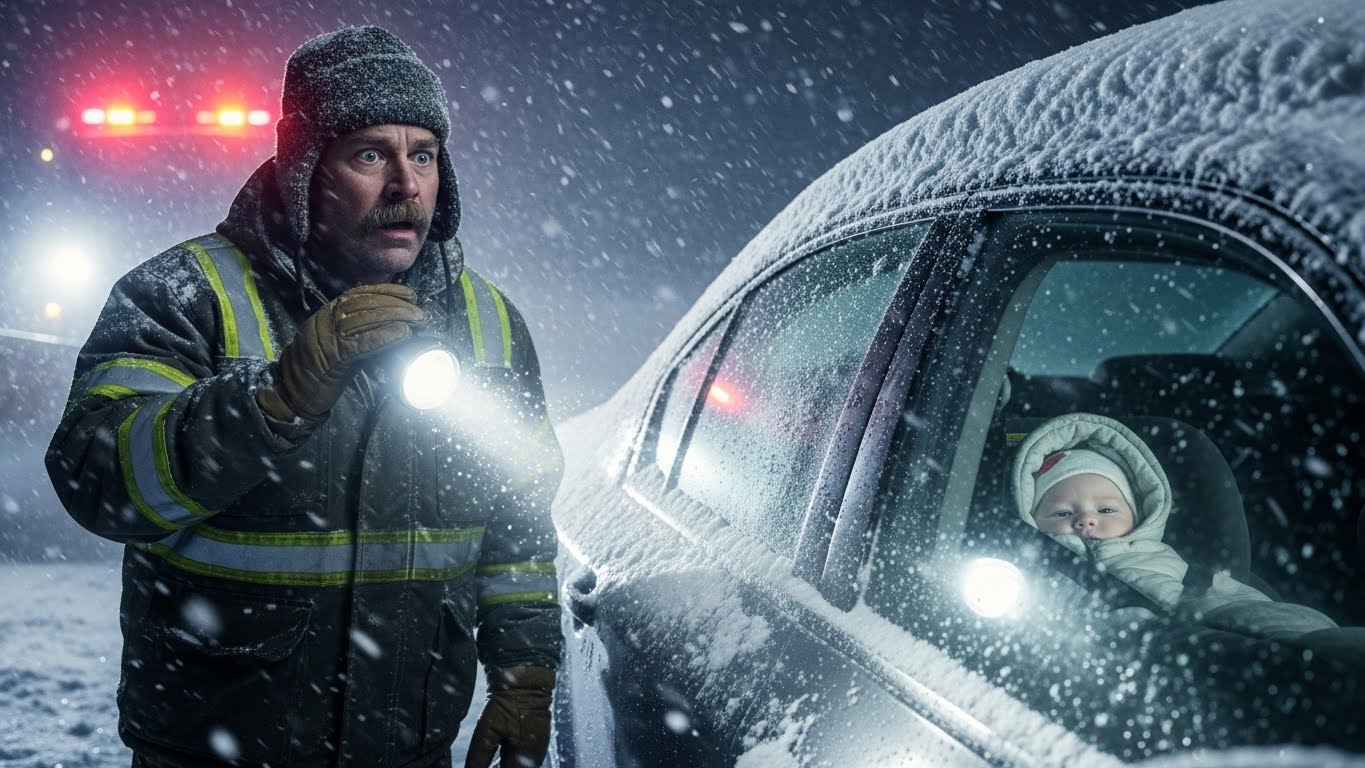
Sully hung up the mic and rubbed his eyes. He was fifty-four years old, and on nights like this, he felt every single day of it in his lower back. The cab smelled of stale coffee and wet wool. Outside, the world had ceased to exist. There were no houses, no trees, just the swirling vortex of snow illuminated by his headlights—a hypnotic, endless tunnel of white.
He hated the snow.
Most people in Minnesota learned to live with it. Sully had learned to hate it with a personal, quiet vengeance. Snow hid things. It covered mistakes. It had covered the patch of black ice ten years ago that sent his station wagon into a ravine, taking his wife, Martha, and their six-year-old son, Toby.
Sully swallowed the lump in his throat. He didn’t talk about it. He just drove the plow. He cleared the roads so other people could get home to their families. It was his penance.
He turned onto the access road near the old textile factory. It was a desolate stretch, flanked by dense woods on one side and a frozen creek on the other. No one should be out here.
Ahead, the headlights caught a shape.
It looked like a pile of trash bags someone had dumped before the storm hit. Or maybe just a weird accumulation of drift against a hidden stump.
Sully checked his side mirror. The massive steel blade on the front of The Brute was angled to push everything to the right. If he kept his line, he’d bury that pile under another two tons of snow, clearing the lane.
He pressed the gas.
It’s just snow, Frank. Just keep moving.
The truck surged forward. Ten yards. Five yards.
Then, a flicker.
It was something primal, a signal from the reptile part of his brain that bypassed logic. A flash of color that didn’t belong in the monochrome world. A dull, rusted red.
Sully slammed his boot onto the brake pedal.
The air brakes hissed violently. The heavy truck skidded, the back end fishtailing on the ice before biting into the asphalt and jerking to a halt. The blade stopped three feet from the mound.
Silence rushed back in, filled only by the howling wind and the thrum of the idling engine.
Sully sat there, heart hammering against his ribs. “You’re seeing ghosts, old man,” he muttered. He reached for the gear shift to back up and go around.
But he couldn’t do it.
He popped the door open. The wind instantly snatched it, nearly ripping it off its hinges. The cold was shocking, a physical slap that took his breath away. He jumped down, his heavy boots crunching into thigh-deep powder.
He waded toward the mound. The wind whipped ice crystals into his eyes, blinding him.
He reached the pile and brushed away the top layer of snow.
Metal. Cold, painted metal.
He swiped harder, frantic now. A roof. A door frame. It was a car. An old Honda Civic, almost completely entombed. The exhaust pipe was buried deep—if the engine was running, whoever was inside was dead from carbon monoxide by now.
Sully fell to his knees, digging at the driver’s side window with his gloved hands. “Hey! Anyone in there!”
He cleared the glass.
The interior was dark. He pressed his face against the cold pane, shielding his eyes from the glare of the plow’s headlights.
The driver’s seat was empty.
Relief washed over him. Abandoned. Someone’s piece of junk broke down, and they hitched a ride or walked to the gas station a mile back.
He started to stand up, ready to radio it in as an abandoned vehicle to be towed later.
Then he saw it.
In the back seat.
A car seat.
And in the car seat, a bundle wrapped in a blue blanket.
Sully froze. He squinted, praying it was a doll. Praying it was laundry.
The bundle didn’t move. But then, a small hand, pale and delicate, slipped out from the blanket and rested against the glass.
It was the size of a plum. The fingers were curled, not in a fist, but loosely. Limply.
“Oh god,” Sully choked out. “Oh god, no.”
He grabbed the door handle and yanked. Locked.
He hammered on the glass with his fist. “Wake up! Hey! Wake up!”
The hand didn’t move. The baby didn’t startle.
Sully scrambled back to his truck, slipping on the ice, cursing vilely. He grabbed the heavy flashlight from the dash—a Maglite, solid steel.
He ran back to the car. He didn’t hesitate. He swung the flashlight with everything he had at the rear passenger window, away from the baby’s face.
CRASH.
The safety glass exploded inward.
Sully reached in, unlocking the door, and ripped it open. The air inside the car was freezing. It was colder inside than outside. The engine had been off for a long time.
He unbuckled the straps, his thick fingers clumsy and trembling. He threw the blanket aside.
The baby was a boy, maybe ten months old. He was wearing a fleece onesie with little bears on it. His lips were a terrifying shade of violet. His eyes were closed.
“I got you. I got you, little man,” Sully whispered, his voice cracking.
He pulled the baby out, tucking the small body inside his own heavy Carhartt jacket, pressing the icy face against the warmth of his flannel shirt.
He looked around the car one last time. He checked the front seat. A purse. A fast-food wrapper. A cell phone on the floorboard, dead screen.
“Where is she?” Sully screamed into the wind. He scanned the tree line. “HELLO! IS ANYONE OUT THERE?”
The woods were silent. The snow fell relentlessly, covering his tracks as fast as he made them.
If the mother was out there, she was gone. The cold killed in minutes without gear.
But the baby…
Sully felt a faint, erratic flutter against his chest. A heartbeat.
Alive.
He turned and ran back to The Brute. He climbed up, shifting the baby to one arm, slamming the door against the storm.
He cranked the heater to the max, stripping off his gloves. He rubbed the baby’s back, the tiny arms.
“Come on, kid. Come on.”
The baby let out a sound—a weak, gasping whimper. It was the most beautiful thing Sully had heard in ten years.
He grabbed the radio mic.
“Dispatch! This is Unit 4! I have a Code Red! I repeat, Code Red!”
“Sully? What’s going on?” Miller’s voice was casual, bored even.
“I found a kid, Miller! A baby! Found him in a buried car on the access road. He’s hypothermic. I’m heading to St. Jude’s. Clear the route. I’m not stopping for lights, and I’m not stopping for snow.”
“A baby? Wait, Sully, say again—”
“CLEAR THE DAMN ROAD, MILLER!” Sully roared.
He threw the truck into gear. He didn’t bother lifting the plow blade all the way up. He hammered the gas. The Brute roared, tires spinning, then catching.
Sully drove with one hand on the wheel, the other holding the freezing child against his heart. He wasn’t a plow driver anymore. He was a father again. And this time, he wasn’t going to let the snow win.
Chapter 2: The Longest Mile
The distance between the access road and St. Jude’s Hospital was four miles. On a clear day, it was a seven-minute drive. Tonight, it was a war of attrition.
The Brute roared, its engine straining against the red line as Sully bullied the machine through drifts that reached the grille. He wasn’t plowing anymore; he was battering his way through. Every impact sent a shudder through the chassis that rattled his teeth, but his right arm remained a steel bar, locking the baby against his chest.
“Stay with me,” Sully gritted out, his eyes darting between the white void of the windshield and the pale, still face of the infant. “You hear me? You don’t get to quit. Not tonight.”
The heater was blasting at full force, turning the cab into a sauna, but the baby was still terrifyingly cold. Sully could feel the chill radiating through his heavy flannel shirt, a cold that felt unnatural, like death trying to stake a claim.
He looked down. The baby’s lips were no longer violet—they were grey.
“Come on!” Sully slammed his hand on the steering wheel.
A memory, unbidden and sharp as a razor, slashed through his mind. Ten years ago. Sitting in the waiting room. The smell of antiseptic and wet coats. The doctor walking toward him, pulling off a surgical mask, shaking his head. “I’m sorry, Mr. Sullivan. We did everything we could.”
“No,” Sully growled, shaking the memory off. “Not this time.”
He grabbed the radio mic again. “Dispatch! Tell them I’m two minutes out! Tell them to have a trauma team at the ER bay! I’m coming in hot!”
“They’re ready, Sully,” Miller’s voice came back, tight with tension. “Police are en route too. Just get there safe.”
Sully drifted around the final corner onto Main Street. The hospital sat on a hill, its emergency sign glowing a hazy, salvation red through the blizzard. The ramp to the ER was unplowed, covered in a foot of fresh snow.
A normal driver would have slowed down. Sully floored it.
The Brute hit the incline with a sickening lurch, tires spinning, throwing up rooster tails of slush. The truck fishtailed, sliding sideways toward the concrete retaining wall. Sully didn’t panic. He steered into the skid, feathered the gas, and felt the heavy tires bite. The truck corrected, surged forward, and slammed to a halt right in front of the sliding glass doors.
He didn’t bother to kill the engine. He kicked the door open and jumped.
His knees buckled when he hit the pavement, the adrenaline draining out of his legs, but he didn’t fall. He cradled the bundle with both arms now and ran.
The automatic doors whooshed open.
The heat of the hospital hit him, carrying that smell—rubbing alcohol and floor wax.
“Help!” Sully’s voice was a roar that cracked into a sob. “I need help here!”
Two nurses and a doctor in blue scrubs were already sprinting down the hall. They had a gurney ready.
“What do we have?” the doctor barked. He was young, Asian-American, with intense eyes. Dr. Park. Sully knew him from his annual physicals.
“Baby found in a car,” Sully gasped, gently laying the bundle onto the gurney. “Engine off. Buried. Maybe an hour, maybe more. He’s… he’s barely breathing.”
Dr. Park stripped the blanket back instantly. “Hypothermia. Severe. Cyanotic. Get a rectal temp and start warm saline IV. Code Blue protocol, let’s move!”
They swarmed the child. In seconds, Sully was pushed to the periphery. He stood there, chest heaving, his hands still shaped like they were holding the child, feeling the phantom weight.
He watched them rush the gurney through the swinging double doors. The last thing he saw was a nurse starting chest compressions with two fingers on the tiny ribcage.
Then the doors swung shut.
Sully stood alone in the hallway. He looked down at his boots. They were leaving puddles of dirty slush on the pristine linoleum. He was shaking. Not from cold, but from the crash. The emotional crash that comes when the emergency is handed off to someone else.
“Sir?”
A security guard approached him cautiously. “Sir, you can’t park that plow in the ambulance bay.”
Sully looked at the man, his eyes hollow. “Move it yourself,” he whispered.
He walked past the guard, heading for the waiting room. He collapsed into one of the orange plastic chairs, the same kind of chair he had sat in ten years ago. He put his head in his hands and wept. He didn’t make a sound; his shoulders just shook as the grief of a decade and the terror of the last hour collided.
Time became fluid. It might have been twenty minutes; it might have been two hours. Sully stared at the vending machine across the room, watching the hum of the refrigerator light.
“Frank?”
He looked up. Sheriff Jim Brody was standing over him, brushing snow off the brim of his hat. Brody was a good man, thick around the middle, with a face that looked like it had been carved out of granite and worried smooth by the job.
“Jim,” Sully croaked.
“You did a hell of a thing out there, Frank,” Brody said, sitting in the chair next to him, leaving a respectful seat gap between them. “Miller told me. You saved that kid’s life.”
“Is he…” Sully couldn’t finish the sentence.
“Doc Park says he’s stable,” Brody said quietly. “Core temp is coming up. Heartbeat is strong. He’s a fighter. Looks like the car seat acted as a bit of insulation, and the snow actually insulated the car from the wind chill. Another thirty minutes, though… well, let’s not talk about that.”
Sully let out a breath he felt like he’d been holding since 3:00 AM. “Thank God.”
“Frank,” Brody’s tone shifted. It became the Sheriff’s tone now. “We found the car. My deputies are digging it out now. We ran the plates.”
Sully turned to face him. “The mother? Was she in the woods?”
Brody shook his head slowly. “No sign of anyone in the immediate area. But that’s not the strange part.”
“What is it?”
“The car is registered to a Sarah Jenkins. Age twenty-six.” Brody pulled a small notebook from his pocket. “Address is in Phoenix, Arizona.”
“Arizona?” Sully frowned. “That’s two thousand miles away. What is she doing on a back road in Minnesota in a blizzard?”
“That’s what we’re trying to figure out,” Brody said. “We put a call into Phoenix PD. Sarah Jenkins was reported missing three days ago. By her husband.”
Sully felt a chill that had nothing to do with the snow. “Missing?”
“Husband said she took the kid and the car and vanished. He claimed she was having a mental breakdown. Said she was dangerous.”
Sully thought about the car. The way it was parked—or stuck—on a road that led to nowhere. The purse left on the seat.
“She wasn’t dangerous,” Sully said softly.
Brody looked at him. “How do you know?”
“Because of the blanket,” Sully said, closing his eyes, picturing the scene. “She wrapped him up, Jim. She put him in the fleece onesie. She strapped him in tight. And… when I broke that window…” Sully paused, his voice trembling. “The keys weren’t in the ignition.”
“So?”
“So she didn’t run out of gas while driving. She stopped. She took the keys. Why?”
Brody rubbed his chin. “To open the trunk?”
“Or to keep the heater from running out of gas while she went for help,” Sully reasoned. “Or… she didn’t want to be found.”
“By who?”
“The husband,” Sully said. It was a leap, but his gut was screaming at him again. The same gut that told him to stop the plow. “A woman runs from Arizona to Minnesota in winter. She’s running away from something, Jim. Not to something.”
Just then, the double doors of the ER swung open. Dr. Park stepped out. He looked exhausted, pulling his mask down around his neck.
Sully stood up immediately.
“He’s awake,” Dr. Park said, a small, tired smile touching his lips. “He’s crying. Loudly. Best sound in the world.”
Sully let out a laugh that sounded halfway to a sob.
“But,” Dr. Park continued, his expression serious again, “we found something. When the nurses were cutting off his clothes to warm him up… we found this pinned to the inside of his onesie.”
Dr. Park held out a plastic biohazard bag. Inside was a piece of paper, folded small, damp with condensation but legible.
Sully took the bag. His hands shook as he read the handwriting through the plastic. It was scrawled, hasty, written in what looked like eyeliner.
His name is Leo. If you find him, please, don’t give him back to David. David will hurt him. I’m going to draw them away. Please. Save my boy.
Sully stared at the note. Draw them away.
The realization hit him like a physical blow. The car on the access road. It wasn’t an accident. It was a decoy.
“She didn’t leave him to die,” Sully whispered, horror and awe mixing in his chest. “She left him to be found. She baited the trap with herself.”
“Draw who away?” Brody asked, reading over Sully’s shoulder. “The husband?”
“Maybe,” Sully said. He looked up at the Sheriff, his eyes hard and clear for the first time in years. The fog of his own grief was gone, replaced by a cold, burning purpose. “Jim, you said you didn’t find her near the car.”
“No tracks,” Brody confirmed.
“Because she didn’t walk away,” Sully said. “She walked back.”
“Back where?”
“To the main road,” Sully said, grabbing his coat. “She wanted to be seen. She wanted whoever was chasing her to follow her, away from the access road. Away from Leo.”
Sully zipped up his jacket.
“Where are you going, Frank?” Brody asked, standing up.
“I know these woods, Jim. Better than your deputies. If she’s out there, trying to lead a predator away from her cub, she’s not going to last the night.”
“Frank, you can’t go back out there. The storm—”
“I left my family once,” Sully interrupted, his voice low and dangerous. “I wasn’t there when they needed me. I’m not making that mistake again.”
He turned to Dr. Park. “Watch that boy. Don’t let anyone near him. Not even if they have a badge.”
Sully pushed past the Sheriff and marched toward the automatic doors. He was going back into the white.
Chapter 3: The Hunter and the Ghost
The woods bordering the access road were known to the locals as “The Tangle.” It was a mess of second-growth pine, choked with briars and steep ravines that dropped down to the frozen creek. In summer, it was hard to navigate. In a blizzard, it was a suicide mission.
Sully didn’t care.
He had parked The Brute sideways across the road to block any incoming traffic and grabbed the emergency kit from under his seat. He carried a heavy-duty flashlight, a flare gun, and the tire iron he’d used to smash the window.
Sheriff Brody and two deputies were pulling up behind him, their red and blue lights flashing uselessly against the wall of white.
“Frank!” Brody shouted over the wind, struggling to open his cruiser door. “Wait for the dogs! We have K-9 units coming from the county!”
“Dogs can’t smell in this cold, Jim! And they can’t track in fresh powder this deep!” Sully yelled back, not breaking his stride. “She’s got maybe twenty minutes before her heart stops. I’m going in.”
“Frank, don’t play hero!”
Sully ignored him. He stepped over the guardrail and slid down the embankment, vanishing into the treeline.
The wind inside the woods was different. It wasn’t a constant scream like on the road; it was a moaning, swirling presence that knocked snow from the high branches, creating sudden, blinding whiteouts.
Sully clicked on his Maglite. The beam cut a sharp yellow cone through the dark.
He scanned the ground. Nothing but smooth, unblemished white.
Think, Sully. Think.
If Sarah wanted to draw someone away from the car, she wouldn’t hide. She would make herself obvious. She would run toward the only other landmark out here: the old textile mill.
Sully turned north, trudging through knee-deep drifts. His lungs burned. His bad knee, the one he twisted in ’98, was screaming.
Keep moving. For Toby. For Martha.
Ten minutes in, he found it.
A scuff mark on a tree trunk. Not a natural scrape. The bark had been sheared off recently.
He shone the light down. There, partially filled in by the falling snow, was a depression. A footprint. Small. A sneaker, not a boot.
And ten feet behind it, another set.
These were different. Heavy. Deep. The stride was long. A man’s stride.
“Got you,” Sully whispered, a cold rage settling in his gut.
He picked up the pace, forcing his aching legs to pump. He followed the tracks. They were weaving, erratic. Sarah was stumbling. She was tired.
The tracks led toward the creek bed—a steep drop-off into a frozen ravine.
Sully reached the edge of the ravine and stopped. He killed his light.
If the hunter was down there, Sully didn’t want to be a beacon. He stood in the darkness, listening.
The wind howled above the trees, but down in the ravine, it was quieter.
Crunch.
Sully’s head snapped to the left.
Crunch. Crunch.
Footsteps. heavy and slow.
Sully squinted through the gloom. About fifty yards away, down near the ice, a beam of light swept across the snow. It wasn’t the chaotic searching of a lost person. It was methodical. Sweeping left, then right. Hunting.
Sully gripped the tire iron so hard his gloves creaked.
He didn’t see Sarah. But he saw where the man was looking. The flashlight beam lingered on a massive fallen oak tree, its roots torn up to form a small, dark cave.
The man with the flashlight stopped. He racked the slide of a pistol. The metallic clack-clack echoed crisply in the cold air.
“Sarah,” a voice called out. It was calm. Terrifyingly calm. A smooth, educated voice that didn’t belong in these woods. “I know you’re cold, honey. I’m cold too. Let’s go get Leo. The car is warm.”
Sully’s heart hammered against his ribs. David.
The figure took a step toward the fallen oak. “Come on out, Sarah. We can talk about this. You’re not thinking clearly. You’re sick.”
Sully saw movement under the root ball. A terrified recoil. She was there.
The man raised the gun. “Don’t make me drag you out.”
Sully didn’t think. He didn’t plan. He just reacted.
He raised his flare gun, aimed it high into the canopy above the man, and pulled the trigger.
THUMP.
The flare hissed upward, striking a heavy pine branch directly above David’s head. It didn’t explode like a firework, but it sizzled and burned a brilliant, blinding magnesium red, sticking to the resinous wood.
“WHAT THE—” David spun around, blinded by the sudden glare from above.
“HEY!” Sully roared, his voice booming like a bear’s. He clicked his heavy flashlight on, aiming it right into David’s eyes, blinding him further. “DROP IT! POLICE!”
It was a bluff. A desperate, stupid bluff.
David shielded his eyes, firing a wild shot into the darkness. BANG!
The bullet whizzed past Sully’s ear, snapping a twig behind him.
Sully didn’t flinch. He couldn’t. He charged down the slope, sliding on the snow, using his momentum as a weapon. He was big—six-foot-two, two hundred and fifty pounds of corn-fed Minnesota muscle.
David fired again, but he was shooting blind into the flashlight’s glare. The shot went wide.
Sully hit him like a freight train.
Shoulder met chest. The impact knocked the wind out of both of them. They tumbled into the snow, rolling toward the frozen creek.
The gun flew out of David’s hand.
Sully scrambled to get on top, but David was younger, faster, and desperate. He kneed Sully in the stomach, hard.
Sully grunted, gasping for air. David scrambled to his feet, eyes wild, searching for the gun in the snow.
“You old fool,” David spat, blood trickling from his lip. “You have no idea what you’ve walked into.”
He spotted the gun. It was five feet away.
Sully was on his knees, wheezing. He couldn’t reach the gun in time. He couldn’t reach David.
David lunged for the weapon.
“NO!” A scream pierced the air.
Sarah launched herself from the root ball. She was barely moving, her limbs stiff with cold, but she threw her entire body weight onto David’s back just as his fingers brushed the pistol grip.
It wasn’t enough to stop him, but it threw him off balance. He face-planted into the snow, kicking Sarah off him with a vicious backward thrust of his boot.
“Get off me, you bitch!”
Sarah crumpled, too weak to rise.
David grabbed the gun. He rolled onto his back, aiming it at Sarah.
“I told you,” he panted, his eyes dead and cold. “I told you no one takes my son.”
Sully roared. He didn’t have time to stand. He threw the only thing he had left.
The heavy steel Maglite left his hand, spinning end over end.
THWACK.
It struck David square in the forehead.
The sound was sickening—bone on metal. David’s head snapped back. The gun fired into the sky as his body went limp, collapsing back into the snow.
Silence returned to the woods, heavy and instant.
Sully crawled over to the gun. He picked it up, his hands shaking violently, and tossed it far out onto the thin ice of the creek. It skittered away into the dark.
Then he crawled to Sarah.
She was curled in a fetal position, her skin ghostly white, her lips blue. She was shivering so hard her teeth were audibly clicking. She looked up at him with eyes that were glassy and fading.
“L-Leo?” she stammered. “Is… is he…”
Sully pulled her up, unzipping his jacket and wrapping it around her, engulfing her in his body heat.
“He’s safe,” Sully choked out, tears freezing on his cheeks. “He’s at the hospital. He’s warm. He’s safe, Sarah. You did it.”
Sarah let out a long, shuddering breath. Her head lolled against Sully’s chest. Her eyes fluttered closed.
“Sarah!” Sully shook her gently. “Sarah, stay with me! Don’t you sleep! You hear me? Don’t you dare sleep!”
She didn’t answer. Her shivering was stopping. That was the last stage.
Sully looked up the steep ravine. The road was too far. He couldn’t carry her up that slope in deep snow fast enough.
He reached for his radio on his belt, but it was smashed from the fight.
He looked at David’s body. The man was groaning, starting to stir.
Sully was alone. He had a dying woman in his arms, a killer waking up ten feet away, and a blizzard that was trying to bury them all.
“Okay,” Sully whispered, hoisting Sarah’s limp body over his shoulder. “Okay. One more mile, Sully. Just one more mile.”
He didn’t go up. He stepped onto the frozen creek. The ice groaned under his weight. It was the fastest way back to the mill, but one wrong step and they’d both go through into the black water.
Sully took a step. Then another.
Behind him, he heard David cough.
“You… you can’t…” David’s voice was weak, but full of venom.
Sully didn’t look back. He started to run on the ice.
Chapter 4: The Thaw
The ice of North Creek wasn’t a solid sheet; it was a treacherous, living mosaic of frozen plates, hidden currents, and air pockets. In the summer, the creek was lazy and shallow. But in the winter, fed by the runoff from the mountains, it was deep, black, and fast.
Sully knew this creek. He had fished it as a boy. He had walked its banks as a grieving father. He knew where the deep pools were. He knew where the ice was rot.
David didn’t.
Sully moved with a shuffling, sliding gait, keeping his knees bent to distribute his weight. Sarah was a dead weight on his left shoulder, her breathing shallow and ragged against his neck. Every step sent a spiderweb of white fractures shooting out from his boots. The sound was a high-pitched ping-ping-ping—the sound of tension reaching its breaking point.
“Stop!”
The voice came from behind, distorted by the wind and pain.
Sully didn’t stop. He didn’t turn. He counted his steps. One, two, three… avoid the dark patch… four, five…
“I said stop, you son of a bitch!”
A gunshot cracked.
The bullet struck the ice three feet to Sully’s right, sending up a spray of razor-sharp shards.
Sully flinched, slipping. He went down to one knee, the impact jarring his spine. The ice beneath him gave a sickening GROAN, a deep, bass note that vibrated through his shinbone. Water bubbled up around his boot—black and slushy.
He froze. If he moved wrong now, they would both go in.
“End of the road, old man.”
Sully turned his head slowly.
David was standing twenty yards back. He was a mess. Blood from the flashlight strike had matted his hair and was freezing in dark streaks down his face. He was holding a second gun—a small ankle piece, a backup. He was limping, favoring his left leg, but the adrenaline of rage was keeping him upright.
“You don’t want to do this, David,” Sully shouted over the wind. His voice was calm, the calm of a man who has already accepted his fate. “The ice won’t hold us. Look at it. It’s rotting.”
“It’ll hold me long enough to put a bullet in you,” David snarled. He took a step.
CRACK.
The ice beneath David dipped. He wobbled, arms pinwheeling.
“Don’t move!” Sully warned, his voice sharp. “David, listen to me. The current is strongest right there. You’re standing on an air pocket. You take one more step, and you’re gone.”
David sneered, wiping blood from his eye. “You think I’m stupid? You think I’m going to let you walk away with my wife? With my son?”
“She’s not your wife anymore,” Sully said, shifting his weight imperceptibly, trying to find leverage to stand. “She’s your victim. And that boy? He’s safe. Even if you kill us, the Sheriff has him. It’s over.”
“It’s over when I say it’s over!” David screamed.
He raised the gun. He took a step forward, planting his foot hard to steady his aim.
It was the step of an arrogant man. A man used to solid ground. A man who thought the world would bend to his will.
But the ice didn’t care about money. It didn’t care about anger. It only cared about physics.
The sheet of ice beneath David didn’t just crack; it disintegrated.
There was no cinematic splash. Just a sudden, violent collapse. One second David was standing there; the next, he was gone, swallowed by the black throat of the creek.
“AHH—!” The scream was cut short as the freezing water hit his lungs.
David bobbed up, thrashing. The current grabbed him instantly, dragging him toward the center channel where the ice was jagged and thick. His hands clawed at the edge of the hole, but the ice just crumbled under his grip.
“HELP! HELP ME!”
Sully watched.
For a split second, the instinct to save kicked in. It was the instinct of a first responder, of a father. He shifted his leg to move toward the hole.
Then he felt Sarah’s faint, erratic heartbeat against his chest. He thought of the tiny hand on the glass. He thought of the bruises that were likely hidden under Sarah’s clothes.
David wasn’t drowning because of an accident. He was drowning because he chose to hunt.
“I can’t reach you!” Sully lied. He didn’t move.
David’s eyes met Sully’s across the expanse of white. They were wide with a realization that came too late. The current yanked him down. His head slipped under. A hand reached up, grasping at the air—a dark mirror of the baby’s hand from earlier.
Then, nothing.
Just the black water swirling, sealing itself back up with slush.
Sully let out a breath that smoked in the air. “Goodbye, David.”
He turned back to the north bank. He gritted his teeth, stood up on his screaming knee, and hoisted Sarah higher.
“Almost there, honey. almost there.”
He trudged forward. The mill loomed ahead, a dark monolith against the grey sky. But at the base of the mill, Sully saw something beautiful.
Lights.
Red and blue strobes bouncing off the brick walls. Flashlights cutting through the trees.
“OVER HERE!” Sully roared, his voice breaking. “DOWN HERE!”
A beam of light swung toward him. Then another.
“I see him!” It was Sheriff Brody’s voice. “I see him! Get the ropes! Get the medics!”
Sully reached the bank. He didn’t have the strength to climb up the muddy slope. He fell to his knees in the snow at the water’s edge.
Strong hands grabbed him. Deputies were sliding down, pulling Sarah from his arms, wrapping her in foil blankets.
“We got her, Frank. We got her.”
Sully slumped back against a tree trunk. The world was spinning. The adrenaline was fading, leaving behind a cold so deep it felt like burning.
Sheriff Brody was in his face, shining a light in his eyes. “Frank? Frank! Stay with me, buddy. You hurt?”
“Toby…” Sully whispered, his eyes unfocused. “I saw… I saw the hand.”
“Frank, you’re in shock,” Brody yelled over his shoulder. “Get a stretcher! Now!”
Sully looked up at the sky. The snow was stopping. The clouds were breaking apart, revealing a single, cold star.
I didn’t fail this time, Martha, he thought as the darkness rushed in to claim him. I brought them home.
Two Days Later
The beeping was annoying.
Sully swatted at the air, trying to hit the alarm clock. His hand hit something plastic and hard.
“Easy, tiger.”
Sully opened his eyes. The light was bright. Too bright.
He blinked. He was in a hospital bed. His left leg was elevated. His chest felt like it had been kicked by a mule.
Dr. Park was standing at the foot of the bed, checking a chart. Sheriff Brody was sitting in the corner, reading a newspaper.
“You’ve been out for thirty hours,” Brody said, folding the paper. “Pneumonia. Exhaustion. And a knee that’s swollen to the size of a cantaloupe.”
Sully tried to sit up and groaned. “Sarah? The baby?”
Brody smiled. It was a genuine smile, one that reached his tired eyes. “Alive. Both of them.”
Sully let his head fall back onto the pillow. The relief was a physical weight lifting off his chest. “And David?”
Brody’s face hardened. “State divers pulled his body out of the weir down near the reservoir yesterday morning. We found his ID. We also found a warrant out for his arrest in Arizona. Attempted murder. Financial fraud. He emptied the family accounts before he chased her. He wasn’t coming for his son, Frank. He was coming to erase the witnesses.”
Sully nodded slowly. “I figured.”
“You figured right.” Brody stood up and walked to the door. “There’s someone who wants to see you. I told her you need rest, but… well, she’s stubborn. Must be the mother in her.”
Brody opened the door.
Sarah rolled in. She was in a wheelchair, wrapped in blankets, looking frail and pale, but her eyes were clear.
And in her lap, sitting up and chewing on a plastic ring, was Leo.
Sully’s breath hitched.
Sarah wheeled herself to the side of the bed. She didn’t say anything at first. She just looked at Sully—really looked at him—with an expression of gratitude that words couldn’t touch.
She reached out and took Sully’s rough, callous hand in hers. Her skin was warm.
“They told me what you did,” she whispered. Her voice was raspy. “They told me you went back into the woods. They told me you fought him.”
“I just… I just drove the plow,” Sully said, his voice thick.
Sarah shook her head. She picked up Leo. The baby looked at Sully with wide, curious eyes. He let out a little gurgle and reached out a hand.
That hand.
Sully stared at it. The tiny fingers. The palm the size of a coin.
“You saw him,” Sarah said softly. “Dr. Park told me. You said you saw his hand on the window.”
“Yeah,” Sully managed to say. “It was… pressed against the glass. Like he was waving. Like he was calling me.”
Sarah’s eyes filled with tears. She looked down at her son, then back at Sully.
“Frank,” she said gently. “Leo was strapped in his car seat the whole time. He was unconscious from the cold before I even left the car. He couldn’t have moved his hand. He couldn’t have reached the window.”
Sully froze. The room went silent. The only sound was the steady beep-beep of the heart monitor.
“But I saw it,” Sully whispered. “I swear to God, Sarah. I saw a hand. If I hadn’t seen it, I would have buried the car. I would have kept driving.”
Sarah squeezed his hand tighter. “I know you saw it. I believe you.”
Sully looked at the baby. Then he looked out the hospital window. The sun was shining on the snow, making it sparkle like diamond dust.
He thought of the access road. He thought of the anniversary. He thought of a six-year-old boy named Toby who used to wave at him from the window every time he pulled into the driveway.
A tear slipped down Sully’s cheek. He didn’t wipe it away.
“I guess…” Sully’s voice broke, but he smiled. A real smile. “I guess I had a co-pilot that night.”
Sarah placed Leo’s small, warm hand onto Sully’s palm. The baby’s fingers curled around Sully’s thumb, holding on tight.
“Thank you,” Sarah sobbed.
“You’re welcome,” Sully whispered.
He wasn’t just a plow driver anymore. And the snow wasn’t just a grave. It was just snow. Cold, white, and melting in the sun.
Sully closed his eyes, and for the first time in ten years, the ghost in the drift was gone. All that was left was the warmth of a tiny hand, holding him to the earth.
THE END.