“If you can make my daughter walk again, I’ll adopt you,” the rich man promised. He never expected what the orphan boy would do…
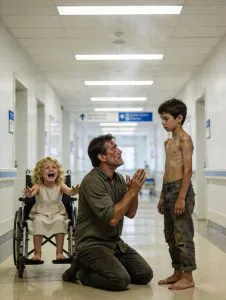
The night the ambulance lights disappeared and the hospital entrance sealed shut behind him, Daniel Whitmore realized his world had split into two chapters: before the accident… and after.
The hallway outside the pediatric intensive care unit felt unnaturally long, washed in pale fluorescent light and the sharp scent of disinfectant. Every footstep echoed like a verdict. Every whisper from passing nurses tightened the knot in his chest.
Inside one of those rooms lay his eight-year-old daughter, Lily Whitmore.
Only hours earlier, she had been laughing at a crosswalk downtown in Portland — a quick errand, a careless driver, a flash of headlights. Then shattered glass. Screeching brakes. Silence.
Now machines hummed beside her small body. Doctors spoke carefully about spinal trauma, nerve damage, uncertain outcomes, and rehabilitation that could stretch for months — maybe years.
When Daniel stepped into her room, Lily wasn’t crying.
She stared at the ceiling instead.
“Daddy,” she murmured when she saw him. “Why can’t I feel my legs?”
He sat beside her, gripping the rail of the hospital bed as though it were the only solid thing left in the world. “They’re resting,” he said gently. “They just need time.”
The folded wheelchair in the corner had already caught her attention. He saw it in the way her eyes drifted toward it… then away.
Late that evening, long after visitors were supposed to leave, Daniel noticed a boy sitting alone down the corridor.
He looked about eleven. Thin. Quiet. Focused on a stack of bright paper in his hands.
He folded each piece slowly, precisely — like someone building something fragile but important.
After a while, the boy approached.
“Sir,” he asked softly, “is the girl in room seven your daughter?”
Daniel nodded.
“I come here sometimes,” the boy said. “I read to kids. Or make things. It helps.”
He hesitated. “My name’s Elias.”
There was no sales pitch. No forced charm.
Just honesty.
Daniel stepped aside.
Elias entered Lily’s room quietly and sat near her bed. For a while, he said nothing. Then he began folding.
“What are you making?” Lily asked faintly.
“Something that flies,” Elias replied. “Paper behaves if you’re patient with it.”
Within minutes, a small crane rested on her blanket.
Lily touched it carefully. “It looks brave.”
From that night forward, Elias returned almost every day.
He brought books from the hospital library. Told stories about stray dogs near the shelter where he lived. Described how rain sounded against tin rooftops. He never asked about the accident. Never mentioned her legs.
He just stayed.
Slowly, Lily started arguing about story endings. She laughed when one of his paper animals collapsed. On the hardest therapy days — when frustration turned into tears — Elias simply sat beside her wheelchair and listened.
Daniel watched from a distance, puzzled at how a child with so little could give so much.
One evening, after Lily had fallen asleep, Daniel spoke to him.
“She listens to you,” Daniel admitted. “More than to anyone.”
Elias shrugged. “She’s stronger than she thinks.”
“And your family?” Daniel asked quietly.
Elias looked down. “Don’t have one.”
The answer lingered heavily between them.
Driven by fear, exhaustion, and hope tangled together, Daniel made a promise he hadn’t planned.
“If my daughter walks again,” he said slowly, “I’ll adopt you. I’ll give you a home.”
Elias didn’t smile.
“I can’t fix her,” he said calmly. “I’m not a doctor.”
“I know,” Daniel replied. “Just… don’t leave.”
Elias nodded. “I won’t.”
Recovery wasn’t miraculous.
It was slow. Uneven. Painful.
Lily learned to sit upright without shaking. Then to stand with braces. The first time she took a trembling step, gripping Elias’s arms for balance, Daniel broke down openly in the therapy room.
Months later, she crossed the floor alone.
Not perfectly. Not effortlessly. But on her own.
Daniel kept his word.
The adoption process stretched on with interviews, background checks, and endless paperwork. But Elias had already moved into their home long before it became official.
For the first time, he left his belongings in one place and found them there the next morning. He ate dinner without rushing. Slept without fear.
Lily called him her brother before anyone told her she could.
Years passed.
Lily grew confident and outspoken, refusing to let her injury define her story. Elias studied social work, determined to support children who felt invisible.
Together, they launched a small outreach program — helping families navigate medical trauma and foster care. That program grew into something bigger than any of them imagined.
One evening, watching the sunset from their backyard, Daniel spoke quietly.
“If we hadn’t met that night…”
Elias smiled.
“We met because we needed each other.”
Years later, Elias would tell children a story about a bird with broken wings who learned to fly — not because it was fixed overnight, but because another bird stayed beside it.
“And did they live happily ever after?” a child once asked.
Elias thought for a moment.
“They lived with love,” he answered.
“And that was enough.”