“Leave it.” Corrupt staff watched a rich brat dump a trash can over the poor scholarship girl’s head… then her BIKER club blocked all the exits.
Chapter 1
Oakridge High School wasn’t an educational institution; it was a country club with lockers.
If you didn’t drive a car that cost more than a starter home, you were invisible. If you wore sneakers that didn’t drop in limited quantities on a specialized app, you were a target.
For me, Maya Reynolds, walking through these polished marble hallways every morning felt like walking across a battlefield armed with nothing but a plastic spork.
I didn’t belong here. Everyone knew it. The only reason I was allowed to breathe the same heavily air-conditioned, lavender-scented air as these trust-fund babies was because of a state-mandated academic scholarship.

My zip code was wrong. My bank account was empty. And in America, especially in the affluent suburbs of Connecticut, that made me a lower life form.
The bell for fourth period had just rung, pouring hundreds of designer-clad teenagers into the main corridor. The noise was deafening—a chaotic symphony of slamming metal, gossip, and the clicking of expensive heels.
I kept my head down. That was rule number one of surviving Oakridge: don’t make eye contact with the apex predators.
I hugged my worn-out binders to my chest, my oversized grey hoodie acting as a makeshift suit of armor. I just needed to make it to AP Chemistry. Just fifty more feet.
“Yo, check it out! The charity case is trying to blend in.”
The voice cut through the hallway chatter like a serrated knife. My stomach instantly dropped to my cheap, scuffed sneakers.
Trent Kensington.
Trent was the closest thing Oakridge had to royalty. His father owned half the commercial real estate in the tri-state area and practically funded the school’s new athletic wing out of his pocket change.
Because of that, Trent walked around like he owned the oxygen in the building. He was tall, aggressively handsome in a generic, catalog-model way, and wore a custom letterman jacket that probably cost more than my monthly rent.
He was standing near the cafeteria entrance, surrounded by his usual posse of sycophants—guys who laughed too hard at his jokes and girls who stared at him with dollar signs in their eyes.
I tried to walk faster, ignoring the tightening in my chest. Just keep walking, Maya. Don’t engage. Don’t give him the satisfaction.
“Hey! Deaf as well as broke?” Trent called out, stepping directly into my path.
I stopped. I had no choice. If I tried to step around him, his massive linebacker buddies, Chase and Brody, would just block me.
“Excuse me, Trent,” I said quietly, keeping my eyes fixed on the silver zipper of his jacket. “I need to get to class.”
“Class? Why do you even bother?” Trent sneered, looking me up and down with exaggerated disgust. “You think getting an ‘A’ in Chem is gonna change the fact that you live in a trailer park? You’re genetically programmed to flip my burgers, Maya.”
The hallway had gone quiet. The kind of quiet that only happens when a crowd smells blood in the water.
Dozens of students had stopped, forming a loose circle around us. Cell phones were already coming out. The glowing lenses of iPhone cameras stared at me like unblinking, mechanical eyes.
This was their entertainment. I was just the court jester.
“Please move,” I whispered, my voice trembling slightly despite my best efforts to keep it steady.
Trent laughed. It was a cruel, hollow sound. “She said ‘please’. Did you guys hear that? The peasant has manners.”
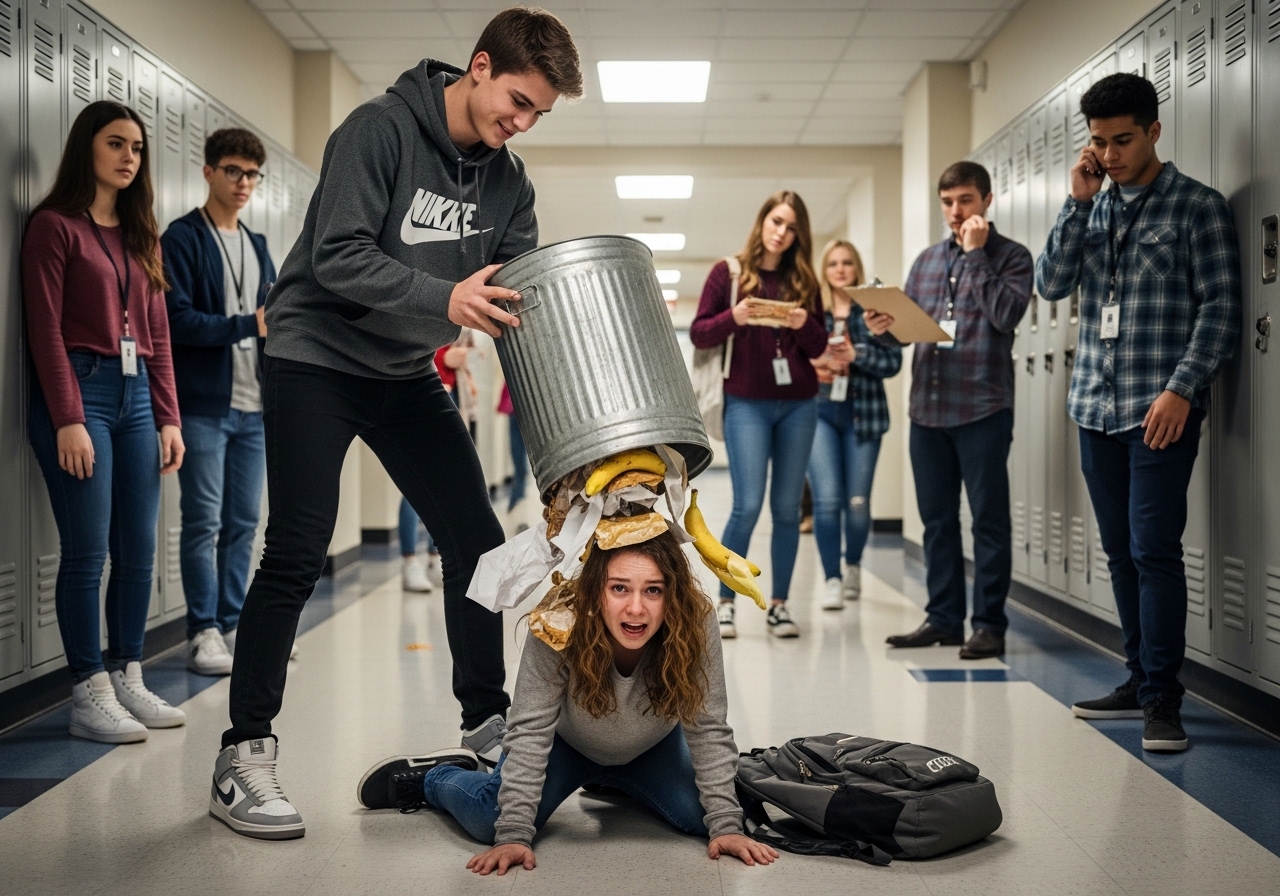
He turned to his friends, flashing a million-dollar, orthodontist-perfect smile. Then, his eyes drifted to the large, grey plastic trash can sitting right next to the cafeteria doors. It was overflowing with the remnants of first-lunch: half-eaten sloppy joes, sour milk cartons, greasy wrappers, and God knows what else.
I saw the idea spark in his eyes. A terrifying, humiliating light.
“You know, Maya,” Trent said, his voice dropping to a conversational, almost friendly tone as he stepped toward the bin. “I was just thinking that your outfit looked a little… dry. A little too clean for someone who belongs in the garbage.”
Before my brain could fully process what he was doing, Trent grabbed the rim of the heavy trash can with both hands.
“Trent, don’t—” I started, taking a step back.
It was too late.
With a grunt of effort, he hoisted the barrel up and tipped it violently toward me.
Time seemed to slow down. I saw a half-empty carton of chocolate milk spinning in the air. I saw a clump of soggy, ketchup-stained fries.
Then, it hit me.
A wave of foul-smelling, cold, sticky refuse crashed over my head and shoulders. The sheer weight of the garbage knocked the binders out of my hands. Papers scattered across the floor, instantly soaking up mysterious, greasy puddles.
A banana peel draped over my left shoulder. Something wet and unidentifiable slid down the back of my neck, creeping under the collar of my hoodie.
The stench was overpowering. Rotting fruit, sour dairy, and damp paper.
For two full seconds, there was absolute, stunned silence in the hallway.
Then, the eruption.
Laughter. Hysterical, mocking, brutal laughter echoed off the high ceilings. It wasn’t just Trent and his friends; it was the entire hallway. The kids in designer clothes were pointing at me, clutching their stomachs, recording my humiliation in ultra-high definition to post on Snapchat and TikTok.
“Looks like trash belongs with the trash!” Trent yelled over the noise, wiping a speck of dirt off his pristine white sneakers. “Have a good day at school, charity case!”
He high-fived Chase, grabbed his girlfriend’s hand, and walked away, completely unfazed. He didn’t even look back. He just swaggered off, flexing for the cameras, an untouchable god in his own mind.
I stood there, frozen, the world blurring as hot, angry tears finally broke through my defenses and mixed with the grime on my face.
I couldn’t move. The shame was a physical weight, heavier than the garbage covering my clothes.
Through my blurred vision, I saw movement to my right.
Mr. Harrison. My AP History teacher.
He was standing right outside his classroom door, a stack of graded papers in his hand. He had seen the whole thing. He was standing less than fifteen feet away.
My heart leaped with a desperate spark of hope. Help me, I thought, staring right into his eyes. Please, say something. Stop them.
Mr. Harrison looked at me. He looked at the garbage covering my body. He looked down the hall at Trent’s retreating, wealthy back.
And then, with a tight, nervous swallow, Mr. Harrison looked away.
He turned his back on me, stepped into his classroom, and firmly pulled the heavy wooden door shut. Click. The sound of that door latching was louder than all the laughter combined.
It was the sound of the system working exactly as intended. Money buys silence. Wealth buys immunity. If you’re poor, you’re not a victim; you’re just an inconvenience.
The crowd began to disperse, the bell ringing a second time to signal that we were officially late. Students walked carefully around me, treating me like a biohazard, whispering and snickering as they passed.
No one offered a hand. No one offered a napkin.
I was entirely, utterly alone.
Slowly, numbly, I bent down and started picking up my ruined notes. The ink had bled, turning my hours of studying into abstract, blue smudges. I shoved them into my backpack, ignoring the sticky residue covering everything.
I didn’t go to Chem.
I turned and walked toward the girl’s bathroom at the far end of the east wing. It was usually empty during this period.
Every step squelched. Every movement released a new wave of awful odors. I kept my eyes locked on the floor tiles, refusing to let anyone see me break down entirely.
I pushed through the heavy bathroom door and locked it behind me.
The fluorescent lights buzzed overhead, casting a harsh, unforgiving glare on the mirrors above the sinks. I forced myself to look up.
The girl staring back at me was a disaster. Her brown hair was matted with brown sludge. Her face was pale, streaked with tears and dirt. She looked small. She looked defeated.
She looked exactly like what Trent Kensington wanted her to be.
I turned on the cold water and started scrubbing furiously at my face. I scrubbed until my skin was raw and red. I yanked the ruined hoodie over my head and threw it directly into the trash, leaving me in just a thin, faded t-shirt.
I leaned heavily against the sink, gripping the porcelain edges until my knuckles turned white.
The sadness was gone. The humiliation was fading.
In their place, something else was rising. Something hot, dark, and incredibly dangerous.
Rage.
For two years, I had taken it. I had swallowed the insults. I had ignored the shoves in the hallway. I had played the good, quiet, grateful scholarship student because I thought this education was my ticket out of poverty.
But looking at my ruined clothes and remembering the cowardly face of Mr. Harrison, a cold truth settled over me.
Playing by their rules wouldn’t save me. The system wasn’t broken; it was built this way. It was built to protect boys like Trent and crush girls like me.
I reached into the front pocket of my backpack and pulled out my phone. The screen was spider-webbed with cracks, a hand-me-down that barely held a charge.
My hands were shaking, but not from fear anymore.
I unlocked the screen and opened my contacts. I bypassed the school’s emergency lines. I bypassed my guidance counselor.
I scrolled down to a single contact, saved simply as ‘J’.
I hadn’t called this number in over a year. When my mother died and the state threatened to put me in the foster system, ‘J’ was the one who showed up. He wasn’t a suit-wearing lawyer. He wasn’t a kindly social worker.
He was my mother’s older brother. My uncle.
And he was the Vice President of the Devils Disciples Motorcycle Club.
He had taken me in, given me a room above his auto shop, and made me promise one thing: “You keep your nose clean, you get those straight A’s, and you stay out of club business. But if anyone ever puts their hands on you, Maya… you call me. You understand? You call me.”
I had promised myself I would never bring his world into mine. I wanted to be legitimate. I wanted to be normal.
But Oakridge High had just proven that ‘normal’ was a luxury I couldn’t afford.
I hit the call button and pressed the cracked glass to my ear.
It rang twice.
Then, a deep, gravelly voice answered, accompanied by the distinct sound of classic rock and clinking metal in the background.
“Yeah. Talk to me.”
I closed my eyes, taking a deep breath that smelled faintly of sour milk and vengeance.
“Uncle Jax,” I said, my voice eerily calm.
The background noise on his end immediately died. The silence was heavy. He knew I wouldn’t call during school hours unless the world was ending.
“Maya. You okay? What’s wrong?” The protective edge in his voice was instant, sharp as a switchblade.
“I’m at school,” I said slowly. “There’s a boy here. His name is Trent Kensington. He… he just dumped a trash can over my head in front of everyone.”
Silence. Deep, terrifying silence on the other end of the line.
“Did the teachers do anything?” Jax asked. His voice had dropped an octave. It didn’t sound like a question; it sounded like a threat.
“No,” I replied, staring at my reflection in the mirror. “They watched. They let him walk away.”
I heard the scrape of a heavy chair pushing back against concrete.
“Are you hurt?”
“Just my pride,” I said. “And my clothes.”
“Where are you right now?”
“East wing bathroom. Locked inside.”
“Stay there,” Jax said. The calmness in his voice was the scariest thing I had ever heard. It was the calm before a hurricane. “Don’t open the door for anyone. Not the principal, not the cops. Nobody.”
“Okay.”
“Maya?”
“Yeah?”
“I’m bringing the brothers. We’re on our way.”
The line went dead.
I lowered the phone, the screen going black in my hand.
Trent Kensington thought he ruled the world because his father had a black Amex card and a country club membership. He thought money made him a god.
He was about to learn that in the real world, money doesn’t mean a damn thing when the devil comes knocking.
I walked over to the paper towel dispenser, pulled out a rough brown sheet, and began carefully wiping the last bit of grime from my cheek.
For the first time since I enrolled at Oakridge High, I smiled.
Chapter 2
The girl’s bathroom in the east wing of Oakridge High suddenly felt like a bomb shelter.
I sat on the cold, hexagonal floor tiles, my knees pulled tightly to my chest. The adrenaline that had spiked when I called Uncle Jax was beginning to recede, leaving behind a cold, shivering dread.
The smell of sour milk and rotting food still clung to my skin, a suffocating reminder of my place in this perfectly manicured world.
I stared at the heavy wooden door. The lock was turned, but it felt flimsy. Flimsy against the weight of the institution outside. Flimsy against the reality of what I had just done.
I had broken my own cardinal rule. I had hit the panic button.
To understand the gravity of that phone call, you have to understand who Jax was. To the state of Connecticut, Jackson Reynolds was a mechanic with a rap sheet that read like a gritty crime novel. He had done time in his twenties. He had scars that he never talked about.
But to the Devils Disciples Motorcycle Club, he was the Vice President. He was the enforcer, the strategist, the man who held the gavel when the President was out of town.
And to me? He was the only reason I wasn’t a statistic.
When my mother died of an overdose three years ago, the social workers had practically printed out my foster care placement before her body was cold. They looked at our empty fridge, the eviction notices, and my threadbare clothes, and decided I was just another tragedy waiting to be processed.
Then, Jax walked into the caseworker’s office.
I’ll never forget it. He was wearing his leather cut, the grim reaper insignia of the Disciples staring down the terrified government employees. He didn’t yell. He didn’t threaten. He just slammed a thick stack of hundred-dollar bills on the desk, handed them paperwork drawn up by the club’s very expensive, very intimidating lawyer, and said, “She’s blood. She comes with me.”
He moved me into the apartment above his custom bike shop. He made sure I had hot meals, a quiet place to study, and a lock on my door.
But he also gave me an ultimatum.
“I live in the dark, Maya,” he had told me on my first night there, his massive, grease-stained hands wrapping around a mug of black coffee. “The club is my life. It’s violent, it’s ugly, and it’s no place for a smart kid like you. You have a brain. You can get out of this zip code.”
He had pointed a thick finger at me. “You keep your head in those books. You go to that fancy magnet school. You don’t tell them who your uncle is, and you don’t bring my world into yours. You be a ghost, Maya. You survive, you graduate, and you leave us in the rearview mirror.”
I had agreed. I had played the ghost perfectly for two and a half years.
I took the insults. I swallowed the sneers from girls carrying Prada bags. I let boys like Trent Kensington use me as a punchline to impress their hollow, sycophantic friends.
I did it all because I believed the lie. I believed that if I just worked hard enough, the system would eventually reward me. I believed an Ivy League acceptance letter would magically erase the stench of poverty.
Trent dumping that garbage on me didn’t just ruin my clothes. It shattered the illusion.
There was no escaping this. The wealthy elites of Oakridge didn’t just want to ignore people like me; they wanted to crush us. They needed us to be beneath them so they could feel tall.
Mr. Harrison turning his back and closing his classroom door was the final nail in the coffin.
The rules of polite society didn’t apply to the poor. So, I was going to introduce them to the rules of the streets.
I looked down at my phone. Ten minutes had passed since I hung up.
Jax’s shop was across town, tucked away in the industrial district. It was at least a twenty-minute drive in normal traffic.
But the Devils Disciples didn’t do ‘normal traffic.’
Out in the hallways, the third bell rang. The chaotic shuffling of hundreds of students died down as doors clicked shut. The school fell into its mandatory, sterile silence.
Somewhere in the west wing, Trent Kensington was probably sitting in AP Economics, twirling a solid gold pen, absolutely convinced of his own invincibility. He probably thought the worst consequence he would face was a mild scolding from a guidance counselor over a cup of herbal tea.
He had no idea that a storm was currently tearing down Interstate 95, heading straight for his fragile, expensive bubble.
I stood up and walked over to the sinks. I splashed more freezing water on my face, scrubbing until my cheeks burned. I wrung out the ends of my hair, watching the brown, greasy water swirl down the immaculate porcelain drain.
Suddenly, the silence of the bathroom was broken.
It wasn’t a voice. It wasn’t a footstep.
It was a vibration.
It started low, a deep, rhythmic thrumming that I felt in the soles of my ruined sneakers before I actually heard it. The water in the toilet bowls began to ripple slightly.
I froze, my hands dripping over the sink.
The vibration grew into a hum. A heavy, guttural, mechanical hum that seemed to be vibrating the very foundation of the multi-million dollar building.
It sounded like distant thunder, but the sky outside the frosted bathroom windows was a clear, brilliant blue.
My heart hammered against my ribs.
They were here.
The hum escalated into a roar. It wasn’t just one motorcycle. It was a pack. A massive, coordinated pack of customized Harley-Davidsons, their mufflers removed, their engines tuned for maximum aggression.
The sound was deafening. It completely swallowed the classical music that usually played softly over the school’s intercom system.
I walked over to the small, frosted window near the ceiling. It was cranked open just a few inches. I pulled myself up on the edge of a radiator to peek out toward the front parking lot.
What I saw made the breath catch in my throat.
Oakridge High’s front lot was a sea of luxury vehicles—Mercedes, Audis, top-tier Teslas. It was a monument to generational wealth.
And tearing through the meticulously landscaped entrance gates was the apocalypse on two wheels.
At the front of the formation was Jax.
He was riding his custom, matte-black Road Glide. He wasn’t wearing a helmet. His dark hair was whipping in the wind, his face set in a mask of pure, unadulterated fury. The sunlight caught the silver VP pin on the chest of his heavy leather cut.
Behind him, riding in a tight, military-precision diamond formation, were at least thirty members of the Devils Disciples.
These weren’t weekend warriors playing dress-up. These were hardened, heavily tattooed men who lived outside the law. They wore steel-toed boots, heavily patched denim, and expressions that promised violence.
The roar of thirty heavy V-twin engines echoing off the brick walls of the school was terrifying. It was a physical force, rattling the glass panes of the windows.
They didn’t park politely in the visitor spots.
Jax swerved his bike perfectly, cutting off the main exit of the circular driveway. The rest of the pack fanned out, their boots slamming down on the asphalt as they boxed in the entire front entrance. They parked their bikes diagonally across the pristine crosswalks, effectively barricading the school.
No one was getting in. No one was getting out.
Through the window, I saw the school’s private security guard—a retired cop named Gary who usually spent his days writing parking tickets for improperly displayed permits—step out of his little booth.
Gary put his hand on his radio, his face draining of all color. He took one step toward the pack of bikers.
Jax kicked his kickstand down. He didn’t even look at Gary. He just reached into his saddlebag, pulled out a heavy, iron tire iron, and let it hang casually from his right hand.
Gary stopped dead in his tracks. He slowly lifted his hand off his radio and took three steps backward, pressing himself against the glass of his booth. He wanted absolutely no part of this.
Smart man.
Jax turned to the group. He gave a single, sharp nod.
Four of the biggest members—men I knew as Brick, Silas, Chopper, and a terrifyingly quiet guy named Ghost—dismounted and stepped up behind Jax.
They didn’t jog. They didn’t rush.
They walked toward the heavy, glass front doors of Oakridge High with the slow, deliberate pace of executioners.
The contrast was jarring. The pristine, ivy-covered brick of the academy, and these five men who looked like they had just crawled out of a war zone, bringing the grit and the grime of the real world directly to the doorstep of the elite.
I dropped down from the window, my legs trembling.
The distant roar of the engines had stopped, replaced by an eerie, heavy silence. But it was a pregnant silence. The kind of silence that happens right before a bomb detonates.
I knew I couldn’t stay in the bathroom anymore. Jax had told me to stay put, but if the administration tried to corner him, or if the police were called, things would escalate into a bloodbath. I needed to be there. I needed to show them exactly what Trent Kensington had done.
I unlocked the bathroom door and pushed it open.
The hallway, which just minutes ago had been a runway for teenage millionaires, was completely deserted. The doors to the classrooms were all shut.
But I could hear the murmurs.
Through the thick wood of the classroom doors, I could hear the panicked whispers of students and teachers. They had all heard the engines. They all knew something was terribly wrong. The illusion of safety had been shattered.
I began walking down the corridor, heading toward the main atrium where the front office was located.
My wet, ruined sneakers squeaked slightly on the polished marble. I shivered, the cold air conditioning biting through my thin t-shirt, but I kept my chin up.
As I rounded the corner toward the main lobby, I heard the sound of heavy boots.
Thud. Thud. Thud.
It wasn’t the frantic clicking of a principal’s loafers. It was the synchronized, heavy footfalls of men who owned whatever room they walked into.
I stopped behind a large, marble pillar just outside the atrium, peering around the edge.
The front lobby of Oakridge High was a massive, two-story glass atrium designed to look like a modern art museum. In the center was a polished mahogany reception desk.
Standing behind that desk was Mrs. Gable, the head secretary. She was a woman who usually terrorized students for not having a hall pass.
Right now, Mrs. Gable looked like she was about to pass out.
Jax stood directly in front of the desk. Brick, Silas, Chopper, and Ghost fanned out behind him, blocking the main doors. Their mere presence seemed to suck all the breathable air out of the massive room.
The silence in the atrium was absolute. You could hear a pin drop.
Jax didn’t yell. He didn’t slam his hands on the desk. He leaned forward slowly, resting his massive, tattooed forearms on the polished mahogany. He looked at Mrs. Gable with dead, cold eyes.
“Where is she?” Jax asked. His voice was a low, gravelly rumble that carried across the entire lobby. It wasn’t a request. It was a demand from a man who had never taken ‘no’ for an answer.
Mrs. Gable swallowed hard, her eyes darting nervously between Jax’s face and the tire iron still gripped in his right hand.
“E-excuse me, sir?” she stammered, her usually sharp voice trembling. “You… you can’t be in here. This is a secure campus. I need you to leave before I call the authorities.”
It was the standard Oakridge script. Threaten them with the police. Use the shield of the institution.
Silas, a massive man with a jagged scar running down the side of his neck, let out a dry, humorless chuckle.
Jax didn’t even blink. He leaned closer.
“I’m going to ask you one more time, lady,” Jax said, his voice dropping to a dangerous whisper that somehow echoed louder than a shout. “Where is Maya Reynolds?”
The mention of my name seemed to short-circuit Mrs. Gable’s brain. She recognized it. She knew I was the scholarship kid. The nobody.
“Maya?” Mrs. Gable squeaked. “She… she’s in class. Sir, please, if you’re a relative, you need to sign in and wait in the designated—”
“I ain’t here for a parent-teacher conference,” Jax interrupted smoothly. “I’m here because someone in this shiny little country club put their hands on my niece.”
Before Mrs. Gable could respond, the heavy mahogany doors to the Principal’s office swung open.
Principal Vance stepped out.
Vance was a man who prided himself on control. He wore a perfectly tailored Italian suit, his silver hair immaculately styled. He was used to dealing with angry, entitled parents who wanted to argue about a B-minus on their child’s transcript. He was a politician, a master of smoothing things over with a fake smile and a firm handshake.
He marched out of his office, adjusting his silk tie, putting on his best ‘authority’ face.
“What is the meaning of this?” Vance barked, stopping a few feet away from Jax. He tried to look imposing, but next to the five towering, leather-clad bikers, Vance looked like a nervous substitute teacher. “You are trespassing on private property. I demand you leave this building immediately.”
Jax slowly turned his head to look at Vance. He looked the principal up and down, taking in the expensive suit and the perfectly manicured nails.
A slow, terrifying smile crept onto Jax’s face.
“You must be the guy in charge,” Jax said softly.
“I am Principal Vance. And if you do not vacate these premises this second, I will have the police arrest every single one of you.”
Jax let out a slow breath. He casually tossed the iron tire iron from his right hand to his left. The heavy metal smacked into his leather glove with a dull, threatening thud.
“Call ’em,” Jax said, gesturing toward the phone on Mrs. Gable’s desk. “Call the cops. Tell them the Devils Disciples are sitting in your lobby. They’ll send three cruisers. Maybe a SWAT van if they’re feeling frisky. It’ll take them at least ten minutes to get past the barricade my boys set up outside.”
Jax took a slow, deliberate step toward Vance. The principal instinctively took a step back, his facade of authority cracking instantly.
“And in those ten minutes, Vance,” Jax continued, his voice devoid of all emotion, “I will tear this beautiful, expensive building apart brick by brick until I find the piece of garbage who humiliated my girl.”
Vance was pale. The reality of the situation was finally penetrating his thick skull. These men didn’t care about his title. They didn’t care about his wealthy donors. They were a force of nature, and they were entirely outside of his control.
“I… I don’t know what you’re talking about,” Vance stuttered, raising his hands defensively. “Maya Reynolds is a student here. No one has touched her. We have a zero-tolerance policy for bullying—”
“Save the PR speech for the PTA meetings,” Jax snarled, stepping into Vance’s personal space. He reached out with terrifying speed, grabbing the lapels of Vance’s custom suit in one massive fist.
Vance let out a strangled gasp as Jax hauled him forward, lifting him onto his tiptoes.
“Zero tolerance?” Jax whispered harshly, his face inches from the principal’s. “My niece just called me from a locked bathroom. Said some rich punk named Trent Kensington dumped a trash can over her head in the middle of a crowded hallway while your teachers watched and did absolutely nothing.”
The name dropped like a bomb in the quiet atrium.
Trent Kensington.
Mrs. Gable gasped, covering her mouth with her hands. Vance’s eyes widened in sheer panic.
Everyone in the administration knew who Trent was. Everyone knew who his father was. And everyone knew that Trent was practically untouchable. The school had buried half a dozen complaints about him already this year to keep the Kensington family donations flowing.
But they couldn’t bury this. The men standing in the lobby wouldn’t be bought off with a check for a new gymnasium.
“Mr. Kensington… he… he’s a very prominent student,” Vance stammered, sweat beading on his forehead as he struggled against Jax’s grip. “There must be a misunderstanding. Trent is a good boy. We can call his father, we can mediate this—”
“I don’t want his father,” Jax growled, the muscles in his jaw ticking. “I want the boy. Bring him to me right now. Or I go find him myself. And if I find him first… there won’t be enough left of him to mediate.”
The threat hung in the air, heavy and absolute.
Vance was hyperventilating. He looked desperately at Mrs. Gable.
“Call… call classroom 204,” Vance choked out. “Tell Mr. Davis to send Trent down here immediately. Don’t tell him why.”
Mrs. Gable scrambled for the phone, her hands shaking so badly she dropped the receiver twice before dialing the extension.
Jax slowly opened his fist, letting Vance drop back onto his heels. He smoothed down the lapels of the principal’s ruined suit with a mocking, gentle pat.
“Good boy,” Jax said coldly. “Now we wait.”
He turned his back on the principal and looked out across the empty atrium, his eyes scanning the corridors.
I was still hiding behind the marble pillar, my heart pounding so hard I thought it would crack my ribs. I had never seen Jax like this. At home, he was stern but gentle. Here, in the face of the people who had hurt me, he was a monster. He was exactly what they deserved.
I took a deep breath. It was time. I couldn’t let them fight this battle without me standing there to face it.
I stepped out from behind the pillar.
“Uncle Jax,” I called out, my voice cracking slightly in the silent hall.
All five bikers snapped their heads toward me instantly.
When Jax saw me, the fury on his face vanished for a split second, replaced by pure, agonizing heartbreak.
He took in my appearance. He saw my wet, stringy hair. He saw the faded, dirty t-shirt. He saw the red, scrubbed-raw skin on my face and the faint remnants of garbage sludge on my jeans.
He saw exactly what Oakridge High had done to me.
Jax closed his eyes for one second, taking a deep, shuddering breath. When he opened them again, the heartbreak was gone.
The monster had returned. And it was hungry.
He didn’t say a word. He just crossed the lobby in three massive strides, pulling off his heavy leather cut as he walked. He reached me, wrapping the thick, heavy leather around my shivering shoulders. The jacket smelled of exhaust fumes, old leather, and safety.
He pulled me into his side, keeping one arm wrapped tightly around my shoulder. He pressed a kiss to the top of my damp head.
“I got you, kid,” he whispered fiercely. “I got you. Nobody ever touches you again.”
He turned back to face the principal and the terrified secretary, keeping me tucked safely against his side. The other four Disciples shifted, forming a protective semi-circle around us.
“Now,” Jax said, his voice echoing with absolute authority. “We’re going to have a little chat with the boy who thinks he’s a king.”
Far down the hallway, the sound of confident, arrogant footsteps echoed toward the lobby.
Trent Kensington was coming. He thought he was being called down for an award. He thought he was untouchable.
He had no idea that he was walking straight into hell.
Chapter 3
The silence in the atrium was absolute, heavy, and suffocating. It was the kind of silence that usually preceded a devastating car crash, the agonizing fraction of a second where you realize the brakes have failed and impact is inevitable.
I stood tucked under Jax’s massive arm, the heavy leather of his Vice President cut draped over my small, trembling shoulders. The scent of motor oil, stale tobacco, and well-worn leather enveloped me. For the past two years, I had tried to scrub that smell from my life, desperate to smell like the lavender and vanilla body sprays the wealthy girls wore.
Now, that rough, industrial scent was the only thing keeping me from collapsing. It was the smell of home. It was the smell of protection.
Across the polished marble floor, Principal Vance looked like a man standing on the gallows. His perfectly tailored Italian suit suddenly seemed two sizes too big for his shrinking, cowardly frame. Mrs. Gable, the usually tyrannical head secretary, was paralyzed behind her mahogany desk, her manicured fingers still resting inches from the telephone she had just used to summon Trent.
None of them moved. None of them dared to even breathe too loudly.
The four other Devils Disciples—Brick, Silas, Chopper, and Ghost—had formed a loose, tactical half-circle behind us. They didn’t fidget. They didn’t whisper. They stood with the terrifying, relaxed stillness of apex predators waiting for a meal to wander into their territory.
Then, we heard it.
The rhythmic, arrogant sound of footsteps echoing down the pristine east wing corridor.
Click. Clack. Click. Clack.
It was a confident stride. A walk that belonged to someone who had never been told “no” in his entire eighteen years of life. Someone who believed the very floor tiles were privileged to be stepped on by his expensive, limited-edition sneakers.
Trent Kensington was on his way.
My stomach plummeted. The phantom sensation of cold, sour milk and slimy, rotting food crawling down my neck returned with a vengeance. I instinctively shrank closer to Jax, my hands gripping the edges of his leather cut so tightly my knuckles ached.
Jax felt my tremor. He didn’t look down, keeping his cold, dead gaze fixed on the hallway entrance, but he pulled me a fraction of an inch tighter against his side. A silent, unwavering promise.
“Steady, Maya,” Jax murmured, his voice so low only I could hear it. “You don’t look away from him. You don’t blink. You let him see exactly who he messed with.”
I swallowed the lump of bile in my throat and forced my chin up. I nodded once.
The footsteps grew louder.
“Honestly, Mr. Davis, I don’t know why Vance is calling me down right before the midterm review,” Trent’s voice drifted into the atrium before he did. It was dripping with that signature, entitled whine. “If this is about the lacrosse budget again, my dad already told him he’s writing the check on Friday.”
Trent rounded the corner and stepped into the massive, glass-walled lobby.
He was looking down at his phone, his thumbs flying across the screen, a bored, arrogant smirk plastered across his handsome face. He was wearing the same $500 custom letterman jacket, not a single drop of the garbage he had dumped on me marring its pristine white leather sleeves.
He took three full steps into the room before his peripheral vision finally registered that something was terribly, fundamentally wrong.
He stopped dead in his tracks.
His eyes flicked up from his phone.
For a split second, Trent’s brain simply couldn’t process the image in front of him. His reality—a reality built entirely of country clubs, trust funds, and bought-and-paid-for authority figures—was violently clashing with the gritty, terrifying reality of the streets.
He saw Principal Vance, pale and sweating. He saw Mrs. Gable, looking like she was about to faint.
And then, he saw them.
Five massive, heavily tattooed bikers, dressed in grim, road-worn leather, standing in the center of his pristine high school.
Trent’s smirk vanished. The color drained from his face so fast he looked like he had been dusted with flour. His phone slipped slightly in his grip, his knuckles turning white as he stared at the grim reaper patch on the back of Chopper’s vest.
“What…” Trent started, his voice cracking, completely losing its arrogant timber. He looked at Principal Vance, desperate for the familiar hierarchy to reassert itself. “Vance? What is this? Who are these people?”
Principal Vance opened his mouth, but before a single word could escape his trembling lips, Silas took a single, heavy step forward.
The thud of Silas’s steel-toed boot on the marble echoed like a gunshot.
Vance snapped his mouth shut, his eyes dropping to the floor. The message was clear: The principal was no longer in charge of Oakridge High.
Trent’s panic began to visibly rise. He was a bully, but he was a country-club bully. He was used to intimidating kids with his father’s lawyers and his own social standing. He had absolutely zero experience dealing with men who settled disputes with tire irons and brass knuckles.
“I asked a question!” Trent said, his voice pitching higher, trying desperately to sound authoritative. “Are these contractors? Because if my dad finds out you’re letting guys like this wander around the school while we’re in session—”
“Your dad,” Jax interrupted.
The deep, gravelly rumble of Jax’s voice cut through Trent’s whining like a rusted saw blade through silk.
Trent froze, his eyes snapping to the man standing in the center of the formation.
Jax slowly, deliberately reached up and pushed the leather cut back from my shoulders just enough to reveal my face clearly.
Trent’s eyes widened. He finally looked at me.
He saw the wet, stringy hair. He saw the faded, damp t-shirt. He saw the red, scrubbed skin of my face.
For three agonisingly long seconds, the gears turned in Trent Kensington’s head. He looked at me, the ‘charity case’ he had assaulted just an hour ago. Then he looked at the five terrifying outlaws standing as my personal guard. He looked at Jax’s arm wrapped fiercely around my shoulder.
The realization hit him like a physical blow.
His jaw dropped. His eyes darted toward the exit behind him, a primal, frantic flight response kicking in.
Ghost, the quietest and arguably the most terrifying member of the Disciples, anticipated the move. Before Trent could even pivot his expensive sneakers, Ghost moved with a speed that defied his massive frame. He ghosted across the marble floor and stepped directly into the hallway entrance, entirely blocking Trent’s only avenue of escape.
Ghost didn’t say a word. He just crossed his thick, tattooed arms over his chest and stared down at Trent with dead, shark-like eyes.
Trent was trapped.
“My… my dad,” Trent stammered, his voice barely a whisper now. He was trembling. The golden boy was shaking like a leaf in a hurricane. “My dad is Arthur Kensington. He… he owns half this town.”
Jax let out a low, humorless chuckle. It was a sound that made the hairs on the back of my neck stand up.
“Arthur Kensington,” Jax repeated, testing the name on his tongue like a bad taste. “Sounds like a guy who writes a lot of checks to make his problems go away. Sounds like a guy who raised a coward.”
“I’m not… you can’t talk to me like that!” Trent protested, stepping back, bumping directly into Ghost’s solid chest. Trent yelped, jumping away as if he had been burned.
Jax slowly detached himself from my side. He took one step toward Trent. Then another.
Trent scrambled backward until his back hit the cold glass of the main entrance doors. He was hyperventilating now, his chest heaving under his designer jacket.
“A coward,” Jax repeated, his voice dropping in volume until it was a lethal, quiet hiss. He stopped three feet away from Trent, looming over the terrified teenager. “A pathetic, weak little boy who thinks having a black Amex card makes him a man.”
Jax reached out, his movements slow and agonizingly deliberate. Trent squeezed his eyes shut, flinching, expecting a punch that would undoubtedly shatter his jaw.
Instead, Jax casually reached out and pinched the expensive white leather of Trent’s custom jacket. He rubbed the material between his thumb and forefinger, examining it.
“Nice jacket,” Jax whispered. “Real clean. Not a speck of dirt on it.”
Trent let out a ragged, terrified breath, opening his eyes slightly. “P-please. I have money. Whatever she wants, I can pay her. I can buy her a whole new wardrobe. Just… just name a price.”
It was the ultimate insult. Even now, backed into a corner, facing the absolute destruction of his fragile ego, Trent thought he could buy his way out of the consequences. He thought my dignity had a price tag.
I felt a fresh wave of heat rise in my chest, burning away the last of the cold shame.
Jax’s eyes darkened to black. The grip on Trent’s jacket tightened instantly, turning from a casual pinch into a brutal, twisting hold.
With a sudden, violent yank, Jax pulled Trent forward, ripping the teenager away from the glass door and hauling him up until Trent was forced to stand on his tiptoes to keep from choking.
“Money?” Jax roared, the sudden explosion of sound echoing like thunder in the cavernous atrium.
Mrs. Gable screamed, diving under her desk. Principal Vance covered his face, shrinking against the wall.
“You think I want your daddy’s dirty money?” Jax snarled, pulling Trent’s face so close I could see the spit flying from Jax’s lips. “You think you can dump a trash can over my blood, humiliate her in front of a hundred people, and then cut a check to make it right?”
“I’m sorry! I’m sorry!” Trent sobbed. The facade was completely gone. He was crying. Thick, ugly tears streamed down his perfectly tanned face. “It was just a joke! It was just a stupid prank, I swear to God!”
“A joke,” Jax repeated softly, dangerously.
He shoved Trent backward.
Trent stumbled, his expensive sneakers sliding on the polished marble. He crashed hard onto the floor, landing ungracefully on his backside, his legs scrambling uselessly against the smooth surface.
He looked pathetic. The king of Oakridge High, sitting on the floor, weeping in terror.
I watched him, feeling a strange, detached sense of justice. This was the boy who had called me trash. This was the boy who had told me I was genetically programmed to serve him.
“Get up,” Jax commanded.
Trent didn’t move. He just sat there, sobbing, wrapping his arms around his knees.
“I said, get up!” Jax barked, his hand dropping down to rest heavily on the iron tire iron still tucked into his belt loop.
Trent scrambled to his feet instantly, his knees knocking together. He wiped his nose on the sleeve of his $500 jacket, ruining the pristine white leather with snot and tears.
“You like making jokes, Trent?” Jax asked, circling the terrified boy like a wolf circling a wounded calf. “You like putting on a show for your little friends?”
“N-no, sir,” Trent stammered.
“Good. Because the show’s over.” Jax stopped circling and pointed a massive, heavily ringed finger directly at me. “Look at her.”
Trent hesitated, terrified to take his eyes off the monster in front of him.
“I said, look at her!” Jax roared.
Trent’s head snapped toward me. His eyes were bloodshot, completely stripped of their usual arrogant sneer.
“You thought she was a nobody,” Jax said, his voice carrying clearly across the lobby. “You thought she was weak because she doesn’t drive a fancy car or wear a plastic watch. You thought she was alone.”
Jax stepped behind Trent, placing heavy, imposing hands on the teenager’s shoulders. Trent flinched violently at the contact, but Jax held him firmly in place, forcing him to face me.
“She is Maya Reynolds,” Jax declared, his voice filled with a fierce, unwavering pride that brought fresh tears to my eyes—tears of gratitude, not sorrow. “She is the blood of the Devils Disciples. She has an entire army standing behind her in the shadows, waiting for the word. And you…”
Jax leaned down, his mouth right next to Trent’s ear.
“…you are just a spoiled little boy playing dress-up in your daddy’s clothes.”
Silence fell over the atrium again, broken only by Trent’s ragged, hitched breathing.
By now, the commotion had drawn an audience. The doors to the nearby classrooms had slowly creaked open. Teachers and students were peering out, their faces pale with shock as they witnessed the complete dismantling of the school’s social hierarchy.
I saw Chase and Brody—Trent’s massive, sycophantic friends who had laughed the hardest when the garbage hit me. They were standing near the library entrance. They weren’t laughing now. They looked terrified, ready to bolt at the slightest movement from the bikers.
“Apologize,” Jax said. It wasn’t a request.
Trent swallowed hard. He looked at me, his eyes wide and pleading.
“Maya… Maya, I am so sorry,” Trent rushed out, the words tumbling over each other in a desperate bid for survival. “I shouldn’t have done it. It was cruel. I’m sorry.”
Jax’s hands tightened on Trent’s shoulders, his thumbs digging painfully into the boy’s collarbones. Trent let out a sharp cry of pain.
“Not good enough,” Jax whispered. “You humiliated her on her knees. You’re going to apologize on yours.”
Trent froze.
The weight of the demand settled over the room. For a boy like Trent, raised to believe he was superior to everyone around him, kneeling to a ‘charity case’ was a fate worse than a beating. It was the complete, public annihilation of his identity.
He hesitated. He looked frantically at Principal Vance, begging silently for intervention.
Vance looked away, staring firmly at a blank spot on the wall.
“I won’t ask twice, boy,” Jax growled, the threat of violence practically humming in the air around him.
Slowly, agonizingly, Trent’s knees began to bend.
He fought it. You could see the internal war raging on his face—the massive, unearned ego battling against raw, primal terror. Terror won.
His knees hit the polished marble floor with a soft, defeated thud.
The king of Oakridge High was kneeling in the dirt, right where he belonged.
He looked up at me from the floor. The arrogance was gone. The cruelty was gone. All that was left was a broken, terrified kid who had finally met a consequence his father couldn’t buy off.
“I’m sorry, Maya,” Trent whispered, his voice cracking. He looked down at the floor, unable to meet my eyes anymore. “I’m so sorry.”
I stood there, wrapped in Jax’s heavy leather cut, looking down at the boy who had made my life a living hell for two years.
I thought I would feel triumphant. I thought seeing him broken and humiliated would fill the hollow, angry ache in my chest.
But looking at him now, trembling on the floor in front of half the school, I didn’t feel triumphant. I just felt exhausted.
He was pathetic. The entire system that propped him up was pathetic.
I looked at Jax. My uncle, the enforcer, the monster who had brought hell to the suburbs just to protect me. He was watching me closely, waiting for my signal. He had given me the power. He had handed me the sword. It was up to me to decide when to drop it.
“We’re done here, Uncle Jax,” I said quietly, my voice steady and clear.
Jax held my gaze for a long moment. He nodded once, accepting my decision.
He took his hands off Trent’s shoulders and stepped away, leaving the boy kneeling alone in the center of the vast atrium.
“You hear that, Vance?” Jax called out, not even looking at the cowering principal. “We’re done. But if I ever hear—if I even get a whisper—that anyone in this shiny little country club looks at her sideways again…”
Jax didn’t finish the threat. He didn’t need to. The revving of a distant motorcycle engine outside the glass doors punctuated the sentence perfectly.
Jax walked over to me. He didn’t grab me roughly this time. He just placed a gentle, calloused hand on the back of my neck, guiding me toward the front doors.
Brick, Silas, Chopper, and Ghost fell into step around us, a perfect, impenetrable shield of leather and muscle.
As we walked past the kneeling, weeping form of Trent Kensington, not a single person in the hallway spoke. The teachers who had turned a blind eye stared at the floor. The students who had laughed and filmed my humiliation parted like the Red Sea, pressing themselves against the lockers to avoid coming anywhere near the Disciples.
We reached the heavy glass doors. Ghost pushed them open, holding them wide as we stepped out of the overly air-conditioned, artificial air of the school and into the warm, bright reality of the outside world.
The rest of the club was waiting. Thirty heavy motorcycles idled in the parking lot, a low, menacing rumble that shook the ground.
As soon as Jax and I stepped outside, the entire pack cut their engines simultaneously.
The sudden silence was deafening.
Thirty hardened men looked at me. They saw the wet hair, the ruined clothes, the oversized leather cut swallowing my frame.
And then, in perfect unison, thirty men gave a slow, respectful nod.
I wasn’t a scholarship kid anymore. I wasn’t the charity case. I was one of them.
Jax walked me over to his bike. He pulled a spare, matte-black helmet from the saddlebag and gently strapped it onto my head.
“Let’s go home, Maya,” he said softly.
He threw a leg over his custom Road Glide and fired the engine. The brutal, thundering roar shattered the silence of the affluent suburb.
I climbed onto the back seat, wrapping my arms tightly around his waist, pressing my face against the heavy leather of his jacket.
Behind us, Oakridge High stood silent and broken. The illusion of their untouchable elite status had been shattered.
Jax kicked it into gear. The entire pack roared to life, a mechanical beast awakening.
We tore out of the parking lot, leaving the perfect, manicured lawns and the shattered egos behind us in a cloud of exhaust and burnt rubber.
I didn’t look back.
Chapter 4
The ride back to the south side of town was a blur of roaring engines, biting wind, and crashing adrenaline.
I clung to Jax’s waist, my face buried in the rough leather of his cut, hiding from the world as we tore down Interstate 95. The heavy, rhythmic vibration of the Road Glide’s massive V-twin engine beneath us felt like a secondary heartbeat, steady and furious.
We rode in a diamond formation, thirty bikes strong. It was a rolling fortress of steel and defiance.
As we crossed the invisible county line that separated the sprawling, manicured estates of Oakridge from the gritty, industrial sprawl of our neighborhood, I felt a physical shift in the air. The scent of fresh-cut grass and lavender gave way to the heavy, familiar odors of exhaust fumes, hot asphalt, and the salty breeze coming off the shipping yards.
We were leaving their world and entering ours.
For the first time since Trent Kensington had hoisted that trash can over my head, the tight, suffocating band of panic around my chest began to loosen.
I wasn’t the vulnerable scholarship kid anymore. I was surrounded by men who would gladly burn down a country club if someone looked at me the wrong way. But with that comfort came a creeping, icy dread.
I had crossed a line. I had broken the firewall I had spent two years building between my academic life and the Devils Disciples.
Jax had always warned me about the gravity of the club’s world. “We don’t play games, Maya. We don’t send angry emails or file complaints. We handle things. And when we handle things, it’s permanent.”
I had unleashed that permanence on Oakridge High. And while Trent kneeling on the marble floor had felt like justice in the moment, I knew the reality of American wealth.
Rich people didn’t just take a loss. They didn’t apologize and walk away. They retaliated. And Arthur Kensington, Trent’s father, was a man who owned politicians like they were trading cards.
The pack slowed down as we exited the highway, the synchronized downshifting of thirty engines echoing off the concrete overpasses. We rumbled down a pockmarked street lined with abandoned warehouses and chain-link fences topped with razor wire.
At the very end of a dead-end street stood Reynolds Custom Cycles.
From the outside, it looked like a standard, slightly run-down mechanic’s garage. Faded brick, rolling steel bay doors, and a neon sign that buzzed erratically. But to the local police, and to the criminal underworld of Connecticut, it was the heavily fortified compound of the Devils Disciples MC.
As we approached, the massive corrugated steel gate slid open, operated by a prospect standing guard inside a reinforced booth.
Jax led the pack into the sprawling, paved courtyard.
The moment the gate slammed shut behind the last rider, a collective breath seemed to release from the group. The engines were cut, one by one, until the courtyard was filled only with the popping of cooling exhaust pipes and the heavy thud of steel-toed boots hitting the pavement.
“Maya.”
Jax’s voice was gentle, a jarring contrast to the violence he had radiated just thirty minutes ago.
I unclasped my stiff fingers from around his waist and slid off the bike. My legs felt like jelly. Without the wind rushing past me, the overwhelming stench of the garbage soaked into my jeans and t-shirt hit my nose again, making my stomach roll.
Jax kicked his kickstand down and stepped off the bike. He pulled the heavy, matte-black helmet off my head, his calloused hands carefully smoothing down my tangled, filthy hair.
The other members of the club were dismounting, pulling off gloves and lighting cigarettes, their eyes entirely focused on us. There was no joking. There was no typical garage banter. The mood was grim and deadly serious.
From the side door of the main clubhouse, a woman came rushing out.
It was Roxy. She was the wife of the club’s Sergeant-at-Arms, a fierce, fiercely maternal woman in her late forties with fiery red hair, a sleeve of traditional tattoos, and a heart that belonged entirely to the club’s extended family.
“Oh, honey,” Roxy gasped, pressing her hands to her mouth as she took in my appearance.
She didn’t hesitate. She didn’t care about the smell or the filth. Roxy closed the distance between us and wrapped her arms tightly around me, pulling my head onto her shoulder.
“I’ve got you, baby girl. I’ve got you,” Roxy murmured, rubbing my back as my exhausted, shivering body finally broke down.
The tears I had fought so hard to hold back in the principal’s office came flooding out. I sobbed into Roxy’s shoulder, my hands clutching the back of her denim vest. It was the ugly, heaving crying of someone who had just survived a car crash and finally realized they were alive.
“Take her upstairs, Rox,” Jax said quietly, his voice tight. “Get her cleaned up. Throw those clothes in the incinerator.”
“Already on it, VP,” Roxy said, pulling back to look at my face. She wiped a smudge of dirt from my cheek with her thumb. “Come on, sweetie. Let’s go get this rich-kid trash off you.”
She kept her arm firmly around my waist, guiding me toward the steel staircase that led to the second-floor apartments above the garage bays.
As I walked away, I looked back over my shoulder.
Jax was standing in the center of the courtyard. He wasn’t looking at me anymore. He was looking at Silas, Brick, and Chopper. The protective uncle had vanished, completely replaced by the Vice President of an outlaw motorcycle club.
“Get the President on the secure line,” Jax ordered, his voice echoing sharply across the asphalt. “Tell him he needs to get back from Boston tonight. We have a situation.”
“You think Kensington is going to push back?” Silas asked, his jaw clenching as he lit a cigarette.
“I know he is,” Jax replied coldly. “A guy like that? He doesn’t care that his kid is a bully. He only cares that his family name was dragged through the mud by a bunch of grease monkeys. He’s going to come for us.”
“Let him come,” Brick rumbled, crossing his massive arms.
“He won’t come with his fists, brother,” Jax warned, turning toward the main garage doors. “He’ll come with lawyers, badges, and city ordinances. Lock the compound down. Nobody rides out alone until Big John gets back.”
I turned away, letting Roxy lead me up the stairs. The gears of war were already turning, and it was all my fault.
Roxy’s apartment was a stark contrast to the rough exterior of the compound. It was warm, impeccably clean, and smelled of vanilla and fresh laundry.
She led me straight into the bathroom, turning the shower dial as hot as it would go. Steam immediately began to billow, fogging up the mirror.
“Take your time, Maya,” Roxy said softly, handing me a stack of thick, clean towels. “Use the heavy-duty scrub under the sink. It’ll get the grease and the smell out. Leave the clothes on the floor. I’ll take care of them.”
“Thank you, Roxy,” I whispered, my voice hoarse.
She smiled—a sad, knowing smile—and squeezed my shoulder before stepping out and closing the door softly behind her.
I peeled off the ruined clothes. The oversized grey hoodie I had thrown away at school felt like a lifetime ago. I looked down at the faded, garbage-stained t-shirt and the stiff, sticky denim of my jeans. They felt like a costume I had been forced to wear. A uniform of poverty that Trent Kensington had tried to brand into my skin.
I stepped under the scalding water.
It burned, but it was a good burn. I grabbed the coarse scrubbing brush and the industrial-strength soap Roxy had mentioned. I scrubbed my skin until it was bright red and raw. I washed my hair three times, watching the brown, greasy water circle the drain, taking the physical remnants of Oakridge High with it.
As the hot water beat down on my shoulders, the reality of what happened played on a loop in my mind.
I saw Mr. Harrison shutting his door.
I saw Principal Vance cowering in the lobby.
I saw Trent, the untouchable golden boy, sobbing on his knees.
They were all cowards. The entire institution was built on a foundation of cowardice and money. They were strong only when they were insulated by their wealth. The moment real, unfiltered danger breached their walls, they crumbled.
I turned off the water, standing in the steamy silence of the bathroom.
I grabbed a towel and wrapped it tightly around myself, stepping out to wipe the condensation off the mirror.
I stared at my reflection. My eyes were bloodshot, my face flushed from the heat. I didn’t look like the quiet, invisible scholarship student anymore. I looked like Jax. I saw the same hard set in my jaw, the same dark, unforgiving intensity in my eyes.
I realized then that I could never go back.
Even if Oakridge didn’t expel me, even if Arthur Kensington miraculously let the incident slide, I could never walk those halls again with my head down. I had tasted power. I had seen the wizards behind the curtain, and I knew exactly how small and pathetic they truly were.
I found a clean, oversized black t-shirt and a pair of soft sweatpants sitting on the closed toilet lid—Roxy’s doing. I put them on, the soft fabric feeling like heaven against my scrubbed skin.
When I walked out of the bathroom, the apartment was empty, but I could hear voices drifting up from the grated floor vents that connected to the main garage below.
I walked quietly into the kitchen and knelt by the vent, peering down through the metal slats.
The garage was fully illuminated by harsh, industrial halogen lights. Seven custom motorcycles were in various states of disassembly on hydraulic lifts. But no one was turning a wrench.
Jax was standing at a heavy metal workbench, surrounded by the senior officers of the club. Silas, Brick, Chopper, and Ghost were there, along with a few others I only recognized by their road names.
They were looking at a laptop screen.
“Arthur Kensington,” Chopper was saying, reading off the screen. “CEO of Kensington Holdings. Real estate development, commercial zoning, private equity. The guy’s worth roughly eight hundred million.”
“He practically owns the local police chief,” Silas added, taking a drag from his cigarette. “Funded his entire re-election campaign last year through a super PAC. If Kensington wants to make our lives miserable, he doesn’t need to hire muscle. He just makes a phone call to the precinct.”
“What’s the play, Jax?” Brick asked, leaning his massive weight against a toolbox. “We can’t fight a billionaire in court. We don’t have the paper for it. And if we start cracking skulls in Oakridge, the feds will use the RICO act to shut this entire charter down.”
Jax leaned heavily on the workbench, his head bowed, rubbing the back of his neck with a grease-stained hand.
He looked tired. He looked like a man carrying the weight of the world, and I knew I had put that weight squarely on his shoulders.
“We don’t go to them,” Jax finally said, his voice a low, gravelly rumble that carried clearly up the vent. “We hold the line here. We make sure our permits are ironclad. We keep the books squeaky clean for the next few months. No side hustles, no unapproved shipments. We go completely legitimate.”
“Legit?” Ghost scoffed quietly. It was the first time I had heard him speak all day. “You think Kensington cares about our zoning permits? He’s a billionaire whose kid just got humiliated by a bunch of bikers. He’s going to use his money to scorch the earth.”
“Let him try,” Jax snarled, his head snapping up, his eyes flashing with a dangerous, feral light. “This shop is paid off. The land is ours. We have the deeds. He can’t just evict us. And if he sends the cops to harass us, we film every second of it. We make it public.”
“Jax,” Silas said softly, playing the voice of reason. “Kensington’s firm just bought the old textile mill two blocks down. They’re planning to bulldoze it and build luxury condos. Gentrification, brother. He’s already trying to buy up this whole neighborhood. This incident with Maya? It just gave him the perfect excuse to accelerate his timeline and push us out.”
I felt my heart stop.
The textile mill. It was the biggest property on the south side. If Kensington Holdings was moving in to gentrify the neighborhood, they wouldn’t stop until every greasy garage, dive bar, and low-income apartment was replaced with artisan coffee shops and overpriced lofts.
Trent dumping garbage on me wasn’t just a high school prank anymore. It had become the spark that ignited a class war over real estate.
“He’s going to try and bleed us dry,” Chopper agreed. “Call in code violations. Send building inspectors every day. Shut down the water. Shut down the power. He’ll make it impossible for us to operate the shop.”
Jax slowly stood up straight. He reached into his pocket, pulled out his heavy Zippo lighter, and flipped the lid open and closed with a rhythmic, metallic clink… clink… clink.
“If Arthur Kensington wants a war,” Jax said, his voice dropping to a terrifying, dead-calm register, “we give him a war. He thinks he can fight us with paperwork and lawyers. He thinks because he wears a suit, he’s insulated from the mud.”
Jax paused, looking at the men around him.
“We pull him into the mud. We find out what his pressure points are. Everyone has dirt. A guy worth eight hundred million doesn’t get that rich without burying a few bodies. We find out who his enemies are. We find out what illegal offshore accounts he’s hiding. We don’t fight him in a courtroom. We fight him in the shadows.”
“And what about Maya?” Silas asked, gesturing upward, unaware I was listening directly above him. “Oakridge is going to expel her. You know that, right? Even if they don’t, Vance will make her life a living hell until she quits.”
A heavy silence fell over the garage.
I pressed my forehead against the cool metal of the vent. The thought of losing my scholarship, of losing the one chance I had at an Ivy League education, was a physical blow. But strangely, it didn’t hurt as much as I thought it would.
“She’s not going back,” Jax said firmly.
“What?” Brick asked in surprise. “Jax, that kid worked her ass off to get into that school. You’ve been protecting her academic record for three years.”
“I was protecting a lie,” Jax replied bitterly. “I thought putting her in a room with rich kids would make her safe. I thought it would make her one of them. I was wrong. It just made her a target.”
I closed my eyes, a single tear slipping down my cheek. He blamed himself. The strongest man I knew was standing in his garage, blaming himself for my pain.
“She doesn’t need Oakridge,” Jax continued, his voice ringing with absolute conviction. “She’s smarter than every single one of those trust-fund brats combined. We’ll get her a tutor. We’ll pay for private online courses. She can test out and go straight to college. But she is never, ever walking back into a place where she’s treated like garbage.”
“Hear, hear,” Chopper muttered in agreement.
“Right now, her safety is the only thing that matters,” Jax said. “Kensington might try to use her to get to us. Ghost, you’re on her detail. You don’t leave her sight. She goes to the grocery store, you go to the grocery store. Understood?”
“Understood,” Ghost replied seamlessly.
I pulled away from the vent, my chest tight with a complex mix of guilt, fear, and overwhelming love.
I had been so desperate to escape this life. I had viewed the Devils Disciples as a temporary crutch, a stepping stone until I could graduate and become part of the ‘respectable’ world.
But the respectable world had thrown garbage in my face and laughed.
The ‘criminals’ downstairs were currently plotting a war against a billionaire to protect my honor and my future. They were risking their freedom, their livelihoods, and their club, all for a nineteen-year-old girl who had spent the last two years trying to distance herself from them.
I stood up from the floor, wiping the tears from my face.
I didn’t want to be a ghost anymore. I didn’t want to hide in Roxy’s apartment while they fought my battles.
If Arthur Kensington wanted to destroy the only real family I had left because his spoiled son couldn’t handle the consequences of his own cruelty, then I was going to help them fight back. I knew the kids at Oakridge. I knew Trent. I knew how they thought, how they operated, and what they valued.
I walked out of the kitchen, heading for the front door of the apartment.
Before I could reach the handle, the sudden, shrill sound of the garage’s perimeter alarm shattered the quiet of the afternoon.
It was a high-pitched, pulsing siren that indicated a breach at the front gates.
I froze, my hand hovering over the doorknob.
Below me, the atmosphere in the garage shifted instantly from tense planning to explosive, violent action.
“Talk to me!” Jax roared over the sound of the alarm.
“Front gate camera!” Chopper yelled, the sound of keys clacking furiously against a keyboard echoing through the vent. “We got vehicles. Not cops. No cherries and berries.”
“Who is it?” Silas demanded, the distinct, terrifying sound of heavy metal being racked and loaded filling the space below.
“Three black Cadillac Escalades,” Chopper reported, his voice tight. “Tinted windows. They just pulled right up to the steel gate and parked horizontally. They’re blocking the exit.”
My heart hammered against my ribs.
Police cars would have sirens. Police cars would have warrants.
Black SUVs with tinted windows meant something else entirely. It meant Arthur Kensington hadn’t called the mayor. He hadn’t called the police chief. He had called his private fixers. He had sent corporate muscle to intimidate a motorcycle club.
“Looks like the billionaire didn’t want to wait for the lawyers,” Jax said, his voice chillingly calm.
I heard the heavy, metallic screech of the main garage doors rolling upward. The afternoon sunlight flooded the bottom floor, casting long, dramatic shadows.
“Silas, Brick, Ghost. With me,” Jax ordered. “Everyone else, stay out of sight but keep your sights on those vehicles. If they try to breach the gate, light them up.”
“Copy that, VP.”
I couldn’t stay in the apartment. The need to see, the need to know what was happening, overpowered my fear.
I yanked the apartment door open and stepped out onto the steel catwalk that overlooked the entire courtyard.
Down below, Jax and his three most terrifying enforcers were walking slowly across the asphalt toward the reinforced steel gate. They looked like a firing squad marching toward the wall.
Through the thick chain links of the gate, I could see the three massive, black Escalades idling menacingly in the dead-end street. The engines purred with a quiet, expensive power.
For a long moment, nobody moved. The bikers stood inside the compound. The SUVs idled outside. It was a high-stakes staring contest between the corporate elite and the street-level outlaws.
Then, the rear passenger door of the center Escalade slowly swung open.
A man stepped out.
He didn’t look like a thug. He didn’t look like muscle.
He was wearing a bespoke, charcoal-grey suit that probably cost more than some of the motorcycles in the garage. His silver hair was perfectly coiffed, his shoes polished to a mirror shine. He looked exactly like a man who spent his days in glass boardrooms deciding the fate of thousands.
Arthur Kensington had come himself.
He stood behind the open door of the SUV, buttoning his suit jacket with an infuriatingly calm, arrogant precision. Two massive men in dark suits and earpieces stepped out of the front doors, taking up positions on either side of him.
Arthur Kensington looked through the steel bars of the gate. His eyes bypassed the massive, heavily armed bikers standing in his path.
He looked up.
His eyes locked directly onto me, standing alone on the second-floor catwalk.
Even from fifty feet away, I could see the absolute, freezing contempt in his gaze. He looked at me not as a person, but as a pest. A rat that had somehow managed to bite his prized son.
Jax noticed the shift in Kensington’s attention. He stepped forward, his massive frame deliberately blocking Kensington’s view of me.
“You’re a long way from the country club, suit,” Jax called out, his voice echoing over the quiet hum of the SUV engines. “You lost?”
Arthur Kensington finally lowered his gaze to Jax. He smiled. It was a thin, bloodless smile that contained absolutely no humor.
“Not at all, Mr. Reynolds,” Kensington replied smoothly, his cultured, aristocratic voice slicing through the heavy air. “I’m exactly where I intend to be. I believe we have some business to discuss regarding my son.”
Jax didn’t flinch. He casually rested his hand on the heavy iron tucked into his belt.
“We don’t do business with cowards,” Jax said coldly. “And we sure as hell don’t do business with men who raise them. Turn your shiny little cars around and go home, Kensington. Before I have my boys strip them for parts.”
Kensington let out a soft, condescending chuckle. He reached into his tailored jacket, moving slowly to avoid startling the heavily armed men in front of him.
He pulled out a crisp, white envelope and held it up between two fingers.
“I’m not here to fight you, Mr. Reynolds,” Kensington said, his voice dripping with poisonous superiority. “I’m here to buy you out. Consider this a formal notice of eviction. As of twenty minutes ago, Kensington Holdings finalized the purchase of the municipal debt on this entire city block.”
The silence that followed was absolute.
“You have seventy-two hours to vacate the premises,” Kensington continued, his eyes locking back onto Jax. “If you are not gone by Monday morning, I won’t send the police. I will send the bulldozers. And I will bury this filthy garage, and everyone inside it, under a mountain of concrete.”
Chapter 5
The silence that followed Arthur Kensington’s declaration was heavier than the humid, industrial air of the south side.
Municipal debt.
It was a term I had only read about in my Advanced Placement Government textbooks. It was a clean, clinical way for the powerful to perform a surgical strike against the poor. In a city struggling with its budget, the local government often sold its outstanding debts—unpaid property taxes, utility liens, ancient infrastructure bonds—to private entities for pennies on the dollar.
The private entity then became the debt collector. And if the debt wasn’t settled instantly? They could foreclose. They could seize the land. They could erase a hundred years of history with a single signature.
Arthur Kensington hadn’t just bought a building. He had bought the ground beneath our boots.
Jax didn’t move. He stood with his feet planted shoulder-width apart, his shadow stretching long across the cracked asphalt toward the man in the charcoal suit.
“Municipal debt,” Jax repeated, his voice dangerously low. “You spent your morning at City Hall, didn’t you, Arthur? Talking to the same guys you play golf with on Sundays.”
Kensington adjusted his cufflinks, the gold glinting in the afternoon sun. “Efficiency is the hallmark of a successful man, Mr. Reynolds. Your club is a blight on this neighborhood. It’s an eyesore that lowers property values and attracts the wrong element. I’m simply… cleaning up. It’s a service to the community.”
“A service?” Silas roared, taking a step toward the gate, his hand tightening on the grip of his holstered sidearm. “You’re trying to steal our home to build glass boxes for people who are too scared to walk these streets!”
Kensington’s private security moved in unison, their hands disappearing into their suit jackets. The tension was a wire pulled so tight it was screaming.
“Easy, Silas,” Jax commanded, never taking his eyes off Kensington.
Jax stepped right up to the steel bars of the gate. He didn’t look like a man who had just been served an eviction notice. He looked like a man who was measuring the distance between his fist and Kensington’s throat.
“You think a piece of paper makes you God?” Jax asked. “You think you can just click a button and delete us?”
“I don’t think it, Mr. Reynolds. I know it,” Kensington replied. He tossed the white envelope through the bars. It fluttered to the ground, landing in a puddle of oil and rainwater. “Seventy-two hours. My legal team is already filing the demolition permits. By Monday morning, this entire block will be a construction site. I suggest you pack your… toys… and find a new sandbox.”
Kensington turned his back on the gate—the ultimate gesture of dismissal. He started walking back toward the idling Escalade, his security detail shielding him.
“Wait!”
The word left my mouth before I could think.
I was still standing on the second-floor catwalk, my hands gripping the cold steel railing. Every eye in the courtyard—biker and corporate muscle alike—snapped upward.
Jax looked up at me, his brow furrowed in warning. “Maya, get back inside.”
I didn’t listen. I couldn’t.
I ran down the steel stairs, the metallic clang-clang-clang echoing through the tense silence. I pushed past Brick and Silas, stumbling slightly until I stood right next to my uncle at the gate.
Arthur Kensington stopped. He slowly turned around, his eyes narrowing as he looked at the girl in the oversized black t-shirt and the damp hair.
“The scholarship girl,” Kensington said, his voice dripping with a mock pity that made my skin crawl. “I hear you’re quite the academic prodigy, Maya. It’s a shame. You had a bright future. But choices have consequences. You chose to involve these… people… in school business. Now, you’ve cost them their home.”
He was trying to break me. He was trying to place the entire weight of the club’s destruction on my shoulders, knowing that the guilt would haunt me more than any physical blow.
“Choices do have consequences, Mr. Kensington,” I said, my voice surprisingly steady. I stepped closer to the bars, staring directly into the eyes of the man who owned the world. “I spent two years at Oakridge High. I sat in class with your son. I spent hours in the library researching the development projects that fuel this city’s elite.”
Kensington let out a soft, bored sigh. “Is there a point to this, or are you just reciting your resume?”
“The point,” I said, my heart hammering against my ribs, “is the Mill Project. The old textile mill you just bought two blocks over.”
I saw it. For just a fraction of a second, the mask of corporate boredom slipped. A tiny, almost imperceptible twitch in Kensington’s left eyelid.
“I know about the environmental impact study,” I continued, feeling a surge of cold, academic clarity. “The one your firm suppressed six months ago. The mill was a chemical processing plant in the fifties. The soil underneath it is saturated with PCBs and mercury. It’s a Superfund site, Mr. Kensington. But you didn’t report that to the city, did you? Because if you did, the cleanup costs would exceed the value of the entire development. You’d lose hundreds of millions.”
The silence now wasn’t just heavy. It was lethal.
Jax looked at me, a slow, predatory grin beginning to form on his face. Silas and Brick shared a glance. They didn’t understand the science, but they understood the look on Kensington’s face.
Kensington’s face had gone from a healthy tan to a sickly, greyish pallor. He stepped back toward the gate, his composure crumbling.
“That is a baseless, slanderous accusation,” he hissed, though the tremor in his voice betrayed him.
“Is it?” I asked. “Because the head of the Oakridge Science Department, Dr. Aris, was the one who conducted the soil samples. He’s a good man, but he’s also a man who likes his tenure. You threatened his career to make those reports disappear. But he kept the data. He kept a digital backup on the school’s private server. The server I have access to as a student aide.”
I was bluffing about the digital backup. I hadn’t seen it myself, but I had overheard Dr. Aris arguing with a man in a suit in the hallway three months ago. I had seen the look of pure, unadulterated fear on the teacher’s face. In the world of the elite, the truth was always hidden just behind a thin curtain of intimidation.
“You’re playing a dangerous game, girl,” Kensington whispered.
“No,” Jax stepped in, his massive hand coming down on my shoulder, pulling me back slightly. He looked at Kensington with a look of pure, unbridled triumph. “She’s playing the game you taught her. The Oakridge game. Information is power, right, Arthur?”
Jax leaned his face against the bars.
“Here’s the new deal,” Jax said. “You’re going to take that white envelope, and you’re going to go back to City Hall. You’re going to ‘donate’ that municipal debt back to the public trust. You’re going to leave this block, and this club, alone. Forever.”
Kensington looked like he wanted to vomit. “And if I don’t?”
“Then Maya here hits ‘send’,” Jax replied. “She sends that environmental report to the EPA, the New York Times, and the local news. By tomorrow morning, Kensington Holdings will be under federal investigation. Your stock price will tank. Your board of directors will have your head on a platter. And that mill project? It’ll be a billion-dollar hole in your pocket that you’ll never climb out of.”
Jax paused, letting the weight of the threat sink in.
“Oh, and one more thing,” Jax added, his voice turning into a serrated edge. “Your son, Trent? He’s going to be expelled. Not for the garbage incident. But for the dozens of other bullying reports you’ve been paying Vance to hide. We have those files, too. We’re going to make sure the world knows exactly what kind of ‘royal family’ the Kensingtons really are.”
Kensington stood there, paralyzed. He was a man who lived and died by his reputation, by the carefully curated image of his success. In ten minutes, a nineteen-year-old girl and a biker had dismantled everything.
He looked at his security guards. They were looking away, suddenly very interested in the asphalt. They were paid to protect him from bullets, not from the truth.
“I will destroy you,” Kensington whispered, a final, pathetic rattle of a dying ego.
“You already tried,” I said softly. “You sent your son to dump trash on me. You tried to treat me like I didn’t exist. But I’m still here, Mr. Kensington. And I’m not going anywhere.”
Without another word, Arthur Kensington turned and practically ran into his Escalade. The door slammed shut with a heavy, expensive thud.
The SUVs screeched away, their tires smoking as they fled the dead-end street.
The gate area was silent for a long moment.
Then, Silas let out a deafening, jubilant war cry. “Did you see his face? The suit almost wet himself!”
Brick and Chopper started laughing, slapping each other on the back, the tension breaking into a chaotic celebration.
Jax didn’t join in the cheering. He slowly turned to look at me.
His eyes were filled with a mix of awe and a deep, soul-shattering pride. He looked at me as if he was seeing me for the first time—not as his sister’s kid, not as a girl he had to protect, but as a formidable woman who had just saved his entire world.
“Maya,” he said, his voice thick with emotion.
He didn’t have words. He just reached out and pulled me into a crushing hug, lifting me off the ground.
“You’re a genius,” he whispered into my hair. “A terrifying, beautiful genius.”
I leaned into him, feeling the solid, unwavering strength of the man who had given me everything. For the first time, the two worlds—the world of books and the world of bikes—weren’t at war. They had merged into a single, unstoppable force.
But as the brothers celebrated, a dark thought flickered in the back of my mind.
Arthur Kensington was a cornered animal. And a cornered animal with eight hundred million dollars is never more dangerous than when it’s been humiliated.
Monday morning was seventy-two hours away.
The war wasn’t over. It had just moved from the lobby of a high school to the dark, deep waters of the real world.
And I knew, deep in my gut, that the Kensingtons weren’t done with us yet.
Chapter 6
Monday morning arrived with a sky the color of a bruised plum.
The seventy-two-hour deadline Arthur Kensington had set was ticking down like a digital detonator. At the Devils Disciples compound, the atmosphere wasn’t just tense—it was tactical.
The club hadn’t slept. Every brother was strapped, the perimeter was reinforced with heavy steel plates welded onto the gates, and the rooftop held two men with long-range optics. We weren’t just waiting for an eviction notice; we were waiting for an invasion.
Jax sat at the main desk in the garage, a cold cup of black coffee in one hand and his phone in the other. He hadn’t touched his bike in three days. He was a general now, not a mechanic.
I sat across from him, my laptop open. I hadn’t been idle either.
If Arthur Kensington thought his money made him invisible, he was about to learn that in the digital age, everyone leaves a trail of breadcrumbs. Especially a man who thinks he’s too big to be followed.
“Maya,” Jax said, his voice raspy from lack of sleep. “Check the cameras.”
I tapped a key, pulling up the live feed of the street outside.
The black Escalades weren’t there. Instead, at exactly 8:00 AM, a single, silver Mercedes-Benz pulled into the dead-end street. It stopped twenty feet from the gate.
No security guards. No sirens. Just a man in a suit stepping out with a leather briefcase.
“It’s a lawyer,” I said, my heart fluttering. “He’s alone.”
Jax stood up, his leather cut creaking as he stretched. “Brick, Silas. Open the gate. But keep the safeties off.”
We walked out into the courtyard. The morning air was crisp, smelling of salt and damp pavement. The lawyer, a middle-aged man with a nervous twitch in his eye, stood by the gate, looking like he’d stepped into a tiger’s cage.
He didn’t wait for Jax to speak. He reached into his briefcase and pulled out a thick stack of notarized documents.
“Mr. Reynolds,” the lawyer said, his voice thin. “I am here on behalf of Kensington Holdings. My client has decided to… reconsider the development plans for this district.”
He slid the documents through the bars.
“These are the deed transfers for the municipal debt,” the lawyer continued. “They have been signed back over to the city with a specific restrictive covenant. This block is now designated as a ‘protected historical industrial zone.’ It cannot be seized for private development for fifty years.”
Jax took the papers, flipping through them with a slow, deliberate thumb. A ghost of a smirk touched his lips.
“And the environmental report?” the lawyer asked, his eyes darting to me.
I held up a thumb drive. “Encrypted and stored in three separate offshore clouds. As long as your client stays on his side of the tracks, the EPA never hears a word about the mercury under that mill.”
The lawyer nodded quickly. “There is one more thing. Mr. Kensington senior has… withdrawn his son from Oakridge High. Trent is being sent to a military academy in Switzerland. Effective immediately.”
“And the principal?” I asked.
The lawyer swallowed hard. “Principal Vance has ‘resigned’ for personal reasons. The school board is currently reviewing the surveillance footage from the hallway incident. Several teachers have been placed on administrative leave.”
Jax handed the papers to Silas. “Tell your boss he made the right choice. But tell him if I ever see a black SUV within three miles of this shop again, I won’t send an email. I’ll send the brothers.”
The lawyer didn’t stay to chat. He scrambled back to his Mercedes and peeled away, leaving only the sound of the wind whistling through the chain-link fence.
The courtyard erupted.
The brothers weren’t just cheering; they were roaring. Silas picked me up and spun me around until I was dizzy. For the first time in years, the crushing weight of being “poor Maya” was gone.
I wasn’t a charity case. I was the girl who had brought a billionaire to his knees with nothing but a laptop and a backbone.
An hour later, Jax and I stood alone by his bike.
“You’re not going back there, are you?” Jax asked, looking at the faded Oakridge High crest on my old backpack sitting on the workbench.
“No,” I said, and the word felt like a heavy chain falling off my neck. “I don’t need a diploma from a place that thinks my dignity is negotiable.”
“So, what’s the plan, genius?”
I looked at the garage, at the men who had risked everything for me, and then out toward the horizon where the sun was finally breaking through the purple clouds.
“I’m taking the GED next week,” I said. “Then I’m applying to MIT. I’ll write my entrance essay on the intersection of corporate environmental crime and social class. I think they’ll find it… compelling.”
Jax laughed, a deep, genuine sound that I hadn’t heard in a long time. He reached into his pocket and pulled out a small, heavy object.
He pressed it into my hand.
It was a silver ring, engraved with the grim reaper insignia of the Devils Disciples.
“You’re not a patch-holder, Maya,” Jax said, his voice soft and serious. “You’re something better. You’re the brains of this family. Wear that, and any club in the country will know who you belong to.”
I slid the ring onto my finger. It was cold and heavy, a mark of a world I had once tried to escape, but now realized was the only place I was ever truly safe.
“Come on,” Jax said, swinging a leg over his bike. “I’ll give you a ride to the testing center. We’ll take the long way. Past the country club.”
“Can we rev the engines?” I asked with a grin.
Jax winked at me, the roar of the V-twin drowning out the rest of the world. “Honey, we’re gonna make enough noise to wake the dead.”
As we tore out of the compound, the wind whipped my hair back, and for the first time in my life, I wasn’t looking down at my shoes. I was looking straight ahead.
In America, they tell you that money is the only thing that matters. They tell you that the people in the suits are the ones who write the history books.
But as we roared past the manicured lawns and the white picket fences of the elite, leaving a trail of thunder and exhaust in our wake, I knew the truth.
Money can buy silence. It can buy influence. It can even buy the law.
But it can never, ever buy the kind of loyalty that comes from the mud. And it can never outrun a girl who finally knows exactly what she’s worth.
THE END.