My 7-Year-Old Son Refused To Sit Down When I Returned Home After Three Months Away — Everyone Said He Just Wanted Attention, Until A Secret Hidden Behind My Front Door Was Finally Exposed
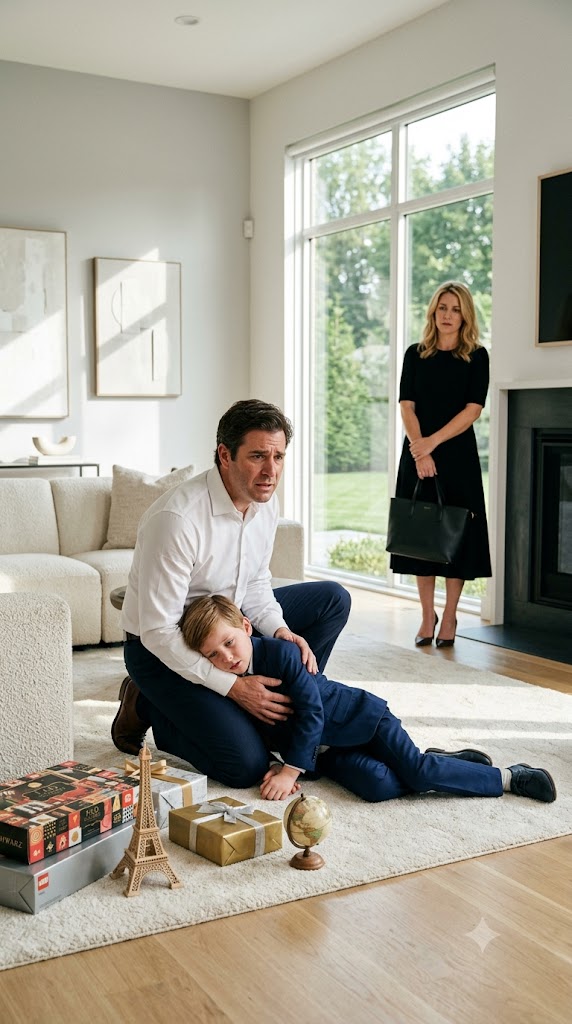
The Boy Who Wouldn’t Sit Down
When Russell Brant stepped out of the private terminal at Westchester County Airport, he expected his seven-year-old son to run into his arms.
He had been away for almost three months, traveling between London, Zurich, and Seattle to close a major software partnership for his company. Every night, no matter how tired he was, he had asked for updates about his son.
His ex-wife, Deanna Pike, always answered the same way.
“Micah is fine.”
“Micah already ate.”

“Micah is asleep.”
“Don’t call tonight. He needs routine.”
Russell had believed her because he wanted to believe her. Deanna lived in the house he paid for. She had a driver, staff access, a generous account for Micah’s food, school, doctors, and clothes. Russell thought money could build a wall around his child.
That afternoon, he realized money could not replace eyes, hands, and presence.
Micah stood beside a black SUV in a navy suit that looked far too stiff for a child. His hair was combed perfectly. His shoes were polished. His shirt was buttoned all the way to his throat.
But he did not smile.
He did not wave.
He did not move toward his father.
Deanna adjusted her sunglasses and sighed before Russell even reached them.
“If he acts strange, don’t make a big deal out of it,” she said. “He has been dramatic lately.”
Russell barely heard her. His attention was fixed on Micah.
He knelt in front of his son and softened his voice.
“Hey, buddy. Dad’s home.”
Micah’s lips trembled. His small hands stayed pressed to his sides.
Russell reached out to hug him, but the moment his hand touched Micah’s back, the boy flinched so hard his whole body tightened.
A tiny sound escaped him.
Not a cry.
Not a complaint.
Something smaller. Something frightened.
Deanna rolled her eyes.
“See? This is what I mean. Everything is a performance now.”
Russell looked up at her, and for the first time in years, he did not see the glamorous woman who had once charmed every room she entered.
He saw someone trying too hard to sound casual.
The Ride Home
Inside the SUV, Micah refused to sit.
Russell asked gently. Then he asked again. The air conditioning was cold, but sweat gathered near the boy’s hairline. He held the side handle with both hands and kept his legs apart in a strange, careful way, as if one wrong movement might hurt.
“Micah,” Russell said, keeping his voice calm. “You can sit next to me.”
“I’m okay standing,” Micah whispered.
Deanna, seated across from them, began talking about a charity dinner, a designer appointment, and a photographer who wanted family pictures for a lifestyle magazine. Russell did not respond. He watched his son’s face instead.
Micah stared at the floor.
Every bump in the road made him close his eyes.
By the time they reached the large stone house in Rye, Russell’s chest felt tight with worry.
He carried several boxes from the trunk: building sets, books, a soccer jersey, and a stuffed bear Micah had once pointed to during a video call.
“I brought you something from England,” Russell said, placing the boxes on the living room rug. “Remember the castle set you wanted?”
For one second, Micah’s eyes lit up.
Then Deanna’s voice sliced through the moment.
“Sit down and play with your father. I have things to do.”
Micah obeyed.
He bent his knees slowly, holding his breath as though preparing for pain. The second his body touched the rug, he cried out and fell sideways, curling into himself.
Russell dropped to the floor.
“Micah!”
Deanna stood near the stairs, annoyed.
“Russell, please. Don’t reward this behavior.”
But Russell was no longer listening.
He carefully loosened the boy’s belt and lifted the stiff fabric away from his skin. A sour smell rose into the air, sharp enough to make his stomach turn.
Then he saw what the expensive suit had been hiding.
Red, irritated skin. Swelling. Signs that his child had been left uncomfortable for far too long, then cleaned roughly at the last minute to make him presentable.
Russell’s hands shook.
Micah covered his face.
“I’m sorry,” the boy whispered. “I tried to be good.”
Russell lifted him with the gentleness of a man carrying something sacred.
“You are good,” he said, his voice breaking. “You were always good.”
Then he turned toward the doorway and shouted for someone to call for medical help.
Deanna’s face went pale.
“I thought it was just a rash,” she said quickly.
Russell looked at her once.
Only once.
“No,” he said. “You hoped I wouldn’t look.”
The Hospital Room
At White Plains Children’s Medical Center, Russell stood behind a yellow line while doctors and nurses moved around Micah.
Deanna stayed near the door, clutching her handbag like it could protect her from the truth.
After nearly an hour, Dr. Elaine Morris came out with a serious expression.
“Mr. Brant,” she said carefully, “your son is dehydrated, undernourished, and dealing with a severe skin condition caused by prolonged lack of proper care. We also found signs that someone tried to clean him harshly shortly before he was brought to you.”
Russell felt the room tilt.
“Harshly?”
The doctor’s jaw tightened.
“As if someone wanted to hide the problem quickly, not treat it gently.”
Russell turned.
Deanna was pretending to read a message on her phone.
“I need to go back to the house and get his things,” she said too fast. “You stay here.”
Before anyone could answer, she left.
That night, Micah woke with a fever. His eyes were half-open, but he was not fully awake.
He squeezed Russell’s fingers and whispered into the dark.
“Please don’t close the door. I’m thirsty. It’s dark.”
Russell lowered his forehead to the edge of the hospital bed.
He had signed deals worth hundreds of millions of dollars.
He had negotiated with powerful people across the world.
But nothing had ever made him feel smaller than hearing his son beg in his sleep.
The next morning, a nurse brought soup. Micah stared at it as if he could not believe it was really for him.
He ate too quickly, then looked terrified when he spilled a little on the blanket.
“I’m sorry,” he cried. “I’ll clean it. Please don’t be mad.”
Russell kept his hands visible and his voice steady.
“Nobody is mad. Food is not a test, buddy. You can eat slowly. You can ask for more. You are safe here.”
Micah stared at him like safety was a language he had forgotten.
The Neighbor’s Truth
When Micah finally slept, Russell stepped into the hallway and called his private investigator, Owen Lark.
“Go to the house,” Russell said. “Check the cameras, the accounts, the staff records, the neighbors. I want everything from the last three months.”
By late afternoon, Owen called back.
“You need to hear this from the woman next door,” he said.
The neighbor’s name was Mrs. Helen Whitcomb. She was a retired elementary school teacher in her seventies, with silver hair and a gentle face made heavy by guilt.
On the video call, she held a tissue in both hands.
“Mr. Brant,” she began, “I should have spoken sooner. I was afraid of getting involved, and I will carry that shame. But your boy was alone.”
Russell could not speak.
Helen continued.
“After you left, the house changed. There were parties most nights. Cars arrived late. Music played until morning. Your ex-wife slept through the day. Sometimes I saw Micah in the backyard before sunrise. He was barefoot. Thin. Quiet. He would pick fruit that had fallen from the trees and wipe it on his shirt before eating it.”
Russell closed his eyes.
His son had lived behind a tall gate, surrounded by wealth, and still gone hungry.
“One afternoon,” Helen said, crying now, “he knocked on the kitchen door from the patio. No one opened it. Then he drank water from the garden hose. I tossed a pack of crackers over the fence. He looked at me and nodded, but he didn’t speak. He looked scared to even say thank you.”
Russell’s hand tightened around the phone.
“Thank you for telling me,” he said, though the words nearly broke in his throat.
Owen entered the house later with legal permission from Russell’s attorney, the preliminary medical report, and emergency documentation.
The mansion smelled of old food, perfume, and stale party air.
The refrigerator held champagne, imported olives, and beauty products cooling on the shelves.
There was almost nothing for a child.
In Micah’s room, Owen found old takeout boxes hidden beneath the bed. Some had dates from weeks earlier.
“He was saving leftovers,” Owen said quietly. “Probably because he didn’t know when he would eat again.”
Russell sat beside Micah’s hospital bed and stared at his sleeping son.
For years, he had told himself that working harder was love.
Now he understood that love also had to come home.
The Evidence She Tried to Hide
The house cameras had been partially erased, but Russell’s security team recovered files from cloud storage.
He watched only one video.
It was from 2:18 in the morning.
Micah appeared in the hallway wearing pajamas. He walked slowly to Deanna’s bedroom door and knocked.
Once.
Twice.
Three times.
Colored lights flashed under the door. Music shook the hallway.
No one opened.
Micah waited, then walked to the linen closet. He opened it and climbed inside, curling himself between blankets and winter coats.
More than an hour later, Deanna came out laughing with a man Russell did not know. She passed the open closet with a glass in her hand.
Micah was less than three feet away.
She never looked down.
Russell turned off the tablet.
He did not yell.
He did not throw it.
His anger had become something colder and more focused.
He sent Deanna one message.
“Come to the hospital tomorrow morning. There are insurance forms that require a parent’s signature.”
She answered within a minute.
“Fine. Make it quick. I have an appointment at noon.”
The next morning, Deanna arrived in white linen, oversized sunglasses, red lipstick, and a new designer bag.
She walked into the hospital conference room expecting paperwork.
Her smile disappeared when she saw Russell seated at a metal table with a family attorney, a child welfare representative, Dr. Morris, and two officers.
“What is this?” Deanna asked.
Russell pointed to the chair across from him.
“Sit down.”
“Do not speak to me like that. I am Micah’s mother.”
Russell’s voice stayed quiet.
“Today, you are going to hear what your son lived through while I was gone.”
Deanna tried to laugh.
“This is ridiculous. Children get sick. You are turning a small issue into a scandal.”
Russell slid the bank records across the table.
“Three months. Luxury stores, spa visits, weekend trips, late-night clubs, hotel suites. Not one doctor visit. Not one proper grocery order for Micah. Not one school lunch payment after April.”
Deanna’s mouth tightened.
“You gave me that money.”
“For our son.”
“I was overwhelmed,” she snapped. “You left me alone with him.”
Russell placed a sealed evidence bag on the table. Inside were rough cleaning cloths taken from her bathroom. Then another bag with the medication bottle found near Micah’s room.
Deanna’s face changed.
“That proves nothing.”
Russell turned the tablet toward her and pressed play.
The room watched Micah knock on the door.
They watched him hide in the closet.
They watched Deanna walk past him without even pausing.
When the screen went black, no one spoke.
Deanna’s eyes filled with tears, but Russell knew those tears were for herself.
“You made me look like a monster,” she whispered.
Russell leaned forward.
“No. You made a little boy feel invisible in his own home.”
The child welfare representative closed the file.
Deanna was escorted from the room soon after. Her voice rose in the hallway, angry and afraid, but Russell did not follow.
For once, he chose not to chase the noise.
He chose to return to his son.
Learning How to Be Safe Again
When Russell walked back into the hospital room, Micah was awake, holding a small blanket against his chest.
“Is Mom coming?” he asked.
Russell sat beside him carefully.
“No, buddy. She is not coming here today.”
Micah studied his face.
“Am I in trouble?”
Russell shook his head.
“No. You are protected.”
Micah seemed confused by the word.
Protected.
As if he had heard it before but never seen what it looked like.
Slowly, he lifted his arms.
Russell leaned in, making sure not to touch any place that hurt. Micah clung to his neck and cried without apologizing, without hiding his face, without asking whether he was allowed to be sad.
Russell cried with him.
The months after that were not simple.
Micah had medical visits, counseling sessions, nightmares, quiet days, and sudden fears that arrived without warning. Sometimes he hid bread under his pillow. Sometimes he asked three times before taking a second serving of dinner. Sometimes, when a glass tipped over, he froze like the whole room might turn against him.
Russell learned to slow down.
He learned to knock before entering Micah’s room.
He learned to keep snacks where Micah could see them.
He learned to say, “You are not in trouble,” as many times as his son needed to hear it.
He stepped away from daily control of his company. Reporters called it shocking. Business analysts called it risky. Former colleagues called it emotional.
Russell did not answer them.
He had spent years building a company people admired.
Now he wanted to build a home where one small boy could sleep through the night.
So he sold the Rye mansion and bought a quiet house near the coast in Maine.
There were no marble floors. No loud parties. No cold hallways that echoed.
There was a kitchen that smelled like pancakes in the morning, a backyard with a wooden swing, and a porch where Micah could watch boats move across the water.
One afternoon, Micah tried to ride a bike across the grass. He wobbled, tipped over, and landed on his side.
Russell hurried toward him, then stopped a few feet away so he would not scare him.
“Micah, are you hurt?”
The boy looked down at his jeans, his eyes filling with panic.
“I got dirty.”
Russell smiled gently.
“Clothes can be washed. You never have to be sorry for falling.”
Micah stared at him for a long moment.
Then, slowly, he reached out his hand.
Russell took it.
That small gesture meant more than any award, any deal, any headline his name had ever earned.
At sunset, they walked along the shore. Micah collected shells in a plastic bucket while Russell carried his little sneakers. The waves washed over their footprints, erasing them almost as quickly as they appeared.
But Russell did not mind.
For the first time, his son was not looking over his shoulder.
And Russell understood something he would never forget.
Justice did not end when the truth was exposed.
Real justice began every morning a child woke up and finally believed the world could be gentle again.
Sometimes a child’s silence is not attitude, rebellion, or drama; sometimes it is the only way they have learned to survive in a place where nobody listened closely enough.
A beautiful house, expensive clothes, and polished family photos mean nothing if the child inside that home does not feel safe, fed, heard, and loved.
Money can pay for comfort, but it cannot replace presence, attention, patience, or the courage to notice when something feels wrong.
A parent who truly loves their child does not measure care by appearances; they measure it by the child’s peace, trust, health, and ability to sleep without fear.
The most painful truths often hide behind perfect smiles, luxury handbags, clean hallways, and people who say, “Everything is fine,” too quickly.
When a child flinches, apologizes too much, hides food, or becomes afraid of small mistakes, they are not being difficult; they may be showing the story they cannot explain.
Healing does not happen in one dramatic moment; it happens through hundreds of quiet promises kept again and again until the heart learns it can rest.
Sometimes the strongest thing a successful person can do is step away from the world’s applause and choose the small voice at home that needs them most.
Real protection begins when an adult stops defending appearances and starts asking the hard questions no one else wants to ask.
Every child deserves a home where food is not a privilege, comfort is not earned, tears are not punished, and love does not disappear when life becomes inconvenient.