My mother-in-law forced me to marry a rich but disabled man. On our wedding night, I lifted him to lay him in bed; we fell, and it was at that moment that I discovered a shocking truth…
My mother-in-law forced me to marry a rich but disabled man. On our wedding night, I lifted him to lay him in bed; we fell, and it was at that moment that I discovered a shocking truth…
The Hidden Strength
My name is Emma Carter. I am twenty-four years old. Since I was a child, I lived with my stepmother—a woman who was cold and ruthlessly pragmatic. For years, she hammered one lesson into my head, as if driving a nail.
“Never marry a poor man.” “You don’t need love. You need a quiet and secure life.”
Back then, I thought she was just a woman worn down by life. Until the day she forced me into a marriage I had no right to refuse. A marriage arranged like a transaction.
The man I had to marry was Ethan Blackwood. He was the only son of one of the most powerful and wealthy families—at least, that’s what the papers said. After a car accident five years ago, people said he was paralyzed. Since then, he had retreated from the spotlight, rarely appearing at any event.
Rumors followed him like a shadow. People said he was cold, arrogant, and bitter toward women. Meanwhile, my family was sinking. My father was drowning in debt, and my stepmother spoke plainly, without beating around the bush.
“If you marry Ethan, the bank won’t seize this house.” “Please, Emma… do it for your father.”
I bit my lip and nodded. But in my heart, I didn’t feel noble. I just felt humiliated. Plain and simple.
The Wedding Night
The wedding was so lavish I felt like I was standing in a stage set rather than real life. It took place at a restored mansion with sprawling gardens, fountains, and string music that drifted through the air like thin mist. I wore a deep red wedding dress embroidered with gold—radiant yet out of place. Inside, I was hollow.
The groom sat in a wheelchair. His face was sharp and stern, as if carved from stone. He didn’t smile. He didn’t speak. His black eyes looked at me, so deep and unreadable that I felt my skin go cold.
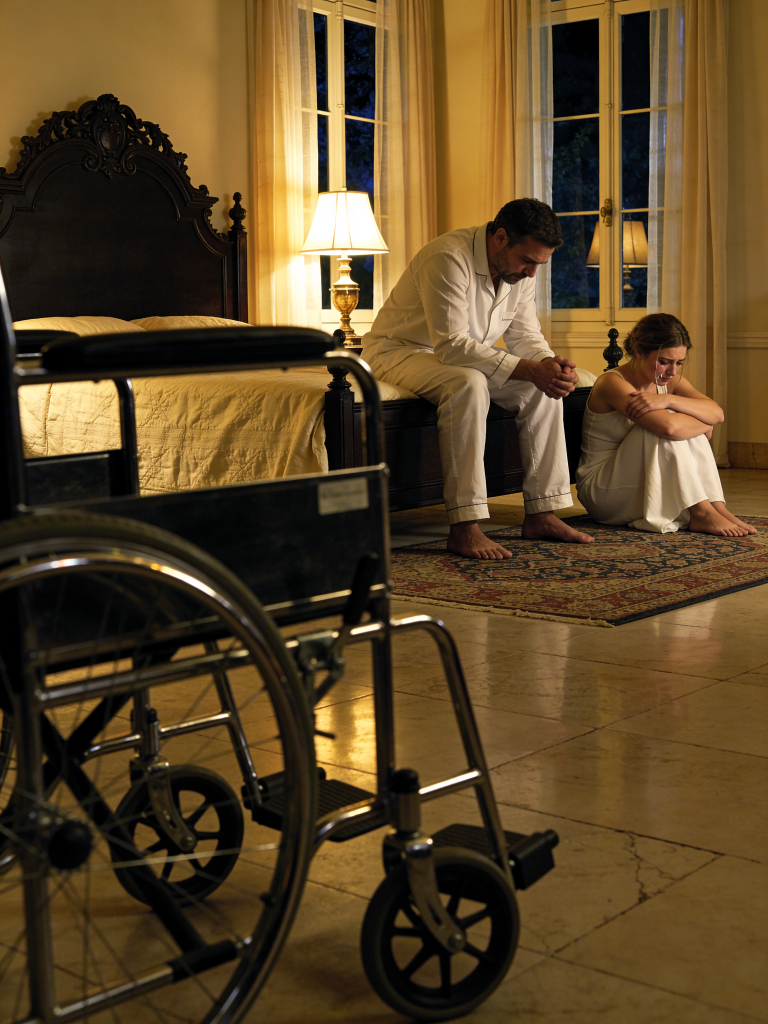
On our wedding night, I entered the room with my nerves frayed. He was still sitting there, motionless, the candlelight casting sharp shadows across his features. The room was so quiet I could hear my own heartbeat. I swallowed hard, trying to keep my voice from cracking.
“Let me help you into bed,” I said, my voice trembling. His lips tightened. “No need. I can manage on my own.”
I took a step back. Then I saw his body stiffen, as if a sudden spasm had passed through him. Instinctively, I lunged forward. “Careful!” I didn’t have time to think.
We fell at the same time. The sound of the impact echoed in the silence, sharper than a breaking glass. I landed on top of him, my face burning with shame. And at that exact moment, I felt something that shouldn’t exist in a paralyzed body.
A movement. Very real. Very clear.
For a fraction of a second, both of us seemed to hold our breath. My hands were pressed against his chest. My cheek was just a small distance from his collarbone, so close I could feel his warmth. Then I felt his thigh contract—plainly, undeniably.
I bolted up as if I had touched fire. “I-I’m sorry,” I stammered. “I didn’t mean to… are you okay?” My throat tightened. I hated myself for that question.
His jaw tightened. But his eyes were no longer distant. They were awake. They were sharp. “Stand up,” he said very quietly.
I stood up, my heart thumping as if it wanted to break out of my chest. He placed one hand on the floor. Then, slowly—with visible pain—he pushed himself up. He didn’t collapse. He didn’t crawl. He… stood up on his own two feet.
I could barely make a sound. “You… you just…,” I whispered. He let out a dry laugh. “You noticed, didn’t you.”
I looked at him as if looking at a truth that had just torn through a veil. “They said you were paralyzed. Your family. The doctors. The press.” He answered instantly, cold and concise. “They only said what benefited them.”
He moved again—with difficulty and pain, but it was movement. I heard myself ask, as if from very far away. “Then why the wheelchair? Why build up that story?”
His face darkened, as if a shadow had fallen over it. “Because lying helps people keep their distance.” He paused for a beat. Then he continued, each word carrying weight. “And in my family, the truth is more dangerous than you think.”
Alliances and Truths
I sat down on the edge of the bed. My wedding jewelry felt as heavy as chains. I suddenly remembered my stepmother’s words about “security,” and I felt like laughing but couldn’t. I turned to him, my eyes stinging but dry.
“Then why did you marry me?” I asked. The question was too blunt, but I didn’t have the strength to be polite. He was silent for a while before answering. “Because you were the only person they considered… insignificant.”
I froze. That one word was enough to cut deep. “Insignificant?”
He spoke steadily, as if reading a dirty summary of his own life. “They needed a wife for me. Someone obedient, discreet, from a desperate background.” He looked at me. “Someone who wouldn’t ask too many questions.”
I gave a bitter smile. “So, I was sold.” Just a short sentence, but it made the room feel heavy.
Something in his gaze softened, if only slightly. “I didn’t know you would be like this.” I frowned. “Like what?” “Someone who moves forward instead of drawing back.”
That night we slept apart, as if a silent ocean lay between the two shores. Days passed, then weeks. In the eyes of the public, Ethan remained the distant, “immobile,” untouchable husband. They praised my “patience” and “sacrifice.” I wanted to scream. But I swallowed it down.
In private, everything was different. At night, he would stand up—sometimes leaning on furniture, sometimes trembling, but always stubborn. We talked. About books. About music. About the smell of the air before a storm, and the cold stone after sunset. About my mother, who died when I was ten, and about his accident.
One night, he spoke as if he were mentioning a display piece. “They never wanted a son.” He looked up at the ceiling. “They wanted a symbol.”
Slowly, something in me shifted. Until the truth demanded its price.
I accidentally overheard my stepmother on the phone; her voice was low and firm, as if signing a contract. “She doesn’t know a thing. The contract is signed.” She paused. “Once we get the second payment, we’re out.”
That night, I confronted him. I didn’t beat around the bush. “She knew everything,” I said. “They used you. They used me too.” He looked at me longer than necessary. Then he replied, frighteningly calm. “I suspected as much.”
I felt my throat tighten. “I was the bait.” He didn’t deny it. “And I let it happen.”
The silence stretched like a taut wire. I hated feeling small in it. I asked, my voice rasping. “What do you want?” He answered, slowly and clearly. “I want to take my life back.” He looked straight at me. “But I can’t do it alone.”
I thought of everything I had endured. I thought of the “security” they used to lock me away. Then I said, short and firm. “You won’t be alone.”
The Awakening
From then on, we became allies. No frills. No fantasies. Just two people pushed into a corner, deciding not to stay down anymore.
We recorded his recovery process. We gathered evidence of betrayals and legal deceptions. It took months, step by step, like piecing back together a picture they had intentionally torn to shreds. I was tired. But I was awake.
Then came a family gathering. The room was full of social laughter and prying eyes. I stood beside him, my hands cold, my heart hot. He took a breath, as if drawing the entire silence toward him.
And Ethan did what no one was prepared to witness. He stood up.
His voice was clear, without a tremor. “I have something to say.” He stopped. “About the accident. About my recovery.” Then his eyes swept across the frozen faces. “And about the people who thought my wife and I were replaceable.”
I took his hand. Hard. A grip that felt like a seal. And the truth burst out; it didn’t need to be shouted to shatter everything.
His uncle was arrested. Accounts were frozen. Their “empire” shook like a building losing its foundation. My stepmother disappeared the very next day. It was hollow, chillingly so.
After everything, he turned to me, his voice low. “You’re free now,” he said. “If you want to leave, I won’t stop you.”
I looked at him for a long time. Then I answered, as slowly as if I were untying a knot in my chest. “I was never free before.” I exhaled. A short sentence. “I am now.”
We rebuilt everything, bit by bit. With truth. By not avoiding it. Love didn’t come like a storm. It came like the dawn—slow, but certain.
On our first anniversary, we walked in the garden. No more string music. Only the wind and footsteps. He looked at me and spoke like a simple confession.
“Thank you… for seeing me when I was hiding.” I smiled. “Thank you for not giving up.”
A simple lesson, but a costly one: security without truth is just another prison. And the most “shocking” thing sometimes isn’t that someone lied to you. It’s the moment you realize—you are stronger than anything they ever calculated.