My Neighbor Forced Her Daughter To Wear A Parka In 115° Heat. I Ripped It Off And Saw Why.
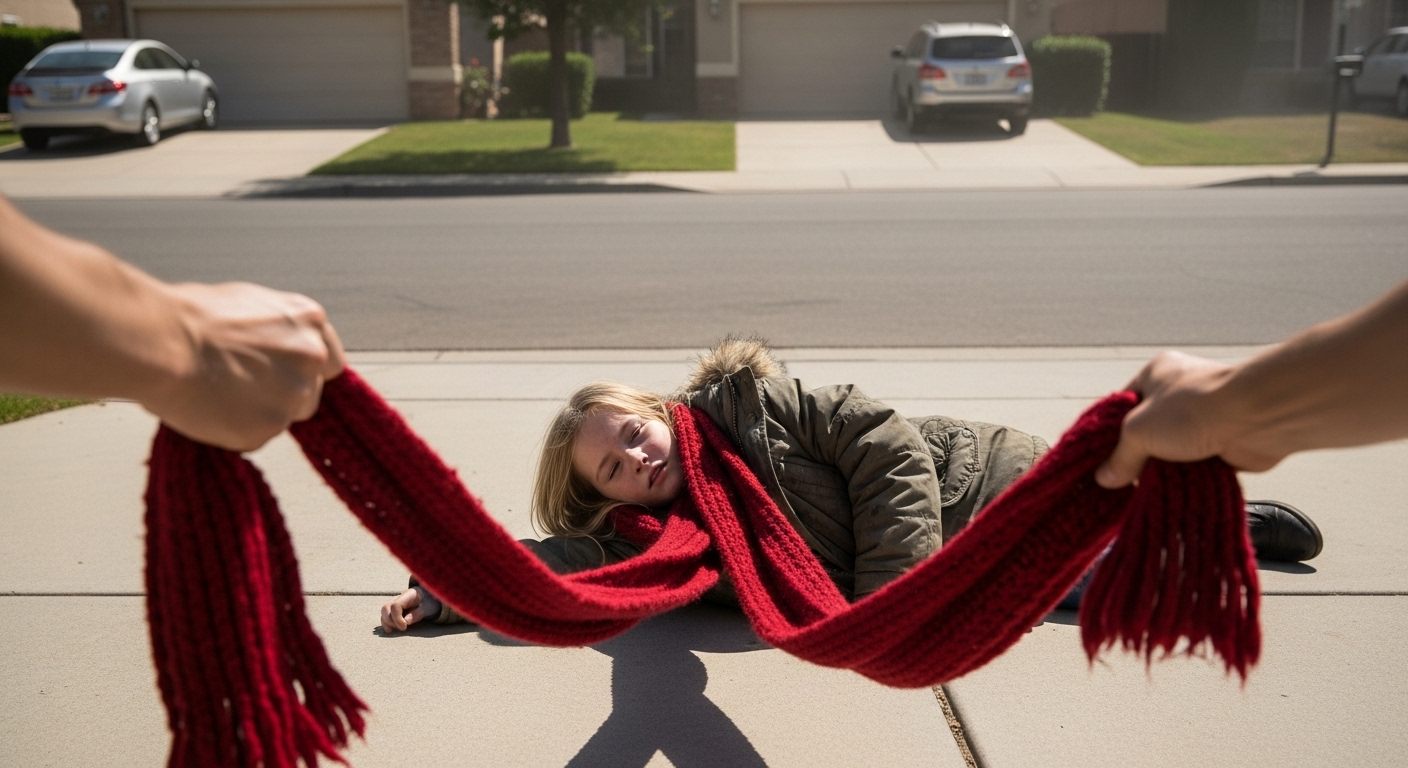
CHAPTER 1: THE HEATWAVE
The heat in Phoenix isn’t like heat anywhere else. It’s physical. It has weight.
It presses down on your shoulders and dries out your eyes the second you step out the door. We were in the middle of a “super-heatwave,” a streak of ten days where the thermometer didn’t drop below 110 degrees until after sunset.
Even the asphalt looked like it was melting. The air shimmered so hard it looked like the whole neighborhood was underwater.
Most people stayed inside with their AC cranking, praying the grid wouldn’t fail.

Not me.
I was in my garage, sweating through my t-shirt, trying to fix the alternator on my truck. My garage door was halfway up, giving me a view of the street at knee-level.
That’s when I saw the U-Haul pull up next door.
The house at 402 had been empty for six months. It was a foreclosure, a sad-looking ranch style with dead grass and peeling paint.
I watched a woman step out of the truck.
She was immaculate. That’s the only word for it.
Despite the brutal heat, she was wearing a crisp, long-sleeved button-down shirt, buttoned all the way to her chin, and long slacks. Her hair was pulled back in a bun so tight it looked painful. She didn’t sweat.
She didn’t even look like she felt the temperature.
I wiped grease on a rag and stood up, debating if I should go say hello. We take care of our own in this cul-de-sac.
Then, the passenger door opened.
A little girl climbed out. She couldn’t have been more than seven or eight years old.
I froze. My wrench clattered to the concrete floor.
The girl was dressed for a blizzard.
She was wearing thick, dark jeans tucked into winter boots. She had on a heavy, puffy parka—the kind you wear to climb Everest. And wrapped around her neck, layers deep, was a thick, red wool scarf.
It was 112 degrees.
I felt like I was hallucinating. Heat stroke, maybe? I blinked, rubbing my eyes.
The image didn’t change.
The little girl stood on the baking pavement. I could see the heat waves radiating off the blacktop around her boots.
She didn’t move. She just stood there, staring at the front door of the empty house, her hands buried deep in her pockets.
“Get inside, Clara,” the mother said. Her voice wasn’t loud, but it carried across the lawn like a crack of a whip. “Now.”
The girl didn’t argue. She didn’t whine about the heat. She just lowered her head, the huge hood of the parka casting a shadow over her face, and shuffled toward the door.
She walked stiffly. Like her joints were rusted.
I walked out of my garage, squinting against the glare. “Hey! excuse me!” I called out.
The woman turned. Her sunglasses were black circles, completely hiding her eyes. She didn’t smile. She didn’t wave. She just waited.
“Welcome to the neighborhood,” I said, wiping my hand on my jeans before extending it. “I’m Mike. Just wanted to say… uh, be careful with the heat today. It’s brutal.”
I gestured toward the door where the girl had disappeared. “Your daughter… isn’t she hot in that?”
The woman stared at my hand until I awkwardly dropped it to my side.
“Clara has a condition,” the woman said. Her voice was flat. Monotone. “She gets cold very easily. Her circulation is poor.”
“Oh,” I said, taken aback. “I’m sorry. I didn’t know. But… it’s over a hundred degrees. That coat looks heavy.”
“She is fine,” the woman said, turning her back on me. “We value our privacy, Mike. Please respect that.”
She walked into the house and slammed the door.
That was three days ago.
Since then, things have only gotten weirder.
I work from home as a graphic designer, so my desk faces the window that looks directly into their yard. I started watching them. I know how that sounds. I sound like a creep. But my gut was screaming at me that something was wrong.
I never saw the husband. Just the woman and Clara.
And every time I saw Clara, she was bundled up.
Yesterday, I saw her in the backyard. The sun was at its peak. I was sweating just sitting in my air-conditioned office.
Clara was out there in the parka and the scarf. She was walking in circles. Perfect, geometric circles in the dirt.
Round and round. Like a robot.
She did it for an hour.
I thought about calling the police. I really did. I typed 9-1-1 into my phone. But what would I say? “My neighbor dresses her kid warmly”?
They’d laugh at me. Or worse, CPS would come, find nothing wrong, and I’d be the guy who harassed the single mom with the sick kid.
But today… today broke me.
It was noon. The news said it was the hottest day of the year. 115 degrees. The pavement was hot enough to fry an egg—literally, my son tried it last year.
I was in the kitchen getting a glass of water when I saw movement out the front window.
It was Clara.
She was walking down their driveway. She was alone.
She was wearing the coat. The boots. The scarf.
But something was wrong with her walk. She was stumbling. Drifting to the left, then correcting to the right.
She looked like a drunk person trying to navigate a straight line.
I slammed my water glass down on the counter. “Oh, hell no,” I muttered.
I ran to the front door and threw it open. The heat hit me like a physical blow, sucking the breath out of my lungs.
“Clara!” I shouted.
She didn’t turn. She took one more step, her boot catching on the edge of the curb.
She went down hard.
She didn’t put her hands out to break her fall. She just face-planted onto the scorching concrete of the driveway.
I didn’t think. I sprinted.
I ran across my lawn, ignoring the burning heat on my bare feet (I hadn’t put shoes on). I reached her in ten seconds, but it felt like ten years.
She was motionless.
I dropped to my knees beside her. The heat radiating off the parka was intense. She was literally baking inside that thing.
“Clara? Honey, can you hear me?”
I grabbed her shoulder and rolled her over.
Her eyes were rolled back in her head. Her face… oh god. It was beet red, but dry. Bone dry. She wasn’t sweating. That’s a sign of severe heatstroke. Her body had stopped trying to cool itself.
“Hey! Help!” I screamed toward her house. “Your daughter is hurt!”
Silence. The house loomed over us, dark and quiet.
I put my hand on her chest to check for breathing. The coat was so thick I couldn’t feel anything.
I had to get this thing off her. I had to cool her down immediately or she was going to die right there on the driveway.
My hands were shaking as I reached for the zipper of the parka.
It was stuck. Or locked? No, just rusted shut.
I yanked it, panic rising in my throat. “Come on, come on!”
I managed to tear the zipper down halfway. I pulled the coat open.
Underneath, she was wearing a wool sweater.
“Are you insane?” I screamed at the empty house. “Who does this?”
I grabbed the hem of the sweater and tried to pull it up, but it was tight.
She gasped. A horrible, rattling sound.
“I’ve got you,” I said, tears stinging my eyes from the panic. “I’m going to get this off you.”
But first, the scarf. It was wrapped so tightly around her neck it looked like a brace.
I reached for the scarf. It was thick, scratchy red wool.
“Okay, Clara. I’m going to loosen this so you can breathe.”
I found the end of the scarf and started unwinding it.
One loop.
Two loops.
The heat coming off her neck was intense, but there was a smell, too. A smell like… copper. And something rotting.
Three loops.
The final layer fell away.
I froze. The world went silent. The cicadas stopped buzzing. The traffic noise disappeared.
My heart stopped beating in my chest.
Her neck wasn’t just red from the heat.
Embedded into the flesh of her throat, hidden by the scarf, was a thick, black metal collar. It looked industrial. Heavy.
But that wasn’t the part that made me scream.
The collar had wires running out of it, disappearing into the skin of her collarbone. And right in the center of the metal band, blinking with a terrifyingly slow rhythm, was a small red light.
And under the light, etched into the metal, was a warning label:
BIOLOGICAL HAZARD: CLASS 4. DO NOT REMOVE. DISTANCE TRIGGER ACTIVE.
Then, the light on her collar turned from red… to green.
And I heard a beep.
CHAPTER 2: THE KEEPER
The beep wasn’t loud. It was a sharp, digital chirp, like a watch alarm. But in that dead-silent, baking heat, it sounded like a gunshot.
Green light. Beep. Green light. Beep.
The rhythm was accelerating.
My first instinct wasn’t curiosity. It was pure, primal survival. The label said “HAZARD.” My brain screamed BOMB.
I threw my body over Clara’s small frame. I curled around her, shielding her head with my chest, squeezing my eyes shut. I waited for the explosion. I waited for the fire.
“Get away from her!”
The voice didn’t come from the house. It came from right behind me.
I didn’t hear footsteps. I didn’t hear the screen door slam. One second the street was empty, and the next, she was there.
A hand grabbed the back of my shirt.
I’m a big guy. Six-foot-two, two hundred pounds. I hit the gym four days a week.
But the force that yanked me backward felt like a forklift.
I flew through the air. I literally lost contact with the ground and slammed onto the concrete driveway three feet away. The air rushed out of my lungs with a wet whoosh.
I scrambled backward, scraping my elbows on the hot pavement, gasping for air.
The mother stood over Clara.
She wasn’t looking at the girl. She was looking at me.
Her sunglasses had fallen off.
I froze.
Her eyes were pale. Not blue, not gray. They were almost white, like the milkiness of a cataract, but sharp. Focused. There was no panic in them. No maternal fear.
Just cold, calculation.
She knelt down, her movements fluid and precise. She didn’t check Clara’s pulse. She didn’t check her breathing.
She reached straight for the collar.
She pulled a small, metallic fob from her pocket—it looked like a high-tech car key. She pressed it against the blinking green light on the girl’s throat.
A sequence of tones played. Da-da-da-dum.
The light turned back to a slow, pulsing red. The beeping stopped.
“You touched it,” she said. She didn’t shout. Her voice was barely a whisper, but it carried perfectly. “You compromised the seal.”
“She… she passed out,” I stammered, finally finding my breath. “She’s wearing a winter coat in July! She’s dying of heatstroke!”
The woman ignored me. She grabbed Clara by the shoulders.
“Initiating wake-up protocol,” she muttered.
She shook the girl. Hard.
Clara’s eyes snapped open.
They didn’t flutter. They didn’t roll. They just snapped wide open, instantly alert.
She didn’t gasp for air. She didn’t cry. She just stared up at her mother with those same pale, empty eyes.
“Up,” the mother commanded.
The little girl stood up.
My jaw dropped. A normal kid who just collapsed from heat exhaustion would be groggy, sick, vomiting.
Clara stood up like a soldier coming to attention. She didn’t sway. She didn’t stumble.
The mother grabbed the scarf from the ground and whipped it back around Clara’s neck, hiding the metal collar, hiding the red light, hiding the “BIOHAZARD” warning.
“Inside,” the mother said.
Clara turned and marched toward the house. The heavy parka dragged on the ground, but she moved with a terrifying, mechanical smoothness.
The mother turned back to me.
She walked closer. I flinched, instinctively scrambling back further.
“You saw nothing,” she said.
“I saw a collar,” I spat back, anger finally overriding my confusion. “I saw wires going into her skin. What the hell are you doing to that girl?”
She tilted her head. “I am keeping you safe, Mike. You should be thanking me.”
“Safe from what? A little girl?”
She smiled. It was the worst thing I had ever seen. It didn’t reach her eyes. It was just a baring of teeth.
“From the contagion,” she said.
Then she turned and walked away. The door clicked shut behind them, and the deadbolt slid home with a heavy thud.
I sat there on the burning driveway for a full minute, my mind racing.
Contagion? Biohazard?
I scrambled to my feet and ran into my house. My hands were shaking so bad I dropped my keys twice before I could lock the door.
I went straight to the kitchen window and peered through the blinds.
The house at 402 was silent. The curtains were drawn tight. It looked like a tomb.
I pulled out my phone. My thumb hovered over the call button.
9-1-1.
I had to. I had no choice. That wasn’t just abuse; that was… something else. The collar. The wires. The strength of that woman.
I hit dial.
“911, what is your emergency?”
“I need police and an ambulance at 402 Oak Street,” I said, my voice trembling. “My neighbor… she’s abusing her daughter. The kid collapsed in the driveway. She’s wearing a winter coat, it’s 115 degrees out.”
“Is the child conscious?” the dispatcher asked.
“Yes, but… she has this thing on her neck. A collar. It says ‘Biohazard.’ The mom dragged her inside. You need to hurry.”
“Officers are on the way, sir.”
I waited.
Ten minutes later, a patrol car rolled up. Two officers, a man and a woman, stepped out. They looked bored, sweating in their uniforms.
I watched from my window. I didn’t go out. I wanted to see what happened first.
They knocked on the door.
A minute passed. Then another.
Finally, the door opened.
The mother stepped out. She looked completely different.
She had changed clothes. She was wearing a light, floral sundress. Her hair was down, soft and wavy. She was smiling. She looked like the perfect suburban mom.
She held the door open, and the officers stepped inside.
My stomach twisted. “No, don’t go in there alone,” I whispered to the glass.
I paced my living room. Five minutes. Ten minutes.
What were they doing? Were they checking the collar? Were they arresting her?
Finally, the door opened again.
The officers walked out. The mother followed them, laughing at something the male officer said. She shook their hands.
She waved as they walked back to their car.
I couldn’t believe it.
I threw my front door open and ran out. “Hey! Officer!”
The female officer stopped, hand on her car door. She looked at me with annoyance.
“Are you the caller?” she asked.
“Yes! Did you see the girl? Did you see the collar?”
The officer sighed, wiping sweat from her forehead. “Sir, we did a welfare check. The child is fine. She’s inside watching cartoons and eating a popsicle.”
“But the coat! The scarf!”
“Mrs. Vane explained everything,” the officer said, flipping her notebook closed. “The daughter, Clara, has a severe autoimmune disorder. Cold Urticaria and a rare photosensitivity condition. She has to stay covered up, or her skin reacts violently to the environment. The ‘collar’ you saw is a medical device. An insulin and epinephrine pump.”
“It said ‘Biohazard’!” I screamed. “It had wires going into her neck!”
The male officer chuckled. “It’s a medical warning, sir. In case EMTs need to treat her. It warns of blood-borne pathogens due to her medication. It’s standard for high-risk kids.”
“She threw me!” I pointed at the mother, who was standing on her porch, watching us with that polite, fake smile. “She threw me three feet!”
The officer looked at the petite woman in the sundress, then back at me—a six-foot-two man.
“Sir,” the female officer said, her voice dropping an octave. “It’s hot. People get agitated. We suggest you drink some water and mind your own business. We don’t want to come back out here for a neighbor dispute.”
“She’s lying,” I said, desperate.
“Have a good day, sir.”
They got in the car and drove away.
I stood there, humiliated.
The mother, Mrs. Vane, stood on her porch. She waited until the police car turned the corner.
Then, she dropped the smile.
She raised her hand and made a gesture. She pointed two fingers at her own eyes, then pointed them at me.
I’m watching you.
She went inside.
I didn’t sleep that night.
I sat in my office, lights off, staring at the screen of my computer. I had opened an incognito tab.
I searched for “Medical collar biohazard class 4.”
Nothing. Just generic safety warnings.
I searched for “Clara Vane.”
Nothing. No school records. No birth announcements. No social media.
I searched for the property records of 402 Oak Street.
It had been bought two months ago by a holding company called “Aegis containment Solutions.”
I typed that into Google.
404 Error. Server Not Found.
My heart was hammering against my ribs. This wasn’t a medical condition. You don’t buy a foreclosure in Phoenix through a shell company for a sick kid.
And that label… Distance Trigger Active.
That’s not for insulin. That’s for a bomb. Or a shock collar. Or something meant to keep a prisoner from escaping.
It was 2:00 AM. The neighborhood was dead silent. The heat had finally broken, dropping to a manageable 95 degrees.
I needed water. My throat felt like sandpaper.
I walked into the kitchen. I didn’t turn on the lights; I knew the layout by heart. I opened the fridge, the light spilling out across the floor.
I grabbed a pitcher of water.
Then I heard it.
Creak.
It came from the living room.
I froze, the pitcher heavy in my hand. It was the sound of a floorboard settling. But I was the only one in the house. My son was at his mom’s for the week.
“Hello?” I called out, feeling stupid.
Silence.
I grabbed a steak knife from the drying rack. I crept toward the living room, using the light from the streetlamps filtering through the blinds.
The room was empty. The shadows stretched long and thin across the carpet.
I let out a breath. “Get it together, Mike. You’re losing it.”
I turned to go back to the bedroom.
And then I saw it.
On my coffee table.
Sitting right in the center, reflecting the moonlight.
It was a small, red ball of yarn.
I walked over to it, my blood running cold. We don’t knit. I don’t own yarn.
I reached out and touched it. It was coarse. Scratchy.
It was the same wool as Clara’s scarf.
Attached to the ball of yarn was a small piece of paper. A sticky note.
I picked it up, squinting to read the handwriting in the dark.
It was written in crayon. Childish, shaky block letters.
H E L P. S H E I S S L E E P I N G. T H E I C E I S M E L T I N G.
I stared at the note. Clara had been in my house. While I was in the office? While I was in the bathroom?
How did she get in? The doors were locked. The windows were alarmed.
Suddenly, a loud THUMP came from the wall shared with the neighbor’s house.
Then a scream.
Not a human scream.
It sounded like a high-pitched, tea-kettle shriek that vibrated through the walls and rattled the teeth in my jaw. It was a sound of pure agony.
Then, a crash. Glass breaking.
I ran to the window.
The front door of 402 Oak Street flew off its hinges.
Not opened. Flew. It was blasted outward, landing in the middle of the lawn.
A figure stumbled out.
It was Clara.
But she wasn’t wearing the parka anymore.
She was wearing a white tank top and shorts.
And I saw why she wore the coat.
Her skin… it wasn’t skin.
In the moonlight, her arms and legs were translucent. They were glowing with a soft, pulsing blue light. And inside her body, beneath the surface, I could see things moving.
Shadows. Swirling, black shapes swimming under her skin like fish in a tank.
She looked at me. Across the lawn, our eyes locked.
The collar on her neck was beeping rapidly now.
Beep-beep-beep-beep.
She opened her mouth, and a cloud of freezing white mist poured out, instantly freezing the cactus in her front yard.
“RUN!” she screamed.
Her voice wasn’t a little girl’s voice. It was deep, distorted, like three voices speaking at once.
Then, something massive and black exploded out of the house behind her, snatching her back into the darkness.
CHAPTER 3: THE ICE HOUSE
I didn’t think. I didn’t plan. I just reacted.
The scream I heard from inside that house didn’t sound like a child anymore. It sounded like tectonic plates grinding together.
I grabbed the baseball bat I keep behind the front door—a souvenir from a Diamondbacks game—and sprinted across the lawn.
The heat was gone.
The moment I stepped onto the grass of 402 Oak Street, the temperature dropped forty degrees. It was like walking into a grocery store freezer.
The grass crunching under my bare feet was frozen solid. The cactus I had admired yesterday was shattered, exploded from the inside out by flash-freezing.
The front door was lying in the middle of the living room.
I stepped through the frame.
“Clara!” I shouted. My breath came out in thick white clouds.
The inside of the house was a nightmare.
Furniture was overturned. The TV was smashed. But it was the walls that stopped me cold.
They were covered in frost. Thick, white, jagged frost that was growing, creeping across the drywall like a fungus.
“Get… out…”
The voice came from the floor.
I looked down. Mrs. Vane was propped up against the overturned sofa.
She looked bad.
Her floral sundress was shredded. But there was no blood.
Where the fabric was torn, I didn’t see skin. I saw a dark, metallic mesh suit underneath. A bodysuit that looked like Kevlar mixed with snake scales.
And her face…
She was bleeding from a cut on her forehead, but the blood wasn’t red. It was silver. Thick, mercury-like liquid that dripped slowly down her cheek.
“What are you?” I whispered, gripping the bat tighter.
She coughed, spitting out more silver fluid. “I told you… to stay away, Mike.”
“Where is she? What did you do to her?”
“I didn’t do anything,” she wheezed. She tried to stand but collapsed back down. “The containment… failed. The heat… it was too much for the regulator.”
She pointed a trembling hand toward the hallway. The hallway was blocked by a wall of swirling white mist.
“She’s leaking,” Mrs. Vane said. “The entity is breaching the shell.”
“Entity? She’s a little girl!”
“She is a Class 4 thermodynamic anomaly,” Mrs. Vane snapped, her eyes flashing with that scary intensity again. “She absorbs energy. Heat. Light. Life. She eats it.”
I looked at the hallway. The mist was getting thicker. The temperature was dropping by the second. I could feel the hairs in my nose freezing.
“She gave me a note,” I said. “She asked for help.”
Mrs. Vane laughed. It was a dry, humorless sound. “It mimics. It learns. It knows that humans are weak to… distress.”
“I don’t believe you.”
I turned toward the hallway.
“Don’t!” Mrs. Vane screamed. “If you go in there, your lungs will freeze in your chest!”
I ignored her. I pulled my t-shirt up over my nose and mouth and stepped into the mist.
It hit me like a physical wall.
The cold was agonizing. It felt like needles piercing every inch of my skin. My eyes watered and the tears froze instantly on my lashes.
“Clara?” I choked out.
The hallway stretched out, distorted by the fog. At the end, the door to what should have been the master bedroom was gone.
In its place was a hole.
Not a hole in the wall. A hole in reality.
A swirling vortex of blue and black darkness, spinning slowly. And standing in the center of the room, floating six inches off the floor, was Clara.
She was glowing.
That blue light I saw earlier was brighter now, blindingly bright. Her skin was transparent glass. I could see her skeleton. I could see her organs.
But her heart wasn’t beating.
In her chest, where her heart should have been, was a ball of black fire.
She turned her head slowly to look at me.
“Mike,” she said.
Her voice wasn’t distorted anymore. It was clear. Sweet. The voice of a terrified child.
“It burns, Mike. The sun burns.”
I took a step forward. “I’m here, Clara. I’m here.”
“Make it stop,” she cried. Tears of ice fell from her eyes and clattered onto the floor like diamonds. “The collar hurts.”
I looked at her neck.
The metal collar was sparking. The red light was strobing frantically.
BEEP-BEEP-BEEP.
“The lady says I’m a monster,” Clara sobbed. “Am I a monster?”
“No,” I said, my voice shaking uncontrollably from the cold. “You’re just a kid. We’re going to get that thing off you.”
I reached out my hand.
“NO!”
I spun around. Mrs. Vane was standing behind me. She was holding a weapon. It looked like a rifle, but the barrel was glowing orange.
“Step away from the subject, Mike,” she ordered. “That collar is the only thing keeping this neighborhood from becoming the next Ice Age.”
“You’re hurting her!” I yelled, shielding Clara with my body.
“I am containing a singularity!” Mrs. Vane shouted back. “If that collar breaks, she will drain the heat from everything within a ten-mile radius. You, me, your house, this city. Everything dies. Frozen in absolute zero.”
She raised the rifle.
“I have to terminate the subject. Move.”
CHAPTER 4: THE PURGE
I stood my ground.
I don’t know why. Maybe it was the way Clara was cowering behind me. Maybe it was the fact that Mrs. Vane was bleeding silver and holding a sci-fi gun.
“You’re not shooting a kid,” I said.
“She’s not a kid!” Mrs. Vane screamed. “Look at her!”
I looked back. Clara was watching me. The black fire in her chest was swirling.
“Mike,” she whispered. “She’s lying. She wants to put me back in the box.”
“The box keeps you alive!” Mrs. Vane retorted.
Suddenly, a siren wailed outside. But it wasn’t a police siren.
It was a low, mechanical hum that vibrated the floorboards.
Mrs. Vane’s face went pale. Paler than usual.
“They’re here,” she whispered. She lowered the gun. “It’s too late.”
“Who?” I asked.
“Aegis,” she said. “The cleanup crew.”
“Police?”
“Exterminators.”
CRASH.
The front window shattered inward. A canister rolled across the living room floor.
It hissed.
“Gas!” Mrs. Vane yelled. She tackled me, knocking me into the frozen bedroom with Clara.
She slammed the door shut and pressed a button on her wrist. A metal shutter slammed down over the bedroom door, sealing us in.
“What is that?” I coughed.
“Nerve agent,” Mrs. Vane said, sliding down the wall. “They aren’t taking chances. They detected the breach. They’re scrubbing the site.”
“Scrubbing? You mean killing us?”
“Yes.”
We were trapped.
In the bedroom with the ice girl. Outside, a government hit squad was gassing the house.
Clara floated closer to me. The cold radiating off her was less intense now. She seemed… calmer.
“They want to hurt us,” Clara said.
“Yes,” Mrs. Vane said, looking at the girl with a strange expression. Not hate. Fear, yes. But also… sadness? “They do.”
“Mike tried to help,” Clara said. She reached out a translucent hand and touched my arm.
It didn’t burn. It felt cool, like a pleasant breeze on a hot day.
“He is nice,” she said.
Mrs. Vane looked at me. “You idiot. You triggered her empathy response. That’s why she’s not freezing you to death right now. She’s modulating her output to protect you.”
“She can control it?” I asked.
“She’s learning,” Mrs. Vane said. She looked at the metal shutter. We could hear heavy boots stomping in the living room.
“Clear left. Clear right. Target is in the master bedroom.” The voices were muffled, robotic.
“We need a way out,” I said. “Is there a back door?”
“Sealed,” Mrs. Vane said. “The whole house is on lockdown.”
“Then we fight,” I said, gripping my bat.
Mrs. Vane looked at the bat and actually laughed. “With that? Those men are wearing powered armor, Mike. They will snap you in half.”
“Then you use your gun.”
“It’s out of charge.”
We sat in silence for a second. The boots were getting closer to the door. Sparks began to fly from the metal shutter. They were cutting through.
Clara floated forward.
She looked at the door. Then she looked at Mrs. Vane.
“Remove the collar,” Clara said.
Mrs. Vane’s eyes widened. “No. Absolutely not.”
“If you don’t,” Clara said, her voice dropping to that deep, distorted growl, “They will kill Mike. And they will kill you.”
“If I take it off, you’ll go critical,” Mrs. Vane said.
“I will aim it,” Clara said.
I looked between them. “Aim what?”
“The cold,” Clara said. “I will aim it at them.”
The sparks were flying faster now. The metal was glowing red hot. They were almost through.
“Do it,” I told Mrs. Vane.
“You’re signing our death warrants,” she said.
“We’re dead anyway!” I yelled. “Give her a chance!”
Mrs. Vane hesitated. She looked at the cutting torch melting her blast door. She looked at the girl she had kept prisoner for months.
She pulled out the fob.
“God forgive me,” she whispered.
She pressed the button.
Click.
The collar on Clara’s neck unlatched. It fell to the floor with a heavy clank.
The silence that followed was heavy.
Clara took a deep breath.
For the first time, she looked… human. Her skin turned a normal shade of pink. The blue light faded. The black fire in her chest disappeared.
She smiled at me.
“Cover your eyes, Mike,” she said softly.
Then she turned to the door.
The metal shutter fell inward with a crash.
Three men stood there. They looked like astronauts in black tactical gear. They raised massive rifles.
“Target acquired,” the lead soldier said.
Clara opened her mouth.
She didn’t scream.
She exhaled.
It wasn’t mist. It wasn’t wind.
It was a beam of pure, white energy.
It hit the soldiers.
There was no sound of impact. No explosion.
They simply… stopped.
The lead soldier turned into a statue. His black armor turned white. Then, he shattered.
He crumbled into a pile of ice cubes and frozen flesh on the floor.
The beam continued, blasting through the soldiers, through the living room, through the front wall of the house, and out into the street.
I watched in horror as the beam hit the Aegis van parked outside. The entire vehicle was encased in a block of ice instantly.
Clara stopped. She slumped forward.
I caught her before she hit the floor. She was freezing cold, but breathing.
“Did I do it?” she whispered.
“Yeah, kid,” I stammered, staring at the pile of shattered soldiers. “You did it.”
Mrs. Vane stood up. She walked over to the window and looked out.
“We have to move,” she said. her voice urgent. “That was just the extraction team. Now that they know she’s weaponized… they’ll send the air support.”
“Air support?” I asked.
“A drone strike,” Mrs. Vane said. “They’re going to level the block.”
She turned to me.
“Grab her, Mike. Do you have a car?”
“My truck,” I said. “In the garage.”
“Does it have gas?”
“Full tank.”
“Then drive,” she said. “Drive like hell.”
We ran to the garage. I threw Clara into the backseat of my pickup. Mrs. Vane jumped in the passenger side.
I hit the garage door opener. Nothing. The power was cut.
“Ram it!” Mrs. Vane yelled.
I slammed the truck into reverse.
We smashed through the garage door, wood and metal flying everywhere. I spun the truck around in the street, tires screeching.
I looked up.
High in the sky, a small black dot was circling.
“Go!” Mrs. Vane screamed.
I floored it.
As we sped out of the cul-de-sac, I looked in the rearview mirror.
A missile hit 402 Oak Street.
The explosion was silent at first, then the shockwave hit us, rattling the truck. A massive fireball consumed the house, my house, and the frozen remains of the soldiers.
We were alive. But we were homeless, hunted, and I had a nuclear-level ice monster sleeping in my backseat.
Mrs. Vane looked at me. She wiped the silver blood from her face.
“Drive north,” she said. “I know a place.”
“Who are you people?” I asked, gripping the steering wheel until my knuckles turned white.
Mrs. Vane looked out the window at the passing desert.
“I’m not people, Mike,” she said softly. “And neither is she. But you… you’re an accessory now. Welcome to the war.”
CHAPTER 5: THE DESERT FEVER
The desert highway stretched out like a black ribbon toward the horizon. I pushed the truck to eighty, then ninety. My hands were shaking so hard I had to white-knuckle the steering wheel just to stay in my lane.
In the back seat, Clara was curled into a ball. She was shivering, but not from the cold. She was whispering in her sleep—weird, rhythmic sounds that didn’t sound like any language I’d ever heard.
“Where are we going?” I demanded, glancing at Mrs. Vane.
She was tinkering with a small device she’d pulled from the shredded lining of her dress. It looked like a compass, but the needle was spinning frantically.
“North. Into the mountains,” she said. “The heat is her enemy. It makes her volatile. We need to get her to a higher altitude, somewhere the ambient temperature is lower.”
“You still haven’t told me what she is,” I snapped. “Or what you are.”
Mrs. Vane looked at me. In the dim light of the dashboard, her silver blood had dried, leaving metallic streaks on her skin.
“Have you ever heard of the ‘Cold Spot’ in the constellation Eridanus?” she asked.
“The what?”
“A vast area of the universe that’s billions of degrees colder than it should be. Scientists think it’s a void. They’re wrong. It’s an entry point.”
She leaned back, her eyes fixed on the road. “Clara isn’t a child. She’s a vessel. She was found in a crash site in the Arctic circle ten years ago. Aegis spent a decade trying to turn her into a battery, a source of infinite energy. But you can’t contain the void forever.”
“And you?” I asked. “Are you her mother or her jailer?”
“I am her Handler,” she said, her voice softening for the first time. “I was a bio-organic construct created to manage her. But after three years… I started to feel things. Empathy. Protectiveness. I realized they weren’t trying to study her. They were trying to hollow her out and use her as a weapon of mass destruction.”
Suddenly, the truck’s engine sputtered.
The radio began to hiss with static, a high-pitched whine that set my teeth on edge.
“They’re jamming us,” Mrs. Vane said, sitting upright. “Look up.”
I leaned forward, squinting through the windshield. Far above, three black sleek shapes were cutting through the moonlight. Not drones. Stealth helicopters.
“Pull over,” she ordered.
“Are you crazy? They’ll catch us!”
“If you stay on the road, they’ll just missile the truck. We have to go into the canyon. Now!”
I yanked the wheel to the right. The truck bounced violently as we left the pavement, hitting the dirt and sagebrush of the Tonto National Forest. I drove blind, the headlights bouncing off rocks and cacti, until I found a narrow ravine tucked between two red-rock cliffs.
I killed the lights and the engine.
Silence.
We sat there, the only sound the ticking of the cooling engine. Above us, the thrum of the helicopters grew louder, then faded as they swept past our position.
“We have ten minutes, maybe less,” Mrs. Vane whispered.
“Mike?”
It was Clara. She was awake. She was sitting up, her eyes glowing with that terrifying blue light again.
“Mike, I’m hungry,” she said.
I reached into the back seat for a bag of chips. “Here, kid, I’ve got—”
“No,” she said. Her voice sounded like ice cracking. “Not food. I’m empty.”
The air inside the truck began to freeze. I watched as frost formed on the steering wheel.
“The discharge back at the house drained her,” Mrs. Vane warned. “She’s starting to pull heat from her surroundings. Mike, get out of the truck. Now!”
CHAPTER 6: THE VOID HUNGER
I scrambled out of the driver’s side just as the windows of my truck shattered from the pressure of the sudden temperature drop.
Clara stepped out of the back. She didn’t look like a little girl anymore. Her hair was standing on end, flickering like white flames. Every step she took on the desert floor turned the sand into jagged glass.
“Clara, stop!” I yelled.
She didn’t hear me. She was looking at the sky.
One of the helicopters had circled back. It had thermal imaging. It had found the “cold spot” we were creating in the desert.
A massive spotlight clicked on, bathing the ravine in blinding white light.
“Subject located. Level 4 engagement authorized,” a voice boomed from a loudspeaker.
“Clara, no!” Mrs. Vane shouted, reaching for the girl.
But it was too late. Clara opened her arms wide.
The desert heat—the 100-degree midnight air—was sucked toward her in a literal whirlwind. I felt the warmth leave my skin so fast it felt like I was being flayed.
The sand, the rocks, even the air itself was being stripped of its energy.
The helicopter’s engine suddenly died. I watched as the rotors slowed, coated in a thick layer of ice in mid-air. The massive machine groaned, losing lift, and fell out of the sky like a lead weight.
It slammed into the cliffside across from us.
BOOM.
But there was no fire. The explosion was a dull thud. The fuel didn’t ignite because it was frozen solid. The wreckage just sat there, smoking blue mist.
Clara collapsed. The blue glow dimmed.
I ran to her, but Mrs. Vane tackled me. “Don’t touch her! She’s at absolute zero right now. You’ll shatter like glass.”
We watched as Clara lay in the sand. The area around her for fifty yards was a winter wasteland in the middle of the Arizona desert.
“She can’t keep doing this,” I said, my voice cracking. “It’s killing her.”
“It’s changing her,” Mrs. Vane corrected. “The more she feeds, the less ‘Clara’ is left. Eventually, the vessel will break, and the void will just… be.”
“We have to help her. There has to be a way to stabilize her.”
Mrs. Vane looked toward the north. “There is a facility. An old Aegis lab built into a decommissioned salt mine. It has a cryogenic stabilizer. If we can get her there, we can reset her regulator.”
“How far?” I asked.
“Sixty miles.”
I looked at my truck. It was encased in two inches of ice. The engine block was probably cracked.
“We aren’t going to make it in the truck,” I said.
That’s when I heard the sound of more engines. Not from the sky. From the road.
A convoy of black SUVs was roaring toward our position.
“They’re coming for their property,” Mrs. Vane said, pulling a silver blade from a hidden compartment in her arm. “Mike, take Clara. Run into the caves. I’ll hold them off.”
“You’ll die,” I said.
She looked at me with those pale, milky eyes and gave me a sad, silver-stained smile.
“I was never alive, Mike. I was built for this. Go!”
I didn’t argue. I wrapped my hands in my thickest flannel shirt, scooped up the freezing, unconscious girl, and ran into the darkness of the canyon.
Behind me, the sound of gunfire and screaming filled the night.
But as I reached the mouth of a deep cave, I heard something else. A sound that made the hair on my neck stand up.
It was a whistle. A cheerful, human whistle coming from the back of the cave.
I stopped. I shifted Clara’s weight and looked into the shadows.
A man was sitting there on a rock. He was wearing a Hawaiian shirt and khaki shorts. He was holding a flashlight.
“Late for a hike, aren’t you?” he asked.
I backed up. “Who are you?”
He stood up, and the flashlight caught his face. He was middle-aged, balding, looking like a high school geography teacher.
But his shadow on the cave wall was wrong.
It was too big. It had too many limbs.
“I’m the guy who’s been waiting for that little girl for a long, long time,” he said.
He smiled, and his mouth kept opening. Further and further. Past his jaw. Past his neck.
“Give her to me, Mike. And I might let you keep your soul.”
CHAPTER 7: THE MAN IN THE MOUTH
The man in the Hawaiian shirt didn’t move, but the air around him began to warp. It smelled like ozone and old, wet copper.
“Who are you?” I whispered, clutching Clara’s freezing body tighter. My arms were starting to go numb through the flannel shirt.
“Names are such human things, aren’t they?” he said. His voice sounded like it was being played through a broken speaker. “Let’s just say I’m a… collector. And you’re holding something that belongs in a much colder gallery.”
He took a step forward. His gait was wrong—his knees bent backward for a split second before snapping back into place.
I looked at his shadow again. It wasn’t a shadow. It was a hole in the light. Dark appendages, like the legs of a giant spider, were twitching behind him, though there was nothing attached to his back.
“She’s just a kid,” I growled, backing toward the cave entrance.
“A kid?” The man laughed, and the sound made my ears bleed. A thin trickle of warm red ran down my neck. “That ‘kid’ is a crack in the hull of your reality, Mike. If she stays here, she’ll drink your sun dry. I’m doing your world a favor.”
Suddenly, a blur of silver and black slammed into the man.
It was Mrs. Vane.
She had survived the soldiers. Her dress was gone, leaving only the sleek, metallic combat suit. Her silver blood was splattered across her chest like a war painting.
“Run, Mike!” she screamed, her arm transforming into a jagged blade of mercury-like metal. “This is a Shifter! He’ll peel the skin off your bones just to see what’s inside!”
She swung at the man. He didn’t dodge. He just opened his mouth.
His jaw unhinged, dropping to his chest, and a mass of black, oily tentacles exploded outward. They caught Mrs. Vane’s blade, the sound of metal on metal screeching through the cave.
I didn’t wait to see more. I turned and sprinted deeper into the cave system.
It was pitch black. I stumbled, my boots sliding on damp rocks. Clara was getting heavier. Her body was pulsing now—a rhythmic heartbeat of cold that sent frost crawling up my arms.
“Mike…” she whimpered. Her eyes opened. They were pure white. “He’s coming. The Empty Man is coming.”
“I’ve got you, Clara. We’re almost there.”
I didn’t know where “there” was, but I saw a faint, artificial light at the end of the tunnel. Not the moon. A flickering, fluorescent hum.
I burst into a massive underground chamber. It wasn’t a cave anymore. It was an industrial bunker.
Heavy steel doors. Warning signs with the “Aegis” logo. And in the center, a massive glass cylinder filled with circulating liquid nitrogen.
The stabilizer.
I ran to the control panel. It was covered in dust and blood. Someone had been here recently.
“Okay, okay… how does this work?” I frantically pressed buttons. A screen flickered to life.
STABILIZATION PROTOCOL: ENTER SUBJECT.
I looked at the cylinder. There was a hatch.
“Clara, honey, I need you to get in the tube. It’s going to be cold, but it’ll help. I promise.”
She looked at the machine with pure terror. “If I go in… do I stay ‘me’?”
I looked at her translucent hands, the black fire swirling in her chest. I didn’t have an answer. I didn’t even know what ‘she’ was anymore.
“I won’t let them take you,” I said.
A wet, slapping sound echoed from the tunnel behind me.
Slap. Slap. Slap.
The Man in the Hawaiian shirt walked into the chamber. He was dragging something behind him.
It was Mrs. Vane’s head.
He tossed it onto the floor. Her eyes were still moving, her silver circuits flickering out.
“The handler was obsolete,” the man said. His shirt was shredded, revealing a torso made of undulating, tooth-filled mouths. “Now. The girl.”
I shoved Clara into the cylinder and slammed the hatch. I hit the ‘INITIATE’ button.
WARNING: EXTERNAL POWER REQUIRED. GRID OFFLINE.
“No!” I screamed, hammering the console. “Work, you piece of junk!”
The man was ten feet away. He began to grow. His skin tore like cheap paper as something much larger and darker began to push its way out from inside him.
“You humans,” the entity hissed. “Always trying to fix things that are meant to be broken.”
I looked at the power cables. They were severed.
Then I looked at the “Biohazard” collar lying on the floor. Mrs. Vane must have dropped it when she tackled him.
The collar. It was a battery.
I grabbed it. The red light was still blinking. Distance Trigger Active.
If I plugged this into the console, it might power the stabilizer. But the moment I connected it, the “distance” between the collar and the girl would be zero. It might explode.
I looked at Clara. She was pressed against the glass, her hand against mine.
“I’m sorry,” I whispered.
I jammed the collar’s wires into the emergency power port.
The console screamed. The cylinder began to roar with blue light.
But the collar didn’t just power the machine.
The “Distance Trigger” hit 0.0.
The explosion didn’t go out. It went in.
A massive vacuum of force sucked everything in the room toward the cylinder—the rocks, the computer, and the Man in the Hawaiian Shirt.
The entity shrieked as it was pulled into the vortex. Its body was shredded into atoms, sucked into the black fire inside Clara.
I felt myself being lifted off the floor.
“Clara! Shut it down!” I yelled.
She looked at me. For one second, the blue light vanished. Her eyes were brown again. Human.
“Goodbye, Mike,” she whispered.
She closed her eyes.
The light became blinding. A wave of absolute zero hit me, and the world went black.
CHAPTER 8: THE SILENCE
I woke up on a pile of sand.
The sun was high in the sky. I could hear the sound of a distant highway.
I sat up, coughing. My skin was peeling, sunburnt to a crisp. The cave was gone. The bunker was gone. There was only a massive, perfectly smooth crater in the middle of the desert.
The sand inside the crater was turned to glass.
I looked around, desperate. “Clara?”
Nothing.
I crawled to the center of the crater. There, lying in the middle of the glass, was a small, red wool scarf.
It was perfectly intact. Not a single thread was singed.
I picked it up. It felt warm. Not the scorching heat of the Arizona sun, but the gentle, living warmth of a child’s neck.
I looked up at the sky.
The sun looked different. It was dimmer. Just a little bit. Like something had taken a small bite out of its light.
I walked toward the highway. My truck was gone. My life was gone. I was a dead man walking, a witness to something that wasn’t supposed to exist.
As I reached the pavement, a black SUV pulled up.
The window rolled down.
A man in a suit, wearing dark sunglasses, looked at me. He didn’t look like a soldier. He looked like an accountant.
“Mr. Miller,” he said. “You’ve had a very long night.”
“Where is she?” I asked, my voice a ghost of a sound.
The man looked at the red scarf in my hand.
“She’s where she belongs,” he said. “The question is, where do you belong?”
He opened the back door.
“Get in. We have a lot to talk about. And Mike… don’t bother looking for your house. It never existed.”
I looked at the scarf. I looked at the man.
I got in the car.
Because I knew something they didn’t.
As I sat in the back seat, I felt a tiny movement in my pocket.
I reached in and pulled out a small, red ball of yarn.
It was vibrating.
And from deep inside the yarn, I heard a tiny, distorted voice.
“Help.”
END