My Sister Banned Me From My Grandpa’s Funeral. She Announced, “SHE RAN AWAY FROM HER DUTY. SHE’S A DISGRACE TO THIS FAMILY.” I Didn’t Argue. When The General Walked In, She Went Pale…
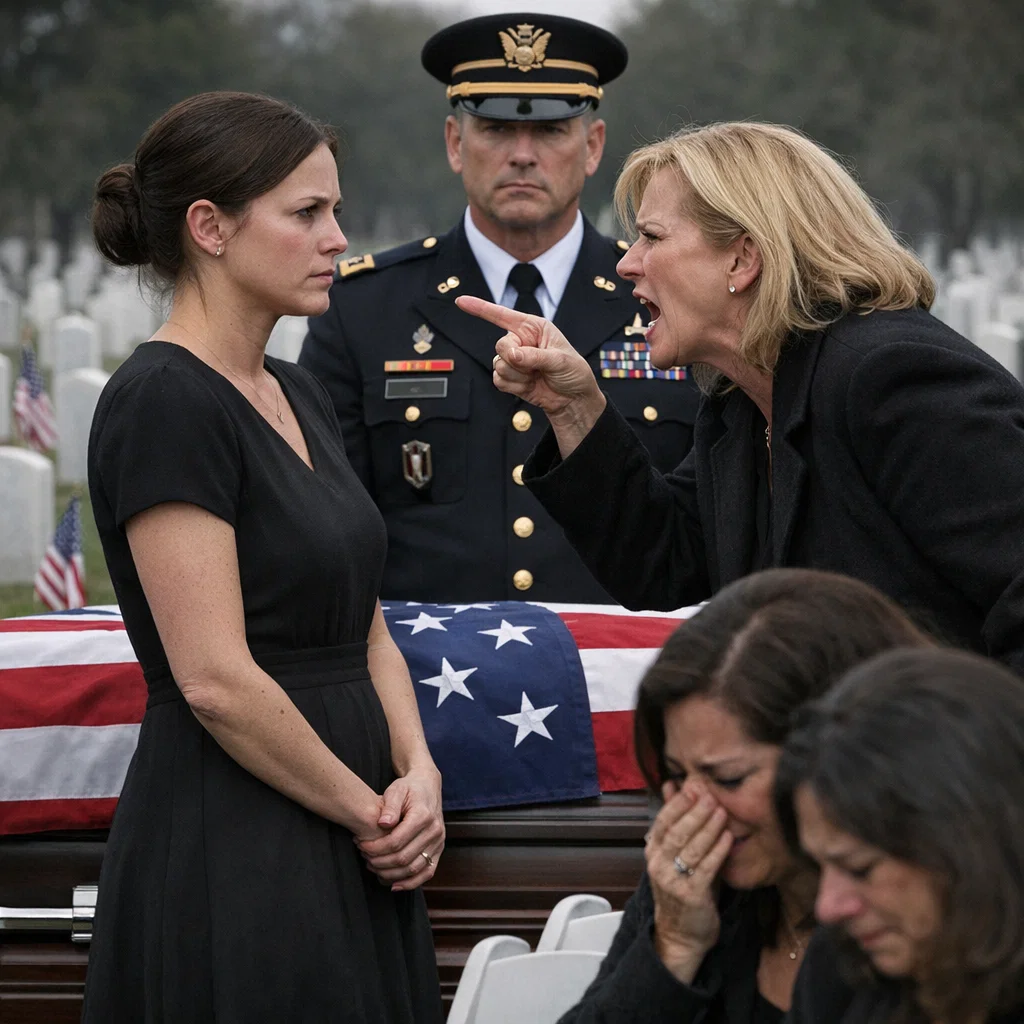
The rain started before sunrise.
Not a storm. Not dramatic thunder. Just a steady, cold sheet that blurred marble and memory alike.
By the time Colonel Avery Whitaker stepped out of her rental sedan at Arlington National Cemetery, the sky was the color of brushed steel and the air carried that sharp, metallic smell of wet stone.
She wore a plain black coat. No medals. No ribbons. No visible rank.
That was deliberate.

The only thing she allowed herself was the silver ring on her right hand—worn thin at the edges from years of habit. She adjusted it once as she closed the car door. A small motion. A quiet anchor.
Her grandfather, Sergeant Major Thomas Whitaker, had asked for a simple funeral.
“No speeches,” he’d told her once during chemo. “No spectacle. Just fold the flag right.”
He’d hated spectacle.
Which made the row of black SUVs lining the curb feel almost insulting.
Staff cars. Political plates. People who hadn’t called in months suddenly rediscovering patriotism because it photographed well.
Avery took a breath and stepped toward the gate.
The cemetery stretched out in disciplined rows of white markers, each one clean, identical, final. Rain darkened the grass between them.
She was ten yards from the entrance when a voice cut through the drizzle.
“Stop.”
Avery didn’t flinch.
She knew that voice.
Brooke Whitaker stood beneath an oversized black umbrella held by a young man in a tailored coat. Brooke’s own outfit looked less like funeral attire and more like a corporate keynote—sharp lines, expensive heels, diamond studs that caught even the muted morning light.
Two private security guards hovered behind her, broad-shouldered and watchful.
Brooke’s smile unfurled slowly.
“Well,” she said, voice carrying easily over rain. “Look who finally decided to show up.”
A few guests turned.
Avery met her sister’s eyes.
“I’m here for Grandpa.”
Brooke’s expression snapped tight.
“You don’t get to say his name.”
The words were sharp, rehearsed.
“You disappeared for five years. No holidays. No birthdays. No hospital visits. And now you think you can walk in and sit in the family row?”
Avery’s jaw tightened, but her posture remained still.
“I was working.”
Brooke laughed lightly—just loud enough to draw attention.
“For those of you who don’t know,” Brooke announced, projecting her voice toward the small crowd gathering under umbrellas, “this is my sister. The one who ran away from her duty.”
The phrase hung in the air.
People shifted.
Curiosity always wins over decorum.
Brooke took a step forward, seizing the moment.
“She’s a deserter,” she said clearly.
The word landed heavy.
It was chosen carefully.
At Arlington, among uniforms and folded flags, that word was more than insult.
It was accusation.
Avery didn’t argue.
She didn’t raise her voice.
Years of training and loss had carved restraint into muscle memory.
Brooke folded her arms.
“Escort her out.”
One of the security guards stepped forward, hand hovering near Avery’s sleeve.
Rain streaked down Avery’s coat, but she didn’t move.
“Don’t,” Brooke added sweetly. “We don’t need a scene.”
The guard reached anyway.
Before his hand could make contact, the cemetery gate behind them shifted open with a metallic groan.
For a moment, everyone paused.
Then it slammed shut again with a hollow clang, echoing down the walkway.
Avery found herself standing just outside the bars.
On the wrong side.
Brooke turned back toward the entrance with satisfaction settling over her features.
“Thank you,” she murmured to the guard. “We’ll handle the rest.”
Inside the gate, guests resumed their positions.
Brooke smoothed her coat, lifted her chin, and stepped toward the covered seating area where the casket rested beneath a canopy.
Avery remained in the rain.
She lifted her right hand and adjusted her silver ring again.
Small habit.
Quiet check.
Inside, near the front row, a four-star general—his uniform darkened slightly by rain—shifted his gaze toward the gate.
His eyes landed on Avery’s hand.
On the ring.
Recognition flickered.
Not confusion.
Recognition.
His posture changed subtly, shoulders squaring with sudden attention.
But Brooke didn’t see it.
She was already turning toward her audience, confident she had reclaimed the narrative.
Avery walked back toward her car without hurry.
Each step felt deliberate.
The rain soaked through her collar and down her spine, but she welcomed the cold.
Cold kept emotion precise.
She slid into the driver’s seat and closed the door gently.
The heater coughed weakly to life.
From her windshield, she could see the canopy, the flag-draped casket, and Brooke stepping forward with that polished composure she’d perfected over decades.
Avery didn’t wipe the fog from the glass immediately.
She let the blur exist.
Inside, Brooke’s voice carried faintly over a microphone.
“Today we gather to honor a man of legacy.”
Legacy.
Like branding.
Avery’s hands rested loosely on the steering wheel.
Five years.
That was the narrative Brooke preferred.
Five years of absence.
Five years of “disappearance.”
Brooke never mentioned classified deployments.
Never mentioned blackout periods.
Never mentioned that Thomas Whitaker had known exactly where his younger granddaughter was.
“Do what you have to do,” he’d told her the last time she visited in uniform, before he stopped recognizing faces reliably. “Just don’t apologize for it.”
She never had.
Under the canopy, Brooke continued.
“My grandfather believed in responsibility,” she said smoothly. “In family. In showing up.”
Avery closed her eyes briefly.
Showing up.
She had been there during the chemo nights when Thomas vomited until he could barely breathe.
She had held the basin.
She had monitored the morphine.
She had been there during the months when Brooke’s schedule was “too full” to accommodate hospital lighting and frailty.
But Brooke had always excelled at optics.
The rain softened into a lighter mist.
Guests leaned closer under umbrellas as Brooke shifted tone.
“In accordance with my grandfather’s final wishes,” she said, voice lowering for effect, “there has been some confusion regarding the estate.”
Avery’s spine straightened.
Estate.
Brooke paused deliberately.
“But I want to clarify. A revised will was signed three months before his passing.”
Three months.
Three months before Thomas died, he hadn’t been responsive.
He hadn’t been able to hold a pen steady.
Avery knew because she had charted medication changes.
She had documented cognitive decline.
She had recorded dates that didn’t bend for convenience.
Through the windshield, she saw a suited attorney step forward with a folder.
The rain felt colder.
Avery reached into her coat and pulled out her phone.
She switched it into a locked, encrypted mode.
Her thumb hovered briefly over the screen.
Then she sent a short, pre-coded message.
Three characters.
No context.
No explanation.
The network she had built didn’t need narrative.
It needed coordinates.
She set the phone face-down on her lap.
Inside the gate, the attorney began reading.
“The entirety of the Thomas Whitaker estate… shall transfer solely to my granddaughter, Rebecca—”
Rebecca.
Brooke’s legal first name.
Brooke stood tall, chin lifted like she was receiving a commendation.
Then she added, softly but audibly, “Grandpa understood that some people can’t carry responsibility.”
Avery exhaled slowly.
Responsibility.
There it was again.
She didn’t storm the gate.
She didn’t call the police.
She didn’t shout.
She waited.
Her phone vibrated once.
A reply.
Confirmed. Stand by.
She looked back toward the canopy.
Near the casket, the four-star general shifted in his seat.
His gaze moved again toward the gate.
Toward the car.
Toward her.
The rain had nearly stopped.
Brooke smiled out at the crowd, convinced she had secured both sympathy and inheritance in one polished speech.
Avery rested her head back against the seat.
The heater rattled softly.
Inside the cemetery, something had begun to change.
And Brooke didn’t see it coming.
The rain stopped completely as the attorney finished reading the revised will.
It wasn’t applause that followed.
It was something quieter.
A shift in the air.
Brooke stood beneath the canopy with practiced stillness, chin lifted slightly, hands folded as if she were graciously accepting an inevitable outcome. The suited attorney stepped back, expression neutral, folder closed.
“The entirety of the Thomas Whitaker estate,” he repeated for clarity, “shall transfer solely to my granddaughter, Rebecca Whitaker.”
Rebecca.
Brooke didn’t correct him.
She preferred the formal version when money was involved.
A few murmurs rippled through the seated guests. Distant cousins. Former colleagues. Veterans in pressed uniforms who remembered Thomas as a disciplined man who believed in procedure.
Brooke leaned toward the microphone again.
“My grandfather trusted me to protect this family’s legacy,” she said smoothly. “He understood that some people—” she paused deliberately, letting her eyes drift toward the gate, toward the shape of Avery beyond it, “—cannot carry responsibility.”
The word responsibility settled over the cemetery like fog.
Beyond the iron bars, inside her car, Avery’s face remained composed.
Three months before Thomas died, he had been legally incapacitated. Not confused. Not forgetful.
Incapacitated.
Avery had the documentation.
She had signed hospital acknowledgments. She had recorded dosage changes. She had witnessed the moment when Thomas stopped recognizing which day it was.
Three months before his death, he could not have revised anything.
Her phone vibrated again.
Second confirmation.
Movement initiated.
She didn’t smile.
She didn’t need to.
Inside the chapel area, the four-star general—General Marcus Hale—remained seated, hands clasped loosely over one knee. He had served with Thomas decades ago. They had disagreed loudly about strategy and laughed loudly about everything else.
He knew Thomas Whitaker.
Thomas had been meticulous about paperwork.
Hale’s gaze moved toward Brooke as she continued speaking.
“Grandpa believed in strength,” she said. “In those who stand firm.”
Hale’s eyes drifted again toward the gate.
He had seen the ring.
He knew that ring.
There are things in military service that never become public. Symbols that mark operations not listed on memorial plaques.
The silver ring on Avery’s right hand wasn’t decorative.
It was earned.
And Hale had been at the ceremony when she received it.
Brooke finished her speech with a final, polished nod.
“Thank you all for honoring his memory.”
The funeral director stepped forward, attempting to restore solemn pacing.
But the mood had shifted.
A few guests exchanged glances.
Whispers carried softly through the rows.
“She wasn’t even here,” someone murmured about Avery.
“Or maybe she was somewhere else,” another voice answered quietly.
Outside the gate, Avery stepped out of her car.
She didn’t rush.
She walked toward the entrance again, rainwater still glistening on the pavement.
The security guard noticed her first.
“Ma’am, you were asked to leave.”
“I’m here to stand,” Avery replied evenly.
“You’re not on the list.”
Avery tilted her head slightly.
“Neither is the truth,” she said calmly.
Before the guard could respond, the iron gate opened again—this time deliberately.
A black government sedan rolled up slowly.
No sirens.
No flashing lights.
Just quiet authority.
Two men stepped out.
Both in uniform.
Both carrying the weight of rank without theatricality.
The guard hesitated.
“Private service,” he began.
The first officer handed him a small, embossed credential.
The guard’s posture shifted instantly.
“Yes, sir.”
The gate remained open.
Avery didn’t look at Brooke.
Not yet.
She walked through.
Inside the seating area, Brooke’s smile faltered when she saw Avery re-enter.
She leaned toward the nearest guard.
“Remove her,” she hissed.
The guard took a step forward.
Before he could reach Avery, General Hale stood.
The movement was subtle—but unmistakable.
“Stand down,” he said.
His voice wasn’t loud.
It didn’t need to be.
The guard froze.
Brooke blinked.
“General Hale, this is a private family matter.”
Hale turned slowly toward her.
“We are here to honor Sergeant Major Whitaker,” he replied. “And the integrity he demanded.”
The rear doors of the chapel opened again.
A line of uniformed personnel entered in disciplined formation. Their steps were synchronized, measured, and silent.
The kind of movement that commands attention without requesting it.
Guests stopped whispering.
Another four-star followed behind them.
General Raymond Keller.
His eyes scanned the room once—then locked onto Avery’s right hand.
The silver ring caught the light.
Recognition settled.
He walked down the aisle without looking at Brooke.
When he reached Avery, he stopped.
He came to full attention.
And he saluted.
Sharp.
Precise.
Unmistakable.
The formation behind him followed in perfect unison.
The room held its breath.
Brooke’s face drained of color.
Keller lowered his hand and spoke clearly enough for everyone to hear.
“Colonel Avery Whitaker.”
The title landed like thunder in a silent sky.
Colonel.
Not deserter.
Not runaway.
Colonel.
Brooke’s fingers trembled near the podium.
“She—she left,” Brooke stammered. “She abandoned—”
“She was deployed,” Hale cut in evenly.
The words didn’t shout.
They corrected.
Avery stepped forward then—not dramatically, not hurriedly.
Just steady.
“My grandfather didn’t care about titles,” she said calmly. “He cared about showing up.”
Her voice carried without strain.
“I was where he told me to be.”
Brooke swallowed.
“This is not the time—”
“It’s exactly the time,” Avery replied.
She removed a slim folder from her coat.
Medical documentation.
Cognitive evaluations.
Physician statements.
“These records confirm that three months before his passing, Sergeant Major Whitaker was legally incapacitated,” Avery said. “He could not have signed a revised will.”
The attorney shifted uncomfortably.
Brooke’s composure fractured at the edges.
“You’re accusing me at a funeral?” Brooke snapped.
“Yes,” Avery said.
Calm.
Final.
She lifted her phone and tapped once.
An audio file played.
Clear.
Undistorted.
Brooke’s voice.
“You won’t even remember this. Just sign it. I’ll handle everything.”
The room didn’t erupt.
It tightened.
Faces changed.
Perception shifted.
Legacy meant something different now.
Outside the chapel, two investigators stepped into position—quiet, patient.
They had timelines.
They had document analyses.
They had signatures that didn’t match baseline samples.
Brooke looked around for support.
She found distance instead.
“You’re ruining this,” she whispered toward Avery.
“No,” Avery replied. “You did.”
The funeral director cleared his throat softly.
General Hale stepped forward and addressed the room.
“Sergeant Major Thomas Whitaker served this country with honor. We will proceed accordingly.”
No one objected.
Brooke stepped back from the podium slowly, her spotlight dissolving under scrutiny.
Avery moved to the casket.
The flag was still perfectly placed.
She placed her hand lightly on it—just for a second.
“I’m here,” she murmured under her breath.
Not to prove anything.
Just to honor him.
Outside, the rain began again.
But this time, it felt cleansing.
The silence after the audio clip ended was not chaotic.
It was controlled.
Which made it worse.
Brooke’s voice—clear, coaxing, unmistakable—hung in the chapel long after the phone screen dimmed.
“You won’t even remember this. Just sign it. I’ll handle everything.”
There was no distortion.
No ambiguity.
No room to reinterpret tone.
The funeral guests didn’t gasp.
They recalibrated.
General Hale didn’t look at Brooke.
He looked at the casket.
Then at Avery.
“Proceed,” he said quietly to the funeral director.
And just like that, the room shifted back to its intended purpose.
Honor.
Not inheritance.
Brooke tried once more.
“This is a private family dispute,” she said, voice tightening at the edges. “It has no place here.”
General Keller turned toward her slowly.
“Fraud involving a decorated non-commissioned officer,” he replied evenly, “is not private.”
The distinction was surgical.
The two investigators who had entered earlier stood near the rear doors. Not aggressive. Not intrusive. Simply present.
One of them spoke calmly.
“Ms. Whitaker, we’ll need you to remain available after the service.”
Brooke’s hands curled slightly into fists.
“This is absurd,” she whispered.
No one rushed to agree.
Avery stepped forward and took her place near the casket.
The honor guard prepared with quiet precision.
Boots aligned.
Gloves adjusted.
Movements synchronized.
The rifle volley echoed cleanly across the cemetery grounds.
Three shots.
Then three more.
Then three.
The sound cracked through the air and settled into the rows of white markers beyond.
Avery didn’t flinch.
She had heard worse.
But this time, the sound wasn’t threat.
It was tribute.
The bugler stepped forward.
“Taps” rose into the damp air, fragile and unmistakable.
Several guests bowed their heads.
Some wiped at their eyes.
Brooke remained rigid, her composure stretched thin like over-pulled thread.
The flag-folding began.
Each motion deliberate.
Each crease sharp.
The honor guard presented the folded flag to General Hale.
Hale stepped toward Avery.
His voice lowered slightly.
“On behalf of a grateful nation…”
He paused.
The formality shifted.
“…and on behalf of those who know what he gave.”
He handed the flag to her.
Not to Brooke.
To her.
Brooke inhaled sharply.
“That’s not protocol—” she began.
Hale met her gaze.
“It is.”
The word was absolute.
Avery accepted the flag with steady hands.
Every fold aligned.
Every edge exact.
Her grandfather had taught her to fold cloth before she could drive.
“Sharp corners mean you care,” he used to say.
She cared.
When the ceremony concluded, guests began to disperse slowly, murmuring in low voices.
Some approached Avery quietly.
A retired colonel clasped her hand.
“Your grandfather spoke of you,” he said simply.
An older woman Avery vaguely recognized from Thomas’s veterans’ group squeezed her shoulder.
“He was proud,” she whispered.
Brooke stood near the podium, alone now.
The umbrella bearer had stepped back.
The security guards kept distance, uncertain which direction loyalty now required.
One of the investigators approached Brooke calmly.
“Ms. Whitaker, we’d like to speak with you.”
“This is harassment,” Brooke snapped, though the snap lacked force.
“We have preliminary analysis indicating irregularities in the will documentation.”
“It was legally drafted!”
“The signature timestamp conflicts with hospital admission records.”
Brooke’s breathing grew shallow.
“You can’t do this here.”
“We aren’t,” the investigator replied. “We’re doing it now.”
Avery walked past her sister without stopping.
Brooke grabbed her wrist.
“Did you plan this?” Brooke hissed.
Avery looked down at the hand gripping her coat sleeve.
“No,” she said calmly. “You did.”
Brooke’s eyes flashed.
“You disappeared. You left everything to me.”
“I was deployed,” Avery replied.
“You could have said something.”
“I couldn’t.”
“You always thought you were better than this family.”
Avery tilted her head slightly.
“No. I just refused to perform.”
The words landed harder than shouting would have.
Brooke released her.
“You’ve humiliated me.”
Avery held her gaze.
“You humiliated yourself.”
Outside the chapel, the rain intensified briefly before easing again.
Investigators guided Brooke toward one of the black SUVs—not with force, but with inevitability.
Cameras from a few local outlets lingered at a distance.
No dramatic arrest.
No handcuffs.
Just questions that would not disappear.
As Brooke was escorted away, she turned once toward Avery.
Not pleading.
Not apologizing.
Calculating.
But calculation requires leverage.
And she had lost hers.
General Hale stepped beside Avery.
“You could have stopped this quietly,” he said.
“Yes.”
“Why didn’t you?”
Avery looked out over the rows of white headstones.
“Because he hated shortcuts.”
Hale nodded once.
“He’d have approved.”
General Keller approached next.
“You’ve made a powerful enemy,” he observed calmly.
“She made herself one,” Avery replied.
Keller studied her for a long moment.
“Colonel, Arlington doesn’t forget names.”
“Neither do I,” she said.
As the cemetery emptied, Avery remained for several minutes alone by the fresh earth.
The investigators’ vehicles were gone.
Brooke was gone.
The spectacle had dissolved.
Only quiet remained.
Avery knelt briefly and pressed her fingers into the damp grass.
“I didn’t come to fight,” she murmured.
Wind moved softly through the trees.
She adjusted the silver ring on her hand.
Habit.
Check.
Anchor.
Footsteps approached from behind.
General Hale again.
“You’re clear,” he said.
“I know.”
“Will you attend the hearing?”
“Yes.”
“Good.”
He hesitated.
“Your grandfather once told me something,” Hale added.
Avery rose slowly.
“He said you’d rather lose comfort than compromise.”
She allowed herself the faintest smile.
“He wasn’t wrong.”
Hale returned the expression.
“No. He wasn’t.”
As Avery walked back toward her car, the sky finally began to break.
A thin line of light pierced through cloud cover.
Arlington returned to its quiet order.
The headline Brooke had tried to write—that Avery was a disgrace, a deserter, a runaway—had dissolved in less than an hour.
Not through shouting.
Not through theatrics.
Through evidence.
Through rank earned, not inherited.
Through a name spoken clearly in a room that could not ignore it.
“Colonel Avery Whitaker.”
Titles didn’t matter to Thomas.
But integrity did.
And integrity had just changed the room.
The cemetery was nearly empty by the time Avery reached her car again.
Rainwater dripped from tree branches in slow, rhythmic taps. The rows of white headstones stood unmoved, indifferent to family conflict and public embarrassment alike.
Arlington did not bend for spectacle.
It recorded names.
That was all.
Avery placed the folded flag carefully on the passenger seat. She didn’t start the engine.
Instead, she sat there in stillness, hands resting lightly on the steering wheel, breathing evenly.
She hadn’t come for confrontation.
She had come to show up.
The rest had followed.
Her phone vibrated.
Encrypted channel.
Update: Probate court filing initiated. Signature review pending. Financial transfers frozen.
Efficient. Clean. Controlled.
No shouting necessary.
Three days later, the hearing was scheduled.
Not dramatic. Not publicized widely. Just a probate courtroom with beige walls and fluorescent lights that hummed faintly overhead.
Brooke arrived dressed in cream instead of black this time. Her composure had returned, but it was thinner—like a glass façade after impact.
Her attorney did most of the speaking.
“This is a misinterpretation,” he argued smoothly. “Our client acted in good faith.”
Avery sat quietly at the opposite table.
In uniform.
Not full dress.
But unmistakable.
The silver ring remained on her right hand.
The judge—a gray-haired woman with sharp eyes—reviewed the medical records first.
“Three months prior to death,” she said slowly, “Sergeant Major Whitaker was under hospice care and legally documented as cognitively incapacitated.”
Brooke’s jaw tightened.
Her attorney shifted tactics.
“The recording could be edited.”
Avery placed her phone on the table without ceremony.
“Forensic verification attached,” she said calmly. “Time-stamped. Cross-referenced with hospital visitor logs.”
The judge skimmed through the attached documentation.
“You were present during hospice?” she asked Avery.
“Yes, Your Honor.”
“While deployed?”
“Yes, ma’am.”
Brooke blinked sharply.
“You weren’t here,” Brooke said, unable to contain herself.
“I was,” Avery replied evenly. “You just didn’t look.”
The judge glanced between them.
“Ms. Whitaker,” she said to Brooke, “you signed as executor under the revised document?”
“Yes.”
“Despite medical records stating your grandfather was legally unable to sign?”
Brooke hesitated half a second too long.
“My understanding was that—”
“That will is void,” the judge said firmly. “We will revert to the previously filed estate plan.”
Silence fell.
Brooke’s expression fractured.
“The original will divided the estate equally between both granddaughters,” the judge continued. “With a designated portion allocated to the Veterans Outreach Foundation.”
Avery didn’t move.
Brooke did.
“That’s absurd,” she whispered. “He changed his mind.”
“Evidence suggests otherwise,” the judge replied.
Then, final.
“This court finds sufficient cause to refer the matter for further investigation regarding attempted fraud.”
The gavel struck once.
Clean.
Controlled.
Done.
Outside the courthouse, Brooke’s polished posture had deteriorated into rigid desperation.
“This isn’t over,” she said quietly as Avery passed her.
“It is,” Avery replied.
“You think this makes you righteous?”
“I think it makes him respected.”
Brooke’s eyes burned.
“You always had to be the hero.”
Avery paused.
“No,” she said calmly. “I just refuse to be the villain in your version of events.”
Brooke’s shoulders dropped slightly.
For the first time since the cemetery, her voice lost its performative sharpness.
“You left me to handle everything.”
Avery studied her sister’s face.
“I trusted you to,” she said.
Brooke looked away.
That was the closest she would come to confession.
The estate resolution took weeks.
Accounts audited.
Properties reassessed.
Donations processed.
The Veterans Outreach Foundation received its designated portion in full.
Avery personally attended the check presentation—not for publicity, but because Thomas would have.
The director of the foundation shook her hand firmly.
“Your grandfather spoke about you,” he said. “He said you understood service.”
“I learned from him,” Avery replied.
Not from Brooke.
Not from inheritance.
From him.
Brooke’s social standing shifted quietly.
Not publicly ruined.
Not theatrically dismantled.
But recalibrated.
Board invitations slowed.
Networking calls went unanswered.
Reputation, once polished, now carried a footnote.
Fraud doesn’t need spectacle to stain.
It lingers.
Brooke stopped reaching out.
Not because she forgave.
Because she recalculated.
Avery did not chase reconciliation.
Some fractures don’t mend.
They redefine.
One month after the funeral, Avery returned alone to Arlington.
Clear skies this time.
No rain.
No crowd.
She knelt beside Thomas Whitaker’s headstone and ran her fingers lightly over the engraved name.
SERGEANT MAJOR
THOMAS E. WHITAKER
U.S. ARMY
She placed the folded flag at the base of the stone for a moment, just long enough to breathe.
“They tried to rewrite you,” she murmured. “I didn’t let them.”
The wind moved gently across the rows.
She adjusted her silver ring again.
Habit.
Anchor.
Memory.
Footsteps approached quietly.
General Hale stopped a respectful distance away.
“Thought I might find you here,” he said.
Avery rose.
“Just checking corners,” she replied.
Hale nodded.
“He’d be proud.”
She didn’t answer immediately.
“I didn’t do it for pride,” she said finally.
“I know.”
They stood in silence for a moment.
Then Hale added quietly, “You didn’t shout.”
Avery’s mouth curved slightly.
“Didn’t need to.”
Integrity doesn’t roar.
It stands.
It documents.
It waits.
It holds its ground.
Brooke had tried to weaponize absence.
Tried to paint service as abandonment.
Tried to turn grief into leverage.
But some truths don’t require amplification.
They just require patience.
Avery walked back toward her car one final time.
The silver ring caught sunlight briefly before she slid her hands into her coat pockets.
At the funeral, Brooke had called her a disgrace.
A deserter.
A runaway.
Instead, a general had stood.
An entire formation had saluted.
And her name had been spoken clearly in a chapel that could not ignore it.
“Colonel Avery Whitaker.”
Not because she demanded it.
Because she earned it.