MY STEPMOM TREATED ME LIKE A HUMAN MOP, THROWING TRASH WHILE I SCRUBBED HER FLOORS — UNTIL MY “MISSING” CEO DAD WALKED IN EARLY, DROPPED A TUX IN MY HAND, AND FLIPPED HER WORLD UPSIDE DOWN
Chapter 1
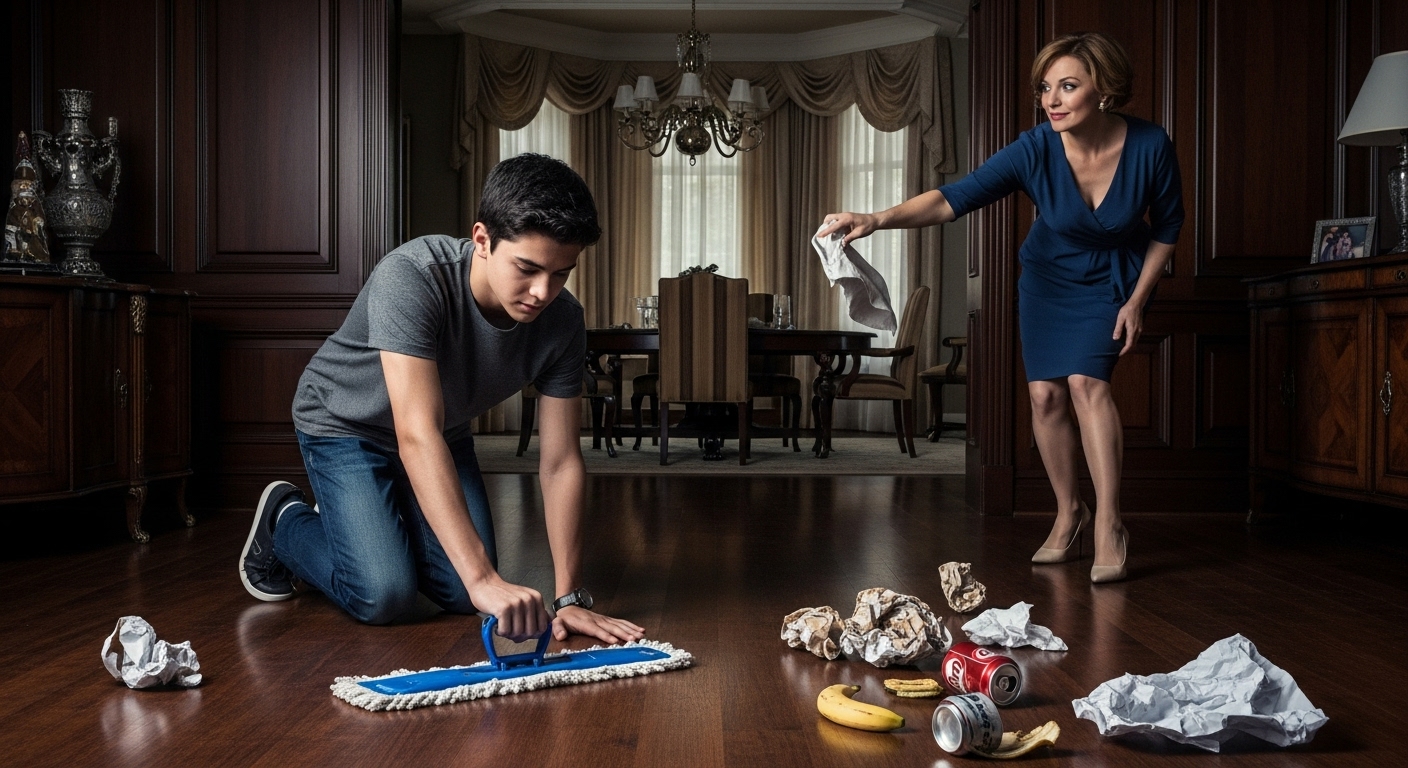
The truffles hit the floor with a wet slap, scattering across the marble I had just spent two hours polishing.
“Oops,” Elena said, her voice dripping with that fake, sugary sweetness she used right before she went for the throat. She didn’t look sorry. She looked delighted. “Clumsy me. Well, don’t just stare at it, Leo. Clean it up. You know how sticky the balsamic glaze gets if it dries.”
I gripped the rag in my hand so tight my knuckles turned white. I was nineteen years old. I was a student at the local community college—the only one she’d “allow” my father to pay for. But in this house, in the sprawling Westcott estate that my mother had designed before she passed, I was lower than the hired help.
At least the staff got paid. I just got room, board, and a daily dose of humiliation.
“Did you hear me?” Elena snapped, her heels clicking aggressively as she stepped closer. She was wearing a custom-made red silk gown, ready for the Founders’ Gala tonight. It was the biggest event of the year in Greenwich. My father, Robert Westcott, was the keynote speaker.
“I heard you, Elena,” I muttered, dropping back to my knees.
“That’s ‘Mrs. Westcott’ to you,” she corrected, kicking a piece of arugula toward my face. “And hurry up. The catering team needs this kitchen spotless for the after-party prep. God, look at you. You smell like bleach and desperation. Stay out of sight tonight, Leo. If any of the guests see you, tell them you’re the new janitor. It’s not far from the truth, is it?”
She laughed. It was a cold, jagged sound that usually made my stomach turn.
I reached for the mess she’d made. My heart was pounding against my ribs, a mixture of rage and grief that I’d learned to swallow over the last five years. Since Dad married her, I’d become a ghost in my own home. Dad was always working, always traveling, always “too busy” to notice that his new wife had slowly turned his son into a servant.
“You missed a spot,” she sneered, looming over me. “Honestly, if you can’t even clean a floor properly, how do you expect to make it in the real world? This is why your father doesn’t take you to these events, Leo. You’re an embarrassment. You lack… polish.”
She raised her glass of champagne, swirling it dangerously. “Maybe I should pour this out too? Give you some practice?”
I bit my tongue so hard I tasted metallic blood. Just finish the degree, I told myself. One more year. Then you can leave.
“Do it,” I whispered, not looking up. “Pour it.”
“Excuse me?”
“I said pour it,” I said, looking up at her. “If it makes you feel powerful to bully a teenager, go ahead. Pour the champagne.”
Elena’s eyes narrowed. The mask of sophistication slipped, revealing the cruelty underneath. “You ungrateful little brat. You think because you have his last name, you matter? You’re nothing. You’re a relic of a dead woman and a mistake.”
She tilted the glass. The expensive, sticky liquid splashed onto my shoulder and down my front, soaking the rags I was holding.
“Clean. It. Up,” she hissed. “And then get out of my sight before the cars arrive.”
She turned around, fluffing her hair in the reflection of the oven door, checking her makeup. She was so absorbed in her own vanity, so confident in her victory, that she didn’t hear the heavy oak front doors open down the hall.
She didn’t hear the lack of chatter.
She didn’t notice that the house had gone deadly silent.
But I did. I looked up, dripping with champagne and salad dressing, toward the archway of the kitchen.
My father was standing there.
He wasn’t supposed to be here. He was supposed to be at the venue, doing press interviews, preparing for his speech. He was supposed to be the distant, unreachable CEO who let his wife run the household however she saw fit.
But there he was. Robert Westcott.
He was wearing his tuxedo trousers and a crisp white shirt, but his jacket was off. His face was unreadable—stone cold. His eyes traveled from the mess on the floor, to the champagne dripping off my shirt, and finally, they landed on Elena’s back.
Elena was still talking to her reflection. “God, it’s exhausting dealing with incompetence. I don’t know why Robert keeps him around.”
“Elena,” my father’s voice rumbled. It wasn’t a shout. It was a low, terrifying baritone that vibrated through the floorboards.
Elena spun around so fast she nearly snapped her ankle. Her face went from smug to sheet-white in a nanosecond. “R-Robert? Honey! You’re… you’re early! I thought you were at the Ritz?”
She stepped over the mess on the floor, putting on her best smile, reaching for him. “I was just… Leo made a terrible mess, clumsy boy, and I was just trying to—”
My father didn’t even look at her. He side-stepped her outstretched hand like she was a piece of furniture.
He walked straight toward me.
The air in the kitchen felt like it had been sucked out. My dad stopped inches from where I was kneeling in the garbage. He looked down at me. For a second, I thought he was going to yell at me too. I flinched.
Pain flashed across his eyes. Pure, raw pain.
He reached down, gripping my arm firmly, and pulled me to my feet. He didn’t care that I was covered in food. He didn’t care that I was dirty.
“Dad, I—” I started, my voice cracking.
“Quiet, Leo,” he said softly.
He turned to the garment bag he was holding in his other hand. He unzipped it with a sharp zzzzzt sound.
Inside was a midnight-blue velvet tuxedo. It wasn’t just any suit. It was a bespoke piece, the kind that cost more than a car.
“Robert?” Elena’s voice trembled. “What are you doing? We have to leave in ten minutes. The limo is outside. Why are you holding that?”
My father ignored her again. He held the jacket up against my shoulders, checking the width. He nodded, satisfied.
“Go wash up,” he said to me, loud enough for the entire staff to hear. “Use the master bath. It has better lighting.”
“The… the master bath?” I stammered. “But Elena said—”
My father turned his head slowly to look at his wife. The look he gave her could have frozen hell over.
“Elena isn’t going to the Gala,” my father said. His voice was calm, deadly calm.
Elena gasped. “Excuse me? Robert, stop joking. I’m the hostess!”
“No,” my father said, turning back to me and handing me the tuxedo. “You’re not.”
He placed a hand on my shoulder, squeezing it tight.
“My son is my date tonight.”
Chapter 2: The Prince of Westcott Manor
The master bathroom was a place I hadn’t set foot in for five years. Not since the week after the funeral, before Elena moved in and started “redecorating” my life out of existence.
It was a cathedral of marble and gold, smelling faintly of sandalwood and expensive cologne—my father’s scent. My hands shook as I turned the heavy brass handle of the shower. The water didn’t sputter or cough like it did in the servant’s quarters in the basement. It cascaded down in a hot, pressurized sheet of steam.
I scrubbed my skin until it was red. I needed to get the smell of cheap champagne and balsamic glaze off me, but more than that, I wanted to scrub away the feeling of her eyes on me. The feeling of being small. Of being dirt.
For years, I had convinced myself that I deserved it. That I was just a burden to my father, a reminder of the wife he had lost. Elena had whispered that narrative into my ear so many times that it had become my truth. He’s too busy for you. You’re just in the way. Be grateful we keep you around.
But the look in my father’s eyes downstairs… that wasn’t annoyance. It was rage. And it wasn’t directed at me.
I turned off the water and stepped onto the heated tile floor. A plush white towel, thick and soft, was waiting. I dried off, avoiding looking at myself in the mirror. I was too thin. My ribs showed too much. The diet of leftovers and stress had taken its toll.
When I walked back into the bedroom, my father was standing by the window, looking out at the sprawling lawn where the event staff were setting up the final touches for the after-party tents. He held a tumbler of scotch in one hand. His knuckles were white.
The midnight-blue tuxedo was laid out on the bed. It wasn’t just a suit; it was a statement. Beside it lay a pair of dress shoes that looked like they had never been worn, polished to a mirror shine, and a set of cufflinks.
“I didn’t know,” my father said. He didn’t turn around. His voice was rough, like gravel grinding together.
I stood there, towel wrapped around my waist, water dripping from my hair onto the Persian rug. “Didn’t know what?”
“That it was… like that.” He took a long sip of the scotch. “I knew she was strict. I knew she wanted you to learn the value of hard work. She told me you requested to move to the basement for privacy. She told me you wanted to work for your allowance to build character.”
He turned around then. His face, usually so composed in boardrooms and on magazine covers, looked shattered.
“She told me you hated coming to these events. That you preferred to stay home and study.”
I let out a short, bitter laugh. “She told me you were embarrassed by me. She said I lacked the ‘Westcott polish’ and that if I showed my face, I’d ruin your stock price.”
The glass in my father’s hand cracked. A spiderweb fracture appeared right under his thumb. He set it down on the dresser with a trembling hand.
“She lied,” he whispered. “God help me, she lied about everything.”
He walked over to the bed and picked up the cufflinks. He held them out to me. My breath hitched. They were silver, inlaid with mother-of-pearl.
“These were your grandfather’s,” he said softly. “Your mother gave them to me on our wedding day. She said, ‘Save these for Leo when he becomes a man.’ I’ve had them in the safe for three years, waiting for the right moment. I didn’t realize… I didn’t realize you were already more of a man than I’ve been lately.”
I took the cufflinks. The metal was cool against my skin. “Why today, Dad? Why did you come back early?”
“I forgot my speech notes,” he admitted. “Or I thought I did. But maybe… maybe it was your mother looking out for us. Because if I hadn’t walked into that kitchen…”
His jaw tightened. He reached out and touched my shoulder, his grip firm and grounding. “Get dressed, Leo. We have a gala to attend. And we are going to reintroduce you to this town properly.”
Putting on the tuxedo felt like putting on armor. The shirt was silk, cool and smooth. The jacket fit as if it had been tailored to my exact measurements—which, I realized, it probably had been. Dad must have had his tailor guess my size based on old photos, or maybe he paid more attention than I thought.
When I looked in the full-length mirror, I barely recognized myself. The slouch was gone. The exhausted, beaten-down boy scrubbing floors was gone. In his place stood a Westcott. I looked like my father, but with my mother’s eyes.
“Ready?” Dad asked. He had put his own jacket back on.
“I think so,” I said. “But… what about Elena?”
“Leave Elena to me.”
We walked out of the master suite and started down the grand staircase. The house was eerily quiet, but I could hear the muffled sound of frantic movement coming from the guest wing.
When we reached the bottom of the stairs, Elena was there.
She had changed her tactic. The anger was gone, replaced by a frantic, teary-eyed desperation. She had fixed her hair, but her makeup was slightly smeared, as if she had been crying—or trying to force herself to.
“Robert!” she cried out, rushing toward us. She ignored me completely, her eyes locking onto my father. “Please, let’s not do this. You’re overreacting. I was just stressed! The gala preparations, the caterers were late, and I just snapped. You know how much pressure I’m under to make you look good!”
She reached for his lapels, her hands trembling. “I love you, Robert. I love this family. Don’t let one little misunderstanding ruin the night. The press is going to be there. What will it look like if I’m not by your side?”
My father stopped. He looked down at her hands on his jacket as if they were poisonous spiders.
“Remove your hands,” he said. His voice was low, devoid of any warmth.
Elena flinched and pulled back. “Robert…”
“You’re right about one thing,” my father said, his voice echoing in the large foyer. “The press will be there. And they will see exactly who is by my side.”
He stepped to the side, gesturing to me.
Elena looked at me then. Really looked at me. For the first time in five years, she didn’t look down. She had to look up. In the tuxedo, standing straight next to my father, I towered over her.
Her mouth opened, but no sound came out. She took in the midnight-blue velvet, the grandfather’s cufflinks, the way I held my head. She saw the resemblance to the woman she had tried so hard to erase.
“You look ridiculous,” she spat, her mask slipping again. “You’re playing dress-up, Leo. You think a suit changes what you are? You’re a charity case.”
“That’s enough,” my father snapped. The sound was like a whip crack.
He stepped between us, shielding me. “You are not to speak to him. You are not to look at him. In fact, you are not leaving this house tonight.”
“You can’t do that!” she shrieked. “I’m your wife!”
“For now,” my father said coldly. “But my lawyers will be here in the morning. Until then, the security team has instructions to keep you on the premises. If you try to come to the Gala, if you try to make a scene, I will have the unredacted prenup released to the tabloids. You know the clause about infidelity? The one we discussed regarding your ‘tennis instructor’?”
Elena froze. All the color drained from her face. She looked like a statue.
“I… I didn’t…” she stammered.
“I know everything, Elena,” my father said, his voice tired. “I was willing to look the other way for the sake of peace. I thought you were at least good to my son. But now? Now I have no reason to protect you.”
He turned his back on her. “Come on, Leo.”
We walked toward the heavy double doors. The butler, a kind man named Henry who had always tried to sneak me extra food when Elena wasn’t looking, was holding the door open. He had a small, secret smile on his face as he looked at me.
“You look sharp, Master Leo,” Henry whispered as I passed.
“Thank you, Henry,” I said, feeling a lump in my throat.
As we stepped out into the cool evening air, the flash of the driveway lights hit us. The limousine was waiting, its engine purring.
Behind us, inside the house, I heard a scream of pure, unadulterated rage. It was followed by the sound of something glass shattering against the wall.
My father didn’t even blink. He walked to the car door, but instead of getting in first, he held it open.
“After you,” he said.
I hesitated. “Dad, you’re the CEO. You go first.”
“Tonight,” he said, looking me right in the eyes, “you are the most important person in the room. Get in.”
I slid into the leather interior of the limo. The scent of new leather and freedom filled the air. My father slid in next to me, and the heavy door thudded shut, sealing out the noise, the house, and the woman who had made my life a living hell.
As the car pulled away, crunching over the gravel of the driveway, I looked back through the tinted rear window. I could see Elena standing in the doorway, a small, red figure against the massive stone house. She looked tiny. Insignificant.
“Where are we going first?” I asked, turning away from the window.
“The red carpet starts in twenty minutes,” my father said, checking his watch. “But before that, we have a stop to make.”
“A stop?”
“I made a phone call while you were in the shower,” he said, a glint of steel returning to his eyes. “To the Board of Directors.”
My stomach flipped. “Why?”
“Because,” he said, adjusting his cuffs. “It’s time you learned the family business. And I’m not talking about an internship. I’m firing the VP of Operations tonight—Elena’s brother.”
My jaw dropped. Elena’s brother, Marcus, had been the one who helped her torment me. He was the one who ‘lost’ my college applications. He was the one who managed the house staff and cut my food budget.
“You’re firing Marcus?”
“Publicly,” my father clarified. “At the Gala.”
He looked at me, and for the first time in years, he smiled. It was a real smile. A dangerous smile.
“Buckle up, Leo. We’re going to burn her kingdom down, brick by brick. And you’re going to light the match.”
The limo accelerated, merging onto the highway toward the city lights that glittered in the distance like diamonds. I sat back, running my thumb over the mother-of-pearl cufflink.
For five years, I had been scrubbing floors. Tonight, I was going to wipe the floor with them.
The venue for the Founders’ Gala was the Grand Hyatt downtown. It was a fortress of glass and light. As we approached, the line of cars stretched around the block. Paparazzi were swarming the entrance, flashes popping like lightning storms.
My heart started to race. “Dad, I… I haven’t been in front of cameras since Mom died.”
“Just look at me,” he said calmly. “Don’t look at the lights. Just walk. You are a Westcott. You own the ground you walk on.”
The car stopped. The driver opened the door.
The noise hit us instantly. Shouting. Cameras clicking.
“Mr. Westcott! Over here!” “Robert! Where is Elena?” “Is that… is that his son?”
My father stepped out first, buttoning his jacket. He turned and extended a hand to help me out, a gesture usually reserved for royalty or dates. It sent a ripple of confusion through the press line.
I stepped out. The flashes were blinding. I blinked, disoriented.
“Head up,” my father murmured, his hand on my back, guiding me forward.
We hit the red carpet. The reporters were screaming questions, but the tone shifted as they got a good look at me.
“Who is that?” “He looks just like Amelia Westcott.” “Is that Leo? The recluse?”
We stopped at the main photo wall. Usually, Elena would be here, preening, hanging off my father’s arm, soaking up the attention. The absence of her red dress was screaming louder than any headline.
A reporter from the Times, a woman my father knew well, leaned over the velvet rope.
“Robert! Robert, where is Mrs. Westcott tonight?” she yelled over the din.
My father stopped. He motioned for the cameras to quiet down. Surprisingly, they did. The air crackled with anticipation. Everyone wanted the gossip. Everyone sensed blood in the water.
My father put his arm around my shoulders and pulled me close. He looked directly into the lens of the main camera, broadcasting live to the local news.
“Mrs. Westcott is no longer representing this family,” he said, his voice projecting clearly without a microphone. “Tonight, I am accompanied by the future of Westcott Enterprises. My son, Leo.”
He looked at me with pride. “Leo will be taking a more active role in the company, starting immediately.”
The crowd gasped. Phones were raised. Thumbs were flying across screens. The headline was being written in real-time.
The Return of the Lost Heir.
I stood taller. I didn’t smile—I didn’t feel like smiling yet. I felt intense, focused. I looked straight into the camera, imagining Elena sitting at home, watching this on the 80-inch TV I used to have to dust.
Are you watching, Elena? I thought. Because I’m just getting started.
We turned to walk inside, but a man in a tuxedo blocked our path. It was Marcus, Elena’s brother. He looked sweaty and nervous. He hadn’t seen the news yet, but he saw us.
“Robert!” Marcus said, his fake smile faltering as he saw me. “And… Leo? What is he doing here? Look at him, he’s… well, he’s practically a child. Elena said he was sick tonight.”
“Elena says a lot of things,” my father said, stopping inches from Marcus’s face.
“Well, anyway,” Marcus laughed nervously, trying to usher us inside. “We have the donors’ table set up. I’ve seated the Senator next to you. Let’s get you a drink.”
“You’re in my seat, Marcus,” I said.
It was the first time I had spoken. My voice was deeper than I expected. Steady.
Marcus blinked, looking at me like a cockroach that had learned to speak. “Excuse me?”
“You’re in my seat,” I repeated. “At the table. And in the company.”
Marcus turned red. “Listen here, you little—”
“You’re fired, Marcus,” my father said casually, as if commenting on the weather.
Marcus froze. The people around us—wealthy donors, politicians, business rivals—went silent, eavesdropping shamelessly.
“W-what?” Marcus stammered. “You can’t be serious. Here? Now?”
“Security has already cleared your desk,” my father said. “Your access badge has been deactivated. And if you’re not off this property in two minutes, I’ll have you escorted out by the police for trespassing.”
“You… you can’t do this! My sister—”
“Is currently explaining to my lawyers why she shouldn’t be in jail for embezzlement,” my father lied smoothly—or maybe he wasn’t lying. With Dad, you never knew how much he really knew.
Marcus looked from my father to me. He saw the end of his free ride. He saw the collapse of the empire he and his sister had tried to steal.
“Security,” my father called out calmly.
Two massive guards stepped out of the shadows.
“Please show Mr. Vance to the exit,” my father said.
As Marcus was dragged away, shouting obscenities, my father turned to me. He adjusted my bow tie slightly, a gentle, fatherly gesture that contrasted with the brutality of what he just did.
“How was that for a start?” he asked.
I looked at the doors opening to the ballroom, where hundreds of people were waiting.
“Not bad,” I said. “But I think I’m going to need a bigger shovel.”
Dad laughed. He actually laughed. “That’s my boy. Shall we?”
We walked into the ballroom.
Chapter 3: The Shark Tank
The ballroom of the Grand Hyatt was a shark tank disguised as a jewelry box. Crystal chandeliers the size of small cars hung from the ceiling, casting prisms of light over three hundred of Connecticut’s wealthiest people. The air smelled of expensive lilies, roasted duck, and the distinct, metallic scent of old money.
As my father and I stepped onto the parquet floor, the room didn’t just go quiet; it froze.
The string quartet in the corner faltered for a beat before recovering. Conversations died mid-sentence. Forks hovered halfway to mouths. Every eye turned toward us.
I felt a bead of sweat trickle down my back, but the velvet of the tuxedo absorbed it. My father’s hand was still on my shoulder, a heavy, reassuring anchor.
“Breathe,” he murmured, barely moving his lips. “They smell fear. Don’t give them a whiff.”
“I’m not scared,” I whispered back. And realized, with a jolt, that I wasn’t. I was angry. And anger is a much better fuel than fear.
We began to move through the crowd. It was like parting the Red Sea. People who had looked through me for years—when I was opening doors for them, or taking their coats, or refilling their wine glasses at Elena’s parties—were suddenly seeing me in high definition.
“Robert! So good to see you!” “And this must be Leo! My, how you’ve grown.” “Splendid suit, young man. Is that Italian?”
I recognized Mrs. Van Der Hoven. She was the head of the Homeowners Association and one of Elena’s closest “friends.” Just last week, I had been on my knees gardening the front flowerbeds when she walked past me and told Elena that “the help looked particularly scruffy today.”
Now, she was beaming at me, her teeth white and predatory.
“Leo, darling,” she cooed, clutching a glass of Pinot Grigio. “I was just telling Robert how much we’ve missed seeing you at the club. You simply must come by for tennis this weekend. My daughter, Sarah, asks about you all the time.”
I looked at her. I remembered Sarah. Sarah used to throw acorns at me when I mowed the lawn.
“That’s kind of you, Mrs. Van Der Hoven,” I said, my voice smooth. “But I think I’ll be busy. The estate needs a lot of… cleaning up. You know how hard it is to get rid of invasive weeds. Once they take root, you have to rip them out by the source.”
Her smile faltered. She knew exactly who—and what—I was talking about.
“I… well, yes. Quite,” she stammered, stepping back.
My father squeezed my shoulder. A silent ‘Good job.’
We made our way to the head table. It was elevated on a platform, overlooking the room. Usually, Elena sat in the center, the Queen Bee holding court. Tonight, that chair was empty.
My father pulled it out.
“Sit,” he said.
“Dad, that’s… that’s the hostess seat,” I said.
“Sit,” he repeated.
I sat. The view from the top was intoxicating. I could see everything. I could see the waiters moving in the shadows—guys my age, sweating, terrified of dropping a plate. I caught the eye of one busboy, a kid named Mateo I knew from the community college. He stared at me, jaw dropped, holding a tray of dirty dishes.
I gave him a subtle nod. He blinked, then grinned and nodded back.
“Ladies and gentlemen,” a voice boomed over the speakers. “Please take your seats. Dinner is served.”
The dinner was a blur of courses I barely tasted. My adrenaline was too high. Throughout the meal, my father was working. He wasn’t eating; he was leaning over to whisper to the Senator on his left, then the bank CEO on his right. I caught snippets: “audit,” “immediate restructuring,” “criminal negligence.”
He was building a case. He was dismantling Elena’s safety net before the dessert even arrived.
Then, came the disruption I had been expecting. But it didn’t come from outside. It came from the table next to us.
Julian Vance.
Julian was Marcus’s son, Elena’s nephew. He was twenty-one, studied at Yale (paid for by my father’s donations), and drove a Porsche (paid for by my father’s company). He was the Golden Boy. He was everything Elena wanted me to be, and everything she made sure I wasn’t.
He stood up, glass in hand, swaying slightly. He was drunk.
“Well, well,” Julian said loudly. The table quieted down. “If it isn’t the Cinderella Man.”
My father stiffened, but I put a hand on his arm. Let me handle this.
I turned in my chair to face Julian. “Hello, Julian. Enjoying the open bar?”
“I’m enjoying the show,” Julian sneered, walking over to our table. He ignored the security guards who started to move toward him. “It’s funny, Leo. Could have sworn I saw you taking out the trash this morning. Now you’re wearing a tux? Did you steal it from your daddy’s closet?”
The room went silent. This was the drama they craved. The elite love a bloodsport, as long as they aren’t the ones bleeding.
“Actually,” I said, standing up. I was taller than him. I hadn’t realized that until now. All those years of shrinking myself had made me forget I was six-foot-one. “My father gave it to me. Along with a job. I hear there’s a vacancy in Operations. Since your father was just escorted out by security, I assume you’ll be needing a ride home? Oh, wait. The Porsche is company property, isn’t it?”
Julian’s face flushed a deep, ugly red. “You little piece of—”
“Careful,” I cut him off, my voice dropping to a low, dangerous register. “I know a lot about you, Julian. You forget that ‘the help’ hears everything. I know about the gambling debts you told your dad were ‘tuition fees.’ I know about the accident in the Hamptons last summer that got hushed up. I was the one who washed the mud off the fender, remember?”
Julian froze. His eyes darted around the room. He saw the Senator listening. He saw the investors watching.
“I…” Julian choked.
“Sit down, Julian,” I said, loud enough for the back tables to hear. “You’re embarrassing yourself. And you’re embarrassing the family name. Which, thankfully, I don’t share with you.”
Julian looked at me, then at my father, who was watching with a look of predatory satisfaction. Julian crumbled. He turned around and all but ran out of the ballroom.
A ripple of whispers broke out. I sat back down.
“Remind me to give you a raise,” my father whispered, taking a sip of his water.
“You haven’t paid me yet,” I replied.
“Touché.”
The lights dimmed. A spotlight hit the podium. It was time for the keynote speech.
My father stood up. The applause was polite, restrained. People were unsure where the power lay tonight. They were waiting to see which way the wind blew.
He walked to the microphone, adjusting it. He looked out over the crowd, his face serious.
“Thank you all for coming,” he began. “Usually, this is the part of the night where I talk about our quarterly earnings, our charitable goals, and how bright the future looks.”
He paused. The silence was absolute.
“But tonight, I want to talk about blindness.”
He gripped the podium. “For the last five years, I have been blind. I allowed myself to be blinded by work, by grief, and by a misplaced trust in those closest to me. I believed that my home was a sanctuary. I was wrong.”
He looked directly at the camera at the back of the room.
“I allowed my own son to be treated as a stranger in his own house. I allowed parasites to feast on the goodwill of this family. And for that, I am deeply sorry.”
He turned and looked at me. “Leo, stand up.”
I stood. The spotlight swung to me. It was blindingly bright.
“Tonight marks a new chapter for the Westcott Foundation,” my father announced. “Effective immediately, the position of Director of Philanthropy—previously held by my wife, Elena—is terminated.”
Gasps filled the room. That was Elena’s crown jewel. It was her social currency.
“The Foundation will be restructured,” my father continued. “And while he finishes his education, my son Leo will be acting as the primary voting member on the board. He has seen life from a perspective many of us ignore. He knows the value of a dollar, and the value of dignity. He will ensure our money goes where it is needed, not where it buys influence.”
Applause started. At first, it was just the busboy, Mateo, clapping from the shadows. Then Henry the butler, who had come along. Then the Senator. Then, like a wave, the entire room erupted. They were clapping for the winner. And tonight, the winner was me.
My father motioned for me to come up to the stage. I walked up the stairs, my legs feeling light. I stood next to him, and he raised my hand like a prizefighter.
For a moment, everything was perfect. The vindication was sweet, like honey on a raw wound.
But then, the double doors at the back of the ballroom slammed open with a sound like a gunshot.
The applause died instantly.
Standing in the doorway was Elena.
But it wasn’t the Elena of the galas. She wasn’t the poised, manicured ice queen.
She was a wreck.
She was wearing the red dress, but it was torn at the hem. Her hair was wild, coming loose from its pins. She was missing a shoe. She was breathing heavily, her chest heaving, her eyes wide and manic.
Two security guards were chasing her, but she had surprised them. She burst into the room, scanning the crowd wildly until her eyes locked on us. On the stage.
“YOU!” she screamed. It was a guttural, animalistic shriek that made the hair on my arms stand up.
She pointed a shaking finger at me.
“You ungrateful little rat! You think you can steal my life? You think you can take everything I built?”
She started marching toward the stage, limping slightly on her one shoed foot. The crowd parted in horror. This wasn’t just a scene; this was a breakdown.
“Elena, stop!” my father commanded into the microphone. His voice boomed through the speakers. “Security!”
“Don’t you touch me!” Elena swiped at a waiter who tried to block her, sending a tray of champagne glasses crashing to the floor. The sound of breaking glass echoed the morning’s incident, bringing the day full circle.
She reached the base of the stage. She looked up at us, her makeup running down her face in black streaks. She looked like a demon.
“I made this family!” she hissed. “I fixed your image, Robert! I tolerated that… that ghost of a son you kept around! And this is how you repay me? By embarrassing me in front of my people?”
“These are not your people, Elena,” I said into the microphone. My voice was calm, contrasting with her hysteria. “And this is not your family.”
Elena’s eyes bulged. She reached into her clutch purse.
For a second, the room stopped breathing. The security guards dove toward her. My father threw his arm in front of me, shielding me with his body.
She pulled out a phone.
“You think you’ve won?” she laughed, a high-pitched, hysterical sound. “You think firing Marcus stops anything? You think locking me in the house stops me?”
She held the phone up, her thumb hovering over the screen.
“I have the files, Robert! The Cayman accounts! The shell companies Marcus set up in your name! If I press send, this whole room goes down with me! The IRS, the FBI—they’re all on the distribution list!”
My father froze. The color drained from his face.
It was a bluff. It had to be a bluff. My father was an honest businessman. He was obsessive about compliance.
But then I saw the look in my father’s eyes. It wasn’t guilt. It was confusion.
“What shell companies?” he whispered.
“The ones I signed off on,” Elena cackled, “using your power of attorney. You were always so busy, remember? ‘Just handle it, Elena,’ you said. ‘I trust you,’ you said.”
She grinned, looking at me.
“So go ahead, Leo. Be the Director. But you’ll be the Director of a bankrupt, indicted company. I’ll burn it all down before I let you have a single cent.”
She held her thumb over the ‘Send’ button.
“Beg me,” she whispered. “Beg me not to do it.”
The room was deadly silent. Three hundred people held their breath.
I looked at my father. He looked paralyzed. If she sent that, even if he was innocent, the investigation alone would tank the stock. It would ruin his reputation. It would destroy everything he worked for.
I looked at Elena. She had the high ground again. She had found the one weapon she had left: mutual destruction.
I stepped out from behind my father. I walked to the edge of the stage, looking down at her.
“No,” I said.
Elena blinked. “What?”
“I said no. I won’t beg you.”
I reached into my pocket and pulled out my own phone.
“Because,” I said, holding it up, “while you were busy screaming, I was busy syncing. You forgot something, Elena. You connect your phone to the house Wi-Fi automatically. And who do you think set up the router? Who do you think manages the network because you couldn’t be bothered to learn how a password works?”
I tapped my screen.
“I just remotely wiped your phone. Factory reset. Starting… now.”
Elena looked down at her screen. It went black. Then, a white Apple logo appeared.
The reboot screen.
She tapped it frantically. “No… No! NO!”
“It’s gone, Elena,” I said coldly. “The files. The emails. The evidence. And since Marcus’s laptop is currently in the hands of corporate security… you have nothing.”
Elena stared at her blank phone. Her hands started to shake. The reality of her defeat crashed down on her.
She looked up at me, her eyes filled with pure hatred.
“I hate you,” she whispered.
“I know,” I said. “The feeling is entirely mutual.”
“Security,” my father said, his voice returning. “Remove this woman from the premises. And call the police. I’d like to press charges for attempted corporate blackmail and extortion.”
The guards grabbed her arms. This time, she didn’t fight. She went limp, sobbing, her red dress dragging on the floor as they hauled her out of the ballroom.
The doors swung shut behind her.
Silence.
Then, slowly, the Senator started clapping. Then the rest of the room joined in. But this wasn’t polite applause. This was a roar.
I looked at my father. He looked exhausted, but relieved.
“Did you really wipe her phone?” he whispered.
“Actually,” I whispered back, “I just put it in Airplane Mode via the family controls app. But she doesn’t know the difference.”
My father threw his head back and laughed. A genuine, belly laugh that echoed through the microphone.
He hugged me, right there on stage.
“Let’s go home, son,” he said.
“Not yet,” I said, looking at the crowd. “I think they want to buy us a drink.”
Chapter 4: The Paper Trail
The ride back to the estate was quieter than the ride there, but it was a different kind of silence. It wasn’t the heavy, suffocating silence of estrangement. It was the comfortable, exhausted silence of two soldiers returning from a war they had just won.
My father loosened his tie, unbuttoning the top collar of his shirt. He looked ten years younger than he had this morning, despite the deep lines of fatigue around his eyes.
“You know,” he said, staring out at the passing highway lights. “I really did think you didn’t want to go to college. She told me you refused to fill out the applications. She said you wanted a ‘gap year’ to find yourself.”
I stared at my hands. The mother-of-pearl cufflinks caught the streetlights.
“I filled them out, Dad,” I said quietly. “I filled out every single one. I gave them to her to mail because she said she had to attach the financial aid forms. I never heard back from any of them. I assumed I just… wasn’t good enough.”
My father’s hand clenched into a fist on his knee. “We’re going to find out what happened. Tonight.”
When the limo pulled up the long, winding driveway, the house looked different. The looming shadows that used to terrify me now just looked like… shadows. The monster that lived inside had been exorcised.
But as we stepped out, we saw that the exorcism wasn’t quite complete.
There were three black SUVs parked near the garage. Men in windbreakers with “PRIVATE SECURITY” printed on the back were patrolling the perimeter.
“I called them,” my father explained, seeing my look. “To secure the premises. I don’t trust Marcus not to come back and try to loot the place.”
We walked inside. Henry was waiting in the foyer. He looked shaken.
“Sir,” Henry said, his voice trembling. “Master Leo. The security team… they found something in Mrs. Westcott’s private study. They said you need to see it before the police evidence team arrives tomorrow.”
My father and I exchanged a look. “Show us.”
We walked to the East Wing. This had been Elena’s domain. I hadn’t been allowed in this corridor for three years. The carpet was plush, the walls hung with avant-garde art that cost more than my entire life’s tuition.
The door to her office was open. Two security contractors were standing there, looking uncomfortable.
Inside, the room was a chaotic mess. It looked like a hurricane had hit it—but not a natural one. Drawers were pulled out, papers were shredded.
“She tried to destroy the evidence before she left for the Gala,” one of the guards said. “But she was in a rush. She missed the floor safe.”
“She doesn’t have a floor safe,” my father frowned. “I know this house. I built it.”
“She had it installed, sir,” the guard said. “Under the rug. We found it because the corner was turned up. And… well, the door was open. She must have grabbed the cash and ran, but she left the paperwork.”
My father walked over to the hole in the floor. He reached in and pulled out a thick, leather-bound accordion folder.
He walked over to the desk and dumped the contents out.
It wasn’t financial records. It wasn’t bank statements.
It was mail.
Dozens and dozens of unopened, thick envelopes.
My heart stopped. I recognized the logos.
Harvard University. Yale. Stanford. Columbia.
“Oh my god,” I whispered, reaching out with a trembling hand. I picked up the one from Harvard. It was dated two years ago.
I tore it open.
“Dear Mr. Westcott, It is our distinct pleasure to inform you of your acceptance…”
I felt like I had been punched in the gut. Tears, hot and fast, pricked my eyes. “I got in,” I choked out. “Dad, I got in.”
My father picked up the Yale letter. Then the Stanford one. His hands were shaking so hard the paper rattled.
“She stole them,” he whispered. His voice broke. “She stole your future. She let you believe you were a failure so she could keep you here… as a servant.”
He looked at me, and his face crumbled. The powerful CEO, the man who had just commanded a room of three hundred people, fell apart. He grabbed me, pulling me into a crushing hug. He buried his face in my neck, and I felt his tears soaking my collar.
“I’m so sorry, Leo,” he sobbed. “I’m so, so sorry. I should have checked. I should have asked.”
“It’s okay, Dad,” I said, holding him back, though I was crying too. “We know now. We know.”
He pulled back, wiping his eyes with a furious motion. The sadness was gone, replaced by a cold, hard resolve.
“You’re going,” he said firmly. “I don’t care that it’s two years late. I will call the Dean of Admissions myself. I will donate a library if I have to. You are going to college, Leo.”
“Sir?” The guard interrupted gently. “There’s more.”
He pointed to a stack of papers at the bottom of the pile. These weren’t letters. They were medical records.
My father frowned, picking them up. “These are… these are from your mother’s doctor.”
My mother had died of a sudden, aggressive illness five years ago. It had been swift and devastating. We had been told it was a rare autoimmune reaction.
My father scanned the pages. His face went pale. Then gray.
“What is it?” I asked, stepping closer.
“This is a toxicology report,” my father whispered. “Dated three weeks before she died. It wasn’t autoimmune.”
He looked up at me, horror in his eyes.
“Arsenic,” he said. “Chronic, low-dose arsenic poisoning.”
The room spun. I grabbed the edge of the desk to steady myself. “What?”
“She was poisoned,” my father said, his voice rising to a shout. “Amelia didn’t get sick. She was poisoned!”
He started flipping through the other papers. There were bank transfers. Huge sums of money moving from an offshore account to a ‘holistic pharmacist’ in the city. The dates matched my mother’s illness perfectly.
And the signature on the authorization forms?
Elena Vance.
“She killed her,” I whispered. The realization hit me like a physical blow. Elena hadn’t just been a cruel stepmother. She wasn’t just a gold digger.
She was a murderer.
“She killed her to get to me,” my father said, his voice trembling with a rage so dark it terrified me. “She killed Amelia to open up the spot. To become the lady of the house.”
He slammed his fist onto the desk, cracking the wood. “AND I MARRIED HER! I brought her into this house! I let her raise you!”
“Dad, stop,” I said, grabbing his arm. “You didn’t know. She’s a psychopath. You couldn’t have known.”
“I have to kill her,” he said, his eyes unfocused. He turned toward the door. “I’m going to the police station. I’m going to kill her with my own hands.”
“No!” I shouted, blocking his path. “Dad, listen to me! If you do that, you go to jail. And she wins. She destroys the family completely.”
“She murdered your mother!”
“And she’s going to rot in prison for it!” I yelled back. “But not if you act like a crazy person! We have the evidence. We have the toxicology report. We have the transfers. This isn’t just fraud anymore, Dad. This is Capital Murder. She’s never getting out.”
My father stopped. He was breathing hard, his chest heaving. He looked at me, seeing the reason in my eyes.
“We need the police,” I said calmly. “We need to give this to the detectives right now. We nail her coffin shut legally.”
My father took a deep breath. He nodded slowly. “You’re right. You’re right.”
He reached for the phone on the desk to call the detective he knew.
But the phone line was dead. No dial tone.
“That’s odd,” he muttered. He pulled out his cell phone. “No signal.”
“Mine neither,” I said, checking my bars. “SOS only.”
The lights in the room flickered. Then, with a loud thrum, the power cut. The house plunged into darkness.
“The generator should have kicked in,” my father said, his voice tense.
“Someone cut the line,” the security guard said, drawing a Taser. “Sir, get behind the desk.”
“We’re not alone,” I whispered.
From the hallway, we heard a slow, rhythmic clapping.
Clap… clap… clap…
A beam of a heavy-duty flashlight cut through the darkness of the corridor.
“Bravo,” a voice said. “You found the stash. I told Elena she was sloppy to keep souvenirs. Sentimental clutter gets you caught.”
Marcus walked into the room. He was holding a large flashlight in one hand and a black pistol in the other. Behind him were two men—thick-necked, wearing ski masks.
“Marcus,” my father growled. “You’re making a mistake. The police are already on their way.”
“Are they?” Marcus laughed. “Because I’m pretty sure the cell jammers we set up say otherwise. And your security team outside? They’re taking a little nap. Chloroform is wonderful stuff.”
The two guards in the room with us raised their Tasers, but Marcus’s men were faster. Two muffled thwip sounds, and the guards dropped, writhing on the floor, tasered by the intruders.
Now it was just me, my father, and three armed men.
“What do you want, Marcus?” my father asked, stepping in front of me again.
“The files,” Marcus said, gesturing to the desk with the gun. “The medical records. The letters. Everything you just found. Elena might be in custody, but she called me right before you ‘wiped’ her phone. She knew you’d come looking. If that toxicology report gets to a DA, it’s the needle for her. And since I bought the poison… well, it’s bad for me too.”
He cocked the gun.
“Hand it over, Robert. And maybe I won’t burn this house down with you inside it.”
My father looked at the papers—the proof of his wife’s murder. Then he looked at Marcus.
“You’ll have to shoot me first,” my father said.
“Dad, don’t—” I started.
“Have it your way,” Marcus sighed. He raised the gun, aiming at my father’s chest.
I didn’t think. I just moved.
I grabbed the heavy crystal paperweight from Elena’s desk—a jagged piece of amethyst—and hurled it.
I wasn’t aiming for Marcus. I was aiming for the flashlight in his hand.
The crystal hit the lens with a satisfying crunch. The light shattered and died.
For a split second, the room was pitch black.
“Get down!” I screamed, tackling my father to the ground behind the heavy oak desk.
A gunshot rang out, deafening in the enclosed space. The bullet splintered the wood right where my father had been standing.
“Get them!” Marcus screamed in the dark.
I rolled away from my father. “Dad, the servant’s passage! Behind the bookshelf!”
I knew this house better than anyone. I knew every creak, every hidden door. I had spent five years trying to be invisible here.
Now, that invisibility was the only thing that could save us.
Chapter 5: The Ghost in the Walls
The darkness behind the bookshelf smelled of dry rot and old insulation. It was a smell I knew well. When I was fifteen, and Elena’s parties went late into the night, I used to hide in these service corridors to study, away from the noise and the demands for more wine.
“Move, Dad,” I whispered, pushing him forward. “Keep your hand on the left wall. There’s a drop-off in ten feet.”
My father was breathing hard, stumbling in the pitch black. “I didn’t even know… this was back here,” he wheezed.
“It’s the servant’s passage,” I said grimly. “It connects the East Wing to the kitchens. It was designed so the help wouldn’t be seen by the guests. Elena loved that feature.”
Behind us, in the office, we heard the sound of wood splintering. Marcus was kicking the door down.
“Where did they go?” Marcus screamed. His voice was muffled by the thick walls, but the rage was clear. “Find them! Check the hallway!”
“They vanished, boss!” one of the thugs yelled.
“They didn’t vanish, you idiots! Find the secret door! Tear the bookshelves apart!”
We had seconds, maybe a minute.
“Dad, we have to move faster,” I urged.
“I can’t see a thing, Leo,” he admitted, his voice laced with panic. The man who navigated billion-dollar mergers was completely helpless in the dark underbelly of his own home.
“I can,” I said. And I could. After years of navigating this house at night to avoid waking Elena, my eyes adjusted to the shadows quickly. I grabbed his hand. “Trust me.”
We moved through the narrow corridor. It was tight—claustrophobic. Spiderwebs brushed against our faces. The floorboards were unfinished and rough.
“Where are we going?” Dad whispered.
“The kitchen,” I said. “It has the knife block. And the back exit to the staff quarters. Henry might be there. If we can get to Henry, he has a landline that isn’t connected to the main grid. The jammer won’t block copper wire.”
We reached a narrow spiral staircase that descended into the bowels of the house. I guided my father down, step by agonizing step.
Above us, a loud CRASH echoed.
“Found it!” Marcus yelled. “They’re in the walls! Go! Shoot anything that moves!”
Heavy boots thundered into the passage above us. They were coming.
“Go, go, go,” I hissed.
We scrambled down the last few steps and burst out through a panel in the pantry. The kitchen was dimly lit by the moonlight streaming through the high windows. It was vast, full of stainless steel surfaces that gleamed like surgical instruments.
“Get a knife,” I ordered.
My father ran to the granite island and pulled out a chef’s knife. He held it awkwardly. I grabbed a heavy cast-iron skillet from the drying rack. It wasn’t high-tech, but it could crack a skull.
“The back door,” I said, pointing to the service entrance.
We ran for it. I reached the handle and shoved it down.
Locked.
“It’s deadbolted,” I cursed. “Elena must have had the locks changed when she fired the old cook.”
“Key?” Dad asked.
“In the manager’s office,” I said. “Which is… on the other side of the kitchen.”
We turned back. But it was too late.
The door from the main hallway kicked open.
One of the masked men stood there. He saw us.
“Here!” he shouted. “Kitchen!”
He raised his gun.
“Down!” Dad tackled me behind the massive marble island just as a bullet ricocheted off the refrigerator, sending sparks flying.
We were pinned.
“Come out, Robert!” Marcus’s voice echoed from the hallway. He sounded out of breath but triumphant. He walked into the kitchen, his flashlight beam cutting through the gloom. “End of the line. No more secret tunnels.”
I looked at my father. He was bleeding from a cut on his forehead where he’d hit the floor, but his eyes were clear. He looked at the knife in his hand, then at me.
“When I make a move,” he whispered, barely audible, “you run. You run for the window.”
“No,” I whispered back. “I’m not leaving you.”
“Leo, you are the only thing that matters,” he said, gripping my arm. “You are the only part of Amelia I have left. I am not letting you die in this house.”
“We do this together,” I said stubbornly. “Remember? The Westcott way.”
Marcus and his two men fanned out. They were moving slowly, checking the angles. They knew we were behind the island.
“You know, Robert,” Marcus called out, his footsteps crunching on the broken glass from the earlier incident. “This is actually poetic. You dying in the kitchen? Where you let your son rot? It fits.”
He was close. I could hear his breathing.
I looked around. I needed a distraction.
My eyes landed on the commercial-grade gas range behind us. The pilot lights were on. And right next to it, on the counter, was a canister of high-proof cooking spray and a bottle of Elena’s expensive brandy.
I looked at my father and pointed to the stove. I mimicked an explosion with my hands.
He understood.
I grabbed the brandy. He grabbed the spray.
“On three,” I mouthed.
One. Two. Three.
My father popped up.
“Hey, Marcus!” he shouted.
Marcus spun around, raising his gun. “Goodbye, Rob—”
My father didn’t attack. He threw the can of cooking spray directly onto the open flame of the gas burner.
At the same exact second, I hurled the bottle of brandy at the wall behind the stove.
The bottle shattered. The alcohol vaporized. The heated can exploded.
BOOM.
A massive fireball erupted in the kitchen. It wasn’t a lethal explosion, but the flash was blinding, and the noise was deafening. The shockwave knocked the pots and pans off the hanging rack, creating a cacophony of metal.
Marcus and his men flinched, shielding their eyes from the sudden searing heat. The fire suppression system triggered instantly.
HISSSSSS!
Chemical foam and water began to rain down from the ceiling, filling the room with a thick, white fog.
“Now!” I screamed.
I didn’t run for the window. I ran for the man on the left.
He was coughing, blinded by the foam. I swung the cast-iron skillet with everything I had.
CLANG.
It connected with his helmet. He dropped like a sack of potatoes, his gun skittering across the wet floor.
My father charged the man on the right. He wasn’t a fighter, but he was a desperate father. He slammed his shoulder into the man’s gut, driving him back into the wall. They grappled for the gun.
That left Marcus.
Marcus had recovered faster than the others. He stood near the doorway, wiping foam from his eyes. He saw me standing over his fallen thug.
He raised his pistol. He leveled it right at my chest.
“You little bastard,” he snarled.
I froze. I had the skillet, but I was twenty feet away. I couldn’t reach him in time.
“Drop the pan,” Marcus ordered.
I dropped it. It clangored on the tile.
“Kick it away.”
I kicked it.
“Now,” Marcus said, grinning. “Watch your father die.”
He began to turn his aim toward my father, who was still wrestling with the other thug.
“NO!” I screamed, stepping forward.
But suddenly, a shadow moved in the doorway behind Marcus.
A loud, distinct thwack echoed through the room.
Marcus’s eyes went wide. He arched his back, a look of shock on his face. He dropped the gun, his hands reaching behind him to clutch his head.
He fell to his knees, revealing the person standing behind him.
It was Henry. The butler.
He was holding a heavy silver serving tray—the one used for tea service. It was dented right in the middle.
“I believe,” Henry said, his voice trembling but dignified, “that the master said you were fired.”
Marcus collapsed face-first into the foam.
I stared at Henry. Henry stared at me.
“Henry,” I breathed. “Nice swing.”
“Cricket, sir,” Henry said, adjusting his tie, though he was shaking. “Played in my youth.”
A gunshot went off.
I spun around. My father and the second thug were on the ground. The gun lay between them.
“Dad!” I screamed.
The thug pushed my father off and scrambled up. He looked at Marcus unconscious, his partner out cold, and Henry holding a serving tray like a gladiator.
He made a calculation. He turned and bolted out the back door, smashing the glass to unlock it.
I didn’t care about him. I ran to my father.
He was lying on his back in the mixture of water and foam. He was clutching his side. Blood was seeping through his white dress shirt, staining it a dark, terrifying crimson.
“Dad! Dad!” I fell to my knees, sliding in the mess. I pressed my hands over his wound.
“I’m… I’m okay,” he gasped, his face pale. “Just a graze. He… the gun went off when I… pushed it away.”
“Henry! Call 911!” I yelled.
“The lines are down, sir!” Henry said, dropping the tray and rushing over. “But I triggered the silent alarm in the staff quarters ten minutes ago. The police should be—”
WEE-WOO-WEE-WOO.
The sound of sirens cut through the night air. Not one. Dozens.
Blue and red lights flashed against the kitchen windows, strobing through the smoke.
“They’re here,” I said, tears mixing with the water on my face. “Dad, hang on. They’re here.”
My father looked up at me. He reached up with a bloody hand and touched my cheek.
“You… you were brave,” he whispered. “You saved us.”
“You saved me first,” I choked out.
The front doors were battered down. Voices shouted.
“POLICE! DROP YOUR WEAPONS!”
“IN HERE!” I screamed. “IN THE KITCHEN! OFFICER DOWN! WE NEED A MEDIC!”
Heavy footsteps pounded down the hall. A SWAT team burst into the room, rifles raised.
“Hands up! Hands up!”
I raised my bloody hands. “He’s hurt! My father is hurt!”
They saw Marcus and the other thug unconscious. They saw Henry standing protectively over us. They saw a CEO bleeding out on the floor of his own mansion.
“Secure the room!” the lead officer shouted. “Get the paramedics in here! NOW!”
The next few minutes were a blur of chaos. Paramedics swarmed us. They cut open my father’s shirt, packing the wound. They put him on a stretcher.
“I’m going with him,” I said, trying to climb into the ambulance.
“Family only,” the paramedic said automatically.
“I am his son!” I roared. The authority in my voice surprised even me. It sounded like my father.
The paramedic looked at me, covered in soot and blood, wearing a ruined tuxedo. He nodded. “Get in.”
As the ambulance doors closed, I looked back at the house.
Police were dragging Marcus out in handcuffs. He was conscious now, yelling, blaming everyone but himself.
I saw the detective—the one my father tried to call—holding a plastic bag. Inside it was the accordion folder. The evidence.
It was over.
The house that had been my prison was now a crime scene.
And as we sped away toward the hospital, holding my father’s cold hand, I realized something.
I was never going back to that basement.
Three Days Later.
The hospital room was quiet. The steady beep of the monitor was the only sound.
My father was sitting up in bed, looking pale but alive. The bullet had missed his vital organs, passing through the fleshy part of his side. A few inches to the left, and… well, I didn’t want to think about it.
I was sitting in the chair next to the bed, reading a magazine I wasn’t actually processing.
The door opened. A detective walked in. Detective miller.
“Mr. Westcott,” Miller said, nodding to my father. “And… Mr. Westcott,” he nodded to me.
“What’s the news, Detective?” my father asked, his voice raspy.
“It’s a slam dunk,” Miller said, pulling out a notepad. “Between the toxicology report, the bank transfers, and the confession Marcus gave us to cut a deal… we have enough to put Elena away for life. Attempted murder, fraud, embezzlement, conspiracy to commit murder. The DA is throwing the whole book at her.”
“And the mother?” I asked. “Did she admit to poisoning my mom?”
Miller sighed. He looked at me with sympathy. “Marcus gave us the receipts for the arsenic. He turned state’s witness on his sister. He claims it was all her idea. He just bought the stuff. She administered it.”
My father closed his eyes, a tear leaking out. “God.”
“She’s currently being held without bail at the county jail,” Miller continued. “She’s… not doing well. She’s demanding to speak to you, Robert. She says it’s all a misunderstanding.”
“I have nothing to say to her,” my father said, opening his eyes. They were hard as flint. “Ever again.”
“Understood,” Miller said. “Oh, and we found these in the trunk of Marcus’s car. Thought you might want them back.”
He handed me a stack of thick envelopes.
The college acceptance letters.
“They’re a bit crumpled,” Miller said. “But the offers are still valid. I checked.”
I took them. They felt heavy in my hands.
“Thank you, Detective,” I said.
Miller left.
My father looked at the letters. “Well? Which one is it going to be?”
I looked at the Harvard one. Then the Stanford one.
“I don’t know,” I said honestly. “I spent so long thinking I had no future, I never planned for actually having one.”
“You have time,” my father said. “But there’s one thing we need to do first. Before you go anywhere.”
“What’s that?”
“We need to go back to the house,” he said.
“Why?” I asked, feeling a knot in my stomach. “I hate that place.”
“So do I,” my father said. “That’s why we’re going to change it. I’m not living in a shrine to my mistakes anymore. And neither are you.”
He pressed the button to raise his bed.
“Call the real estate agent, Leo. And call the auction house. We’re selling everything.”
“Everything?”
“Everything Elena touched,” he said. “The furniture, the art, the jewelry. We’re selling it all and donating the proceeds to the autoimmune research wing at the hospital. In your mother’s name.”
He looked at me.
“And the house? We’re going to renovate. Starting with that damn kitchen. I want to knock down the wall to the servant’s quarters.”
“You want to expand the kitchen?” I asked.
“No,” he said, smiling faintly. “I want to remove the separation. No more hidden passages. No more secrets. Just a home.”
He held out his hand.
“Help me up, son. We have work to do.”
I helped him stand. He leaned on me, heavy and warm.
We were battered. We were bruised. We were grieving. But for the first time in five years, we were standing on solid ground.
Chapter 6: The Architect of Tomorrow
The auction gavel hit the podium with a sound that felt like a guillotine blade dropping.
“Sold!” the auctioneer bellowed, pointing his pen at a woman in the third row. “To the lady in the green hat. The Louis XIV chaise lounge, formerly from the private collection of Mrs. Elena Westcott. Sold for twelve thousand dollars.”
I stood at the back of the room, leaning against a marble pillar, arms crossed. Beside me, my father sat in a wheelchair—a temporary measure while his stitches healed—watching the proceedings with a grim satisfaction.
“That was her favorite chair,” he murmured. “She used to make me sit on the floor while she lounged on it to read her magazines.”
“Well,” I said, checking the tablet in my hand where I was tracking the sales. “Now it belongs to Mrs. Higgins from the Garden Club. And the proceeds are going to buy a new dialysis machine for the pediatric wing.”
My father let out a short chuckle. “She would hate that. Being charitable with her things.”
“They aren’t her things anymore, Dad,” I reminded him. “They’re just things.”
It had been a month since the night of the gala. A month of police interviews, lawyer meetings, and media storms. The story of the “Cinderella Son” and the “Poisoner Stepmother” had gone national. News vans had camped outside our gates for two weeks.
But inside the gates, the silence was finally breaking.
We were purging the house. Everything Elena had bought, touched, or looked at was being sold. We stripped the heavy velvet drapes to let the sunlight in. We tore up the carpets she had installed to hide the hardwood my mother loved.
“Mr. Westcott?”
I looked up. It was Henry, looking sharper than ever in a new suit. We had promoted him to House Manager. No more serving trays, unless he wanted to hit a burglar with one.
“Yes, Henry?”
” The movers are ready for the portrait in the East Hall,” Henry said, a twinkle in his eye. “They were asking if we wanted to crate it for storage or…”
“Burn it,” my father said instantly.
“Dad,” I interjected. “We can’t burn it. It’s an oil painting. The fumes would be toxic.”
“Throw it in the dumpster?” Dad suggested hopeful.
“Actually,” I said, scrolling through my tablet. “I had a better idea. The local target range called. They’re looking for… unique targets for their charity shoot next week.”
My father grinned. It was the first time I’d seen him smile like that—mischievous, light—in years. “Approved.”
Two weeks later, the day of Elena’s sentencing arrived.
I hadn’t planned on going. I thought I wanted to be done with her. But my father insisted. “We need to see the door close,” he said. “So we know it’s locked.”
The courtroom was packed. Marcus had taken a plea deal—fifteen years in exchange for testifying against his sister. But Elena? Elena had fought to the bitter end. She claimed insanity. She claimed coercion. She claimed it was all a conspiracy led by me.
The jury didn’t buy it for a second.
When the judge asked if she had any final words, Elena stood up. She was wearing a beige prison jumpsuit. Her hair was graying at the roots, her face gaunt without the fillers and the makeup. She looked like a ghost of the woman who used to terrorize me.
She turned around and looked directly at the gallery. She scanned the faces until she found us.
My father sat stoically. I sat beside him, wearing a simple gray suit, my acceptance letter to Harvard folded in my pocket like a shield.
“Robert,” she rasped. Her voice was thin. “I did it for us. You have to know that. I wanted us to be perfect.”
My father didn’t blink. He didn’t nod. He just looked at her with the same detached curiosity one might have for a bug trapped in a jar.
“And you,” she spat, her eyes shifting to me. The sadness vanished, replaced by that familiar spark of malice. “You think you’ve won? You’ll never be him, Leo. You’ll never be a titan. You’re soft. You’re weak. You’re just a boy who got lucky.”
The judge banged his gavel. “Ms. Vance, address the court, not the gallery.”
“I hope you fail!” she screamed as the bailiffs moved in. “I hope you crash and burn without me to guide you!”
“Sentencing,” the judge boomed, cutting her off. “For the charge of First Degree Murder of Amelia Westcott… Life in prison without the possibility of parole. For the charge of Attempted Murder of Robert Westcott… twenty years, consecutive. For the counts of fraud and embezzlement…”
The numbers piled up. Life plus a hundred years.
As they dragged her away, kicking and screaming, I felt a strange sensation in my chest. I waited for the joy. I waited for the triumph.
But it wasn’t joy. It was just… relief. quiet, heavy relief. Like setting down a backpack I’d been carrying for five years.
“She’s wrong, you know,” my father whispered as the heavy oak doors slammed shut behind her, sealing her fate.
“About what?”
“About you being soft,” he said. “You’re not soft, Leo. You’re kind. There’s a difference. She never understood that kindness requires more strength than cruelty ever will.”
He put a hand on my shoulder. “Let’s go get a burger. I’m starving.”
The final phase of the “exorcism” was the renovation.
My father was true to his word. He hired a demolition crew the day the doctors cleared him to walk without the cane.
I stood in the kitchen—the new kitchen—holding a sledgehammer.
The wall before me was the one that separated the main cooking area from the servant’s quarters. It was the wall that had defined my existence. On one side, luxury. On the other, squalor.
“You want to do the honors?” the foreman asked, handing me safety goggles.
I put them on. I looked at the wall. I remembered the nights I leaned against this plaster, listening to the parties I wasn’t allowed to attend. I remembered the cold drafts. I remembered the isolation.
“Leo?” my father called out from the doorway. He was holding a blueprint. “Architect says if we knock this down, we can put in a breakfast nook. Loads of morning light.”
“Sounds perfect,” I said.
I gripped the handle of the sledgehammer. I took a deep breath.
For the boy who scrubbed the floors, I thought.
I swung.
CRASH.
The drywall exploded. Dust billowed out. I swung again. And again.
With every strike, I felt lighter. I wasn’t destroying a house; I was breaking out of a cage.
When the dust settled, a beam of sunlight cut through the hole I’d made, illuminating the kitchen floor where Elena had once thrown garbage at me.
It didn’t look like a prison anymore. It just looked like a room.
“Nice swing,” Dad said, stepping over the rubble. “Better than Henry’s cricket shot.”
“Don’t let Henry hear you say that,” I laughed, wiping sweat from my forehead. “He’s framing that serving tray.”
Dad walked through the hole in the wall, looking around the small, cramped room I had lived in. He went to the small desk in the corner—the only piece of furniture I had refused to let him sell yet.
He ran his hand over the notches I had carved into the wood. A calendar of days.
“I should have come down here,” he whispered. “I should have seen this.”
“You’re here now,” I said.
He turned to me. “I found something. In the master safe. Hidden in the back, behind Elena’s passport.”
He pulled out a small, velvet box.
“It’s your mother’s ring,” he said, his voice choking up. “The one Elena claimed was lost during the move. She… she kept it as a trophy.”
He opened the box. A sapphire surrounded by diamonds glittered in the dusty light.
“I want you to have it,” he said. “Not to wear. But to keep. To give to someone worthy one day. Someone who understands what real love looks like.”
I took the box. “Thanks, Dad.”
“And,” he added, pulling a set of keys from his pocket. “Since you’re heading up to Cambridge next week… you’re going to need a way to get there. The limo is a bit conspicuous for a freshman.”
I looked at the keys. They were for a car.
“Nothing too flashy,” he quickly added. “An Audi. Safe. Reliable. All-wheel drive for the snow.”
“Dad,” I smiled. “I can take the train.”
“Take the car, Leo,” he ordered, mocking sternness. “You’re a Westcott. We don’t do trains unless we own the railroad.”
We both laughed. It felt good to laugh in this room.
The day I left for Harvard was crisp and autumnal. The leaves on the estate were turning gold and red, matching the brick of the house.
The driveway was no longer filled with police cars or news vans. It was just Henry, the staff, and my father standing by the new gray Audi.
I threw my last duffel bag into the trunk. I was packing light. I didn’t want to bring much from the past with me. Just my clothes, my laptop, and the picture of my mom I’d retrieved from the attic.
“You have everything?” Henry asked, handing me a travel mug of coffee. “I packed a sandwich for the road. Roast beef, no mustard, just how you like it.”
“Thanks, Henry,” I said, shaking his hand. “Keep him out of trouble, will you?”
“I shall do my best, sir,” Henry said, bowing. “Though without you here to balance the books, he might try to buy a vineyard again.”
I turned to my father.
He looked healthy. The color was back in his cheeks. He was standing tall, the shadow of the last five years finally lifted from his shoulders.
“Call me when you get there,” he said. “And on Sundays. We have a standing Zoom call for the board meeting review.”
“Dad,” I groaned. “I’m going to be a freshman. I have to study. And go to parties.”
“You can do both,” he said. “You’re on the Board of Directors now. You have a responsibility.”
He paused, his expression softening.
“I’m going to miss you, kid.”
“I’m going to miss you too, Dad.”
I hugged him. It wasn’t the tentative, desperate hug of the night in the kitchen. It was a solid embrace between two men who had fought a war back-to-back and won.
“Go,” he said, patting my back. “Go show them who you are.”
I got into the car. The engine purred to life—quiet, powerful.
I rolled down the window.
“Dad?”
“Yeah?”
“Don’t sell the house,” I said. “Keep renovating it. Make it ours again.”
He smiled, looking back at the massive stone manor. “I plan to. By the time you come back for Christmas, you won’t even recognize it.”
I put the car in drive.
As I pulled away, crunching over the gravel, I looked in the rearview mirror one last time.
I saw my father waving. I saw the house, standing proud against the blue sky.
For years, I had dreamed of escaping this place. I had dreamed of running away and never looking back.
But as I turned onto the main road, heading toward the highway and my future, I realized I wasn’t running away.
I was just moving forward.
The boy who scrubbed the floors was gone.
The Architect of Tomorrow was just getting started.
[END OF STORY]