Poor Girl Pregnant Out of Wedlock Is Shamed by the Village — Then a Billionaire Marries Her
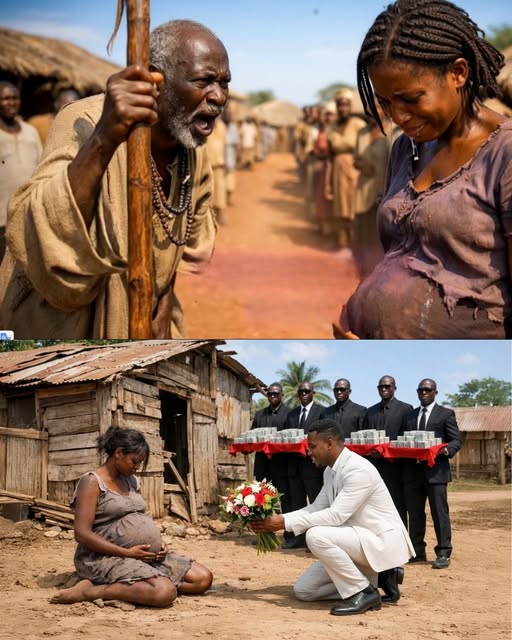
In the middle of the dusty village square near Kisii, Joy Wamboka stood alone, her hands trembling over her pregnant belly. Angry voices flew at her from every side like stones.
“Shameless girl!” one woman shouted.
“You have cursed this village!” another cried.
Then the village elder, Mzee Otieno, lifted his staff and pointed toward the road.
“Leave,” he said coldly. “Leave before your child brings disgrace to us all.”
Tears slid silently down Joy’s cheeks and fell onto the red earth.
And then, just as the crowd’s cruelty reached its peak, the low rumble of engines broke through the noise.
Three black luxury SUVs rolled slowly into the square.
A tall man stepped out.
He walked straight toward Joy.
And what he said next made the entire village fall silent.
Long before the day the village gathered to shame her, Joy Wamboka had been known for something very different.
In the small hills outside Kisii, Kenya, people once spoke of her with warmth. She was the kind of girl older women praised and children trusted. Hardworking like her mother. Respectful. Kind.
Joy’s life had never been easy, but it had always been honest.
She lived with her mother, Mama Nyamura, in a small mud-walled house with a rusted iron roof at the edge of the village. Their home stood beside a narrow dirt path where children passed each morning on their way to school and farmers carried bananas, cassava, and maize toward the market.
The house had only two rooms and a cooking corner outside, but it had always been full of laughter.
Mama Nyamura had raised Joy alone since Joy was seven years old. Her husband had died suddenly after a short illness, leaving behind debts, grief, and almost nothing else. From that day, Joy grew up quickly.
While other children played after school, Joy carried water from the river in yellow jerry cans, helped in the shamba, and worked beside her mother in the fields. By seventeen, she was already selling roasted maize and sukuma wiki at the village market.
And she did it with pride.
People liked buying from Joy. She greeted everyone with a warm smile. She called elderly women shosho with genuine respect. If children passed her stall with empty hands, she sometimes slipped them a roasted cob of maize anyway.
From a distance, Mama Nyamura would watch her daughter and smile with tired, proud eyes.
“One day,” she would say softly, “your kindness will bring you blessings.”
For many years, it seemed that might be true.
Then Brian Uma came into Joy’s life.
Brian arrived in the village riding a bright red boda boda motorcycle. He was tall, charming, loud, and full of laughter. Unlike the quiet farmers who had spent their whole lives in the village, Brian carried the energy of someone who had seen busier towns and bigger roads.
Girls noticed him immediately.
But Brian noticed Joy.
At first it was small things. He began stopping near her vegetable stall after dropping off passengers. He would remove his helmet, wipe sweat from his forehead, and buy roasted maize even when he clearly was not hungry.
“Your maize is the best in Kisii,” he would tease.
Joy would laugh. “You say that every day.”
“Because it’s true every day,” Brian would reply with a grin.
Slowly, their conversations grew longer. Sometimes Brian stayed after the market closed and helped Joy carry her baskets home. Sometimes he sat outside her house in the evenings while Mama Nyamura prepared tea over the charcoal stove.
Mama Nyamura liked him at first. He spoke respectfully. He called her Mama. He talked about opening a transport business one day, buying several motorcycles, maybe even trucks.
“I want to build something real,” he once said, gazing toward the hills glowing orange in the sunset.
Joy believed him.
And because she had lived such a hard life for so long, she allowed herself to hope.
Months passed. Brian visited more often. He told Joy he loved her. One quiet night beneath a sky full of stars, he took her hands in his and made a promise that would change everything.
“Joy,” he said softly, “I want you to be my wife.”
Her heart raced.
“Are you serious?”
“Of course,” he said. “I just need time to save money. I want our wedding to be beautiful.”
Joy believed him completely.
For a while, life felt brighter than it ever had. She moved through the market with new energy. She hummed while arranging vegetables. Even Mama Nyamura noticed.
“You look happy these days,” her mother said one evening.
Joy blushed.
“Maybe the future is finally opening for us.”
Mama smiled, but her voice held a gentle warning.
“Hope is good, my daughter. But always protect your heart.”
Joy nodded.
But love has a way of softening caution.
Then one morning, Joy woke with a strange feeling. Her body felt different. Days later, the truth could no longer be ignored.
Joy was pregnant.
Fear and joy collided inside her at once.
She waited until evening before telling Brian. They met near the small river where women washed clothes and children played in the shallows.
Her voice trembled.
“Brian… I’m going to have a baby.”
For a moment, Brian’s face went completely still.
“You’re sure?”
Joy nodded. “I went to the clinic.”
Silence stretched between them.
She expected him to hold her, to reassure her, to repeat all the promises he had made. Instead, Brian stepped back. His eyes shifted away.
“This is sudden,” he muttered.
Joy felt the ground beneath her confidence begin to crack.
“But we talked about marriage,” she said softly.
“I know,” he said. “I just need time to think.”
It was the first time she had ever seen him look afraid.
Days passed.
Brian stopped coming to the market.
Joy told herself he was busy.
Then a week passed.
Then two.
Finally, she went looking for him. She walked to the boda stage where the motorcycle riders gathered each morning, but Brian’s red bike was gone.
One rider shrugged when she asked about him.
“He left,” the man said casually. “Moved to another town. Better work.”
Joy felt the air leave her lungs.
“Did he leave a message?”
The rider shook his head.
That was the moment Joy understood.
She had been abandoned.
Word of her pregnancy spread quickly. Villages have long memories and even faster tongues.
At first, people whispered.
Then the whispers became conversations.
Then the conversations became public humiliation.
Women who once greeted her warmly now turned away. Men laughed behind her back. Customers stopped buying from her stall. Even church grew cold.
One Sunday, she heard two women whispering behind her during the sermon.
“She should not even be here.”
“She is a bad example for our daughters.”
That was the last time Joy went to church.
Still, she kept working.
She went to the market every morning. She arranged tomatoes, sukuma wiki, green peppers. She lowered her eyes and endured the stares. She walked home with baskets still full because fewer and fewer people bought from her.
By then, even the elders had started talking.
One afternoon, beneath the large acacia tree in the market square, Joy overheard Mzee Otieno speaking.
“This situation cannot continue,” he said firmly. “A child without a father brings disgrace to the whole community.”
Joy walked faster, but the words followed her.
At night, as rain tapped softly on the iron roof of their home, Joy lay awake and placed a hand over her stomach.
The baby moved.
For a moment, calm entered her heart.
This child had done nothing wrong.
And yet somehow the village had decided that both mother and baby were shame.
What Joy did not know was that hundreds of kilometers away in Nairobi, a man named Daniel Mwangi was already on a journey that would soon change her life.
Daniel was thirty-six years old, one of the most powerful businessmen in East Africa, and one of the quietest. His company, Mwangi Global Logistics, ran fleets of cargo trucks across Kenya, Uganda, and Tanzania. He had invested in technology, energy, transport, and land. The magazines called him “the quiet billionaire.”
But behind the success was exhaustion.
Not the exhaustion of business.
The exhaustion of disappointment.
Too many people smiled at him because of what he owned. Too many women admired his money, not his heart. Too many friendships carried hidden motives. Since the death of his mother six months earlier, the emptiness had only deepened.
His mother had always reminded him of who he was before wealth.
“You can build towers,” she used to tell him, “but never forget the soil your feet first touched.”
After her death, Daniel found himself haunted by that sentence.
So one morning, he canceled his meetings, ignored the investors’ dinner, and left Nairobi in a dark SUV with only one driver. He headed west, toward the green hills and rural roads that reminded him of childhood and of his mother’s voice.
He did not yet know that the trip meant to heal him would bring him straight into Joy Wamboka’s storm.
The afternoon Daniel’s vehicle passed through Joy’s village, dark clouds were gathering over the hills.
In the market, the wind rose. Dust spun across the square. Vendors hurried to secure their goods before the rain began. Joy stood beside her small table, stacking tomatoes and greens neatly, trying to ignore the familiar feeling of being watched.
Then Beatrice Mora appeared.
Beatrice was known in the village for her sharp tongue and love of public shame.
She stopped in front of Joy’s stall and looked pointedly at her swelling stomach.
“So,” she said loudly, “this is where shame sits in the market.”
Several vendors turned to listen.
Joy kept arranging vegetables.
“I came to sell food, Mama Beatrice,” she said quietly.
“Sell food?” Beatrice scoffed. “Or teach young girls how to behave like you?”
Laughter rose from nearby women.
Joy’s hands trembled slightly.
“I did not ask for trouble.”
“You invited it,” Beatrice snapped. “A woman who respects herself does not end up pregnant with no husband.”
Lightning flashed in the distance.
Thunder followed.
Then the rain came down.
Vendors rushed toward the nearest shelter. Joy grabbed her basket and ran too, but when she reached the covered area, Beatrice stepped in front of her and blocked the entrance.
“No,” she said coldly.
Joy froze. Rain soaked through her clothes.
“I just need to wait until it slows,” Joy whispered.
Beatrice shook her head.
“You bring shame with you.”
No one moved aside.
No one said, Let her in.
So Joy stepped back into the rain.
Water poured down her face. Her dress clung to her body. Her shoulders trembled from the cold. But she stayed standing beside her little stall, alone.
Then, near the edge of the market, an elderly woman named Shosho Akinyi slipped in the mud while carrying a heavy sack of maize. She fell hard, crying out in pain.
The crowd gasped.
But nobody moved.
Without thinking, Joy ran.
She knelt in the mud, lifted the sack away, and helped the old woman sit up.
“Shosho, are you hurt?”
“My leg,” the woman groaned.
Joy supported her carefully and guided her toward a doorway where someone finally offered shelter.
“Thank you, my child,” the old woman whispered.
Joy nodded and stepped back into the rain again.
And that was the moment Daniel saw her.
His SUV had slowed near the market because of the storm. Through the blurred windshield, he noticed one image that stood apart from everything else: a pregnant woman, soaked to the bone, helping someone while the people around her stayed dry and watched.
“Stop the car,” Daniel said.
He stepped out into the rain and kept watching.
There was something in Joy’s posture that struck him immediately. She looked hurt, humiliated, exhausted.
But not broken.
Daniel walked across the muddy square and stopped beside her stall.
“You should be under shelter,” he said quietly.
Joy looked up at him in surprise. She had expected pity or curiosity.
Instead, his voice carried only calm respect.
“I tried,” she replied softly.
Daniel glanced toward the shelter where the villagers stood watching. He understood.
He picked up a tomato.
“How much?”
Joy blinked. “For the tomatoes?”
“Yes.”
“Twenty shillings.”
Daniel handed her a note worth far more.
She frowned. “You gave too much.”
“Then give me more vegetables.”
For the first time in many days, a small uncertain smile touched Joy’s face.
She placed tomatoes and peppers into a plastic bag and handed it to him.
“Thank you,” she said.
They stood in the rain for a moment in silence.
Then Daniel asked quietly, “They are judging you, aren’t they?”
Joy lowered her eyes.
“It is easier for people to judge than to understand.”
Daniel looked at her for a long moment.
“What is your name?”
“Joy. Joy Wamboka.”
“I’m Daniel.”
He nodded once, tucked the bag of vegetables under his arm, and left.
It was a simple meeting.
But neither of them forgot it.
The next day, Joy was summoned to stand before the elders beneath the acacia tree.
Word had spread through the village. By the time she arrived, a crowd had already formed. Faces watched her with open curiosity, judgment, and hunger for drama.
Mzee Otieno raised his staff.
“Joy Wamboka,” he said firmly, “you stand before us carrying a child without a husband. Our community cannot ignore actions that dishonor our traditions.”
Joy kept her head high, though her heart pounded.
“I did not plan this,” she said. “I trusted someone who lied to me.”
“That does not erase shame,” someone in the crowd shouted.
The elder lifted his hand for silence, then spoke the sentence that made Joy feel the ground shift beneath her.
“You must either reveal the father of the child,” he said, “or leave this village until the matter is resolved.”
“Leave?” Joy whispered.
“Yes.”
“My mother lives here,” she said, her voice breaking. “This is my home.”
“Your actions have consequences,” he replied coldly.
And then the rumble of engines returned.
The same black SUV rolled into the village square.
People turned in surprise as Daniel stepped out.
He walked into the gathering and stopped respectfully before the elders.
“Good afternoon,” he said.
Mzee Otieno nodded stiffly.
Daniel listened in silence as the accusations continued. Then, when the elder paused, Daniel spoke.
“May I ask one question?”
The crowd murmured. The elder hesitated, then nodded.
Daniel looked around at the villagers.
“You say the father left,” he said. “And yet all the punishment falls on the woman alone.”
“That is our tradition,” the elder replied.
Daniel’s voice remained calm.
“But is it just?”
The crowd shifted uneasily.
Then old Shosho Akinyi stepped forward and raised her hand.
“The girl helped me in the rain,” she said. “When everyone else stayed under shelter.”
The crowd murmured again.
Daniel looked at Joy.
“Kindness like that deserves recognition, not exile.”
The elders postponed the decision until the next day.
That evening, while the village buzzed with gossip about the rich stranger defending Joy, another figure returned under cover of dust and fading light.
Brian Uma.
He had heard rumors. A rich man had entered the story. People were talking. And Brian, frightened that the truth might destroy his reputation, came back not to make things right, but to protect himself.
That night he stood at Joy’s door as if months had not passed.
“I heard there’s trouble,” he said.
Joy stared at him, trembling with disbelief and anger.
“You disappeared.”
“I had work.”
“You left when I told you about the baby.”
Brian glanced away, then back at her.
“I came to fix the situation.”
“What situation?”
He nodded toward her belly.
“This.”
Then he made his real purpose clear.
“If the village starts believing that rich man is responsible,” he said, “your life could change. You should let them believe it.”
Joy stared at him in horror.
“You want me to lie?”
“It’s practical.”
“No,” Joy said firmly. “The truth is simple. You are the father of this child.”
Brian’s face hardened.
“Lower your voice.”
“Why?” she asked. “Because the neighbors might hear?”
When she demanded that he take responsibility, he refused. When she threatened to tell the truth, he smiled with cold calculation.
“Tomorrow,” he said, “I will tell the elders that you tried to trap me.”
Then he left.
Joy did not sleep that night.
Morning came heavy and gray.
The square filled even faster than the day before. Everyone wanted to hear what Brian would say.
He stood near the front of the crowd, arms crossed, pretending calm. Joy stood beside her mother, trembling but upright.
When Mzee Otieno invited him to speak, Brian stepped forward dramatically.
“People are saying I am responsible for Joy’s pregnancy,” he began. “That is not true.”
Joy felt the lie strike her like a slap.
Brian kept talking.
“Yes, we spoke sometimes. Yes, we knew each other. But she misunderstood my friendliness. When she told me she was pregnant, she tried to pressure me into claiming the child.”
Gasps rippled through the crowd.
“That is a lie!” Joy cried.
But Brian kept going, louder now.
“She is trying to attach responsibility to any man who will listen.”
The crowd murmured.
The lie was spreading.
Then a calm voice cut through the gathering from the back.
“That’s enough.”
Daniel had returned.
He stepped into the square with the same quiet composure as before.
Brian stiffened.
Daniel looked at the elders.
“This conversation is missing one thing,” he said.
“What?” the elder asked.
“Evidence.”
Then Daniel asked the question that cracked Brian’s story open.
“If this man had nothing to do with the pregnancy,” Daniel said, “why did he disappear immediately after she told him?”
Brian snapped that he had left for work.
Daniel did not argue.
Instead, he reached into his jacket and removed an envelope.
Inside was a clinic record.
He handed it to the elder.
Mzee Otieno adjusted his glasses and read.
Then his eyebrows rose.
“This record,” he said slowly, “confirms that Joy visited the clinic several months ago… accompanied by Brian Uma.”
A wave of shock moved through the villagers.
The elder kept reading.
“And Brian signed as the responsible partner.”
Silence.
Brian’s face turned pale.
The crowd erupted.
“You lied!”
“You wanted to destroy her!”
“You abandoned her!”
Even Beatrice looked stunned.
Joy stood frozen as tears filled her eyes. Not because she had been proven right, but because after months of humiliation, the truth had finally been spoken out loud before everyone.
Mzee Otieno turned to Brian, his face hard with disgust.
“You have dishonored this community.”
Brian lowered his head. His arrogance was gone.
Then Daniel stepped forward once more.
He turned to Joy.
The crowd quieted.
“Joy Wamboka,” he said gently.
Joy looked up.
“I came to this village only passing through,” he said. “But sometimes life brings us somewhere for reasons we do not understand.”
He paused.
Then he said the words that made the entire village stop breathing.
“If you are willing,” Daniel said, “I would like to marry you.”
Shock swept through the square.
Brian stared in disbelief.
The villagers looked from Daniel to Joy and back again, unable to process what they had just heard.
Joy’s heart pounded.
“Why?” she whispered.
Daniel met her eyes.
“Because character matters more than reputation,” he said. “Because when everyone turned away from you, you still chose kindness. Because you deserve respect.”
Joy’s eyes filled with tears.
“You saw me only briefly.”
“That was enough,” Daniel said.
For a moment, she almost wanted to say yes.
Not because she loved him. Not because she understood him. But because in that moment, his offer felt like a doorway out of shame.
Still, something deeper in her refused to move too quickly again.
She lifted her chin and said quietly, “I cannot accept today.”
The crowd gasped again.
Daniel looked surprised, but not offended.
Joy took a breath.
“You defended me when no one else did. I will never forget that. But marriage should not happen because of sympathy, or because of a dramatic moment in a village square. I trusted one promise too easily before. If I ever marry, it must be because we truly know each other.”
For a second, there was only silence.
Then Daniel smiled.
“That,” he said, “is a wise answer.”
He looked at her with something even stronger than admiration now.
Respect.
Mzee Otieno stepped forward again and raised his staff.
“For many days,” he said, “this village has spoken harshly against Joy Wamboka. Today we have learned that the truth was not what it first seemed.”
He turned to the crowd.
“From this moment forward, Joy will not be treated as an outcast in this community. The father of the child has been identified, and responsibility will fall where it belongs.”
The square filled with murmurs.
The balance had shifted.
Shame no longer pointed at Joy.
It pointed at Brian.
Daniel stepped back toward his vehicle, then turned one last time to Joy.
“I meant what I said,” he told her quietly.
Joy nodded.
“I know.”
“I will be in this region for a while,” Daniel added.
Then, after a small pause, Joy gave him a faint but genuine smile.
“Then maybe we will have time to talk.”
“I would like that,” he said.
The SUVs rolled away, leaving behind a village that would never forget what it had witnessed.
Joy stood beneath the acacia tree beside her mother.
Mama Nyamura wrapped an arm around her shoulders.
“My daughter,” she whispered.
Joy leaned into her and closed her eyes.
The path ahead was still uncertain. She was still pregnant. She still had wounds to heal. She still did not know what would become of Daniel, or whether his promise might grow into something real.
But one thing had changed forever.
She was no longer alone.
Sometimes the world is quick to judge people at their lowest moment. Communities decide a person’s story before hearing the truth. Mistakes become permanent labels, while kindness is forgotten.
But Joy’s story proved something powerful:
A person’s worst moment does not define their whole life.
What matters most is how they carry themselves through hardship.
Joy faced gossip, betrayal, humiliation, and fear. Yet she never allowed bitterness to kill her kindness. And in the end, it was that quiet strength, shown in the middle of a storm, that changed everything.
Justice did not come through revenge.
It came through truth.
Through courage.
And through one man willing to see beyond the noise.
Because the world may shame those who fall.
But it will always remember those who rise with dignity.