She Raised Their Kids for 12 Years—They Called Her a Thief Until THIS Happened
The courtroom reeked of floor wax and cheap coffee. Maribel Cruz gripped the edge of the defendant’s table, her knuckles white against the fake wood grain.
Across the aisle, Eleanor Blackwell dabbed her eyes with a silk handkerchief. Grant Blackwell stared straight ahead, jaw clenched. The cameras ate it up.
“The Larkspur Emerald,” the prosecutor announced, his voice echoing. “Four point two million dollars. Gone from a locked safe. Only three people had the combination.”
He pointed at Maribel. “The victim. His wife. And the housekeeper they trusted for twelve years.”
The jury’s faces told Maribel everything. Guilty before the trial even started.

“I didn’t take anything,” she whispered to her court-appointed lawyer.
He didn’t look up from his notes. “They found your mother’s medical bills. Six figures in debt. It’s not looking good.”
“Mrs. Blackwell,” the prosecutor said smoothly, “can you describe the defendant’s behavior in the weeks before the theft?”
Eleanor stood, composed and elegant. “Maribel seemed… distracted. Anxious. I asked if everything was alright, but she wouldn’t talk to me.”
“Did you notice anything else unusual?”
“She asked for an advance on her salary. Twice in one month.” Eleanor’s voice cracked perfectly. “I should have seen the signs.”
Maribel’s hands shook. “That was for my mother’s surgery. I told you—”
“Ms. Cruz, you’ll have your chance,” the judge warned.
The prosecutor smiled. “No further questions.”
Maribel’s lawyer stood. “Mrs. Blackwell, in twelve years, did Ms. Cruz ever steal from you before?”
“No, but—”
“Did she have access to jewelry, cash, credit cards?”
“Well, yes, but—”
“And in twelve years, nothing went missing until now?”
Eleanor’s mask slipped for just a second. “Desperate people do desperate things.”
The lawyer sat down. He had nothing.
“Ms. Cruz,” the judge said, “do you wish to make a statement before we proceed?”
Maribel stood slowly. She looked directly at Eleanor. “Do you really believe I did this? After I raised your children? After I held Theo when he had nightmares? After I—”
“You betrayed us,” Eleanor said coldly. “For money. That’s all you ever wanted.”
The words hit like a slap.
“Your Honor,” the prosecutor said, “we’re ready for the first witness—”
BANG.
The double doors exploded open.
“Theo! THEO, STOP!”
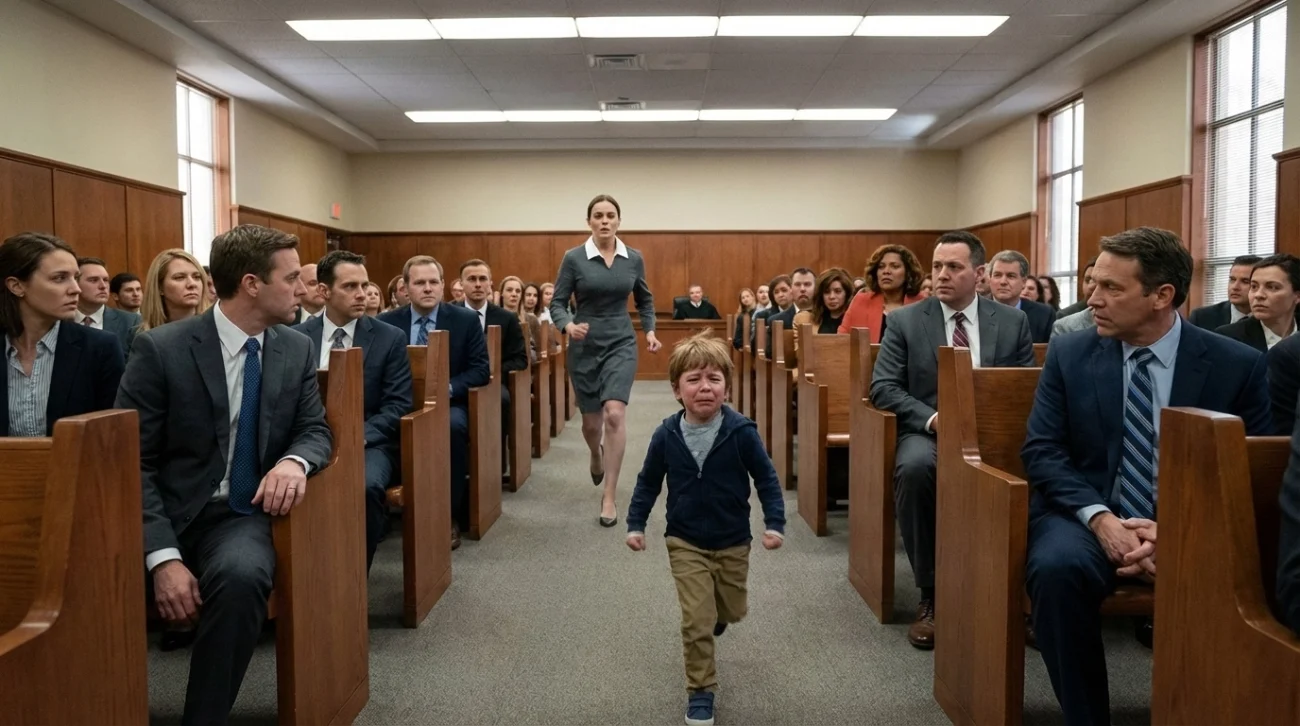
A nanny in a gray uniform was chasing a small boy sprinting down the center aisle. His face was red, tears streaming.
“STOP!” six-year-old Theo Blackwell screamed. “You’re lying! She didn’t do it!”
The courtroom erupted.
“Order!” The judge slammed his gavel. “Someone remove that child!”
But Theo was already at Maribel’s table. He crashed into her, wrapping his arms around her waist, sobbing into her dress.
“They’re lying!” he cried. “Maribel didn’t take anything!”
“Theo!” Eleanor was on her feet, face pale. “What are you doing here? Come here right now!”
Theo turned to face the room, his small body shaking but his voice clear. “I know who stole the emerald.”
Silence dropped like a curtain.
Grant Blackwell’s face had gone gray. “Theodore, son, come to Daddy. You’re confused.”
“Let the boy speak!” A juror called out, leaning forward.
The judge studied Theo carefully. “Young man, do you understand what happens in a courtroom?”
Theo nodded, wiping his nose on his sleeve. “It’s where people tell the truth. Or go to jail.”
“And do you know how important it is to tell the truth?”
“Yes.” Theo’s voice broke. “Maribel told me. She said God sees the truth even when it’s dark.”
Maribel pressed her hand to her mouth, tears spilling.
“What do you want to tell us, son?” the judge asked gently.
Theo took a shaky breath. He looked at his father. “I was hiding in the closet. In Mommy and Daddy’s bedroom. I was going to jump out and scare Daddy.”
“When was this?” the judge asked.
“The day the emerald went missing.” Theo’s voice got stronger. “Daddy came in. He was on his phone. He was yelling.”
Grant stood abruptly. “Your Honor, this is ridiculous—”
“Sit down, Mr. Blackwell.” The judge’s voice was steel.
Theo continued. “Daddy said, ‘I don’t have the money, Tony. I need more time. They’re going to hurt me if I don’t pay.’”
The gallery gasped.
“Then he went to the painting—the one with the horses—and moved it. There was a safe in the wall. He put in the numbers and took out the green box.”
“The emerald?” the prosecutor asked, standing.
“Theo, stop!” Grant’s voice cracked. “You don’t know what you’re saying!”
“He put it in his pocket,” Theo said, tears streaming. “Then he called the police. He said Maribel took it.”
“LIES!” Grant roared. “He’s a child! He’s confused! She put him up to this!”
But Theo shook his head. “Maribel was making me grilled cheese. I know because the butter was burning. I could smell it all the way upstairs.”
Three seconds of absolute silence.
Then the courtroom exploded.
“Mr. Blackwell, sit down!” the judge shouted.
Grant lunged toward the aisle. Two bailiffs grabbed him. His designer jacket tore. His Rolex smashed against the wooden rail.
“You’re ruining everything!” he screamed at Theo. “You stupid boy!”
Eleanor sank into her chair, her face in her hands.
Maribel dropped to her knees and pulled Theo close. “It’s okay, baby. You’re so brave. I’ve got you.”
The prosecutor was already packing his briefcase. “Your Honor, in light of this testimony, the state moves to dismiss all charges against Ms. Cruz.”
Maribel’s lawyer jumped up. “We demand immediate release and formal charges against Grant Blackwell for perjury, fraud, and filing a false police report!”
The judge banged his gavel. “Charges against Ms. Cruz are dismissed with prejudice. Bailiffs, take Mr. Blackwell into custody. Mrs. Blackwell, remain in the city pending investigation.”
He looked down at Maribel, still kneeling on the floor with Theo in her arms.
“Ms. Cruz, you’re free to go. With the court’s deepest apologies.”
Outside, the sunlight was blinding. Reporters swarmed like locusts.
“Ms. Cruz! How does it feel?” “Will you sue?” “What’s next for you?”
Maribel stood at the top of the courthouse steps, holding Theo’s hand. Camera flashes popped like fireworks.
The nanny appeared, reaching for Theo. “Come on, sweetheart. Time to go.”
“No!” Theo clung to Maribel’s leg. “I want to stay with her! Don’t make me go back there!”
Maribel knelt down. “You have to go with Nanny for now, okay? But I promise—I promise—I will never abandon you.”
She kissed his forehead. “You saved me today. You’re the bravest person I know.”
“Ms. Cruz?”
A tall man in a charcoal suit stepped forward, business card already extended. “Elias Thorne. Civil litigation.”
“I can’t afford a lawyer.”
“You don’t need to.” His smile was sharp as glass. “I watched the whole thing. I take cases like this on contingency. And this case? This is going to bury them.”
He leaned closer. “Defamation. Malicious prosecution. Wrongful termination. Emotional distress. By the time we’re done, that mansion you cleaned for twelve years? It’s yours.”
Maribel looked at the card. She looked at Theo, watching her with desperate hope.
For twelve years, she’d been invisible. The help. The woman who scrubbed toilets and raised other people’s children.
But this child had run into a courtroom to save her.
She took the card. “Mr. Thorne, I don’t want the mansion.”
He raised an eyebrow. “No?”
“No.” She looked at the nanny still holding Theo’s hand. “I want custody. Full legal custody.”
Thorne’s smile turned predatory. “Then let’s get to work.”
SIX MONTHS LATER
The estate sale at the Blackwell mansion was packed. Vultures in designer clothes picking over the bones of old money.
Grant was in federal prison—five to ten for fraud and theft. Eleanor had fled to Scottsdale, leaving the wreckage behind.
Maribel walked through the front doors one last time, wearing a navy pantsuit and heels that clicked on the marble she used to scrub.
Elias Thorne walked beside her. “You sure about this?”
“I need to see it. Just once more.”
The foyer was stripped bare. The chandelier she’d polished weekly was gone. The paintings she’d dusted—sold. The silence was strange without the echo of Eleanor’s heels.
“The judge signed the final order this morning.” Thorne handed her a manila envelope.
Her hands trembled as she opened it.
Not a deed. A guardianship agreement.
Theodore Blackwell was legally hers.
“The settlement came through too,” Thorne said. “Eight point four million. Plus the house, the cars, and the emerald itself—recovered from a pawn shop in Newark.”
Maribel stared at the paper. “It’s really over?”
“It’s really over. Grant and Eleanor lost everything. You won everything.”
“Mama!”
Theo ran in from the garden wearing muddy sneakers and a T-Rex shirt. He didn’t look like a little adult anymore. He looked like a kid.
He crashed into her, laughing. “Can we go? This place smells weird.”
Maribel looked around the empty shell. The walls that had witnessed her humiliation. The floors where she’d cried in storage closets. The kitchen where she’d fed a lonely little boy grilled cheese.
All of it—gone. Stripped. Sold.
“Yes,” she said, taking Theo’s hand. “We’re leaving. We’re never coming back.”
She walked out into the sunlight with the boy who’d saved her. The boy she’d raised. The boy who was finally, legally, hers.
Behind her, the mansion stood empty.
Ahead of her, a new house waited—smaller, warmer, theirs.
Maribel Cruz didn’t look back.
VIDEO PROMPT:
A modern American courtroom under harsh fluorescent lighting. All characters are white American adults and children, realistic and natural in appearance. Close-up: a small white American boy, six years old, sprints down the center aisle, his face streaked with tears, his voice breaking as he shouts. Behind him, a nanny in a gray uniform chases after him, calling his name. The gallery erupts—gasps, murmurs, the scraping of chairs.
Cut to the boy reaching the defendant’s table where a white American woman in a simple dress stands frozen, her eyes wide. The boy crashes into her, wrapping his arms around her waist, sobbing into the fabric. Close-up on her trembling hands as they move to cradle his head.
Across the aisle, a white American man in an expensive suit half-rises from his chair, his face draining of color. His mouth opens but no sound comes out.
The boy turns to face the courtroom, his small body shaking. Extreme close-up on his face—tears streaming, lips trembling. The boy says, his voice cracking: “I know who it was.”
Immediately, the man in the expensive suit shouts desperately: “Theo! THEO, NO!”
The boy’s eyes dart toward his father, then back to the judge. He takes a shaky breath. The boy continues, his voice dropping to a whisper: “It was…”
Beat. Heavy silence. The courtroom is frozen.
The boy’s voice barely audible, trembling: “It was my—”
Video ends abruptly mid-sentence.
No logos, no brand names, no watermarks, no text overlays, no subtitles. Cinematic, realistic, grounded tone. Modern American courtroom drama style.