The house was worth more money than most people would earn in three lifetimes.
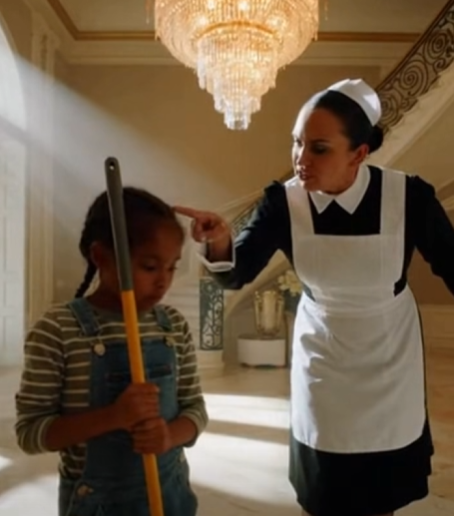
Lily stayed there for a moment longer, nodding even after Mary straightened up and walked away. Her small body trembled, but she didn’t move. She waited until the sound of footsteps faded down the hallway and the house swallowed the noise again.
Only then did she push herself up.
She finished mopping. Slowly. Carefully. Like she was afraid the floor itself might complain if she missed a spot.
That night, her parents came home late. Expensive coats, tired faces, phones still glowing in their hands. They kissed Lily on the top of her head without really looking at her.
“Go to bed, sweetheart,” her mother said. “We’ll talk in the morning.”

Lily wanted to say something. Anything.
But Mary’s words sat heavy in her chest.
So she went to bed.
Days passed. Then weeks.
The house stayed perfect.
Lily didn’t.
She grew quieter. She flinched when footsteps came too close. She learned how to cry without making a sound. At school, she smiled when teachers asked if everything was okay. She said “yes” because that was easier than explaining something she didn’t have the words for.
Mary stayed.
And Mary watched.
But silence has a strange habit. It doesn’t disappear. It builds pressure.
One Sunday afternoon, Lily sat at the kitchen table with her grandmother, Evelyn, who had come to visit from Fresno. Evelyn didn’t have marble floors or glass walls. She had worn hands, warm eyes, and a way of noticing things people tried hard to hide.
She poured Lily a glass of milk and slid it across the table.
“You’re not eating,” she said gently.
Lily shrugged.
Evelyn waited. She always waited. That was her gift.
Finally, Lily whispered, “Grandma… am I bad?”
The question landed heavy.
Evelyn set the glass down. “Who told you that?”
No answer.
Evelyn reached across the table and took Lily’s hands. She noticed the redness on her palms. The stiffness in her fingers. The way Lily wouldn’t quite meet her eyes.
“You listen to me,” Evelyn said softly. “Kids don’t carry this kind of sadness for no reason.”
That night, Lily told her everything.
Her voice shook. She stopped often. She cried hard and ugly, like a dam breaking. And when she was done, Evelyn held her like she was seven again and the world was still fixable.
The next morning, Evelyn didn’t raise her voice. She didn’t storm around the house. She did something far scarier.
She made phone calls.
By the end of the week, Mary was gone. No drama. No shouting. Just gone.
Lily’s parents were forced to listen—to really listen—for the first time. There were tears. Apologies that came late but came real. Changes that didn’t happen overnight, but happened.
The house stayed expensive.
But it stopped being cold.
Years passed.
Lily grew.
She remembered everything—not with bitterness, but with clarity. She learned that silence protects the wrong people. She learned that speaking up doesn’t make you weak. And she learned that pain, when faced honestly, can turn into strength.
As an adult, Lily didn’t chase luxury. She chased meaning.
She worked with kids who came from quiet houses with loud problems. She listened. She believed them. She was the adult she once needed.
One evening, after a long day, she drove home to a modest house with creaky steps and warm lights. Her grandmother’s old recipe simmered on the stove. Nothing fancy. Just food that felt like home.
Lily smiled.
The house wasn’t worth millions.
But inside it, no child cried unheard.
And that made all the difference.
This work is inspired by real events and people, but it has been fictionalized for creative purposes. Names, characters, and details have been changed to protect privacy and enhance the narrative. Any resemblance to actual persons, living or dead, or actual events is purely coincidental and not intended by the author.
The author and publisher make no claims to the accuracy of events or the portrayal of characters and are not liable for any misinterpretation. This story is provided “as is,” and any opinions expressed are those of the characters and do not reflect the views of the author or publisher.