The Mission of Mercy and the Architecture of a Mutual Rescue
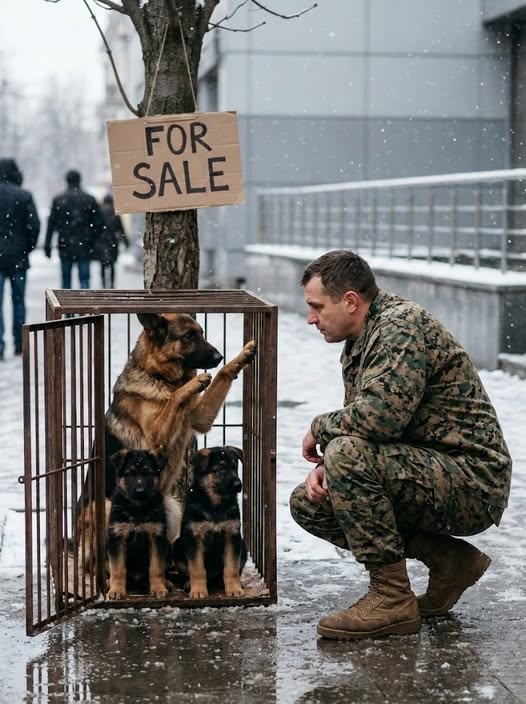
On a frigid New York evening, Ethan Walker, a Navy SEAL struggling to find his footing in the civilian world, encountered a sight that halted his rhythmic, hyper-vigilant march through the city. A rusted cage sat abandoned in the slush, containing a German Shepherd mother and two shivering puppies, their fur glazed with frost. Amidst the indifferent flow of the East 72nd Street crowd, Ethan saw a reflection of his own internal battle in the mother’s resigned gaze. It wasn’t a look of fear, but the heavy, familiar stillness of a living thing that had learned to survive without the promise of help.
Driven by a protective instinct that transcended his training, Ethan negotiated a $40 purchase for the “property” from a nearby vendor, effectively claiming the abandoned animals as his own mission. He moved with deliberate, steady care, kneeling in the biting cold to offer a bare hand to the mother, who sniffed his fingers in a fragile gesture of unearned trust. As a passing stranger offered wool blankets, Ethan draped the cage like a shield and carried the shivering family toward his truck. The act was a surgical extraction from the city’s indifference, moving the dogs from the “resignation” of the street to the potential of a sanctuary.
In the spare, quiet confines of his Brooklyn apartment, Ethan transitioned into a focused caretaker, swapping his combat readiness for the precision of nutritional rehabilitation. He prepared rice porridge and meat for the emaciated mother—now named Hope—while tending to the smaller, weaker puppy. The sterile atmosphere of his home was further softened when his neighbor, Eleanor, arrived with chicken soup and a shared history of loss, recognizing in Ethan the same “warrior’s posture” her late husband once held. The apartment, once just a place to exist between shifts of hyper-vigilance, began to hum with the small, vital sounds of recovery.
Ultimately, the rescue of the German Shepherd family functioned as a mutual salvation, anchoring Ethan to a present reality that finally outweighed the static and alarms of his past. As Hope rested her head against his knee, the apartment shifted from a temporary barracks into a living home, smelling of warmth rather than isolation. Ethan realized that while he had provided the blankets and the food, the dogs had provided the mission and meaning necessary to bridge the gap between surviving a war and living a life. For the first time since coming home, the silence of the room didn’t feel like an absence, but a profound, hard-won peace.