The “Monster” In The White Vest: Why A Biker Risked A Prison Sentence To Tackle A Stranger’s Child In Broad Daylight.
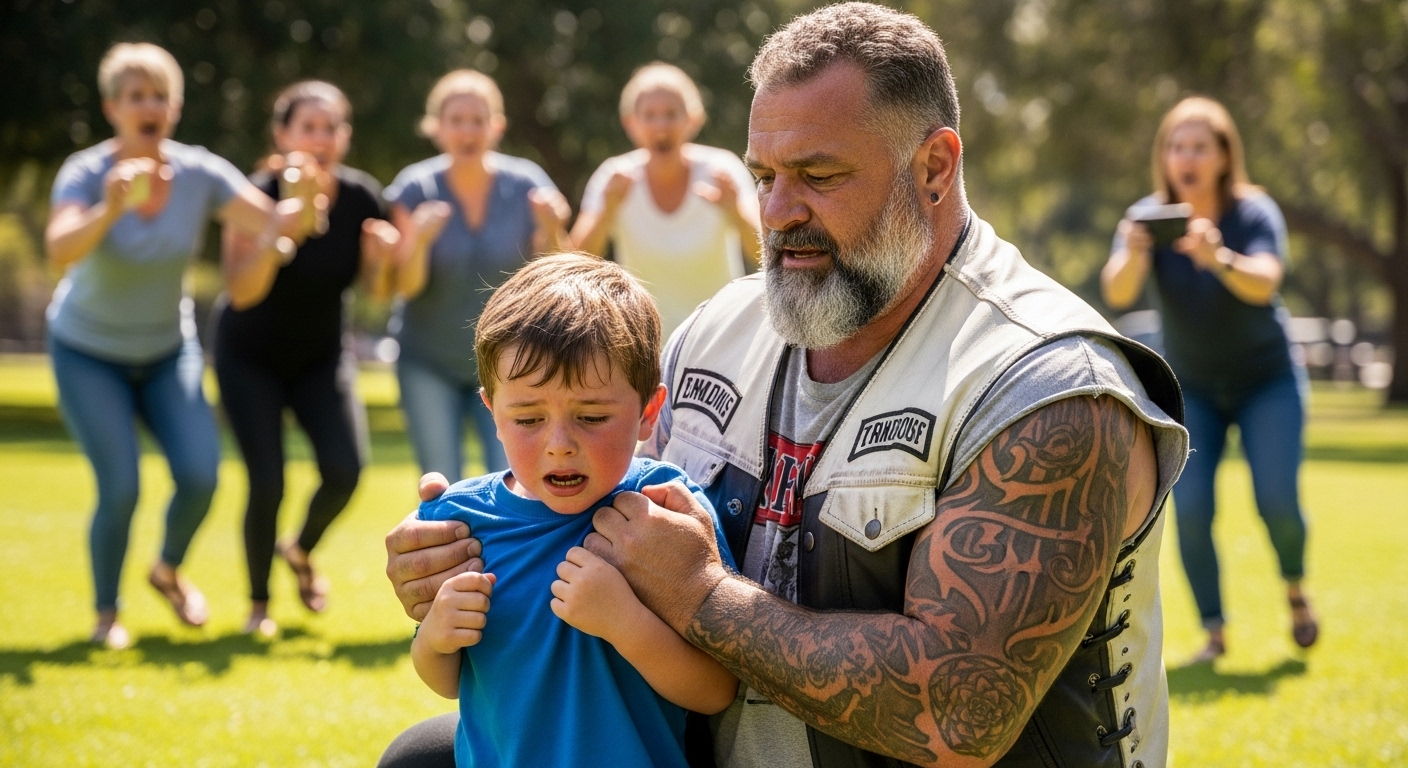
Everyone saw a monster attacking a defenseless child. They pulled out their phones, filming and ready to ruin my life before I even spoke. But as the crowd closed in, screaming for my blood, they didn’t realize the terrifying truth hiding in that boy’s throat. One second later, the world stopped spinning.
The sun was beating down on the asphalt of Oak Creek Park, the kind of humid Ohio afternoon that makes your shirt stick to your back. I was just passing through, leaning my Harley against the curb near the playground. I needed a break from the road and a bitter black coffee from the stand across the street.
My bike, a customized 1998 Fat Boy, was the only thing that kept my head straight these days. People usually gave me a wide berth when they saw the white leather vest and the ink trailing down my forearms. I get it; I’m six-foot-four and built like a brick wall with a beard that’s seen better decades.
I was leaning against my seat, blowing on the steam of my cup, when I saw him. A little guy, maybe six years old, wearing a bright blue Captain America shirt. He was standing near a bench, a few yards away from a group of parents who were busy laughing and looking at their phones.
At first, it looked like he was just playing a game. He was standing perfectly still, his back to the swings. But then his little hands went to his throat. It’s a gesture you never forget once you’ve seen it in the field.

I set my coffee on the pavement. I didn’t even think about the heat of the cup or the fact that it spilled over my boots. My heart started a heavy thud against my ribs, a rhythm I hadn’t felt since my time in the service.
The kid’s face was turning a shade of purple that didn’t belong on a human being. He wasn’t crying—not really. He couldn’t. There was no air to make the sound.
I looked at the parents. They were ten feet away, arguing about some school board meeting or a neighbor’s new fence. They were completely oblivious to the fact that their son was slipping away right in front of them.
“Hey!” I tried to shout, but my voice felt like it was trapped in gravel. I started moving. I didn’t walk; I lunged.
I’m a big man, and when I move fast, people notice. Especially when I’m wearing heavy boots and chains are rattling on my belt. I saw a mother’s head snap up, her eyes widening as she saw this giant biker charging toward her kid.
I didn’t have time to explain. I didn’t have time to be polite or ask for permission. Every second I wasted was a second of oxygen that kid’s brain wasn’t getting.
I reached him in four strides. I grabbed him by the shoulders and spun him around. He looked up at me, his eyes bulging and filled with a primal, silent terror that broke my heart into a million pieces.
“LOOK AT ME!” I roared. I needed him to focus. I needed him to not pass out on me before I could get a grip.
The park went dead silent for a heartbeat, and then the chaos erupted. “Hey! Get away from him!” a man screamed—likely the father. I heard the sound of sneakers hitting grass, a heavy, desperate sprinting sound coming right at my back.
I ignored them. I didn’t care if they tackled me. I didn’t care if I got arrested.
I saw the kid’s lips. They weren’t just blue anymore; they were starting to look grey around the edges. He was fading. His small hands clawed at my tattooed wrists, leaving thin red marks, but he couldn’t get a grip.
I dropped to one knee, looming over him like a shadow. To anyone watching from twenty feet away, it looked like I was assaultive. It looked like I was shaking the life out of a toddler.
“NÀY! NHÌN TÔI ĐI!” I shouted again, the urgency in my voice probably sounding like pure rage to the bystanders. I wasn’t angry. I was terrified for him.
I could feel the crowd closing in. I heard a woman shriek, “He’s hurting him! Call 911! Someone stop him!”
I felt a hand grab my shoulder, trying to yank me back. It was a guy in a golf shirt, his face twisted in a mask of “heroic” fury. He swung a fist, grazing my ear, but I didn’t flinch.
“Get off me!” I barked, shoving him back with an elbow without even looking. I had to stay focused. I had to be the wall.
I moved behind the boy, wrapping my arms around his tiny waist. I formed a fist, placing it just above his navel. I could feel his little body trembling, his ribcage tight and frozen.
“Stay with me, kid… don’t fade on me,” I whispered, my voice thick with a desperation I hadn’t felt in years. I could feel his heartbeat through his shirt—fast, erratic, and weakening.
The father was back on his feet, screaming something about a weapon. A group of three men were now circling me, looking for an opening to take me down. They saw the tattoos, the leather, and the “violence” of my movements.
They didn’t see the piece of hard plastic toy or the chunk of an apple—whatever it was—lodged deep in the boy’s windpipe. They didn’t hear the whistling sound of a closing airway.
I took a deep breath, positioned my hands, and prepared for the first thrust. I knew if I didn’t get this right on the first try, the crowd would be on top of me, and the boy would be gone before they realized their mistake.
I looked up for a split second. A dozen phones were pointed at me. I was going to be the “Biker Predator” on the evening news. I was going to be the villain of the year.
“One… two…” I counted under my breath.
Just as I pulled back for the first massive heave, I felt a heavy weight slam into my back. Someone had jumped on me, their arm wrapping around my neck, choking me.
“Let him go, you freak!” the man yelled into my ear.
I was losing my balance. The boy was slipping from my grasp. The world was screaming, and the only person who knew the truth was a six-year-old who couldn’t speak.
CHAPTER 2: THE SOUND OF SILENCE
The guy on my back was heavy, smelling like expensive cologne and pure, unadulterated panic. His forearm was pressed against my windpipe, and for a second, I was the one who couldn’t breathe. But my eyes were locked on the boy, Leo—I didn’t know his name then, but I saw the light fading from his pupils.
I didn’t have time to fight fair. I threw my head back, hard, feeling the satisfying thud of my helmet-less skull connecting with the guy’s nose. He let out a wet grunt and his grip loosened just enough for me to shrug him off.
I didn’t even look to see where he fell. I lunged back for the kid, who was now collapsing, his knees hitting the woodchips of the playground. I grabbed him under the arms, hauling his small frame up against my chest.
“I’ve got you, little man,” I growled, more to convince myself than him. I ignored the screaming mother who was now clawing at my leather vest, her fingernails leaving white streaks on the cowhide.
I positioned my fist again, right in the sweet spot of his diaphragm. I gave one massive, upward thrust, putting every bit of my strength into it. Nothing happened.
The crowd was a blur of angry faces and waving arms. I heard someone yell that the cops were thirty seconds out. They thought they were witnessing a kidnapping or a murder in broad daylight.
I didn’t care about the cops; I cared about the fact that this boy’s hands had gone limp. I delivered a second thrust, harder this time, feeling the vibration of his tiny spine against my chest. My own heart was hammering so hard I thought it might crack a rib.
Then, I heard it. A wet, disgusting, beautiful pop.
A half-chewed, oversized green grape shot out of his mouth like a wet bullet, landing three feet away in the dirt. For a heartbeat, there was absolutely no sound in that park. Not the wind, not the cars, not the screaming parents.
Then came the sound of the kid drawing in a ragged, whistling breath. It was followed by a sharp, piercing wail—the most beautiful noise I’d ever heard. He was alive, and he was letting the whole world know about it.
I felt the tension leave my body so fast I almost fell over. I gently lowered him to the ground, my hands shaking like a leaf in a storm. I didn’t say a word; I just stepped back, giving him room to breathe.
The mother, the one who’d been trying to tear my eyes out, froze. She looked at the grape on the ground, then at her sobbing son, and then up at me. Her face went from white-hot rage to a ghostly, haunting pale in two seconds.
The guy I’d headbutted was sitting in the grass, blood streaming from his nose, looking confused. The “heroes” who had been circling me like sharks suddenly stopped. The phones were still out, but the angles were shifting.
I wiped a bead of sweat from my forehead, my heart still racing at a hundred miles an hour. I looked down at my white vest, now stained with a bit of the kid’s saliva and my own sweat. I felt like a ghost standing in the middle of a crime scene that never happened.
“He was choking,” I said, my voice sounding like it was coming from the bottom of a well. “He couldn’t breathe.”
The mother didn’t say thank you. She couldn’t. She just scooped her boy up and held him so tight I thought she might finish what the grape started. She was sobbing, great heaving gasps of relief and guilt.
I looked around and saw the blue and red lights reflecting off the trees at the edge of the park. The sirens were cut, but the local PD was rolling in fast. I knew how this looked—a giant biker, a bleeding father, and a crying child.
I didn’t want to explain my life story to a cop with a chip on his shoulder. I didn’t want to be the center of a “brave citizen” report or a “misunderstood giant” segment on the news. I just wanted to be back on the highway, where the air was clean and nobody knew my name.
I turned toward my Harley, my boots crunching on the gravel. I could feel the eyes of the entire park on my back. I felt like a marked man, even though I’d just saved a life.
As I reached for my handlebars, a hand caught my sleeve. I spun around, my instincts on high alert, ready to swing. It was the father, the one with the bloody nose.
He wasn’t reaching for a weapon. He was reaching for me, his eyes wide and brimming with tears. He opened his mouth to speak, but the words wouldn’t come out.
Before he could say a word, a heavy hand slammed onto my other shoulder. I turned to see a police officer, his hand resting on his holster, his face set in stone.
“Don’t move,” the officer barked. “Hands where I can see them, now!”
I looked at the officer, then at the father, then at the crowd of people still filming. I knew right then that saving the kid was the easy part. Surviving the aftermath was going to be the real fight.
CHAPTER 3: THE TRIAL BY TIKTOK
I spent four hours in a small, windowless room at the precinct. It smelled like stale coffee and floor wax. They didn’t handcuff me, but they didn’t let me leave either.
The officer who brought me in, a guy named Miller, kept looking at my tattoos. He was trying to figure out if the ink on my arms meant I was part of a gang or just a guy who liked art. In a town like this, there wasn’t much of a difference to people like him.
“You’ve got quite a record, Jax,” Miller said, flipping through a folder. “Aggravated assault ten years ago. A couple of disorderly conducts. You’re not exactly a Boy Scout.”
“I never claimed to be,” I replied, staring at the flickering fluorescent light. “The kid was dying. I did what had to be done. Ask the parents.”
“We are asking them,” Miller said, leaning back. “The father is at the hospital getting his nose checked. He says you attacked him.”
I laughed, a dry, humorless sound. “I headbutted him because he was choking me while I was trying to save his son’s life. Perspective is a funny thing, isn’t it?”
Miller didn’t laugh. He just stared at me with that blank, “I’m just doing my job” look. I knew he was waiting for a call from the DA or the Chief. They were trying to decide if I was a hero or a liability.
What I didn’t know was what was happening outside that room. While I was sitting in silence, the world was busy dissecting my life. The videos from the park had already hit the internet.
By the time Miller walked back in two hours later, his entire demeanor had changed. He wasn’t looking at me like a criminal anymore. He was looking at me like I was a ticking time bomb.
“You’re free to go,” he said, handing me my keys and my leather vest. “The parents aren’t pressing charges. They… they saw the video.”
“Which one?” I asked, standing up and stretching my cramped muscles.
“All of them,” Miller replied, his voice tight. “There’s one from a girl on the swings. It shows the whole thing—the kid turning blue, you jumping in, the ‘hero’ dad tackling you. It’s got six million views already.”
I felt a cold pit form in my stomach. Six million people had seen my face. Six million people knew what I looked like, what I rode, and where I had been.
I walked out of the precinct and the sun was already setting. My Harley was sitting in the impound lot next door. I paid the fee, fired it up, and felt the rumble of the engine settle my nerves.
I headed for my apartment, a small place on the edge of town where I kept to myself. I just wanted to sleep. I wanted to forget the look in that kid’s eyes and the feeling of the grape popping out of his throat.
But as I pulled into my driveway, I saw them. Three news vans were parked on the curb. A dozen people with microphones and cameras were standing on my lawn.
They saw my bike and swarmed. “Jax! Jax! Over here! How does it feel to be the ‘Biker Guardian’?” a woman yelled, shoving a mic toward my helmet.
“Did you think you were going to kill him?” another voice shouted. “What about the man you injured? Do you have a message for the family?”
I didn’t stop. I rode the bike right onto the sidewalk, forcing them to scatter, and pulled into my garage. I slammed the door shut and locked it, leaning my back against the wood.
My phone started vibrating in my pocket. It didn’t stop. Notifications were flying in like shrapnel—Facebook tags, Twitter mentions, Instagram DMs from strangers.
I made the mistake of clicking on one. It was a TikTok video with a dramatic, slowed-down version of a pop song playing in the background. The caption read: THE MONSTER WHO SAVED AN ANGEL.
The comments were a war zone. Half the people were calling me a hero. The other half were digging up my past, posting my old mugshots, and calling me a violent thug who got lucky.
I sat in the dark of my living room, watching the shadows of the reporters outside move across my curtains. I felt like a caged animal. I had saved a life, and in return, I had lost my own.
I went to the kitchen and poured myself a drink. I needed something to numb the noise. I was halfway through the glass when I heard a soft, rhythmic thudding.
It wasn’t the reporters. It wasn’t the wind. It was coming from the back of the house, at the sliding glass door that led to the small, fenced-in yard.
I grabbed a heavy flashlight from the counter and crept toward the back. I clicked it on, the beam cutting through the darkness.
I expected a stalker, or maybe a persistent journalist trying to get a “candid” shot. I didn’t expect to see a woman standing there, her face tear-streaked and red, clutching a small manila envelope to her chest.
It was the mother from the park. The one who had tried to scratch my eyes out.
She wasn’t screaming now. She looked terrified, looking over her shoulder at the street where the news crews were still waiting. She tapped on the glass again, her eyes pleading.
I slid the door open just a crack. “How did you find me?” I hissed.
“The internet,” she whispered, her voice trembling. “They posted your address in the comments of the video. I had to come. I had to tell you something before things get worse.”
I looked at the envelope in her hand. “Whatever it is, I don’t want it. I just want everyone to leave me alone.”
“You don’t understand,” she said, leaning in closer. “My husband… the man you hit. He’s not who everyone thinks he is. And he’s not going to let this go.”
I felt the hair on the back of my neck stand up. “What are you talking about?”
“He’s a prosecutor, Jax. A powerful one. And he’s humiliated. He’s already calling in favors to make sure that ‘hero’ narrative disappears.”
As she spoke, I heard the sound of a car door slamming in the street. Then another. The reporters started shouting again, but this time, they sounded different. They sounded scared.
I looked past the woman and saw black SUVs pulling up behind the news vans. Men in tactical gear were stepping out, and they weren’t local PD.
“Get inside,” I told the woman, grabbing her arm and pulling her into the kitchen. I locked the door and killed the lights.
“What’s happening?” she whimpered.
“I think your husband just brought the war to my front door,” I said, looking through the blinds.
But as I watched, the men didn’t head for my house. They headed for the news vans. They started smashing cameras and grabbing phones. They were erasing the evidence.
And then, one of them turned toward my garage, holding something that looked like a thermal detonator.
CHAPTER 4: TOTAL BLACKOUT
The explosion didn’t sound like it does in the movies. It wasn’t a roar; it was a sharp, ear-splitting crack followed by the sound of glass shattering into a million pieces. My garage door didn’t just break; it disintegrated.
The woman, Sarah—I’d finally caught her name on the envelope—screamed and hit the floor. I grabbed her by the collar and dragged her behind the kitchen island just as a second blast rocked the house.
This wasn’t the police. This wasn’t a standard arrest. This was a professional “cleaning” crew. Someone wanted the story of the Biker Hero to end in a tragic fire.
“Stay down!” I barked, my ears ringing so loudly I could barely hear my own voice. Smoke started curling under the kitchen door, thick and smelling of gasoline and burnt rubber. My bike. They’d blown up my bike.
That was the mistake. You can mess with my life, you can mess with my reputation, but you do not touch the Fat Boy.
I felt a cold, familiar rage settle over me. It was the kind of calm that comes when you have nothing left to lose. I reached under the kitchen sink, pulling back the false panel I’d installed years ago.
I didn’t pull out a gun. I pulled out a small, ruggedized laptop and a high-gain antenna. If they were going to play dirty, I was going to play digital.
“Who are these people?” Sarah sobbed, her hands over her ears. “Mark… my husband… he said he was just going to ‘fix the PR.’ He didn’t say anything about this!”
“Your husband is a lot more than a prosecutor, isn’t he?” I said, my fingers flying across the keyboard. “You don’t get a tactical team to burn down a house over a bruised ego.”
I tapped into the local mesh network. I’d spent my time in the Signal Corps before my dishonorable discharge—a story for another time—and I knew how to see what others couldn’t.
Outside, the men in black were moving with military precision. They were jam-ming the cell signals in a three-block radius. That’s why the reporters were silent. No one could go live. No one could call for help.
They were creating a “dead zone” to cover the execution of the man who knew too much.
“Look at me, Sarah,” I said, grabbing her shoulders. “I need you to tell me exactly what’s in that envelope. Right now.”
She looked at the manila folder, her knuckles white. “It’s his files. He… he keeps records. People he’s ‘helped’ get off. Bribes. Connections to the cartel across the border. I found it in his safe three months ago.”
“And you brought it to me? Why?”
“Because you’re the only person I’ve seen in years who did something good without asking what was in it for him,” she said, her voice cracking. “I thought… I thought if you had this, he couldn’t hurt you.”
“Well, he’s currently trying to turn us into charcoal, so the plan needs work,” I muttered.
I saw a movement on the monitor. A man was approaching the back sliding door. He was carrying a suppressed submachine gun. He wasn’t looking for a conversation.
I looked at the kitchen island, then at the heavy cast-iron skillet on the stove. I didn’t have a weapon, but I had a plan. And I had a very angry disposition.
I whispered to Sarah to crawl into the pantry and lock the door. She didn’t argue.
I stood by the side of the sliding door, pressing my back against the wall. I could hear the faint click of the lock being picked. These guys were good, but they were arrogant. They thought they were hunting a biker, not a specialist.
The door slid open an inch. A flash-bang grenade rolled into the room.
I didn’t close my eyes. I didn’t turn away. I kicked the grenade back toward the door with the toe of my boot just as it went off.
The boom was deafening. The man in the doorway let out a choked yell as the white light blinded him and the pressure wave slammed him back into the patio furniture.
I didn’t wait. I lunged through the smoke. I grabbed the barrel of his gun, twisting it upward as I drove my knee into his gut. He folded like a lawn chair.
I didn’t kill him. I just put him to sleep with a well-placed elbow to the temple. I stripped the gun from his hands and checked the magazine. Full.
I looked out into the yard. Two more were coming over the fence. They saw their buddy go down and started opening fire. The glass of the sliding door turned into a rain of diamonds.
I dove back into the kitchen, the bullets chewing up the wooden cabinets above my head. Flour and spices exploded into the air, creating a weird, gritty fog.
“Jax!” Sarah screamed from the pantry. “There’s more of them at the front!”
I looked at the laptop. The data was still uploading. I’d set it to blast the contents of that envelope to every major news outlet and the FBI’s tip line the moment the jammer was disabled or the laptop was destroyed.
But the upload was only at 40 percent. I needed time. I needed to hold a house against a hit squad with nothing but a stolen SMG and a heart full of spite.
I looked at the stove. The gas was still on from when I was making coffee. A crazy, desperate idea started to form in my head. It was the kind of idea that usually ended with a closed casket.
“Sarah!” I yelled over the gunfire. “When I say run, you go out the basement window and don’t stop until you hit the main road. Do you hear me?”
“What are you going to do?”
“I’m going to give the ‘Biker Guardian’ a finale they’ll never forget,” I said, reaching for the gas dials.
I turned every burner to high without lighting them. The smell of natural gas began to fill the room, sweet and deadly.
I checked the laptop. 65 percent.
The front door kicked open. I heard the heavy thud of boots on the hardwood. They were inside.
I hunkered down behind the island, the gun gripped tight in my hands. I waited until I saw the first shadow round the corner of the hallway.
“Hey!” I shouted, making sure they knew exactly where I was.
The shadow stopped. “Give us the files, Jax. We make it quick. The girl lives.”
“The girl is already gone,” I lied, my voice steady. “And the files? They’re already halfway to the cloud. You’re too late.”
I saw the red dot of a laser sight dance across the kitchen floor. It was moving toward the stove.
I realized then that they weren’t going to shoot me. They were going to do exactly what I was planning. They were going to blow the place and call it a gas leak.
A hand reached around the corner, holding a lighter.
I had three seconds. I looked at the laptop: 88 percent. 89 percent.
“See you in hell,” I whispered.
I didn’t wait for the explosion. I grabbed a heavy wet towel from the sink, wrapped it around my face, and threw myself through the shattered remains of the sliding glass door just as the world turned orange.
The shockwave caught me mid-air, tossing me like a ragdoll into the neighbor’s fence. I hit the wood hard, the air leaving my lungs in a painful rush.
Everything went black for a second. When I opened my eyes, my house was a towering inferno. The men in black were scrambled, some on the ground, some trying to retreat to their SUVs.
The jamming must have cut out, because suddenly, every car alarm on the block started screaming at once.
I looked at my hand. I was still clutching the manila envelope. I’d managed to grab it in the chaos.
I tried to stand, but my leg buckled. I looked down and saw a piece of shrapnel embedded in my thigh. Blood was soaking through my jeans, dark and hot.
I looked toward the street. The black SUVs were peeling out, leaving their fallen comrades behind. They were cutting their losses.
But then, one car didn’t leave. A silver Mercedes-Benz pulled up slowly, stopping right in front of the burning wreck of my home.
The window rolled down. I saw a man in a crisp suit, his nose bandaged and his eyes filled with a cold, murderous calm. Mark. The “Hero” Dad.
He didn’t have a gun. He just had a phone. He held it up, showing me the screen.
It was a live feed of a dark room. In the center, tied to a chair, was the six-year-old boy. Leo.
He wasn’t choking this time. He was crying, his mouth covered in duct tape.
Mark didn’t say a word. He just pointed toward the backseat of the Mercedes and then sped off into the night.
I was bleeding out, my house was gone, and the kid I’d saved was now a pawn in a game I didn’t fully understand.
I looked at the envelope in my hand. I looked at the fire.
And then, I saw Sarah. She hadn’t run to the road. She was standing by the ruins of the garage, holding my scorched, battered leather vest.
“We have to go,” she said, her voice eerily calm. “I know where he took him.”
I took a deep breath, the smoke stinging my lungs, and forced myself to stand. The pain was white-hot, but the rage was hotter.
“Get the car,” I growled. “We’re going to finish this.”
CHAPTER 5: THE GLASS HOUSE
The “car” Sarah had was a beat-up Honda Civic she’d kept hidden in a friend’s garage. It was a far cry from my Harley, but it was a ghost on the road. We drove in a silence so thick it felt like it was pressing the air out of my lungs.
My leg was a mess. I’d used a spare flannel shirt from the backseat to tie a makeshift tourniquet above the shrapnel wound. Every time I hit the brake, a white-hot spike of agony shot up my spine, making my vision blur at the edges.
“He has a place,” Sarah said, her voice barely a whisper. “A glass-fronted cabin on the edge of Blackwood Lake. It’s supposed to be our ‘getaway,’ but he mostly uses it for meetings he doesn’t want the state to know about.”
I looked at the manila envelope sitting on the dashboard. It was the only thing I had left of my life. My house was a pile of ash, my bike was a skeleton of melted steel, and I was a fugitive in my own town.
“How far?” I asked, grinding my teeth against the pain.
“Forty miles. Through the back roads.” She looked at me, her eyes red-rimmed but steady. “Jax, you don’t have to do this. You saved him once. You’ve done enough.”
I looked at the blood soaking through the flannel on my thigh. I thought about the kid’s face in the park—the way he’d looked at me like I was a god when I gave him back his breath. I thought about him sitting in that dark room, terrified and alone.
“In my world, you don’t start a job and leave it half-done,” I said. “Besides, I don’t like people who blow up my motorcycle.”
The drive felt like an eternity. The Ohio landscape shifted from suburban sprawl to dense, skeletal forests. The moon was a sliver of ice in the sky, offering just enough light to see the shadows of the trees dancing across the hood.
I spent the time thinking about the “cleaning crew.” Mark wasn’t just a prosecutor; he was a gatekeeper for someone much bigger. You don’t get professional hitmen and signal jammers on a government salary.
As we neared the lake, the road turned to gravel. I cut the headlights, navigating by the pale moonlight and the dim glow of the dashboard. The Honda bounced over the ruts, each jolt sending a fresh wave of nausea through me.
“There,” Sarah pointed.
A gravel driveway wound through a cluster of towering pines. At the end, perched on a rocky cliff overlooking the black water of the lake, was a modern structure of cedar and glass. It looked like a temple of luxury, but tonight, it was a fortress.
Two black SUVs were parked in the circle drive. Men were patrolling the perimeter with flashlights, their beams cutting through the mist rising from the lake. They were armed, and they were alert.
“They’re expecting us,” I muttered. “Mark knows you’d come here. He’s counting on it.”
“What do we do?” Sarah asked, her hand trembling as she reached for the door handle.
“You stay in the car. If I’m not back in twenty minutes, you drive until you find a state trooper. Don’t stop for anyone else.”
I reached into the glove box and found a heavy tire iron. It wasn’t an SMG, but in the dark, it was a silent equalizer. I stepped out of the car, my leg nearly giving way under my weight.
I leaned against the door, taking a deep, shaky breath. The smell of pine and damp earth filled my nose. Somewhere in that glass house, a little boy was waiting for a monster to finish what he’d started.
I started to move, staying low, keeping to the shadows of the trees. I could hear the rhythmic “thump-thump” of my heart in my ears. I was a broken-down biker with a hole in my leg and a piece of iron in my hand.
I reached the first guard near the edge of the woods. He was smoking a cigarette, looking bored. He didn’t see the shadow detach itself from the oak tree behind him.
I didn’t give him a chance to cry out. I swung the tire iron with everything I had left, catching him right at the base of the skull. He went down without a sound, his cigarette hissing as it hit the wet grass.
I stripped his radio and his sidearm—a Glock 17. I checked the chamber. Loaded.
I looked up at the house. The second floor was dark, but a single light was burning in the basement level, which was visible through the glass windows facing the lake.
I saw a silhouette move past the glass. It was small. Too small to be a man.
My heart leaped. Leo.
I began to scramble down the rocky embankment toward the basement entrance. My wounded leg dragged behind me, a dead weight that I forced to move.
I reached the glass door at the bottom of the cliff. I could see inside. Leo was there, tied to a chair, just like in the video. But he wasn’t alone.
Mark was standing over him, holding a syringe. He wasn’t looking at the boy. He was looking at his watch, a look of cold, calculated impatience on his face.
I raised the Glock, my finger tightening on the trigger. But before I could aim, a heavy cold barrel pressed against the back of my neck.
“Drop it, Jax,” a voice whispered. “Or the kid gets the needle.”
CHAPTER 6: INTO THE LION’S DEN
I felt the cold steel of the gun against my skin and realized I’d been played. Mark wasn’t just waiting for Sarah; he’d been tracking the signal from the laptop I’d used back at the house. He’d baited the trap, and I’d walked right into the center of it.
“Slowly,” the voice said. It was one of the men in black—the leader, the one who’d survived the explosion. His face was scorched on one side, his eyebrow gone, replaced by a raw, red blister.
I let the Glock slip from my fingers. It hit the dirt with a dull thud.
“Inside,” he grunted, shoving me toward the glass door.
I stumbled into the basement, my leg finally giving out. I hit the polished concrete floor hard, the impact jarring the shrapnel in my thigh. I let out a low groan, the world spinning in nauseating circles.
Mark looked up. He didn’t look like the panicked father from the park anymore. He looked like a man who had just closed a very successful business deal.
“The Biker Guardian,” Mark said, his voice smooth and devoid of any emotion. “You really are a glutton for punishment, aren’t you?”
He looked down at Leo. The boy’s eyes were wide with terror, tears streaming down his face, soaking the duct tape over his mouth. When he saw me, a tiny, muffled whimper escaped him.
“Let him go, Mark,” I croaked, trying to push myself up. “You’ve got the files. You’ve got the girl outside. This doesn’t have to be about the kid.”
Mark chuckled, a dry, rattling sound. “The files are irrelevant now. My associates have already wiped the servers they were uploading to. And Sarah? She was always a liability. But the boy… the boy is a different story.”
He tapped the syringe against his palm. “You see, Jax, the world loves a tragedy. A hero biker saves a boy, only for the traumatized child to ‘accidentally’ overdose on his mother’s medication while the hero watches. It’s a clean ending. Everyone goes home.”
“You’re going to kill your own son to save your skin?” I felt a wave of disgust so powerful it almost drowned out the pain.
“I’m saving a legacy,” Mark replied, leaning over Leo. “He’s young. He won’t even feel it. Just a long sleep.”
I looked around the room, desperate for an opening. The guard with the burnt face was standing by the door, his rifle pointed at my chest. Two more were coming down the stairs from the upper floor.
I was trapped in a glass box with a madman and a dying boy.
But Mark had made one mistake. He was so focused on his “clean ending” that he forgot what happens when you corner a man who has already lost everything.
“Hey, Mark,” I said, my voice dropping to a low, dangerous growl. “You want to know why I got that dishonorable discharge?”
Mark paused, the needle an inch from Leo’s arm. He looked at me, a flicker of curiosity in his eyes. “I’m sure it’s a fascinating tale of mid-western delinquency.”
“I was an explosives specialist,” I said, a slow grin spreading across my face despite the blood in my mouth. “And I never go anywhere without a backup plan.”
I reached into the pocket of my leather vest—the one Sarah had handed me. She hadn’t just given me the vest; she’d given me the small, black remote I’d kept hidden in the lining for years. It was a trigger for the emergency “disposal” system I’d built into the Honda’s engine.
I wasn’t going to blow the car. I’d re-wired the remote to the high-gain antenna I’d tucked into the manila envelope Sarah was holding in the car.
“What are you talking about?” Mark sneered.
“I didn’t upload those files to the news,” I said. “I uploaded them to a live-stream that’s currently being broadcast to every police radio in the county. And the trigger? It’s my heart rate. If it drops too low—or if I press this button—the audio of you admitting to this ‘clean ending’ goes live on every channel.”
It was a bluff. A massive, desperate lie. But in the dim light, with the adrenaline pumping, Mark’s confidence wavered.
He looked at the guard. “Check the frequencies!”
The guard started to reach for his radio. That was the split second I needed.
I didn’t go for Mark. I didn’t go for the guard. I lunged for the heavy floor lamp next to me and swung it like a flail, smashing the glass of the basement window.
The sound was like a bomb going off. The pressurized air from the lake breeze rushed in, and for a second, the room was a whirlwind of shattered glass and chaos.
I heard the guard fire his rifle, the bullet whizzing past my ear. I didn’t stop. I threw myself at Mark, tackling him away from Leo.
The syringe flew from his hand, shattering against the concrete. We hit the floor in a tangle of limbs and expensive fabric. Mark was surprisingly strong, fueled by the desperation of a man who saw his world crumbling.
He clawed at my eyes, his fingers digging into the skin. I slammed my forehead into his face, feeling his nose break for the second time that night.
“Get him!” Mark screamed, blood spraying from his face.
The guards closed in, their boots thundering on the concrete. I rolled over, grabbing the Glock I’d dropped earlier—the one the guard had forgotten to kick away in the confusion.
I didn’t shoot to kill. I shot the supports of the massive glass wine rack behind them.
Hundreds of bottles of vintage wine exploded in a cascade of green glass and red liquid. It looked like a bloodbath, and it created a slippery, treacherous floor that sent the guards sliding.
I scrambled toward Leo, my fingers fumbling with the duct tape on his mouth. I ripped it off as gently as I could.
“Run, Leo! Out the window! Go to your mom!” I yelled.
The boy didn’t hesitate. He scrambled through the broken glass, his small hands bleeding, and disappeared into the night.
I turned back to face the guards, but I was out of time. Mark had recovered, and he was holding a small, silver derringer he’d pulled from his ankle holster.
He pointed it right at my head.
“You ruined everything,” he hissed, his face a mask of gore. “I don’t care about the files anymore. I just want you dead.”
His finger tightened on the trigger.
CHAPTER 7: THE FINAL LEVERAGE
The world slowed down. I could see the hammer of the derringer beginning to move. I could see the sweat dripping off Mark’s chin. I could see the reflection of the burning house—my house—in his crazed eyes.
Then, the roof of the glass cabin exploded.
Not from a bomb, but from the weight of a black tactical helicopter dropping out of the sky. The downwash from the rotors shattered the remaining glass walls, sending a hurricane of debris through the room.
Flash-bangs detonated in a series of blinding white bursts.
I dove for cover behind a heavy oak table, my hands over my ears. I heard the distinct thwip-thwip-thwip of suppressed submachine guns.
The guards who had been sliding in the wine were gone in seconds. They didn’t even have time to raise their weapons.
I looked up, squinting through the dust and the strobe-light effect of the helicopter’s searchlight. Figures in slate-gray tactical gear were rappelling down from the ceiling. They didn’t have “POLICE” on their backs. They had “DEA.”
Mark was standing in the center of the room, looking around in a daze. He still had the derringer in his hand, but he looked like a child holding a toy.
“Drop the weapon!” a voice boomed over a loudspeaker.
Mark didn’t drop it. He turned the gun toward the men in the air.
He didn’t get a shot off. A single marksman from the helicopter took the shot. Mark spun around, the derringer flying from his hand as a bullet shattered his shoulder. He hit the ground, screaming, the “legacy” he’d tried to protect now nothing but a stain on the floor.
I stayed where I was, my hands behind my head. I knew the drill. To these guys, I was just another combatant in a high-stakes bust.
A pair of boots appeared in my field of vision. They were clean, polished, and attached to a man in a windbreaker that said “AGENT.”
“Jax Miller?” the agent asked, looking down at me.
“That’s what it says on the mugshots,” I grunted.
“We’ve been tracking Mark’s associates for eighteen months,” the agent said, signaling for a medic. “We were waiting for the ‘Big One’—the evidence that linked the prosecutor’s office directly to the cartel’s money laundering. We didn’t expect a biker with a hero complex to hand it to us on a silver platter.”
“I didn’t do it for you,” I said, wincing as the medic started cutting away my jeans to get to the shrapnel. “I did it for the kid.”
“We know. We saw the live-stream.”
I blinked. “The live-stream? I was bluffing.”
The agent smiled, a small, grim twist of the lips. “Your friend Sarah wasn’t. She found the laptop in the car. She figured out how to hit ‘Go.’ The whole state heard Mark confess to the kidnapping.”
I let out a breath I’d been holding since the park. Sarah. The woman I’d thought was a victim had ended up being the smartest person in the room.
They loaded me onto a stretcher. As they carried me out of the ruins of the glass house, I saw them.
Sarah was sitting on the back of an ambulance, her arms wrapped around Leo. The boy was wrapped in a shock blanket, but he was eating a chocolate bar and talking to a female officer.
When he saw me, his face lit up. He tried to jump down, but Sarah held him back, whispering something in his ear.
She looked at me and nodded. A simple, silent acknowledgment of everything we’d been through. I didn’t need a “thank you.” I didn’t need a medal. I just needed to know they were safe.
As the ambulance doors started to close, the agent leaned in.
“You’re going to be a very famous man, Jax. The media is going to want a piece of you. The governor is already talking about a commendation.”
“Tell them I’m busy,” I said, closing my eyes. “Tell them I need to find a new bike.”
CHAPTER 8: ASHES AND JUSTICE
Six months later, the dust had finally settled.
The trial of Mark Vance was the biggest story in the country for nine weeks. They called it the “Corrupt Crown” case. With the evidence Sarah provided and my testimony, Mark was sentenced to forty years without the possibility of parole. His “associates” followed him into the federal system shortly after.
I didn’t go to the sentencing. I didn’t watch the news.
I was sitting on a new porch, in a small town three states away. It wasn’t much—a little cabin in the woods with a view of the mountains. It was quiet. It was safe.
In the driveway sat a brand new 2026 Harley-Davidson Road Glide. It wasn’t my old Fat Boy, but it had its own soul. It was painted a deep, midnight blue.
The “Biker Guardian” money—the rewards, the book deals I’d turned down, the GoFundMe that strangers had started for me—was more than I knew what to do with. I’d kept enough to rebuild my life and put the rest into a trust fund for a kid named Leo.
I heard the sound of a car pulling up the gravel drive. It wasn’t a tactical SUV or a news van. It was a familiar silver sedan.
Sarah stepped out, followed by a much taller, much happier-looking Leo. He was wearing a new shirt—this one had a motorcycle on it.
“Hey, Jax!” he yelled, running up the steps and giving me a high-five that nearly knocked me out of my chair.
“Hey, kid. You growing again? You’re going to be taller than me by Christmas.”
He laughed and ran toward the woods to explore. Sarah walked up the steps, carrying a box of homemade cookies.
“How’s the leg?” she asked, sitting in the chair next to me.
“It aches when it rains, but I can still ride,” I said, looking at the bike. “How’s life in the ‘normal’ world?”
“It’s getting there,” she said, looking out at the mountains. “The nightmares are fewer. Leo’s doing great in school. He tells everyone his ‘Uncle Jax’ is a superhero.”
“I’m just a guy who hates grapes,” I joked.
We sat in silence for a while, watching the sun dip below the peaks. I’d lost my house, my anonymity, and my peace of mind for a few weeks. But looking at the two of them, I knew I’d gained something I hadn’t had in a long, long time.
A reason to keep riding.
I stood up, grabbing my leather vest from the railing. It was a new one, but I’d sewn the old patches onto it. The leather was stiff, waiting to be broken in by the wind and the road.
“You leaving?” Sarah asked.
“Just for a bit,” I said, putting on my helmet. “The road is calling. And I’ve got a lot of miles to make up for.”
I fired up the Harley. The roar of the engine echoed through the trees, a powerful, steady heartbeat that felt like home.
I looked back one last time. Leo was waving from the edge of the woods. Sarah was smiling.
I kicked the bike into gear and headed toward the horizon. The “Biker Guardian” was gone, replaced by just another man on a motorcycle, searching for the next sunset.
But I knew one thing for sure. If I ever saw a kid in trouble again, I wouldn’t hesitate. I’d do it all over again, in a heartbeat.
Because sometimes, the world needs a monster to fight the real ones.
END