They Laughed When He Fell at the Country Club, But No One in That Ballroom Knew the Humiliated Husband on the Marble Floor Had Once Been the Ghost Every Highway Feared and Every Brother Still Obeyed
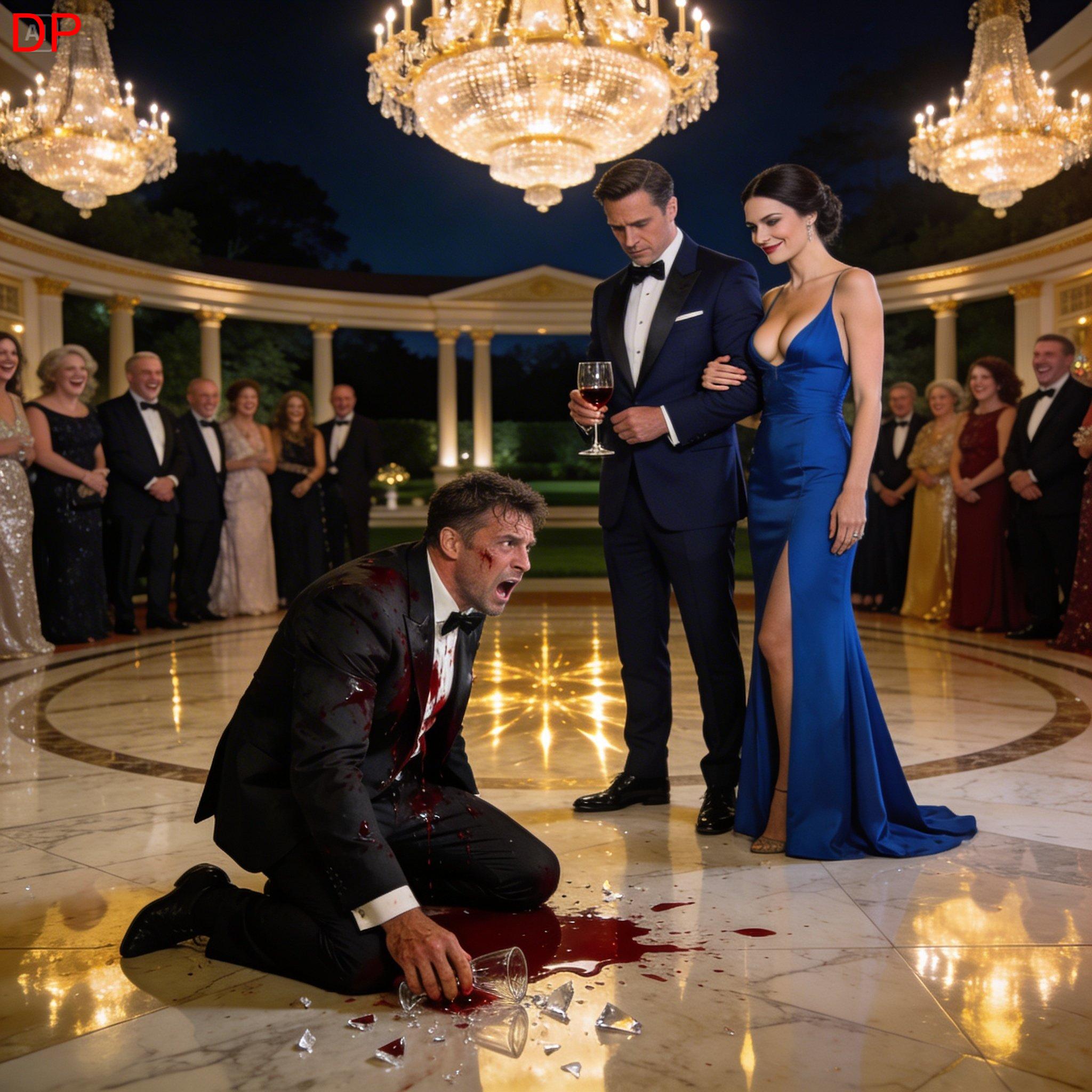
The floor of the Oak Ridge Country Club was cold enough to feel through the knees of my cheap tuxedo pants, and polished so hard it caught every chandelier in the room and threw their light back at me like mockery. I could see my own reflection in that marble for a second—broad shoulders bent at an ugly angle, dark hair mussed, one hand braced against spilled wine, the other half-curled as if my body hadn’t yet decided whether to rise or strike. The Bordeaux seeped through my jacket in a slow, expensive stain. It smelled rich and old and wasted, exactly like everything else in that room.
“Oops,” Bradley Sterling said.
He didn’t sound surprised. He didn’t sound apologetic. He sounded entertained.
That man had a voice made for boardrooms and country clubs, smooth and educated and sharpened just enough to cut. He stood over me with one hand still wrapped around the stem of his glass, the other tucked into the pocket of a navy dinner jacket that probably cost more than my first truck, my second truck, and the garage apartment I lived in before Sarah all put together.
“I guess some things just aren’t built to stand under pressure,” he went on, smiling the way men smile when they know an audience is on their side. “Just like your career, right, Jax?”
The laughter came exactly when he expected it to. A few quick bursts first, then a wider ripple moving through the cluster of donors, board members, lawyers, wives in silk, husbands in custom suits, all of them enjoying the relief of watching someone lower in their invisible pecking order get knocked off balance. Laughter like that is never about the joke. It is a vote. A little civic ceremony of cruelty.
I tasted copper where the inside of my cheek had caught my teeth when I hit the floor. My jaw throbbed. One shoulder had slammed into the leg of the chair beside me hard enough that I knew it would bruise by morning. But none of that was what hurt. None of that was what made something dark and old lift its head inside me.
I looked up, but not at Bradley.
I looked for Sarah.
My wife stood less than three feet away, one hand resting lightly on Bradley’s forearm as if she belonged there. As if that placement of skin on fabric was the most natural thing in the world. She wasn’t reaching toward me. She wasn’t horrified. She wasn’t even embarrassed. Her lips had curved into a small, tight smirk, and it was that expression—more than Bradley’s shove, more than the laughter, more than the wine soaking into my jacket—that cracked something cleanly in the center of me.
It wasn’t the smirk of a woman stunned by a social disaster.
It was the smirk of a woman who agreed with the room.
“Get up, Jax,” she whispered, and her whisper was sharper than Bradley’s joke. “You’re making a scene. Just go to the car and wait for me. You’re clearly out of your element.”
Bradley chuckled and took one half-step closer, enough that the shine of his loafers filled my line of sight. Polished Italian leather. Soft soles. Men like him bought shoes to glide over floors. Men like me bought boots to stand in oil, blood, rain, and whatever else the world felt like spilling.
“Listen to the lady,” he said. “Go back to the garage. Leave the real business to the men who know how to handle it.”
I stayed where I was for one more second.
Maybe two.
Time does strange things when humiliation turns into revelation. It stretches. It clarifies. It slices away excuses so fast it feels like mercy.
For five years I had been swallowing myself in pieces. That sounds dramatic if you’ve never done it. If you’ve never learned how to sand down your own edges so somebody else won’t feel threatened touching you. If you’ve never stood in front of a mirror practicing smaller smiles, softer tones, safer silences. If you’ve never let people reduce you because the one person you loved kept telling you that reduction was growth.
I had traded leather for linen. Traded grease under my fingernails for a keyboard and quarterly reports. Traded midnight rides and bonfire meetings and men who would have bled for me for neighborhood barbeques where nobody said what they meant and everyone kept score anyway. I had eaten tiny food on giant plates. I had laughed at bad jokes from men I could have folded in half with one hand. I had let strangers ask if it was “hard” adjusting to “this kind of life,” as if I’d crawled out of a ditch to attend their fundraiser instead of willingly walking away from a kingdom most of them couldn’t survive a week inside.
I had done all of it because Sarah said she wanted normal.
But kneeling there in spilled wine with her smirk aimed at me like a blade, I finally understood what she had really wanted.
Not normal.
Tame.
A man on a leash feels a lot like a civilized man from a distance.
My hand landed on a shard of broken crystal lying near my knee. I didn’t pick it up to use it. I just let my fingers find its edge. Felt the bite of it. The clean honesty of something sharp. It grounded me.
Then I stood.
Slowly.
I’m six-foot-three. About two hundred and thirty pounds when I’ve been eating right, a little less when stress starts chewing holes through my appetite. Office chairs hadn’t softened me. I still carried every hard year in my shoulders, every fight in my ribs, every mile in my legs. As I rose to my full height, Bradley’s laughter died before he could hide it. The room went quieter than the background music. He took a half-step back without meaning to.
Fear is quick. Pride is slow. The body always knows first.
I straightened my tie. Wine dripped from the hem of my jacket onto the marble.
I looked Sarah in the eye.
“I’m going,” I said.
“Good,” she snapped, already turning back to Bradley with that dry little social smile. “I’m so sorry. He’s been under a lot of pressure lately. I think he’s just… struggling.”
Struggling.
That was the word she used for me whenever she needed to translate my existence into something her friends could digest. I wasn’t angry, she’d say. I was struggling. I wasn’t restless, I was adjusting. I wasn’t proud, I was defensive. I wasn’t dangerous, not really, I was just wounded in ways she believed only she understood.
There are women who heal men. There are women who destroy them. The most dangerous ones convince themselves they are doing both at once.
I turned and walked away before my face could betray what was moving under it.
The ballroom opened into a grand foyer framed in dark wood and gold trim, portraits of dead benefactors glaring down like a jury too rich to care. Somewhere behind me, a few voices picked up again, uncertain at first, then steadier once they’d decided the threat had passed. Somebody laughed again. Somebody else asked for another drink. The pianist, who had stopped mid-song, began to play once more with the careful hands of a man who didn’t want trouble but liked a paycheck.
At the front doors, a valet in a red coat glanced at the stain on my jacket and then quickly away. His expression held something worse than judgment.
Pity.
I pushed out into the night.
The air outside was cool and damp and smelled faintly of fresh-cut grass. The country club grounds spread in elegant silence beneath strings of warm lights and carefully placed lanterns. Manicured hedges. White stone fountains. Imported trees that had been uprooted from one life and replanted in another until they looked like they belonged. Beyond the circle of brightness around the clubhouse, the dark pressed close and honest.
My silver Lexus sat where I’d parked it, a car Sarah had chosen because it looked “responsible.” That was her word too. Responsible. She always said it with admiration, but she used it like a tranquilizer dart.
I got in, shut the door, and just breathed for a moment.
My chest rose and fell hard enough to make my ribs ache. I could still hear Bradley’s voice. Still see Sarah’s hand on his arm. Still feel the old thing inside me pacing now, no longer drowsy, no longer patient.
I opened the center console and shoved aside grocery receipts, a packet of mint gum, organic dog treat coupons from a pet store Sarah liked because the branding looked ethical. At the very back, behind a false plastic panel I had installed myself five years earlier, my thumb found the latch.
The compartment clicked open.
Inside lay a black flip phone.
Nothing fancy. No apps. No tracking. No digital life tethered to it. Just hard plastic, a tiny screen, a battery I charged once a month whether I wanted to or not. I had told myself it was insurance. A relic. A habit too dangerous to surrender completely. But as I held it in my palm that night, I knew the truth.
Some part of me had always known this day might come.
I flipped it open.
One contact.
Hoss.
I hit dial.
It rang once.
Then a voice answered, rough as gravel and warm as a shot of whiskey. “Ghost?”
Just hearing the old name hit me like opening a locked room and finding the air still good inside.
“Yeah,” I said.
On the other end I heard engine noise, men talking, the kind of open-road racket that doesn’t come from suburbia or office parks or quiet streets lined with ornamental maples. It comes from movement. It comes from lives that don’t apologize for being loud.
“Ghost,” Hoss said again, and this time the word cracked with disbelief and something close to joy. “Is that really you, brother?”
“It’s me.”
A pause. Then, lower: “You in trouble?”
I looked through the windshield at the glowing windows of the clubhouse. At the silhouettes moving inside. At the life I had crawled into for love and let suffocate me by degrees.
“Yeah,” I said. “I think I finally figured out I am.”
Another pause, shorter this time. I heard metal move, the sharp slap of a kickstand coming up.
“Where are you?”
“Oak Ridge Country Club.”
There was the sound of somebody in the background asking who it was. Hoss didn’t answer him.
“What do you need?” he asked.
I let my gaze sweep the building one last time. I thought about the men inside who measured worth in money, schooling, bloodline, and social ease. I thought about Bradley’s grin. I thought about Sarah, who had once looked at me like I was the only real thing in a false world and had slowly taught herself to hate the parts of me that couldn’t be put on a shelf.
Then I said the words I should have said years earlier.
“I need the family.”
Silence.
Not uncertainty. Not hesitation. The kind of silence that happens when a bell is struck and everyone who hears it understands exactly what is being asked.
“How many?” Hoss said.
I leaned back against the seat and closed my eyes for a second. Fifteen hundred men. Chapters across states. Decades of loyalty. A nation built from steel, bad decisions, blood oaths, patched vests, and a code the outside world never bothered to understand before condemning.
“All of them,” I said. “Tell every chapter within reach. I want bikes rolling before midnight.”
That got me a sharp exhale from him. Almost a laugh, but darker.
“Well,” he said, “sounds like the dead are walking.”
I opened my eyes again. “Tell them Ghost called.”
His answer came without a trace of doubt. “They’ll come.”
I hung up and set the phone on the passenger seat.
For a few seconds I just sat there, listening to the faint hum of my own engine and the distant music still drifting out from the country club. My heart had steadied. My breathing had steadied. The humiliation was still there, but it had changed shape. It wasn’t a wound anymore. It was fuel.
I put the Lexus in gear and drove away from Oak Ridge.
Not home.
Not to the beige house with its staged living room and throw pillows nobody leaned against. Not to the kitchen where every surface had to stay spotless because Sarah said clutter made her anxious, though somehow my existence never seemed to trigger the same concern. Not to the bed where she slept curled neatly on one side and turned her back if I came to her still smelling like work or wind or anything too close to who I’d once been.
No.
I drove to the edge of town where the houses thinned, then to a row of storage units backed against a tree line and hidden from the road by chain-link and neglect. I’d rented Unit 47 for five years under a different name and paid cash every month. Sarah thought I kept old tools there. Some furniture from before the marriage. Maybe tax records. She had never asked to see it. She liked the symbolic version of my past much better than the physical one.
The roll-up door rattled when I unlocked it.
The smell hit me first.
Oil. Dust. Old leather. Cold metal. Faint gasoline. A smell so familiar it reached somewhere under language and squeezed.
I flicked on the light.
Inside wasn’t storage.
Inside was every part of me that had refused burial.
There was a battered red toolbox wider than a coffin and heavier than sin. Shelves lined with parts, carburetors, sprockets, spare cables, wrapped engines under canvas. There was a workbench scarred by years of use and burns and careless knives. On the far wall hung photographs in cheap frames: men shoulder to shoulder beside bikes, bonfires in the dark, a younger version of me with my arm around a grey-bearded giant who would later answer to Hoss, another with my old man standing beside the first Reaper banner they ever stitched by hand. There were no tasteful landscapes here, no curated memories. Just truth nailed to plywood.
And there, under a cover in the center of the unit, waited the machine Sarah had once called “that death trap.”
I stripped off the tuxedo jacket first and threw it in the trash barrel by the door. Then the bow tie. Then the white dress shirt already ruined at the collar and cuff from wine and blood. I stood for a moment in the harsh overhead light, broad and scarred and no longer pretending the body inside those clothes belonged in candlelit charity rooms.
From a locker I pulled faded heavy denim, black and worn at the thigh. A plain T-shirt. Thick socks. Steel-toed boots. I dressed with the calm efficiency of ritual.
Last came the leather vest.
It hung alone on a hook like something alive.
The patch on the back had faded over the years. Black and silver, the skull with cracked eyes, the curved rocker above it reading IRON REAPERS. Lower rocker naming the mother chapter. Old road dust still embedded in the seams. Tiny cuts, a cigarette burn near the left shoulder, a dark spot by the hem that would always be blood no matter how many times anyone pretended otherwise.
I took it down and slid my arms through.
The weight settled on my shoulders with the force of recognition.
A strange thing happened then.
I could breathe.
It sounds simple, stupid even, but I had not taken a full breath in years. Not one that reached all the way down. Not one that expanded my ribs like they were built for power instead of restraint. That vest didn’t make me a different man. It made me legible to myself again.
I pulled the cover from the bike.
My 1978 Shovelhead gleamed dully in the fluorescent light, black tank, chrome pipes, custom bars, every inch of it built with my own hands long before Sarah or Oak Ridge or cubicles or dinner parties. It wasn’t perfect. Perfection is for showrooms and liars. It was mean, stubborn, loud, and honest.
I wheeled it out of the unit and into the gravel lot.
First kick: nothing.
Second kick: a cough.
Third kick: ignition.
The engine erupted awake with a violent roar that bounced off the surrounding units and rolled out toward the trees. For a heartbeat I just stood there with both hands on the bars and let that sound hit me in the chest. It was crude. Mechanical. Living. No insulation. No softening. The exact opposite of everything I had been told a grown man should want.
I checked the time.
10:45.
The party at Oak Ridge would still be going. The dancing maybe. The speeches maybe. Sarah might still be inside trying to laugh off what had happened, smoothing over embarrassment with explanations that made me smaller and Bradley cleaner. Maybe she was checking her phone and irritated I hadn’t texted back. Maybe she was already planning how to frame the argument we’d have later so it became about my temper and not her contempt.
Didn’t matter.
I swung a leg over the bike and pulled out onto the road.
The night air hit my face like a slap and a blessing.
Most people in Oak Ridge knew me as Jax Miller, project manager, homeowner, husband. They knew I worked at a mid-sized construction company where Bradley sat on the board and liked to remind everyone he had “taken a chance” hiring me. They knew I kept my lawn trimmed, waved to neighbors, helped old Mrs. Donahue with her groceries, and spent Saturdays pretending a push mower was enough machinery to quiet the restlessness under my skin.
They did not know that long before all that, I had been called Ghost.
They did not know my father had helped found the Iron Reapers when biker clubs still formed in the shadows of war and factory layoffs and the kind of grief small towns never put in the paper. They did not know I had grown up around men who smelled like gas and tobacco and saw the world as simple only in the ways that mattered: loyalty, debt, blood, betrayal. They did not know that by twenty-five I had become the youngest president in club history, because age doesn’t matter much when enough people have watched you bleed and stay standing.
They definitely did not know I’d done three years in federal prison for a weapons charge that should have pinned on three different men instead of me. I had gone in smiling because taking that fall kept the club from splintering during a war with a rival set. I had come out harder. Quieter. More dangerous. Men started calling me Ghost because once I entered a room there was no forgetting I’d been there, but somehow I could still seem dead-eyed calm even while deciding whether someone would walk out of it.
It wasn’t a life civilians understand. Mostly because they never ask the right questions. They hear biker and imagine mindless violence, leather costumes, chaos for chaos’s sake. They don’t understand governance when it doesn’t wear a tie. They don’t understand what it means to hold together forty chapters across multiple states, to settle disputes without triggering bloodshed, to make sure widows are fed, children get school clothes, prisoners’ families get help, funerals are honored, promises are kept. They don’t understand that laws are not the same thing as order.
The club had been my inheritance. My burden. My pride.
Then I met Sarah.
She was teaching second grade then, or said she was. We met in a roadside diner thirty miles outside Trenton, a place with cracked red vinyl booths and coffee strong enough to wake the dead. I had stopped in alone after a run north, road dust on my boots, patch on my back, knuckles split from a problem solved behind a warehouse an hour earlier. She was sitting at the counter grading papers, her dark hair tied back, glasses low on her nose, a little frown between her brows as if the world kept disappointing her in manageable daily doses.
Most women looked at me one of two ways back then: with fear they found exciting, or excitement they called fear afterward. Sarah looked at me like she was reading a book no one else had been smart enough to open correctly.
That’ll get a man killed faster than a gun.
She noticed the blood on my knuckles when I asked the waitress for more coffee. Noticed the patch. Noticed everything. But instead of performing discomfort like nice girls are taught to, she asked if I’d punched a wall or a person.
I laughed. She didn’t.
“Which one?” she asked again.
I told her it depended on whether the wall could talk.
She smiled then, and the whole room changed shape around it.
Women like Sarah don’t seduce with heat first. They seduce with recognition. She made me feel seen in the exact places I wanted to be forgiven. She asked questions nobody else had the nerve or patience to ask. About my father. About prison. About whether I was ever tired of being the man everyone expected to handle the worst thing in the room. About what peace might look like for somebody like me.
Nobody had ever asked me that last one.
I kept coming back to that diner. At first for coffee. Then for her. Eventually I learned enough to understand she came from money—not grotesque Bradley Sterling money, but the quiet old kind. Good schools. Nice family. Expectations. She said teaching was the one thing she’d chosen for herself. She made it sound like rebellion. She said my life fascinated her because it was so unfiltered, so real compared to the curated nonsense she’d grown up around.
That’s the problem with being admired for your wildness by someone who has never actually lived near wild things. One day they stop admiring and start redesigning.
At first her requests were small.
Could I not show up to dinner with the guys smelling like smoke?
Could I wear a button-down just this once because her sister would be there?
Could I maybe think about what life would look like at forty if I kept going this way?
Then the requests became dreams.
Couldn’t we go somewhere nobody knew my name?
Couldn’t I be more than what my father had been?
Couldn’t I prove love by choosing her over all of it?
I was stupid enough to confuse sacrifice with devotion.
The truth is I had already been tired. The wars with the Ash Kings out west had cost too many boys. Federal pressure had been tightening. My father was dead by then, my mother too, and leadership had become a constant act of holding a crumbling wall upright with my back. Sarah arrived at exactly the moment a man is easiest to persuade there must be another life waiting if he would only set down the weight.
So I did the impossible.
I stepped down.
No one outside the club ever understood what that meant. They thought president was some vanity title, some cartoon gang-boss nonsense. But to step down the way I did—clean, without fracture, without retaliations, without three ambitious men deciding blood was cheaper than consensus—took more diplomacy than every charity board in Oak Ridge combined.
Hoss became my successor. The old chapters agreed because he had my trust and his own reputation to carry him. I spent months brokering peace between factions, settling territory questions, making sure the prison funds and widow funds and chapter books were tighter than they’d ever been. I handed off everything. Everything except the emergency phone and the storage unit. Even then maybe I knew you never amputate your past cleanly. You just bury it shallow and pray it doesn’t claw its way up when it smells betrayal.
Sarah cried when I told her it was done. Told me nobody had ever loved her like that. Told me I was the bravest man she knew. Told me she could finally see the future.
It did not occur to me then that her future required my extinction.
The ride to the truck stop cut through old industrial roads and low strips of highway where the town lights thinned and darkness stopped pretending to be decorative. I opened the throttle and let the Shovelhead run. Every shift loosened something in me. Every mile peeled away one more layer of suburbia, one more careful sentence, one more apology I had made just to keep peace in a house that never truly belonged to both of us.
When I reached the abandoned truck stop ten miles outside Oak Ridge, the place sat empty under a flickering neon sign that had once promised diesel, pie, and twenty-four-hour service. Now it offered cracked asphalt, weeds through concrete, busted vending machines, and the kind of anonymity America leaves behind in strips. Moonlight silvered the lot. Wind rattled a loose sheet of metal somewhere at the back.
I killed the engine and stood beside the bike.
For a while there was nothing.
Then the asphalt beneath my boots began to hum.
If you’ve never heard a large pack of motorcycles approaching at distance, you might think the world itself is coming apart. It starts below hearing, almost—a vibration in the ground, a pressure against the ribs. Then it climbs. A low animal growl becomes a layered mechanical thunder. One engine, then ten, then fifty, then so many it becomes impossible to separate machine from momentum.
The first cluster of headlamps appeared over the bend to the south.
Twenty bikes.
Then behind them, more.
Fifty.
A hundred.
Chrome flashed under moonlight. Black and silver colors caught the wind. Engines rolled in waves that seemed to stretch beyond the curve of the road itself. Men from Jersey, Philly, Baltimore, the coast, small inland chapters and city chapters, all riding hard because a call had gone out that should have been impossible.
Ghost had called.
The lead rider came in hot and dropped his bike sideways in a spray of gravel so dramatic it would have been funny if it wasn’t Hoss doing it. He was huge. Had been huge at twenty and only gotten more so with age, until he looked less like a man and more like a weather event in denim. Beard gone mostly grey, left eyebrow split by a scar that disappeared into his temple, shoulders like a loading dock. He killed the engine and was off the bike before it settled.
He hit me like a bear.
My ribs protested. I laughed anyway.
“You skinny bastard,” he barked, holding me at arm’s length once he let go. “You look like hell.”
“You look uglier than I remember,” I said.
“That’s leadership.” He grinned, exposing the missing tooth he’d lost in a bar fight down in Camden three years back. “We earn every inch.”
Behind him the lot kept filling. Men cut engines, dismounted, pulled off helmets. Some I knew instantly despite years gone by. Some had aged. Some hadn’t. Some were boys I remembered patching in who now wore the confidence of seasoned road captains. Some were old hands whose faces had become part of the club’s architecture in my memory.
And all of them were looking at me.
Not with questions.
With recognition.
It hit me then harder than the hug had—that I had not disappeared for them the way I thought I had. You leave a title, maybe. You leave a seat at the table. But there are certain names a family doesn’t strip from your bones.
Hoss followed my line of sight and snorted. “Told you they’d come.”
“How many?”
“Still rolling in. Last count I got before my phone started melting was twelve hundred committed. More joining on the road. We’ll break fifteen easy.”
I looked at the highway where lights still approached in clusters.
“All for me?”
“All because you said you needed us.” His expression shifted, softer beneath the roughness. “That’s different.”
Men started drifting closer but kept enough distance to let the first exchange happen. Respect. Protocol. Old instinct. I recognized several of the regional presidents and road captains. Grim. Curious. Ready.
Hoss lowered his voice. “So tell me straight. Who do we bury?”
The question was casual in wording, absolute in meaning. Not bluster. Not theater. If I had named a man that night, the club would have treated that information with the gravity of war.
“No one,” I said.
A few shoulders relaxed. A few others seemed almost disappointed.
“We’re not here for bodies,” I went on louder. “We’re here for memory.”
That got their attention in a different way.
I climbed onto an old fuel barrel so they could all see me over the bikes. The moon sat above them. Fifteen hundred engines ticked and cooled and idled. Fifteen hundred men waited.
Five years earlier I had walked away from this because I thought love demanded it. Standing there under the dead truck stop sign, looking over those faces, I saw what I’d really done. I hadn’t abandoned violence for goodness. I had abandoned belonging for approval. There’s a difference no one teaches you until it nearly kills you.
“They think I’m dead,” I said. “The people in Oak Ridge. The ones in the country club. My wife.” The word tasted flat. “They think the man I was can be mocked because he’s gone. Tonight they’re going to learn the difference between buried and sleeping.”
The wind moved through the lot. Nobody spoke.
“We ride into town two by two,” I said. “Slow. Loud. Through the center streets. Past every manicured lawn and every porch light. Then we take the club.”
A murmur passed through the crowd, dark and pleased.
“No weapons unless I call for them. No civilians touched. No property unless it’s in our tires’ way. This is not a riot. This is a reminder.”
Heads nodded. Men started exchanging looks, already understanding formation, route, backup, contingencies.
Hoss shouted, “You heard the man.”
I stepped down and swung onto the Shovelhead. As soon as I took the front position, something in the whole lot aligned. It was physical. A chain tightening. An old mechanism clicking back into place after rust.
The formation rolled out.
The ride into Oak Ridge felt like escorting my old life to its grave.
We hit the outer roads just after eleven-thirty. The town changed around us by degrees. Truck depots gave way to strip malls, strip malls to tree-lined streets, streets to the curated wealth of the suburb belt. The road surface smoothed. Decorative lamps replaced utilitarian poles. Hedges grew taller. Mailboxes became architectural statements. Silence thickened like a social contract.
Then we arrived.
Fifteen hundred bikes moving at twenty miles an hour produce a very specific kind of terror. Too slow to be a chase. Too disciplined to be random. Too large to be ignored. Too loud to be mistaken for anything but intent.
Lights flipped on in houses one by one. Curtains moved. Front doors cracked open. I saw faces in rectangular glows all along the route: men in pajama pants, women clutching robes closed at the throat, teenagers holding phones aloft to record, little kids wide-eyed behind their parents’ legs. Some looked scared. Some looked thrilled. Some looked like they were seeing a myth roll through their cul-de-sac.
A police cruiser pulled out from a side street near the elementary school. Its lights flashed blue once, twice, throwing color across chrome and leather. The officer inside crept along the shoulder for maybe ten seconds, took in the endless line of riders, and made the smart choice. Lights off. Hands on wheel. Watch and report.
You don’t stop a storm by being the first raindrop to object.
By the time we turned up the winding approach road to Oak Ridge Country Club, the whole place was lit up like a stage awaiting punishment. Security floodlights came on in a stuttered burst. The gatehouse guard stood frozen, one hand on his radio, his face a white oval in the booth window. He looked about nineteen. I remember thinking he probably took this job expecting rich drunks and the occasional argument over valet tickets, not an organized incursion by fifteen hundred outlaw bikers led by a ghost story.
He didn’t ask for invitations.
Didn’t ask for names.
He slapped the gate open so fast the arm nearly bounced back up.
We poured through.
The parking lot was a little museum of status: German SUVs, Italian sports cars, British sedans, a line of glossy vehicles meant to signal taste, discretion, power. We rolled right past them and onto the lawn by the eighteenth hole. Tires cut into the immaculate grass. Mud kicked up. Somewhere in the clubhouse I imagined a board member feeling a psychic wound as months of landscaping budget vanished under American steel.
I brought the Shovelhead to a stop directly in front of the main entrance.
One by one the other engines cut.
The silence after that was so complete it felt heavier than the noise had. Fifteen hundred men on a lawn, no longer moving, no longer roaring, simply waiting. There are silences that invite peace. This was not one of them.
Through the tall windows of the ballroom I could see movement. Faces. Hands to mouths. A waiter backing up so fast he nearly dropped a tray. Somebody pulled a curtain aside and then let it snap back as if the glass itself might break from what was standing outside it.
I got off the bike.
Hoss came to my left. To my right, Big Manny from the Wilmington chapter, long-limbed and tattooed right up to his neck. Behind him, Wrench from the Jersey shore set, who had the hands of a surgeon and the soul of a prison shiv. Two more enforcers stepped in wordlessly. Not because I needed protection. Because old forms matter.
I looked back at the sea of riders.
“Stay put unless I call,” I said.
A hundred voices answered at once. “Yes, Boss.”
I walked to the doors and pushed them open.
The music inside died in a strangled note.
The ballroom was still beautiful in the empty-headed way expensive places are beautiful. Chandeliers. White linen. Silver platters. Floral arrangements tall enough to look like ego in bloom. But the room had changed. Fear alters architecture. It drains glamour from walls and leaves only materials.
Every face turned toward me.
A waiter stood with a bottle of champagne halfway tilted over a flute and never finished pouring. A county commissioner had gone pale under his tan. Two women in gowns clutched one another’s wrists as if a social event had suddenly become weather. The local hospital donor couple, the real estate sharks, the board members, the wives, the husbands, the climbers, the born-rich, the professionally fake—every single one of them stared as my boots thudded across the marble.
Bradley stood near the buffet with a scotch in hand.
Sarah was beside him.
Her face had gone bloodless. Not from concern for me. From confusion first, then dawning panic. It is a terrible thing to watch a person realize the version of you they controlled was not the whole inventory.
“Jax?” she said, and my name came out thin.
I didn’t answer her.
I walked to within five feet of Bradley and stopped.
He looked good on paper. Around six feet, gym-built, expensive haircut, the kind of hands that always seemed recently moisturized. The kind of confidence you can purchase by never once being the weakest man in a room that mattered. But now his eyes kept flicking over my shoulder toward the windows, toward the dark shapes beyond them, toward the impossible scale of consequence gathering on his lawn.
“What is this?” Sarah asked. “What are you doing? Who are these people?”
I kept my eyes on Bradley.
“You told me to go back to the garage,” I said to him. “So I did.”
Bradley swallowed. Tried to recover. Men like him are trained early never to show fear before subordinates, women, cameras, or people they consider beneath them. Unfortunately for him, fear had already reached his sweat glands.
“You’re trespassing,” he said. His voice came out louder than necessary, almost relieved to hear itself. “I’ve called the police. You and your thugs are finished.”
I laughed.
It wasn’t a warm sound. It came out low and dry and amused by the gap between his words and reality.
“The police are outside, Bradley,” I said. “They’re not coming in.”
He blinked.
I took one step closer. “Turns out men with radios aren’t eager to interrupt a family reunion.”
A muscle in his jaw jumped.
“Jax, please,” Sarah said, now trying on a different tone. Softer. Persuasive. The one she used in private when she wanted to redirect me without triggering open defiance. “Let’s not do this here. Let’s go home and talk.”
I turned my head just enough to look at her.
And for the first time maybe ever, I saw her clearly without love doing any of the editing.
She was beautiful. That hadn’t changed. Dark hair arranged carefully, pearl earrings, blue dress cut to flatter without appearing to demand attention. Her face was still the face that had once undone me in a diner booth over burnt coffee and algebra worksheets. But beauty without tenderness is just symmetry. Standing there in that ballroom, I could see every strategy she’d ever used laid bare: the little shames disguised as refinement, the corrections disguised as support, the way she always made my concessions sound like maturity and hers sound like needs.
“Home?” I asked.
Her throat moved.
“The beige museum?” I said quietly. “That’s not my home.”
She flinched. Not because I’d insulted the house. Because I’d stopped using her language.
Bradley found some courage in that, enough to straighten his spine. “You think this little stunt means something? You think because you brought a bunch of lowlife bikers to a private club you’ve accomplished anything? You’re still exactly what you always were.”
“Am I?”
“Yes.” He took a step forward himself now, drunk on his own voice. “You’re a mechanic. A thug. A man my company hired out of charity because Sarah begged me to give you a chance. You wore a suit for a few years and thought that made you one of us.”
There it was.
A tiny sound escaped Sarah before she could stop it. Not surprise. Recognition. She knew he’d crossed into truth she had helped maintain.
I let the moment hang.
Then I said, very softly, “You think Sarah got me that job?”
Bradley’s expression flickered.
I smiled a little.
“That company was circling bankruptcy six years ago after the Essex collapse,” I said. “Three private creditors. One labor stoppage. Two lawsuits buried so deep the board forgot they existed. I walked your numbers through a friend who still owes me for not leaving him in the desert outside Tucson. Then I fixed the union problem you couldn’t solve because the steward’s brother rides with Baltimore South. You don’t know that because men like you never notice the hands that keep your table level.”
The room had gone absolutely still again.
Bradley stared at me like I’d started speaking another language.
“You…” he began, then stopped.
“I let you think I was charity,” I said. “That was my mistake.”
Hoss later told me that was the exact moment the room changed. Not when we entered. Not when they saw the bikes. That had scared them. But fear alone still leaves room for condescension. What broke them was the realization that the man they’d been mocking might understand power better than they did.
Sarah shook her head once, fast, as if she could deny the facts simply by refusing to narrate them. “Jax, please.”
“No,” I said.
I looked back at Bradley. “I’m not here to hurt you.”
He exhaled a little too obviously.
“That would be easy,” I added.
Then I stepped even closer until only a breath of air remained between us.
“I’m here to give you a choice.”
The county commissioner behind him made a nervous sound like he wanted to leave but hadn’t yet been told he was allowed.
Bradley’s nostrils flared. “What choice?”
“You think you’re the alpha in this room. Fine. You and me. Right now. No lawyers. No security. No club. No audience unless they want one.” I spread my hands. “Two men.”
A few guests gasped, because the upper class loves violence only when it arrives sanitized in movies, stocks, or policy decisions. Anything with a body in front of them makes them fragile.
Bradley hesitated.
His eyes went to the windows again. To my vest. To my face.
Then, because pride can turn even mediocre men into volunteers for their own humiliation, he said, “And if I say no?”
“Then you live with all of them”—I glanced around the room—“knowing you publicly humiliated a man you believed was beneath you and hid behind police when he stood up.”
The line landed. I saw several male donors looking at Bradley now not with support but with the kind of evaluative discomfort men reserve for other men whose failure may become contagious.
“And if I win?” he asked.
“You won’t.”
The corner of his mouth twitched. “That’s not an answer.”
I looked past him to the ballroom door where two club security men stood halfway hidden, clearly unwilling to involve themselves unless instructed by someone richer than them. Then back to Bradley.
“If you somehow put me down,” I said, “I walk out. Tonight. I leave the car, the house, the job. I vanish. You never hear my name again.”
Sarah made a strangled sound. “Jax—”
I lifted one finger without looking at her and she stopped speaking.
“And if I win,” I said, “you sign over the foreclosure claim on Sal’s garage. You apologize. Not to me. To every working person in this room you’ve ever looked through. On your knees.”
A murmur spread through the crowd. Some of them knew Sal. The old garage downtown had serviced half the town for forty years. Bradley’s development company had been trying to seize it through a chain of legal maneuvers after the property taxes went sideways and a predatory lender bought the note. Condos. Boutique retail. Progress with a knife in its sleeve.
Sarah grabbed Bradley’s arm. “Don’t.”
He yanked free. “Why not? So he can posture? So he can grandstand in front of his criminals?”
“You don’t know who he is,” she hissed.
That should have saved him.
It did not.
“I know exactly who he is,” Bradley said loudly, making sure everyone heard. “He’s a nobody who got lucky.”
He stripped off his jacket and tossed it over a chair. Rolled his shoulders. Brought his fists up in a practiced boxing stance. Fancy gym lessons. Charity event conditioning. Enough skill to beat other men at country club smoker nights where people cheered with bourbon in their hand and no real consequence in the room.
I stood still.
“First hit is yours,” I said.
He hesitated only long enough to decide not to seem afraid.
Then he threw a right hook.
I’ll give him this: it was fast and not entirely stupid. It clipped me square on the jaw, sharp enough to snap my head sideways and send a bright crack of pain through my mouth. Somewhere behind us a woman cried out. I tasted blood immediately.
I let the momentum carry half a step, then turned back.
The room held its breath.
Bradley was smiling.
That was his last good moment of the night.
I spat blood on the floor between us and looked at him. Really looked. Past the clothes, the ego, the tidy cruelty. Underneath he was what many entitled men are: a creature whose entire identity depends on nobody calling his bluff in public.
I smiled back.
Not because I enjoyed hurting men. I’ve done enough of it to know enjoyment is the least interesting part. I smiled because for the first time in years, I was no longer pretending weakness for peace.
“My turn,” I said.
I didn’t use a fist.
Fists break hands. Palms end arguments.
I drove the heel of my right hand up into his nose with every pound of my body behind it. There was a wet crunch loud enough to make three people visibly flinch. Bradley’s head snapped back. His balance vanished. His hands dropped instinctively to his face as his knees folded and he hit the marble hard, all polished confidence gone in less than a second.
Blood came fast between his fingers. Dark red on navy silk, white shirt, pale marble.
He made a low sound—not a word, not a threat, just pain.
Nobody moved to help him.
I stood over him and felt nothing dramatic. No triumph. No rage. Just certainty. The clean stillness that follows an overdue correction.
“You’re wrong,” I said. “I’m not a nobody.”
His eyes watered around the pain and humiliation.
“I’m the man who decided to leave this room with his soul intact,” I said. “You should think about what that makes you.”
Then I looked up and addressed the room.
“The party’s over.”
Nobody argued.
“You can go home now,” I said. “Tell whoever you want what you saw. Tell them the Ghost was here. Tell them some men get quieter before they get louder.”
That was enough.
The room broke.
Chairs scraped. Heels clicked frantically. Men reached for jackets, phones, wives. Conversations exploded in whisper-hissed bursts. A woman knocked over an entire tray of desserts and didn’t even glance back. The county commissioner made for the side exit. The hospital donor couple practically jogged. Oak Ridge’s finest began evacuating themselves with all the dignity of frightened prey.
Within two minutes the ballroom was nearly empty.
Bradley still writhed on the floor, half turned on his side, moaning and cursing through blood. The security men had vanished entirely. I saw one peering from behind a column and then disappearing again when my gaze found him.
Sarah remained.
She stood in the center of the wreckage with one hand pressed to her own chest as if she couldn’t quite believe her heart belonged to a body this vulnerable. Fear had reached full bloom on her face now, but beneath it there was something uglier and more human.
Loss.
Not of me. Of control.
“Jax,” she whispered.
I walked toward her.
She didn’t step back at first. Then she did. Just one small involuntary movement, heel sliding on marble.
It should have hurt more than it did.
“You humiliated him,” she said.
I stopped a few feet away. “That’s your concern?”
Her lips parted, then pressed together.
“I didn’t mean…” She looked around the emptied room as though words might be hiding in the floral arrangements. “I didn’t mean for any of this to happen.”
That line would have worked on me once. Maybe even a month earlier. But the spell had gone out of her voice.
“No,” I said. “You just meant for me to be embarrassed, diminished, corrected. You meant for everyone here to laugh and for me to absorb it the way I always do so you could keep your place.”
Tears rose in her eyes almost instantly. Sarah’s tears had always come fast. I used to think that meant feeling. Now I knew sometimes it just means talent.
“I wanted you to be better,” she said. “I wanted more for you.”
I laughed, and the sound surprised even me because it held no bitterness. Only exhaustion finally setting down its load.
“You didn’t want more for me,” I said. “You wanted less of me.”
She shook her head hard. “That’s not fair.”
“Fair?” I repeated. “Five years of apologizing for the fact that I make your friends uncomfortable. Five years of turning every room into a test I was already failing the moment I walked in. Five years of listening to you correct how I talk, what I wear, who I see, how I sit, what I drink, what I say, what I don’t say. Fair?”
Her face crumpled in a way that would have undone me once.
“You’re scaring me.”
“No,” I said gently. “I’m disappointing you. That’s different.”
Something shifted in her then. Survival maybe. A sharper edge returning as she sensed tears weren’t working the way they used to.
“So what?” she said. “You’re just going to throw everything away? Your job, your home, your life—because someone embarrassed you at a party?”
It was almost impressive, the speed with which she could reduce a collapse of truth into a social misunderstanding.
I reached into my pocket and pulled out the house keys and the Lexus fob.
She saw them and went still.
I walked over to where Bradley lay and dropped both onto the floor beside his bleeding hand.
The metal clicked against marble.
“Keep the house,” I said. “Keep the car. Keep the furniture. Keep every beige, responsible, curated thing in it.”
Her voice broke. “Where are you going?”
I looked back at her over my shoulder.
“Home,” I said. “The real one.”
Then I turned and walked out.
The doors opened on night, moonlight, grass carved up by tire tracks, chrome glinting under the country club floodlights. Fifteen hundred men waited. Nobody shouted this time. Nobody had to. The whole lawn held stillness like a loaded spring.
I stepped onto the front porch and Hoss took one look at my face and grinned.
“How’d it go?”
“His nose lost the argument.”
A few nearby men laughed, low and appreciative.
“And the garage?” Hoss asked.
“I’ll get the papers.”
He nodded once, like that was all the outcome detail he required. “Then we got one more ride in us.”
I swung onto the Shovelhead and lit the engine. The others followed in a chain of thunder.
As we rolled off the lawn and back through the gate, I didn’t look at the clubhouse again.
Oak Ridge had its story now.
But I wasn’t finished.
We rode not toward the highway this time but toward the industrial district downtown where old brick buildings still stood shoulder to shoulder like tired prizefighters and every third storefront was either abandoned or too stubborn to die. It was after midnight, but the streets weren’t empty. Word travels faster than law in a town like that. At intersections I saw people stopped on sidewalks staring as we passed. At a gas station two teenagers climbed onto the hood of a Civic to film us. Somewhere a dog barked itself hoarse.
Sal’s garage sat on the corner of Mercer and Fifth, an old cinderblock building with two bay doors, faded lettering, and a hand-painted sign that had outlasted three mayors, a recession, and most of the men who once worked under it. SALVATORI AUTO & MACHINE. Lights were on inside.
When we turned onto the block, I saw him.
Sal sat in a lawn chair in front of the closed bay doors with a shotgun across his lap.
He was eighty if he was a day, shoulders caved but eyes still sharp under a Yankees cap stained dark at the brim. He’d taught me how to set timing when I was sixteen, how to listen to an engine instead of just looking at it, how to identify the sound of a bad bearing by ear, how to curse meaningfully in three languages. He had probably forgotten more about machinery than most men ever learn.
He rose when he recognized the lead bike.
“Jax?” he said into the roar.
I killed the engine and dismounted. Behind me, row upon row of bikes settled.
“It’s me, Sal.”
He looked from me to the club and back. Emotion moved across his face so quickly it took different forms before deciding on one: confusion, concern, then something like fierce old-man pride.
“What the hell are you doing with an army?”
“Collecting debt.”
From inside my vest I pulled the folded papers I had taken on my way out. Bradley, half-conscious and bleeding, had signed the relevant documents under the watch of two of his own lawyers who had appeared from somewhere in the panic and suddenly become very cooperative. Amazing what clarity pain and reputation risk can bring to a man.
I handed the packet to Sal.
He squinted at it in the weak light, then at me, then back again. His hands trembled.
“What is this?”
“Your garage,” I said. “Free and clear. No foreclosure. No lien transfer. No condo project. It stays yours until you decide otherwise, and nobody from Sterling Development so much as sneezes in this direction without asking.”
Sal’s mouth opened. Closed. He looked down at the deed again like paper might turn into a joke if stared at long enough. Then his eyes filled.
“You stupid son of a bitch,” he whispered.
I laughed.
He set the shotgun aside and grabbed me by the back of the neck with one grease-stained old hand and pulled me into a hug that smelled like machine oil and wintergreen tobacco. My throat tightened unexpectedly.
“I taught you too well,” he muttered against my shoulder.
“Not well enough,” I said. “Took me too long to remember.”
When we stepped apart, Hoss had climbed off his bike and was watching with the small smile he usually reserved for funerals where the deceased had died worth mourning.
Sal wiped at his eyes angrily and looked out at the endless line of riders.
“Every one of these boys come for you?”
“Not boys,” Hoss said. “Family.”
Sal nodded like he understood that better than most. Then he jabbed a finger at me. “You eaten?”
I hadn’t.
“Then the coffee’s burnt and the donuts are stale and if you complain I’ll hit you with the wrench by the tire rack.”
Men laughed. Tension dissolved. Somebody in the back shouted that stale donuts built character.
We opened the garage.
Within minutes the place was alive. Coffee brewed again. Bay lights blazed. Folding chairs came out. Men leaned against toolboxes and hoods and walls. Some smoked outside. Some checked on old bikes. Some just stood around grinning because there is a joy in answering a call that matters and finding the man who made it still standing.
I stayed out front with Hoss and Sal while the night thinned toward dawn.
A lot had changed in five years. Chapters had grown. Some had gone straight or straighter. Some had gone sideways and been brought back into line. A few men were gone—dead, imprisoned, vanished into the long statistical machinery that eats those living too close to the edge. Hoss filled me in without ceremony. Just facts, names, debts remembered, dues paid.
Eventually he said, “You coming back for real?”
Sal pretended not to listen while very obviously listening.
I watched the men moving in and out of the garage light. The younger ones. The older ones. Brothers by oath and habit and too many miles to count. I thought about the house waiting empty for me except for whatever Sarah was telling herself. I thought about the construction firm, the neighborhoods, the dinners, the years I had spent filing off every dangerous, difficult, truthful piece of myself until I had become tolerable and hollow.
Then I thought about the club.
Not as nostalgia. Not as rebellion. As responsibility.
“I’m not coming back to who I was,” I said at last.
Hoss studied me.
“But I’m done pretending the world they built is cleaner than ours just because they hide the blood further upstream.”
Sal made an approving grunt.
I turned to face them both fully. “If I come back, things change.”
“Such as?” Hoss asked.
“No more side business that puts money above code. No more stupid wars over pride. We protect our own, sure. But that extends. We stop acting like being feared is the same as being respected. There are towns falling apart while men in rooms like that one tonight eat lobster over the corpse of everything working people built. We have numbers. We have reach. We have loyalty. Maybe it’s time we remember those can build as well as burn.”
Hoss took a long breath and glanced around at the compound of men around us. “You planning to make saints out of sinners?”
“No,” I said. “Just men with better aim.”
He laughed then, hard and genuine. “Hell. That almost sounds like leadership.”
By dawn we rode out to the main clubhouse in the woods.
The Reapers’ compound had always looked more like a frontier settlement than a criminal headquarters, which amused people expecting something cinematic. Cabins. Main lodge. Workshops. Fire pit big enough to bury bad memories in. A machine shed. A shooting range cut into the hill. Security cameras tucked where outsiders never spotted them. The place smelled of pine, gasoline, coffee, damp earth, and old wood smoke. Home has a scent. This was mine.
The gates opened as we approached, and the yard beyond filled with waiting faces—members too far out to make the Oak Ridge run, old ladies in robes carrying coffee, kids barefoot on the porch, dogs weaving between tires.
When I rolled in, a cheer went up.
Not wild. Not performative. Something deeper. Recognition made communal.
I killed the bike and stayed seated for a moment.
The sun was climbing behind the treeline, painting everything gold at the edges. After a night of neon, chandeliers, marble, blood, and throttle, that quiet morning light felt almost holy.
Hoss handed me a mug of black coffee so strong it probably stripped paint.
“You okay?”
I looked down at the cup. At my own hands around it. The knuckles. The scars. The faint grease already worked back into my fingerprints from the garage. My jaw had begun to stiffen where Bradley had landed his one clean shot. I touched it and winced.
Then I looked up at the clubhouse, at the men on the porch, at the grounds I had once crossed every day without needing to ask myself where I belonged.
“Yeah,” I said. “I think I finally am.”
The next few days spread the story faster than any of us expected.
In towns like Oak Ridge, scandal travels with class anxiety strapped to its back. By noon the following day, there were already three competing versions of events: in one, a violent ex-con crashed a fundraiser with a gang of armed bikers and terrorized local officials; in another, a powerful developer got what he deserved after publicly humiliating a working man; in a third, the whole thing had been an elaborate blackmail scheme tied to old organized crime. Every version contained a grain of truth and missed the center entirely.
Sarah filed for divorce within the week.
The papers arrived by courier to the clubhouse, which felt like an accidental joke. I sat on the porch in a wooden chair with my boots up on a crate and read through every line while Hoss smoked beside the railing and pretended not to watch my face.
She wanted the house, the car, the accounts, and a formal statement from me acknowledging “emotional volatility” as a contributing factor in the dissolution of the marriage.
I laughed so hard coffee came out my nose.
“What?” Hoss said.
I handed him the section and he read it once, then twice, then barked a laugh of his own loud enough to bring half a dozen men out of the machine shed.
“What’s funny?” Big Manny called.
“Apparently Ghost had feelings,” Hoss said.
That started a whole new round of laughter.
I signed everything except the lie. Sent the papers back with a note through the attorney stating she could keep every material thing we had shared, but not my biography. The final settlement cost me less than I’d expected because once her counsel understood I wasn’t contesting assets, the machine of upper-middle-class divorce did what it always does and streamlined itself around money.
I never saw Sarah again in person.
I heard things.
That she told people I’d suffered a breakdown. That I had become involved with a dangerous cult. That she had tried for years to save me from myself and eventually failed. That Bradley had been misrepresented as well, that he was actually the victim of an unstable man’s criminal intimidation. That there were whispers Bradley himself relocated to Charlotte after the board decided a public profile lower than sea level would be good for the company. That he had surgery on his nose and still hated mirrors.
People always narrate around their own shame. Very few face it straight.
I had my own reckoning to handle anyway.
Coming back to the club as a symbol is easy. Coming back as a leader is hard. Especially when you are the one who walked away.
For the first month I didn’t assume the presidency. Hoss kept the patch and the seat. I sat in on chapter council, visited regional houses, rode with road captains, listened more than I talked. I wanted to know what the Reapers had become without me. Where the rot was. Where the strength was. What five years had done.
Some things impressed me.
The pension support fund for widows had doubled. Hoss had made sure no family lost a house because a member died or went in. Several chapters had started legitimate towing and salvage operations. One of the younger presidents down south was running a vocational training program for kids aging out of foster care, teaching them welding and basic engine work. Another chapter had quietly rebuilt storm-damaged homes in a county the government forgot.
Some things made me angry.
A few edges of the club had slipped toward easy money and stupid risk. Small-time narcotics handling in one chapter. Protection rackets disguised as “security consultation” in another. Too many younger members confusing notoriety with backbone. Men always drift toward the easiest available mythology if nobody gives them a better one.
So I started doing what I had always done best.
I walked into rooms and changed the temperature.
One chapter in Delaware lost half its officers after I sat across from them for ninety minutes and explained in very simple terms why using the patch to move fentanyl made them predators, not brothers. Another chapter’s treasurer tried to skim widow funds and wound up stripped of colors in a ceremony so quiet it became legend by lunch. A road captain in Baltimore who’d been escalating a personal feud into chapter business got one chance to stand down. He took it after meeting my eyes for about four seconds.
The club began to tighten.
Not softer. Sharper.
I did eventually take the seat back, but only after Hoss called a full council and every regional president voted before I even entered the room. When they brought me in afterward, Hoss stood, took off the president’s rocker, and held it out.
“You should never have left,” he said.
Maybe another man would have replied with something grand about destiny or bloodline or unfinished work. I just looked around that room—the scarred table, the mismatched chairs, the men who had buried brothers and raised sons and crossed state lines in the middle of the night because I said I needed them—and I told the truth.
“I know.”
Then I took the patch.
What followed wasn’t some clean redemption arc. Life almost never gives you those. We were still outlaws in many eyes. Sometimes in fact. We still fought. We still bled. We still ran up against law, rival clubs, bad instincts, old histories. But the club began leaning toward something I could stand behind without apology.
We opened two more machine training shops in dead industrial districts where kids had more hustle than options. We set up a legal defense pool for members and families, managed cleanly and transparently this time. We started escorting abuse survivors when local courts failed to protect them. Quietly. Without social media heroics. We put our bodies where frightened institutions would not. We also broke three men’s hands in separate unrelated incidents when they mistook compassion for weakness. Growth doesn’t erase utility.
As for me, I got used to sleeping again.
That surprised me most.
In Oak Ridge I had slept like a man under shallow water, never fully reaching the surface or the bottom. At the clubhouse, in a small room above the machine shed with a narrow bed and one window overlooking the pines, sleep took me whole for the first time in years. I would wake before dawn sometimes and just listen—to birds, distant tools, a bike starting somewhere, laughter from the kitchen, wind in the trees. Nothing polished. Nothing staged. No tension humming beneath every object because all the furniture had to tell the same lie.
I rebuilt my Shovelhead one winter weekend with three younger members watching and handing me tools. One of them, a twenty-year-old patch prospect named Leon, asked if the story about Oak Ridge was true.
“Which version?” I said.
“The one where you made fifteen hundred riders mobilize over a dinner party.”
I looked up from the carb and smiled a little. “It wasn’t about the party.”
He frowned. “Then what was it about?”
“Respect,” I said.
He thought about that, then said, “For you?”
I tightened the bolt and wiped my hands.
“No,” I said. “For the part of me I let somebody else name for too long.”
That’s the thing nobody tells you about losing yourself inside a relationship: the recovery isn’t dramatic most days. It isn’t always one giant ride into the night or a fistfight or a declaration. Mostly it’s small acts of refusal. Refusing to apologize for your shape. Refusing to translate your instincts into something polite enough for contemptible people to tolerate. Refusing to call captivity compromise. Refusing to accept love that only functions when you are diminished.
Sometimes, though, recovery does roar in on a thousand engines and leave tire marks on a golf course.
Word about Oak Ridge eventually faded the way all scandals do when richer people decide a newer one deserves attention. But traces of it remained.
Sal’s garage stayed open. More than open, it thrived. Reaper chapters funneled business there when they could, and the old man hired on two apprentices from our machine training shop who turned out to have genius in their hands. Every time I stopped by, he pretended to resent the extra traffic while grinning like a thief.
The construction company where I had worked limped through a restructuring after several board members quietly distanced themselves from Bradley’s fiasco. One of the union reps I knew sent word that men on site still told versions of the story over lunch, each one improving my aim and worsening Bradley’s dignity.
Mrs. Donahue from Oak Ridge somehow tracked down the clubhouse address and mailed me a handwritten card six months later. Inside she wrote: Dear Jax, I always thought Sarah was too worried about what everyone else thought. Also, your lawn has gone to weeds. I suppose that means you’re happier. Best, Margaret. Enclosed was a clipping from the local paper about one of our shop programs helping unemployed veterans certify as mechanics.
I kept that card.
Not because it mattered much what Oak Ridge thought. But because it reminded me that even inside careful neighborhoods full of fearful people, somebody had been watching truth try to breathe.
There were nights, though, when the past came back in a more personal shape.
Not guilt. That passed.
Memory.
I would be out on the road alone, late, the highway black and wide under a moon thin as a scar, and I’d remember Sarah in the diner, before all of it rotted. Glasses sliding down her nose. Ink on her wrist. That patient, curious gaze that had once made me feel less monstrous and more known. I’d remember her teaching me which fork belonged to what course while trying not to laugh at how much I hated the whole ritual. The first apartment we rented. The night she cried in my arms and said she was scared I would die young if I stayed in the life. The sincerity in her. Because yes, it had been there. That is what made the rest possible.
People like simple villains because simple villains let everyone else stay pure. Life almost never offers that convenience.
Sarah hadn’t started out wanting to hollow me. I believe that. I think she truly loved some version of me. The wounded version. The dangerous-but-redeemable version. The project with a pulse. But love without respect curdles. And once she realized I contained whole countries she could not map or govern, admiration turned into management. Management turned into contempt. By the end she no longer loved me as a man. She loved the idea that she had almost succeeded at transforming one.
Some nights that thought made me sad in ways I didn’t advertise.
Most nights it just made me ride faster.
The club threw me a party on the one-year anniversary of Oak Ridge.
I didn’t ask for it. Wouldn’t have. But brothers are like weather and family obligations fused into one nuisance, so by dusk the whole compound was lit with string lights, grills smoked, kegs tapped, and somebody had dragged an old salvaged marble tile into the yard with BRADLEY’S FLOOR stenciled across it in red paint.
Hoss nearly choked laughing when he saw my face.
“You are all children,” I told them.
“Yeah,” he said. “But loyal children.”
Music rolled. Bikes lined the field. Sal came out and roasted me publicly for wearing suburban sweaters for as long as I had. Half the club contributed stories, exaggerated or otherwise, about my “domestic era.” At one point Big Manny produced an actual beige throw pillow and set it on the president’s chair as a ceremonial insult.
I laughed more that night than I had in years.
Later, after the bonfire burned down to red coals and most of the younger guys had passed out or paired off or ridden home, I took my bike out alone.
No destination. Just road.
The stars were clear, cold and countless. Pine gave way to open fields. Then highway. Then the kind of dark stretch where your headlight becomes the whole world and every thought either resolves or gets left in the ditch.
I thought about what I had lost.
A marriage, yes.
A house. A career of a certain sort. The illusion of social arrival. Whatever fragile approval I had managed to build among people whose hands had never once created anything that smelled like effort.
But loss measured that way is accountant thinking.
What I had really lost was the desire to be mistaken for harmless.
That turned out to be a gift.
I had also gained something more difficult to describe to anyone outside the life. Not just freedom. Freedom is too broad, too easy a word. Plenty of men are free in technical terms and live their whole lives in cages built from fear of disapproval. What I gained was alignment. A full-body yes to my own existence. A ceasefire inside my chest.
At eighty miles an hour on a black road, that feels a lot like grace.
The loudest thing about a motorcycle is never the engine. Not really. It’s the answer it gives to silence. It takes all the pressure, all the swallowed words, all the compromise and grief and fury and turns them into motion. It says you are here. You are moving. You are not furniture in somebody else’s idea of a respectable life.
By the time dawn began to leak into the horizon, I was three counties over and smiling for no reason anyone in Oak Ridge would understand.
I stopped at a roadside diner just after sunrise. Not the same one where I met Sarah, though for a moment the shape of the booths made memory tug. This place was smaller. Greasier. Better. I sat at the counter in my vest with road dust on my boots and ordered coffee and eggs.
The waitress, an older woman with tired eyes and a tattoo of a swallow on her wrist, poured me a refill before I asked and said, “Long night?”
“Long few years,” I said.
She snorted like she’d heard that answer before from men with less honesty and more excuses.
When she dropped the check, she nodded toward the patch on my back. “You boys the ones made a country club cry last year?”
I looked up at her.
News really never dies in this country. It just changes tables.
“Depends who’s asking,” I said.
She smirked. “A woman whose landlord stopped trying to muscle her out after some very polite bikers had a conversation with him six months ago.”
I leaned back slightly.
“You’re welcome,” I said.
“I figured.” She topped off my coffee again. “Heard a lot of things about clubs when I was younger. Most of ’em probably true about somebody. But there are worse sounds in the world than men showing up when bullies think nobody bigger’s coming.”
Then she walked away.
I sat there a long time after she said that, looking into black coffee gone still.
There it was again. The thing I had been trying to build with the Reapers without ever putting into one sentence. Not sainthood. Not image repair. Not a counterfeit version of legitimacy.
Presence.
Showing up when it counts.
That’s what Hoss had done when I called. What fifteen hundred riders had done. What I had failed to do for myself for five whole years. What Sarah had never once intended to do except in ways that made her indispensable. What men like Bradley count on the world not doing for the people they target.
Bullies thrive where witnesses remain private.
I paid the check, left a generous tip, and walked back out into the morning.
My bike waited in the sun, black paint catching gold. Beyond the parking lot the highway unspooled west, empty and full at once, like a promise nobody could make for you.
I pulled on my gloves, swung a leg over, and brought the engine to life.
There are moments in a man’s life when he can feel the exact seam between who he has been and who he will permit himself to become. Most people miss those moments because they’re busy translating them into something acceptable. I had done enough translating.
So I rolled onto the highway and let the machine answer for me.
Maybe somewhere in Oak Ridge, Sarah still wakes in a clean quiet house and hears a motorcycle in the distance and feels something she calls fear because it is easier than calling it memory. Maybe Bradley still touches the bridge of his repaired nose and tastes humiliation every time he signs his name. Maybe the people in that ballroom still tell the story over drinks, each of them locating themselves a little more favorably inside it.
None of that matters much anymore.
What matters is this:
I lived.
Not politely. Not correctly by their standards. Not in a way that made everyone comfortable. But I lived.
I learned that a man can leave a kingdom for love and still be right to do it, even if the love fails, because not every mistake is wasted. Some mistakes strip you to the grain and show you what was load-bearing all along. Some humiliations are really introductions. Some nights begin with spilled wine on marble and end with fifteen hundred engines carrying a name back from the dead.
I once thought the best thing I could become was harmless enough to be accepted by people who despised what made me strong.
I know better now.
A man should not have to amputate his soul to be called civilized.
A woman who loves you should never need you smaller to feel safe.
A brotherhood is not defined by the fact that it can destroy. It is defined by what it refuses to abandon.
And home—real home—is not where everything matches. It is where you do not have to edit your breathing.
The road taught me that long before I was wise enough to listen. It teaches me still.
So when the night is deep and the miles are open and the stars scatter over the asphalt like old promises finally keeping themselves, I lean into the wind and let the bike run. The ghosts of who I have been ride with me sometimes—young president, convict, lover, husband, exile, fool, returning king, mechanic, son. I don’t outrun them. I don’t need to. They are all mine.
The engine growls beneath me. My vest pulls at my shoulders. The horizon stays just far enough away to remain worth chasing.
And in that sound—thunder, steel, breath, memory—I hear the only truth that ever mattered:
I am not the man they tried to civilize into disappearance.
I am the man who came back.
THE END