“You were about to kick out a soldier’s mother… until you saw the name you were never meant to read.” — The Graduation Day That Left the Lieutenant Colonel Stunned
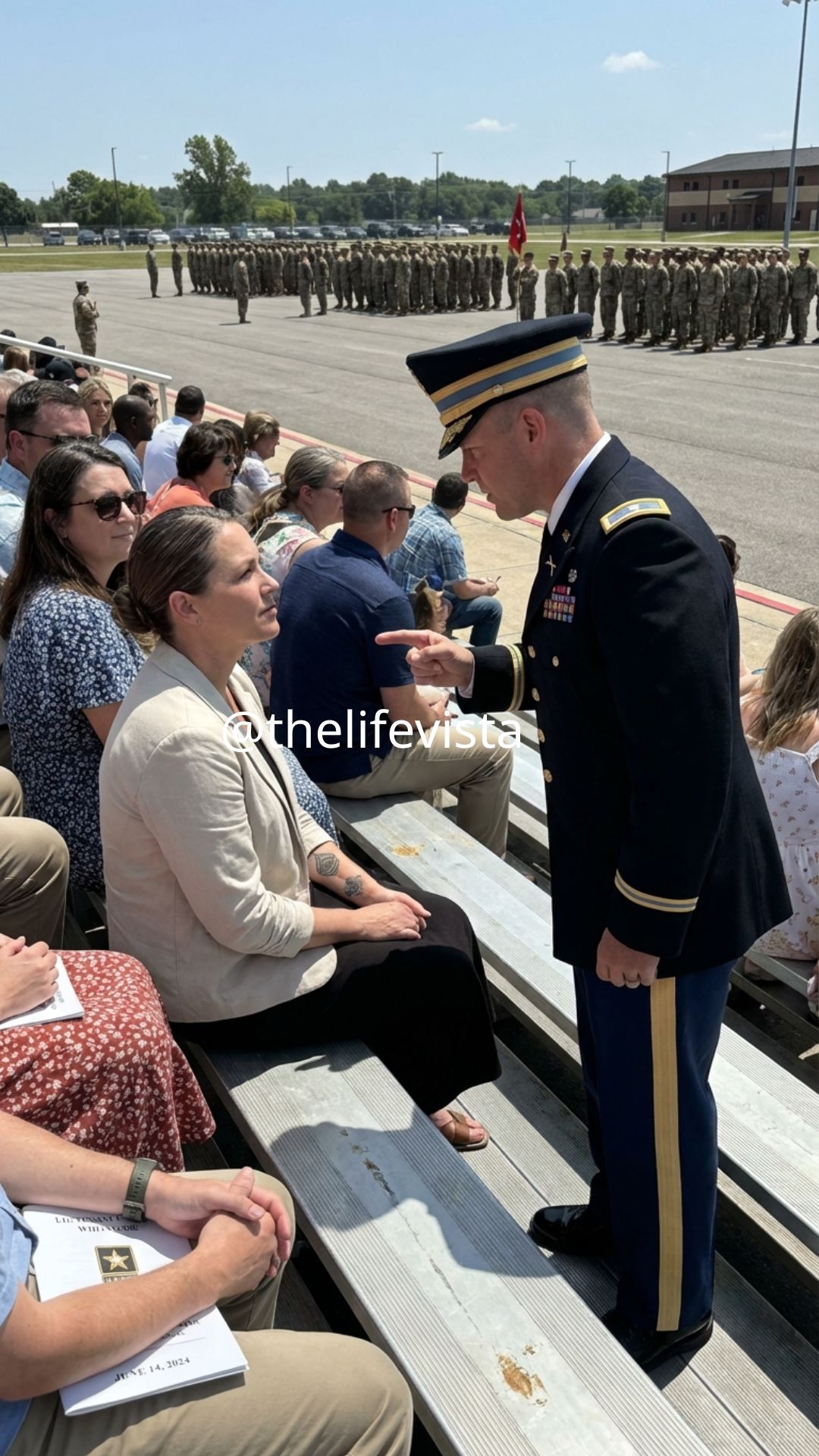
“Ma’am, if you can’t follow basic ceremony rules, I can have you removed from these stands right now.”
I turned toward the voice without hurry. The graduation field shimmered in the late morning heat, rows of young soldiers standing in formation while families leaned forward in bleachers trying to catch one more glimpse of a son or daughter who suddenly looked older in uniform. I had come for one reason only: to watch my son, Ethan Brooks, cross the line into the life he had chosen for himself. I had promised I would sit quietly, clap when the others clapped, and let the day belong to him.
Then Lieutenant Colonel Marcus Whitaker decided a mother glancing toward her son for two seconds was an act of indiscipline.
He stood in the aisle beside my seat, pressed uniform, rigid jaw, the kind of officer who wore authority like polished metal. He told me I had disrupted the decorum of the event. His tone carried that particular confidence some men develop when they have never been forced to measure themselves against anything truly dangerous. The families nearby went silent. A few looked embarrassed for me. Others looked pleased it was happening to someone else.
I could have answered a dozen different ways. I could have reminded him that no one on that field had broken bearing because I looked toward the formation. I could have asked whether public intimidation of a guest fit his idea of leadership. Instead, I said, “I’m here for my son. I’m not causing a problem.”

That should have ended it.
Instead, he leaned closer and told me that if I wanted to stay, I would keep my eyes forward and my mouth shut. He did not shout. Men like him rarely needed to. They relied on humiliation delivered quietly, where dignity bled slower.
As I shifted on the bleacher, the sleeve of my blouse pulled back.
His eyes dropped to my forearm.
He saw the ink first—a small, faded mark most people took for some old military design. It was not decorative. It was the operational insignia of a compartmented unit so obscure that even many senior officers would not recognize it unless they had read the right blacked-out files in the right room. Marcus Whitaker recognized enough to go still.
Not fully. Not yet.
Then he asked my name.
I should have lied. Habit almost made me. But I was tired of pretending on a day that belonged to my son, and the truth had its own kind of discipline. So I told him.
“My name is Olivia Grant.”
His face changed so fast it almost looked painful.
He knew the name. Not from newspaper stories or medals on a wall. From something else. Somewhere in his professional life, he had brushed against a sealed record attached to an operation that had officially buried me fifteen years earlier. In those papers, Olivia Grant had been listed as killed in action. Closed. Filed. Gone.
The stands around us felt suddenly smaller.
He stepped back. Not because I raised my voice. Not because I threatened him. But because in one reckless moment, he realized he had tried to throw out a dead woman whose name still moved through classified channels like a warning.
And when my son glanced toward the bleachers and saw the colonel staring at me like he had just seen a ghost, I knew the ceremony was over in more ways than one.
Marcus Whitaker had never encountered a situation quite like this during his years of service, where a routine enforcement of protocol suddenly unraveled into a confrontation with hidden layers of military history that challenged his assumptions about authority and the individuals who quietly carried its burdens, forcing him to reconsider the boundaries between discipline and unnecessary confrontation in a public setting filled with proud families.
How much did Marcus Whitaker really know about the mission that was supposed to have killed me—and what would happen if my son started asking why?
Marcus Whitaker recovered quickly, at least on the outside.
That was the first thing I respected about him. Weak men collapsed when surprised. Better men adjusted. He straightened, lowered his voice, and asked if we could speak somewhere private. I told him no. Not because I wanted a scene, but because I would not be escorted anywhere by a man who had just tried to shame me in front of families. So he remained there in the aisle, trapped between his rank and my refusal.
He addressed me differently after that.
Not warmly. Not apologetically, at first. Just carefully.
“Ma’am,” he said, “I wasn’t aware.”
“That much is obvious,” I replied.
He swallowed whatever pride still wanted to fight. Then he asked the question I had expected. Was I the Olivia Grant connected to Operation Black Thorn? I did not answer directly, and I did not need to. His expression told me he already knew. He had seen enough in the files to understand the outline: remote deployment, compartmented authority, mass-casualty avoidance, total deniability. The sort of mission that existed only in fragments afterward, with names removed and outcomes preserved.
In his records, I had died during extraction.
In reality, I had survived, and survival had come with conditions. New paperwork. Silence. Distance from my old life. Most of all, distance from the kind of attention that follows people once institutions decide to mythologize or erase them. I chose erasure. It was cleaner.
Marcus Whitaker glanced toward the formation where Ethan Brooks still stood, unaware that his commanding officer had just stepped into a classified grave and found it breathing. That, more than anything, unsettled me. I had not spent years staying buried only to have my son’s first milestone in uniform contaminated by my past.
So I made it simple.
“You will leave this alone,” I told him. “You will let my son have his day. And you will never use what you think you know to help or hurt his career.”
To his credit, Marcus Whitaker did not pretend not to understand.
Then the ceremony ended, and Ethan Brooks came looking for me with the sharp eyes of a young man who had already noticed too much. He had seen the colonel’s posture change. He had seen people nearby pretending not to stare. He hugged me, smiled for the photos, thanked me for coming, and then quietly asked, “Mom… who was that really about?”
I told him the safest truth available.
“It was about a man learning the difference between authority and character.”
He laughed once, but he wasn’t satisfied.
Neither was I.
Because later that afternoon, Marcus Whitaker approached me one more time—this time with something in his hand. A folded copy of an old personnel summary. My dead name. My old unit. My son’s future standing two hundred feet away.
And in that moment, I had to decide whether to trust him with the one thing I had protected for years:
The truth about why I let the world believe I never came home.
Olivia Grant had carefully constructed her post-service life around the principle of protecting her family from the shadows of her operational history, understanding that the weight of classified experiences could inadvertently shape or burden the next generation if not handled with deliberate restraint and foresight, especially during significant personal milestones like a child’s military graduation where emotions and perceptions run particularly high.
I met Marcus Whitaker behind the reviewing hall after the ceremony, near a line of empty folding chairs stacked against a brick wall. The celebration noise carried from the lawn—families laughing, camera shutters clicking, new soldiers pretending they were not exhausted. Ethan Brooks was somewhere inside that bright noise with his classmates, and I intended to return to him as quickly as possible. But Marcus Whitaker stood waiting with that folded personnel summary in one hand and the expression of a man trying to decide whether he was about to commit a professional error or correct one.
He handed me the paper without ceremony.
I recognized the formatting before I looked at the words. It was an internal legacy abstract, the kind of sanitized profile prepared for officers with access to old operational case studies. It contained almost nothing and still too much: Olivia Grant; multi-theater special operations attachment; commendations redacted; status—killed in action during exfiltration, 2011. No photographs. No family data. No real details. Just enough to turn a name into a rumor.
“I shouldn’t have brought this,” he said.
“No,” I answered, folding it once and giving it back. “You shouldn’t have.”
He accepted the correction. That was another point in his favor.
What followed was not confession. I had not spent half a lifetime protecting certain truths just to empty them into the hands of a man I met properly less than an hour earlier. But I gave him what he needed to hear, and perhaps what he deserved.
I told him that long before Ethan Brooks was old enough to understand what a deployment meant, I had served in places where success was often measured by what never reached the news. My unit specialized in the sort of operations governments thanked only by denying. We inserted quietly, left less quietly, and carried the kind of responsibility that looked heroic from a distance and corrosive up close. People imagine elite work as glory. Mostly it is math, fatigue, speed, grief, and the permanent awareness that one bad decision can bury people who trusted you.
Operation Black Thorn had gone wrong in the way many secret operations do—not through incompetence, but through optimism layered over incomplete intelligence. We were sent to extract an asset network before it collapsed. Instead, we walked into a split battlefield: hostile militia, compromised friendly intermediaries, civilians in the wrong structures, and a communications failure that isolated half our support chain. The mission succeeded in the narrow way reports like to define success. People were evacuated. Critical material did not fall into enemy hands. A regional bloodbath was prevented.
It also cost lives.
Mine was listed among them because, operationally, it solved more problems than my survival would have. A dead operator cannot be tracked through relatives. Cannot be subpoenaed by committees. Cannot become a political inconvenience if a mission is ever exposed. I was offered the choice in language softer than that, but not by much. Accept the burial on paper, start over under constraints, and keep my family beyond the blast radius of attention. Or come back officially and let people with rank and agendas decide how much of my life belonged to them.
I chose silence.
Not out of shame. Out of control.
Ethan Brooks was still young then. I wanted him to grow up without my name placed over his every achievement like a second uniform he never asked to wear. I had seen children of decorated soldiers either exploited by legacy or crushed beneath it. Doors opened for the wrong reasons. Expectations came preloaded. Failures looked like betrayal. I wanted my son to fail or excel on his own terms, and if that meant letting history misfile me, I could live with it.
Marcus Whitaker listened without interrupting. When I finished, he looked older.
“That’s why you never told him?” he asked.
“That’s why I never told anyone who didn’t need it.”
He nodded once, then said the thing that mattered most: “Your son’s path will stay his.”
That was not a promise made lightly. Officers influence careers in a thousand subtle ways. Recommendations. Evaluations. First assignments. Whether a young graduate is treated as a person or an extension of someone else’s reputation. I watched his face carefully, trying to judge whether humility had truly replaced the brittle pride from the bleachers. I decided, provisionally, that it had.
Before we parted, Marcus Whitaker apologized. Not the hollow kind issued to neutralize discomfort. A real apology. He said he had mistaken composure for noncompliance and assumed the authority to correct what he had not taken time to understand. I told him the Army did not suffer from too little correction. It suffered from too many people who confused volume with leadership. He almost smiled at that.
Then Ethan Brooks found us.
He walked up in dress uniform, sleeves sharp, face sunburned from the field, still carrying the posture of a young man trying to act older than his joy. He looked from Marcus Whitaker to me and instantly knew something serious had passed between us. My son had always been perceptive. It was one of the reasons I worried for him. Perceptive people see both excellence and hypocrisy too clearly.
Marcus Whitaker surprised me by solving the moment better than I would have.
He looked Ethan Brooks in the eye and said, “You should be proud today. Not because of anyone standing beside you. Because of what you earned.”
Then he saluted him—not formally, not in violation of protocol, but with the smallest respectful gesture a senior officer can make without turning a family moment into theater. Ethan Brooks stood a little straighter. He would remember that longer than he knew.
We took pictures after that. Smiling ones. Awkward ones. One where Ethan Brooks looked embarrassed because I adjusted his collar in front of his friends. Another where he laughed so hard he broke bearing completely. For a few precious minutes, the hidden machinery of the past receded, and I got what I came for: my son, alive and proud, stepping into adulthood under his own name.
Later, when the crowds thinned and we walked toward the parking lot together, Ethan Brooks asked again what had happened in the stands. I thought about lying. I thought about giving him another polished answer about professionalism. Instead, I gave him something truer.
“I served in ways I don’t talk about,” I said. “Some people still recognize pieces of that. But it has nothing to do with who you have to become.”
He was quiet for several steps.
Then he said, “Was he afraid of you?”
“No,” I replied. “He was surprised by me. There’s a difference.”
Ethan Brooks considered that. “Are you ever going to tell me the whole story?”
“Maybe someday,” I said. “When telling it helps you more than not telling it.”
He accepted that better than most adults would have. That was another reason I trusted the future with him. He did not demand inheritance. He understood timing.
A month later, he reported to his first assignment. Marcus Whitaker kept his word. No favors appeared. No whispered legacy followed Ethan Brooks into the system. His evaluations were his own. His mistakes were his own. His growth was his own. That was the outcome I had protected for years, and seeing it hold felt more satisfying than any citation ever pinned to my chest.
As for me, I remained what I had chosen to become: not a ghost, not exactly, but a woman who had done difficult things and refused to let them become the loudest thing in the room. Real strength, I had learned, rarely announces itself. It sits still when challenged. It knows what it has survived. It does not need strangers to validate it, and it does not use old victories to dominate new lives.
That day on the bleachers, Marcus Whitaker thought discipline meant forcing a mother to stare straight ahead.
He learned, instead, that discipline can look like a woman carrying a buried history without ever weaponizing it against her own son.
And I learned something too: sometimes the past doesn’t need to stay dead forever. Sometimes it only needs to stay quiet long enough for the next generation to speak in its own voice.
In the weeks following the graduation ceremony, Olivia Grant reflected deeply on the unexpected intersection of her concealed past and her son’s promising future, recognizing that moments of vulnerability like the one with Marcus Whitaker could either undermine years of careful protection or reinforce the boundaries she had established to safeguard Ethan Brooks’s independence. The encounter served as a reminder that even the most disciplined individuals occasionally confront elements of their history in public settings, where split-second decisions carry the potential to ripple outward and affect family dynamics in unforeseen ways. Marcus Whitaker’s willingness to adjust his approach after the initial confrontation demonstrated a capacity for growth that many officers in similar positions might lack, ultimately contributing to a more positive resolution that allowed the day to conclude on a note of mutual respect rather than lingering tension. This experience highlighted the delicate balance required when personal histories involving classified operations intersect with the everyday milestones of civilian and military life, emphasizing the importance of discretion and empathy in leadership roles.
As Ethan Brooks began his initial assignment and navigated the early challenges of military service, Olivia Grant observed from a distance with quiet satisfaction, noting how his achievements stemmed purely from his own efforts without the shadow of her legacy influencing evaluations or opportunities within the ranks. The absence of any undue interference from Marcus Whitaker confirmed that the senior officer had honored their agreement, allowing Ethan Brooks to build his career on merit alone and fostering a sense of genuine accomplishment that would serve him well in the years ahead. For Olivia Grant, this outcome validated the difficult choices she had made years earlier, proving that prioritizing her son’s autonomy over personal recognition could yield long-term benefits that outweighed the emotional cost of maintaining secrecy. The gradual unfolding of these events illustrated how protective silence, when rooted in love and foresight, could create space for the next generation to define success according to their own standards and experiences.
Over time, the subtle lessons from that graduation day continued to shape interactions within the family and beyond, as Olivia Grant occasionally shared fragments of her background with Ethan Brooks when appropriate, always ensuring that such revelations supported his development rather than imposing unnecessary burdens or expectations. Marcus Whitaker maintained a professional distance while occasionally crossing paths in military circles, his earlier misstep evolving into a foundation for greater awareness about the human elements behind uniform protocols and the diverse backgrounds of those attending official events. This evolution in perspective benefited not only the individuals involved but also contributed to a broader understanding within the command structure about the value of measured responses and the avoidance of hasty judgments in high-visibility situations. The story of that day ultimately became a private touchstone for Olivia Grant, reinforcing her belief that true resilience often manifests through restraint and the careful stewardship of one’s history.
In reflecting on the entire sequence of events, Olivia Grant came to appreciate how the confrontation in the stands had inadvertently strengthened the bond with her son by opening a pathway for honest, albeit gradual, conversations about service, sacrifice, and the personal costs associated with certain forms of duty. Ethan Brooks’s respectful acceptance of partial truths demonstrated maturity beyond his years, suggesting that he possessed the emotional intelligence necessary to handle more complex revelations in the future without allowing them to overshadow his own path. Meanwhile, Marcus Whitaker’s transformation from an enforcer of rigid decorum to a more thoughtful leader served as evidence that even seasoned officers can benefit from encounters that challenge their preconceptions, ultimately enhancing their ability to lead with both authority and compassion. These interconnected developments underscored the idea that moments of unexpected revelation, when navigated with integrity, can foster growth across multiple generations and professional hierarchies without compromising the core principles of discretion and family protection.
If this story stayed with you, share it, tag someone strong, and tell us whether true power is loud or quiet.