Who Is Really a Billionaire? The Tiny Clue Hidden Inside This Money Puzzle
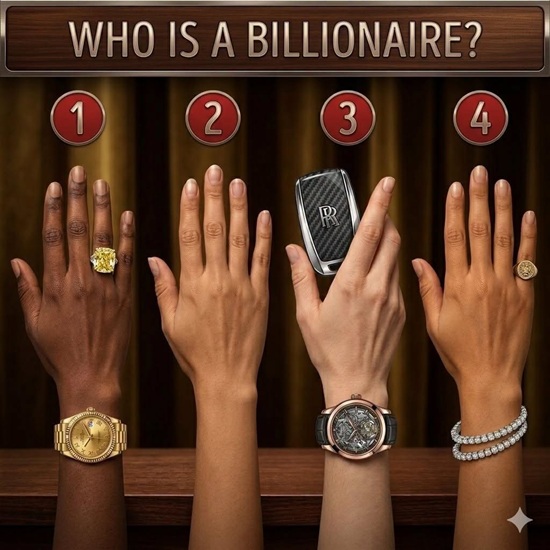
Visual puzzles often appear simple at first glance, yet the most entertaining ones are designed to exploit assumptions people make almost automatically. In this puzzle, viewers are asked to determine which character can genuinely be described as a billionaire. Several figures may be surrounded by expensive-looking possessions, impressive clothing, cash or other symbols normally associated with wealth. The challenge is not simply to choose the person who looks richest.
Instead, the solution depends on examining the information shown in the image and distinguishing visible luxury from actual measurable wealth. The first concept worth understanding is the meaning of the word billionaire. In ordinary financial usage, a billionaire is someone whose net worth is at least one billion units of a particular currency, commonly discussed in major currencies such as U.S. dollars. Net worth is different from salary, income or the amount of cash someone happens to possess.
It is generally calculated by considering the value of assets a person owns and subtracting relevant liabilities or debts. That distinction is often the key to solving puzzles built around apparent wealth. Imagine that one character is wearing an expensive suit, carrying a luxury watch and standing beside an exotic sports car. Those objects immediately create an impression of enormous wealth. Yet the picture may never establish that the person actually owns the car. It could theoretically be rented, borrowed or financed. Even if the character owns everything displayed, a luxury vehicle and expensive clothing alone would generally remain far below the billion-level threshold. The visual impression can therefore be much stronger than the mathematical evidence.
Another character might look considerably less impressive. Perhaps this person wears ordinary clothing and stands beside a modest desk. Hidden somewhere in the illustration, however, could be a document indicating ownership of a company valued at hundreds of millions, significant property holdings or investments that push the person’s total assets beyond one billion. In a carefully constructed puzzle, that small numerical clue can matter far more than every glamorous object surrounding another character.
This is why observation should come before assumption.

A useful first step is to examine every number appearing in the image. Look at signs, account balances, labels, ownership percentages, property values and any other numerical information associated with the characters. Puzzle designers often place the decisive clue somewhere viewers are likely to overlook because their attention is drawn toward something more visually dramatic.
The units attached to those numbers are equally important.
A character possessing $10 million is undeniably wealthy by ordinary standards, but $10 million is not $1 billion. One billion equals 1,000 million. Consequently, even several piles of money labeled in millions may not be enough to establish billionaire status. The viewer must add the amounts rather than simply deciding that the numbers look large.
For example, suppose a fictional character is shown with assets worth $300 million, $250 million and $200 million. Adding those figures produces $750 million. That represents extraordinary wealth, but it still falls $250 million short of $1 billion. If another character quietly owns an asset valued at $1.05 billion, the second person satisfies the numerical threshold despite possibly appearing much less extravagant.
The puzzle may become more complicated if debts are displayed.
Suppose someone owns assets worth $1.2 billion but also owes $400 million. In a simplified net-worth calculation, subtracting the liabilities leaves approximately $800 million. That person would therefore not have a net worth of $1 billion based on those stated figures. Looking only at the value of the assets would produce the wrong answer.
This illustrates the difference between gross assets and net worth.
Owning expensive things does not mean someone possesses their full value free of obligations. Businesses can carry debt. Houses can have mortgages. Vehicles can be financed. Investments can be accompanied by liabilities. A puzzle that explicitly provides such information expects the viewer to incorporate it into the calculation.
Income presents another potential distraction.
Someone might be shown earning $5 million every month. That sounds enormous, and it certainly represents exceptionally high income. But income and net worth measure different things. Monthly or annual earnings describe money received over a period of time, whereas net worth concerns the value of what someone owns after relevant liabilities are deducted.
A person earning millions could theoretically have significant expenses or debts.
Another individual could earn comparatively little from employment while owning a valuable company or a large investment portfolio.
Therefore, the character with the highest salary is not automatically the billionaire.
Ownership is another detail worth examining carefully. If the puzzle shows someone standing beside a mansion, the viewer should determine whether the illustration actually says that person owns it. Visual proximity does not establish ownership in the real world, and clever puzzles sometimes exploit precisely that assumption.
The same principle applies to cars, jewelry, private aircraft or other luxury objects.
A person can stand beside an expensive vehicle without owning it.
Someone can wear an expensive-looking watch without the image establishing its actual value.
A large house in the background may belong to somebody else unless the puzzle provides an ownership clue.
The safest strategy is to use only information that the illustration clearly supplies.
Currency symbols can also become important.
If several characters have assets expressed in different currencies, simply comparing the printed numbers may produce an incorrect result. One billion units of one currency does not necessarily have the same value as one billion units of another. Exchange rates change over time, so a puzzle involving multiple real currencies would need enough context to make the intended comparison possible.
If no exchange-rate information is supplied, viewers should avoid inventing precise conversions that the puzzle does not require.
Some puzzles use fictional currencies or simplified symbols instead.
In that case, the goal is usually mathematical rather than financial.
Another common trick involves ownership percentages.
Imagine a character who owns 10 percent of a company valued at $5 billion. The entire company may be worth $5 billion, but the character does not personally own all $5 billion. In a simplified puzzle calculation, a 10 percent interest would correspond to approximately $500 million before considering any additional factors.
A different character might own 60 percent of a $2 billion company.
That stake would correspond to approximately $1.2 billion under the puzzle’s simplified assumptions.
Suddenly, the less impressive company can create the larger personal fortune.
Real-world net-worth calculations are considerably more complicated than these examples. Business valuations can change, privately held companies can be difficult to value, and taxes, ownership structures, debts and restrictions can affect estimates. Public lists of billionaires are therefore estimates based on available financial information rather than literal counts of money sitting in bank accounts.
For a visual puzzle, however, the calculation is normally intentionally simplified.
The viewer should work with the information the puzzle provides.
Start with each character individually.
Write down every asset that the image clearly associates with that person.
Then identify its stated value.
Next, add those assets together.
If the puzzle explicitly shows liabilities, subtract them.
If it gives only partial ownership of an asset, calculate the value of that share rather than assigning the entire asset to the character.
Finally, compare the resulting totals with the one-billion threshold.
This method prevents clothing, facial expressions or expensive-looking surroundings from influencing the answer.
It also reveals why these puzzles can be surprisingly difficult.
Human beings make rapid judgments based on visible status signals. A designer suit, luxury automobile, large house or elaborate jewelry immediately communicates “wealth” because those objects are culturally associated with money. Puzzle creators can deliberately use those associations as distractions.
The person who looks richest may therefore be the obvious wrong answer.
Meanwhile, the genuine clue might be a tiny document in another character’s hand.
Perhaps it says “company ownership: $1.1 billion.”
Maybe a modestly dressed person owns several properties whose combined value exceeds the threshold.
Or perhaps someone appearing extremely wealthy also has a visible debt large enough to reduce their net worth below one billion.
The puzzle becomes easier once every decorative element is separated from information that can actually be calculated.
It is also important not to create facts that are absent from the illustration.
If a character is wearing a gold-colored necklace, viewers cannot automatically assign it a value of $50,000. It could be worth considerably more, considerably less or nothing close to that amount. Unless the puzzle gives a value, the necklace usually should not become part of the numerical solution.
Likewise, an expensive-looking building cannot simply be valued according to what a viewer imagines it would cost.
A fair visual puzzle should contain enough explicit information to identify the intended answer.
The challenge is finding that information.
The distinction between wealth and appearance also gives the puzzle a small real-world lesson.
Someone’s clothing does not reveal their bank balance.
A person’s car does not provide a complete financial statement.
Living extravagantly does not automatically mean possessing enormous net worth, just as living modestly does not prove someone lacks substantial assets.
Financial position cannot reliably be determined from appearance alone.
That does not mean every visual puzzle provides a realistic model of personal finance. Most deliberately simplify complicated concepts so the answer can be discovered from a single image. Their purpose is entertainment and observation rather than professional financial analysis.
Still, the basic mathematical distinction remains useful.
One million and one billion are dramatically different quantities.
A billion is one thousand millions.
That scale can be difficult to appreciate because both numbers sound extremely large in everyday conversation.
If someone had $999 million in net assets, that person would be extraordinarily wealthy but would still fall just below a $1 billion definition.
If another person’s net assets totaled $1.001 billion, the second person would cross that threshold despite the relatively small difference between their fortunes.
That is why every digit can matter in this type of puzzle.
Before selecting an answer, viewers should therefore perform one final check.
Did you count assets rather than income?
Did you subtract any debts shown?
Did you account for ownership percentages?
Did you read the units correctly?
Did you accidentally assign ownership of an expensive object simply because someone was standing beside it?
And, most importantly, does the character’s demonstrated net worth actually reach or exceed one billion?
If the answer to those questions is clear, the solution should become much easier.
The puzzle’s real trick is not necessarily hidden money.
It is the tendency to confuse looking wealthy with being a billionaire.
One is an impression.
The other is a numerical threshold.
A flashy character may dominate the illustration while possessing only a fraction of the necessary wealth. A quieter character may hold the decisive clue in a small account statement, business document or property certificate.
So instead of choosing the most glamorous figure immediately, inspect the details.
Read every label.
Compare every relevant number.
Separate assets from income.
Subtract stated liabilities.
Ignore luxury objects whose ownership or value is not established.
Then calculate.
The correct answer is not necessarily the person who looks as though they have the most money.
It is the character whose confirmed net assets, according to the information provided by the puzzle, reach at least one billion.
That difference is exactly what makes the challenge work—and why the smallest clue in the picture may ultimately be worth more than every sports car, designer outfit and pile of cash surrounding it.