If You’re a Woman With Chin Whiskers, Here’s What Your Body May Be Telling You
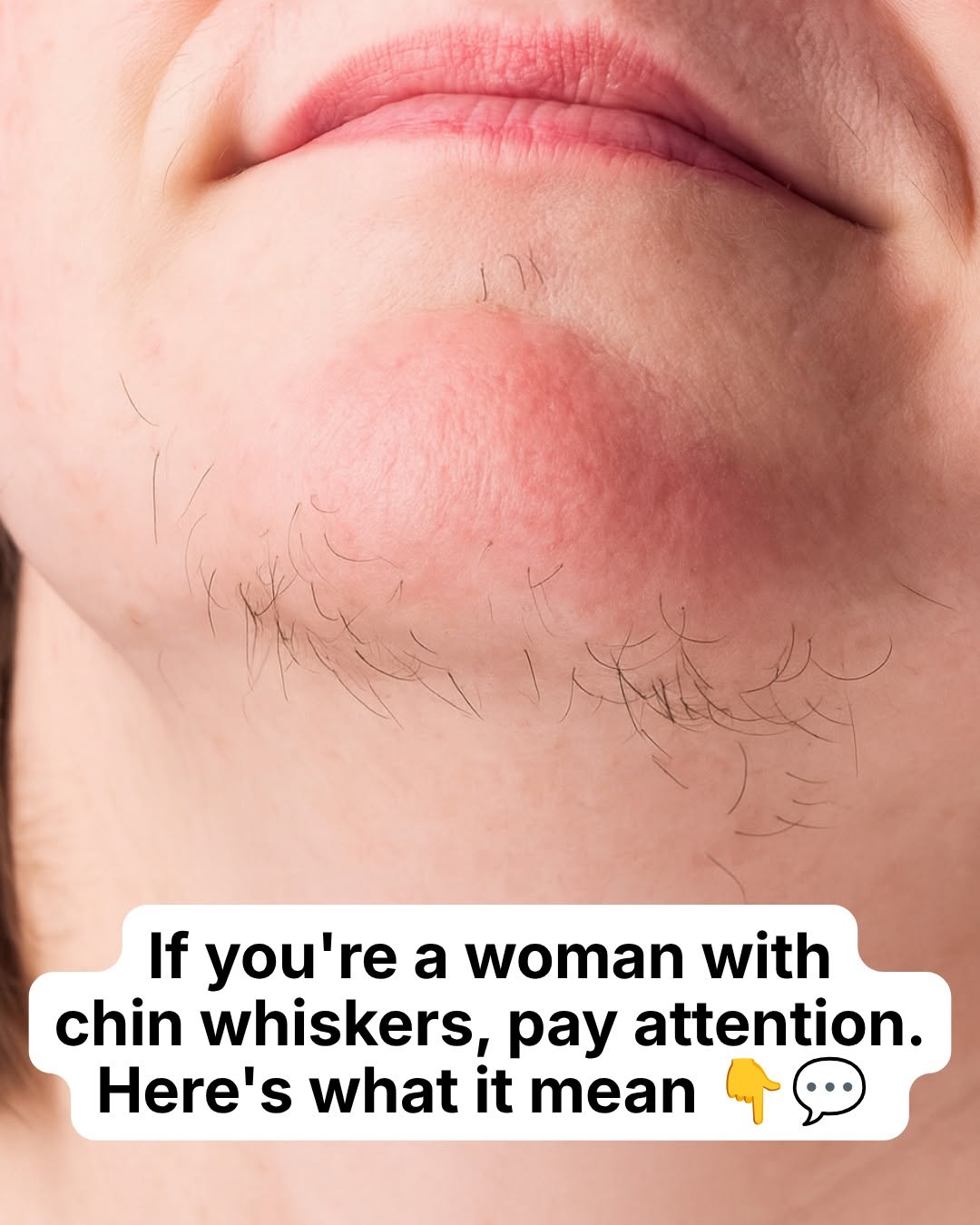
pond differently to hormones from one person to another.
That means two women with similar hormone levels may have very different amounts of facial or body hair. Genetics, age, ancestry, and the sensitivity of individual hair follicles can all influence how noticeable that hair becomes.
MedlinePlus notes that women normally have fine hair on areas including the chin and upper lip. The medical term hirsutism generally refers instead to excessive growth of coarse, dark hair in a pattern more commonly associated with male hair growth.
So if you occasionally find one or two coarse chin hairs — especially if they have developed gradually — it does not automatically mean you have a hormonal disorder.
The bigger question is whether the hair is part of a broader pattern.

When Chin Hair Becomes “Hirsutism”
Hirsutism describes excessive growth of dark, coarse hair in women in androgen-sensitive areas.
These may include the:
Chin and upper lip
Jawline
Chest
Lower abdomen
Back
Inner thighs
It is different from the soft, light-colored “peach fuzz” that naturally covers much of the body.
Hirsutism is relatively common. The Endocrine Society estimates that it affects approximately 5% to 10% of women.
And while increased androgen activity frequently plays a role, not every woman with hirsutism has abnormally high testosterone levels. Sometimes the hair follicles are simply more responsive to normal hormone levels, and in some cases no specific cause is identified.
That is why chin hair should be viewed as a clue rather than a diagnosis.
1. Your Genetics May Simply Favor More Facial Hair
Before assuming there is a medical problem, look at your family.
Does your mother have noticeable chin hair?
What about your sisters, aunts, or grandmother?
Hair-growth patterns are strongly influenced by genetics. Some women naturally develop more coarse facial or body hair than others, even when their hormone levels are within expected ranges.
Family history can also influence the likelihood of conditions associated with hirsutism.
The important distinction is whether the pattern has been relatively stable throughout your adult life or whether something suddenly changed.
If you have always had a few noticeable chin hairs and otherwise feel well, the explanation may be fairly ordinary.
If you suddenly begin growing significantly more facial hair, however, it deserves closer attention.
2. Aging And Menopause Can Make Chin Hair More Noticeable
For many women, chin whiskers seem to appear almost out of nowhere in their 40s, 50s, or beyond.
Hormonal changes associated with perimenopause and menopause may help explain why.
As estrogen levels decline, the balance between estrogen and androgen activity changes. Even without a dramatic increase in testosterone, androgen effects may become relatively more noticeable.
The result can be an interesting contrast: hair on the scalp may become thinner while a few coarse hairs begin appearing around the chin or upper lip.
Cleveland Clinic notes that new or increasing chin hair can occur during the menopause transition as estrogen declines and testosterone has a relatively stronger effect.
So if you are approaching or have gone through menopause and have gradually developed a few chin hairs, this can be a common age-related change.
Again, gradual is an important word.
Rapid or extensive facial-hair growth should not automatically be blamed on menopause.
3. PCOS Is One Of The Most Common Hormonal Causes
When significant facial hair occurs alongside other symptoms, healthcare providers often consider polycystic ovary syndrome, commonly known as PCOS.
PCOS is associated with increased androgen activity and can produce several symptoms in addition to unwanted facial hair.
Possible signs include:
Irregular or infrequent periods
Acne
Difficulty becoming pregnant
Increased facial or body hair
Thinning hair on the scalp
Metabolic problems in some people
PCOS is one of the most common causes of hirsutism.
But having a few chin hairs does not mean that you have PCOS.
The combination of symptoms matters much more.
For example, a woman with two long-standing chin hairs and regular menstrual cycles is in a very different situation from someone who develops increasingly coarse facial hair together with irregular periods and worsening acne.
Diagnosis should be made by a healthcare professional, not by facial hair alone.
4. Your Hormone Levels May Not Be The Whole Story
It is tempting to think:
“More chin hair must mean more testosterone.”
The reality is more complicated.
Some women with symptoms of excess androgen activity have normal-looking androgen levels on blood tests. Hair follicles themselves vary in sensitivity to hormones, meaning that the same amount of circulating androgen can produce different effects in different people.
This is one reason doctors look at the entire clinical picture rather than relying on a single symptom or laboratory result.
In fact, Endocrine Society guidance suggests that women who have normal menstrual cycles and only localized unwanted hair — without a broader abnormal hirsutism pattern — do not necessarily need androgen testing because the likelihood of finding a disorder that would change management is relatively low.
In other words, one rogue chin whisker is not an automatic ticket to extensive hormone testing.
5. Certain Medications Can Affect Hair Growth
Sometimes the explanation may be hiding in the medicine cabinet.
A number of medicines and hormone-containing products have been associated with increased facial or body hair.
Examples can include certain testosterone or androgen products, anabolic steroids, DHEA supplements, danazol and minoxidil, among others. Mayo Clinic also notes that skin-to-skin exposure to another person’s topical androgen product can sometimes affect hormone exposure.
Never stop a prescribed medication simply because you notice facial hair.
Instead, tell your healthcare provider when the change started and provide a complete list of prescription drugs, over-the-counter medicines, supplements, hormone products and topical treatments you use.
That timeline can provide an important clue.
6. Less Common Hormonal Conditions Can Also Cause Excess Hair
PCOS gets much of the attention, but it isn’t the only condition associated with hirsutism.
Less commonly, excessive hair growth may occur with conditions affecting the adrenal glands or other parts of the endocrine system.
These include conditions such as Cushing syndrome and congenital adrenal hyperplasia. Rarely, an androgen-producing tumor involving an ovary or adrenal gland can lead to rapidly increasing facial or body hair.
The word rarely matters here.
Finding a chin hair is not a reason to assume something serious is happening.
What makes doctors more concerned is a sudden and dramatic change.
Pay Attention To How Fast The Hair Appears
The speed of change can sometimes be more informative than the hair itself.
Gradual development of several coarse hairs over many years is generally less concerning than suddenly developing substantial facial or body hair within several months.
Mayo Clinic recommends medical assessment when severe or rapidly progressing facial or body hair develops over a relatively short period, particularly when it occurs with signs of virilization.
Possible warning signs include:
Rapidly increasing facial or body hair
A noticeably deeper voice
Significant new scalp hair loss
Increased muscle development without an obvious explanation
Severe or rapidly worsening acne
Enlargement of the clitoris
Major menstrual changes
These symptoms do not tell you what the cause is, but they do justify prompt medical evaluation.
What About Chin Hair And Irregular Periods?
This combination deserves particular attention.
If coarse facial hair is accompanied by irregular, infrequent, or absent menstrual periods, it increases the possibility that an underlying hormonal condition may be involved.
PCOS is one common possibility, but it is not the only one.
A healthcare professional may ask about your menstrual history, when the hair growth began, medications, fertility concerns, acne, weight changes, scalp hair loss and family history.
Depending on the situation, hormone testing or other investigations may be recommended.
The goal isn’t simply to get rid of the hair.
It is to determine whether the hair is just a cosmetic concern or part of a health condition that should be addressed.
Does Shaving Make Chin Hair Grow Back Thicker?
No.
This is one of the most persistent hair-removal myths.
Shaving cuts the hair at the surface of the skin. It does not change the follicle underneath, increase the number of follicles or make your body produce more androgen.
Freshly shaved hair can temporarily feel thicker because its tip has been cut bluntly instead of tapering naturally.
That sensation can create the illusion that shaving has changed the hair.
It hasn’t.
So if shaving works well for you, there is no medical reason to avoid it because of fears that it will create more facial hair.
What Can You Do About Unwanted Chin Hair?
If your chin hair is medically harmless but cosmetically annoying, you have several options.
Simple techniques include shaving, tweezing, threading, waxing and depilatory creams. Some methods can irritate sensitive skin, so gentle technique and appropriate skin care are important.
Longer-lasting approaches include laser hair removal and electrolysis.
Laser treatment works by targeting pigment in the hair and generally works best on darker hairs. Multiple sessions are usually necessary, and facial hair in women may require ongoing maintenance.
Electrolysis treats individual follicles and can work on light-colored hairs that lasers do not target effectively. The American Academy of Dermatology notes that multiple treatments are required because hair grows in cycles.
For significant hirsutism related to androgen activity, treating the underlying hormonal problem may also reduce new hair growth.
Doctors may use hormonal medications in appropriate patients, but treatment depends on factors such as age, medical history, pregnancy plans and the underlying cause. The Endocrine Society recommends that medication choices for hirsutism be individualized and notes that some anti-androgen medicines require reliable contraception because of pregnancy-related risks.
These medications should never be started simply based on something you read online.
When Should You Talk To A Doctor?
Consider speaking with a healthcare professional if:
Facial or body hair is rapidly becoming thicker or more widespread.
You develop significant hair growth over only a few months.
Your periods become irregular or disappear unexpectedly.
You have troublesome acne together with increasing facial hair.
You notice scalp hair loss along with new facial hair.
Your voice becomes noticeably deeper.
You develop other unusual physical changes.
The hair growth is causing significant emotional distress.
You simply want to understand why it is happening.
You do not need to wait until symptoms become severe to ask questions.
And cosmetic concerns are valid concerns, too. If facial hair affects your confidence or quality of life, a dermatologist, gynecologist or endocrinologist may be able to help.
The Bottom Line
So, what does it mean if you’re a woman with chin whiskers?
Sometimes, very little.
A few stray chin hairs may be a perfectly normal result of genetics, aging, menopause-related hormonal changes or the natural sensitivity of your hair follicles.
More extensive coarse facial hair — particularly when accompanied by irregular periods, acne or other hormonal symptoms — may represent hirsutism and can sometimes be associated with conditions such as PCOS.
And sudden, rapidly progressing hair growth deserves medical attention, especially if it occurs together with a deeper voice, scalp hair loss or other significant physical changes.
The most important thing to remember is this:
Chin hair is a symptom, not a diagnosis.
One whisker cannot tell you your testosterone level. It cannot diagnose PCOS. And it certainly does not mean something is automatically wrong with your body.
Instead of panicking over what appears in the mirror, pay attention to the bigger picture — how much hair is growing, how quickly it changed, and whether anything else in your body has changed along with it.
Sometimes that stubborn chin hair is simply a stubborn chin hair.