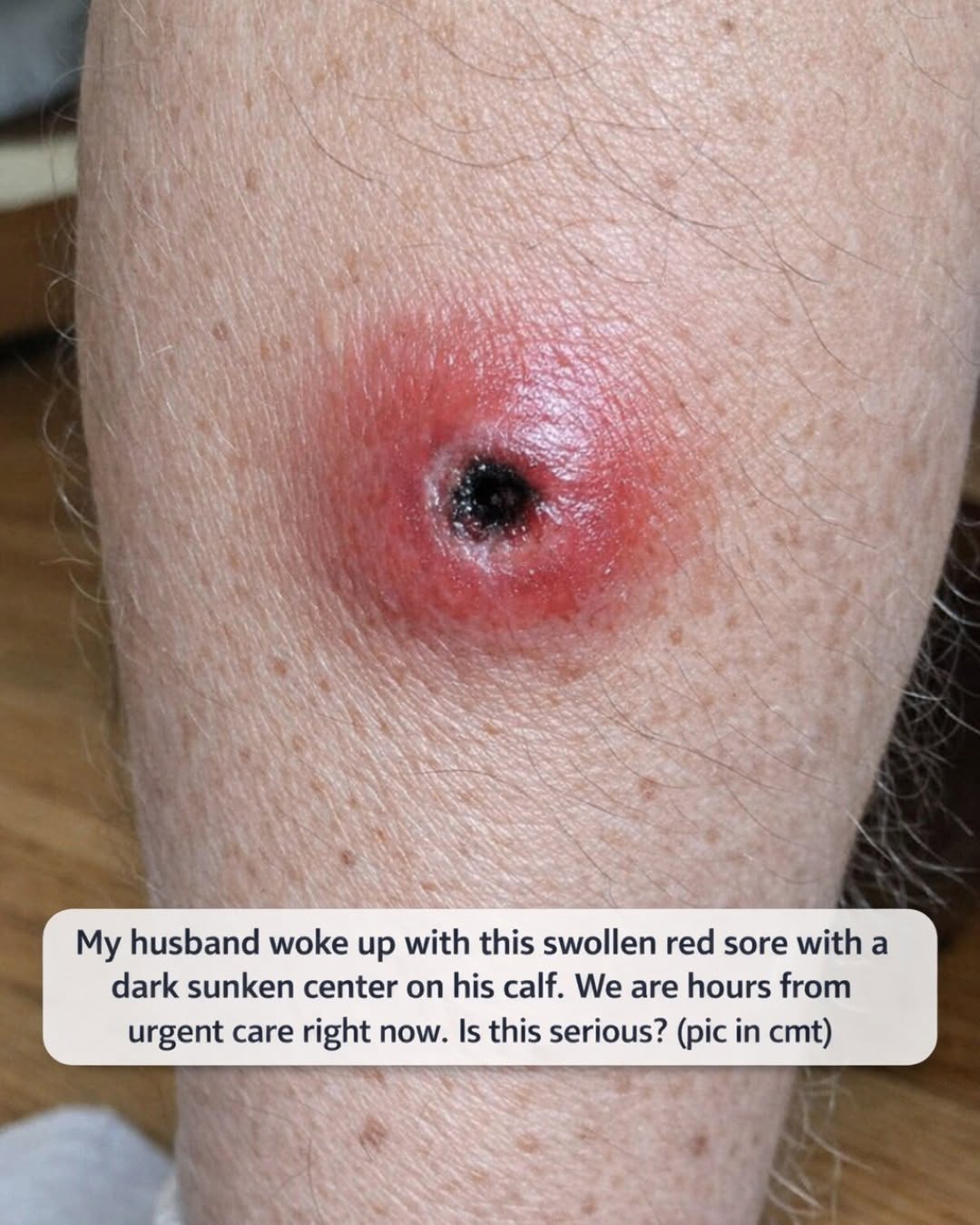
My husband woke up with this swollen red sore with a dark sunken center on his calf. We are hours from urgent care right now. Is this serious?
If your husband woke up with a swollen, red, painful sore on his calf and the middle looks dark, sunken, or blistered, I would treat that as something that needs medical attention soon. When you live far from town, I know how easy it is to second-guess yourself and hope something will settle down on its own. But a sore with a dark center can mean more than a simple bug bite. It can happen with a serious skin infection, a bite from a brown recluse in some parts of the country, or even a boil or abscess that is starting to damage the skin.
As a mom in a small Midwestern town, I’ve had plenty of moments standing in the kitchen with a cup of coffee and that sinking feeling of, “Do we watch this, or do we go now?” This is one of those times when I would lean toward caution. I’ll walk you through what signs make this more urgent, what you can do in the next 30 to 60 minutes while you’re still at home, what not to do, and when the answer is to head out for care even if the drive is long.
1. Why this could be serious
A swollen red lesion with a dark, sunken center is not the classic look of a mild mosquito bite or simple skin irritation. That description raises concern for tissue injury under the skin. One possibility people worry about is a brown recluse spider bite, which can start as mild redness and then develop a pale or dusky center, a blister, or an ulcer-like spot over several hours to 2 or 3 days.
Just as important, though, a painful red sore with a dark center can also be a skin infection such as cellulitis, an abscess, or a staph infection including MRSA. Those are often more common than true spider bites. Either way, if the area is getting worse, feels hot, is very painful, or is developing a cratered middle, it deserves medical evaluation.
2. Brown recluse bites do happen, but many “spider bites” are actually infections
Brown recluse spiders are found most commonly in the south-central and Midwestern United States. They tend to hide in quiet, undisturbed places like garages, sheds, closets, basements, cardboard boxes, shoes, work gloves, and folded bedding. A person usually does not feel a dramatic bite right away. Sometimes they notice pain later, or they wake up with a lesion after sleeping.
That said, doctors often see wounds blamed on spiders that turn out to be bacterial infections. A spider usually is not seen. So while the sore could be from a recluse, it is safer to think of it as a potentially serious skin lesion rather than trying to diagnose it for sure at home.
3. The appearance that raises concern
The features you described matter. A red outer area plus a dark, sunken, bluish, purple, or black center can suggest poor blood flow or tissue death in the middle of the lesion. Some people describe it as a “bull’s-eye,” while others say it looks like a bruise with a crater in the center. The area may measure 1 to 3 inches across at first, then expand over 12 to 48 hours.
If there is a blister, especially a blood-filled blister, or if the center looks gray, purple, or black, that moves it out of the “watch and wait” category for me. If the calf is becoming increasingly tight or swollen compared with the other leg, that is another reason to get help quickly.
4. Check for whole-body symptoms right now
Take 2 minutes and look beyond the sore itself. Ask whether he has fever, chills, nausea, vomiting, body aches, dizziness, weakness, headache, a racing heartbeat, or trouble breathing. Also notice whether he seems unusually sleepy, confused, or shaky. In adults, those symptoms can point to a spreading infection, a stronger reaction to venom, or another urgent problem.
If he has a thermometer, take his temperature now. If you have a pulse oximeter or blood pressure cuff at home, it is reasonable to check those too, but do not delay leaving if he looks truly unwell. A fever of 100.4°F or higher, shaking chills, faintness, or rapid worsening pain would push this higher on the urgency list.
5. What to do in the next 30 minutes
Wash the area gently with soap and lukewarm water for about 30 seconds. Pat it dry with a clean towel. If the skin is open, cover it loosely with a clean, dry dressing or gauze. Remove any tight sock or compression sleeve so nothing is trapping swelling around the calf.
Elevate the leg so the calf is slightly above heart level if possible. A cool compress can help with pain and swelling. Use a cloth-wrapped ice pack for 10 minutes on, then 10 minutes off. Do not place ice directly on the skin for 20 or 30 minutes straight, especially if the center already looks damaged.
Use a pen to mark the edge of the redness and write down the time. That is one of the simplest and most helpful things you can do before a long drive. If the red area grows past that line over 1 to 3 hours, you have clear proof it is spreading.
6. What not to do
Do not cut it, squeeze it, lance it, or try to “drain the poison.” Do not put a tourniquet around the leg. Do not use a suction device. Do not apply heat, and do not slather on home remedies like butter, baking soda paste, essential oils, or harsh antiseptics such as full-strength hydrogen peroxide over and over. Those can irritate the skin and make tissue damage worse.
I would also skip leftover antibiotics from the medicine cabinet unless a medical professional specifically tells you to use them. The wrong antibiotic may not help, and starting one can muddy the picture if he is later evaluated.