Can the Way You Make a Fist Reveal Whether You’ll Be Rich or Poor?
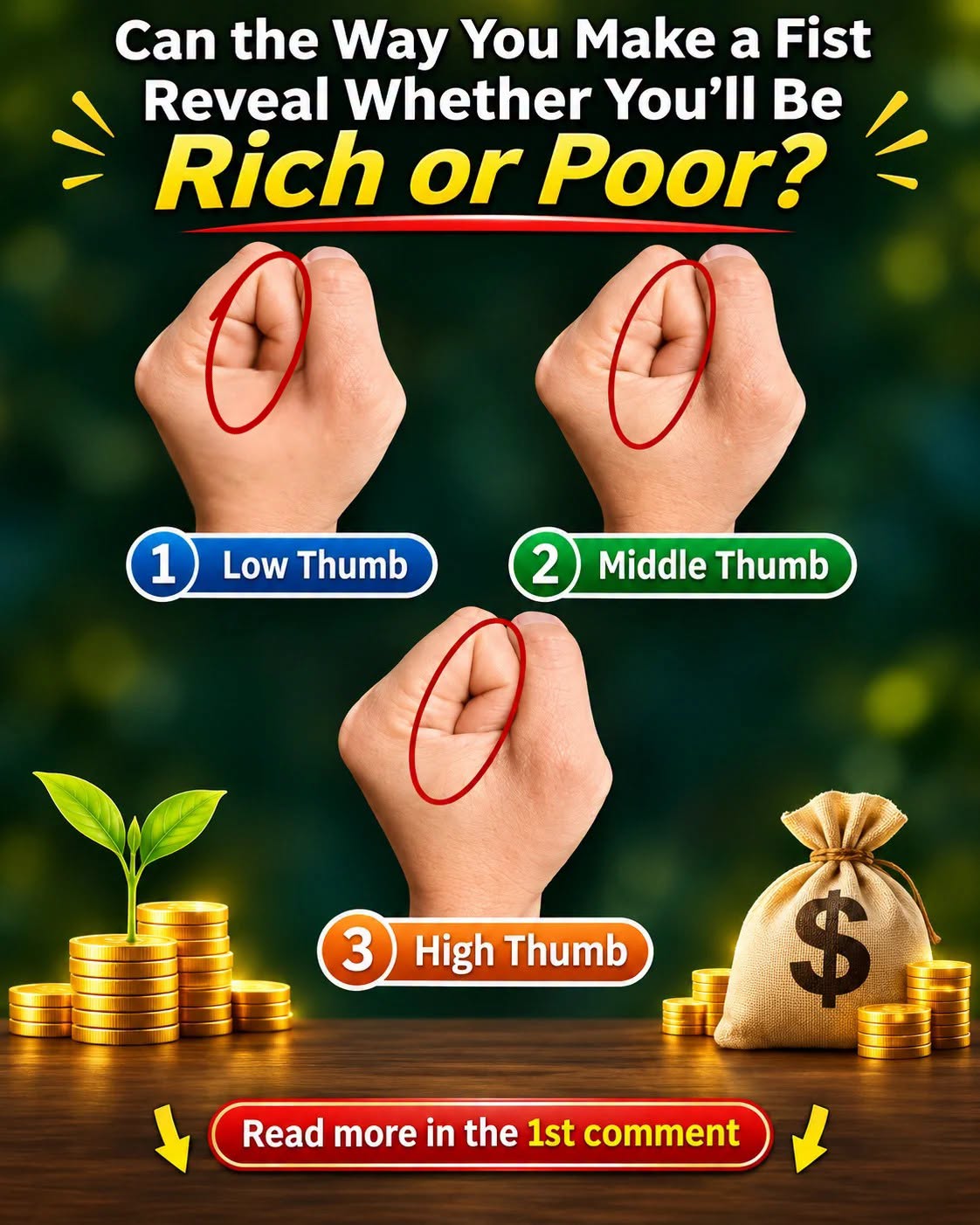
The way you naturally position your thumb when making a fist might seem like an insignificant habit. However, a popular personality test suggests that this simple gesture could offer an interesting perspective on your personality, decision-making style, and relationship with money. But how much truth is there behind it?
Have you ever paid attention to the way you close your hand into a fist?
Most of us perform this simple movement without giving it a second thought. Some people position their thumb close to the bottom of their fist, others place it across the middle, while some keep it higher and more prominent.
A popular personality quiz circulating on social media associates these three different positions with distinct personality types, financial attitudes, and approaches to success.
While there is no established scientific evidence that the position of your thumb can predict your wealth or financial future, this entertaining exercise can provide an opportunity to reflect on your strengths, weaknesses, and everyday habits.
How to Take the Fist Personality Test
Taking this test requires only a few seconds.

Relax your hand and fingers.
Slowly close your hand into a comfortable fist.
Allow your thumb to settle into its natural position.
Observe where your thumb rests in relation to your other fingers.
Compare your hand with the three personality types described below.
Try not to deliberately change the position of your thumb to match a particular result. Simply observe what feels most natural to you.
Type 1: Your Thumb Rests Low — The Quiet and Cautious Thinker
If your thumb rests low against your closed fingers, this personality quiz associates you with a thoughtful, reserved, and considerate nature.
Your Personality
You may recognize yourself as someone who values responsibility, emotional security, and meaningful relationships. Rather than drawing attention to yourself, you might prefer to demonstrate your abilities through consistent actions.
You may also find satisfaction in helping others and fulfilling your responsibilities without expecting recognition in return.
Your careful approach can be particularly valuable when dealing with situations that require patience, attention to detail, and thoughtful judgment.
However, being overly cautious may sometimes prevent you from stepping outside your comfort zone.
Your Attitude Toward Money
If this description resonates with you, you may prefer financial security over uncertainty. You might feel more comfortable maintaining a familiar routine than pursuing an opportunity with an unpredictable outcome.
Although caution can protect you from unnecessary financial risks, excessive hesitation may limit your opportunities for professional and financial growth.
For example, you might hesitate to negotiate a higher salary, apply for a more challenging position, develop a new skill, or explore an unfamiliar career path.
Your greatest challenge may not be a lack of ability, but a reluctance to recognize and communicate your own value.
How to Improve Your Financial Future
Learn to recognize your strengths and accomplishments.
Become more comfortable discussing your professional value.
Invest in education and practical skills.
Take manageable, well-researched risks.
Set healthy boundaries when helping others financially.
Your takeaway: Kindness, patience, and caution are valuable qualities. Combining them with greater confidence and initiative may help you create new opportunities without sacrificing your sense of security.
Type 2: Your Thumb Rests Across the Middle — The Balanced and Practical Planner
If your thumb naturally rests across the middle of your fist, the quiz describes you as someone who values practicality, adaptability, and balance.
Your Personality
You may prefer to understand a situation before responding to it. Rather than relying entirely on emotions or first impressions, you might consider different perspectives and evaluate the possible consequences of your decisions.
This approach can help you navigate changing circumstances and maintain productive relationships with others.
You may also be comfortable finding compromises, adapting to new environments, and working toward realistic long-term goals.
However, the desire to make the perfect decision can sometimes become an obstacle in itself.
Your Attitude Toward Money
This personality profile represents a balanced approach to financial management.
You may feel comfortable spending money on things that improve your quality of life while also recognizing the importance of saving for the future.
Instead of chasing every exciting financial opportunity, you might prefer to compare alternatives, assess potential risks, and make informed choices.
These habits can support long-term financial stability.
Nevertheless, constantly waiting for the ideal moment can lead to missed opportunities. Sometimes, a reasonable decision made at the right time is more valuable than a perfect decision made too late.
How to Improve Your Financial Future
Establish clear short-term and long-term financial goals.
Develop a realistic monthly budget.
Build an emergency savings fund when possible.
Give yourself reasonable deadlines for important decisions.
Recognize when you have enough information to move forward.
Your takeaway: Balance is a powerful foundation for financial well-being, but meaningful progress also requires the ability to act when the circumstances are right.
For illustration purposes only
Type 3: Your Thumb Rests High — The Confident and Ambitious Opportunity Seeker
If your thumb sits higher and appears more prominently on your fist, this personality quiz associates you with confidence, independence, and ambition.
Your Personality
You may recognize yourself as someone who enjoys challenges, welcomes new experiences, and takes initiative when opportunities arise.
Rather than waiting for circumstances to change, you might prefer to explore ways of improving your situation.
You may also enjoy setting ambitious goals, solving problems, and discovering possibilities that others have overlooked.
Confidence and determination can be valuable assets, particularly when pursuing career advancement, entrepreneurship, or personal development.
However, confidence becomes less helpful when it prevents you from recognizing your limitations.
Your Attitude Toward Money
This profile emphasizes financial growth and opportunity.
You may be interested in increasing your income, developing additional sources of earnings, or exploring new business and investment possibilities.
A willingness to accept carefully considered risks can sometimes open doors to greater financial opportunities.
However, ambition alone does not guarantee success.
Overconfidence may lead to impulsive purchases, unrealistic expectations, excessive borrowing, or financial decisions made without sufficient research.
Successful financial management requires not only the courage to pursue opportunities but also the discipline to recognize when an opportunity is unsuitable.
How to Improve Your Financial Future
Research opportunities before committing money.
Distinguish calculated risks from impulsive decisions.
Maintain adequate savings before taking major financial risks.
Listen to constructive feedback.
Be willing to change direction when new information becomes available.
Your takeaway: Ambition can create opportunities, but patience, humility, and sound judgment help turn those opportunities into sustainable progress.
Why Do People Make Fists in Different Ways?
Although personality quizzes often attach symbolic meanings to everyday gestures, the way a person makes a fist is primarily a matter of anatomy and movement.
The human hand contains a complex network of bones, joints, muscles, tendons, and nerves that work together to produce coordinated movements.
The thumb is particularly important because of its ability to move across the palm and interact with the other fingers, a movement known as thumb opposition.
The position of your thumb when closing your hand may be influenced by several factors, including:
Individual hand anatomy.
Joint flexibility and mobility.
Muscle coordination.
Familiar movement patterns.
Previous injuries or physical limitations.
Personal comfort and habit.
These physical factors provide more plausible explanations for differences in fist formation than personality or financial status.
A particular thumb position does not indicate intelligence, ambition, leadership ability, or future earning potential.
Why Do Personality Tests Often Feel Surprisingly Accurate?
Have you ever taken an online personality test and felt that the result described you almost perfectly?
Psychology offers an interesting explanation known as the Barnum effect, sometimes called the Forer effect.
The Barnum effect describes our tendency to interpret broad, widely applicable personality statements as highly accurate descriptions of ourselves.
Psychologist Bertram Forer demonstrated this phenomenon in a classic study published in 1949. Participants received identical personality descriptions presented as individualized assessments, yet many considered the feedback highly accurate.
Consider statements such as:
You care about others but sometimes neglect your own needs.
You value security but occasionally dream of taking bigger risks.
You are confident in familiar situations but sometimes doubt yourself.
You want to succeed, although you occasionally struggle with uncertainty.
Many people can identify with these descriptions because they reflect common human experiences.
This helps explain why simple personality quizzes can feel meaningful even when they are not based on scientifically validated assessment methods.
The enjoyment comes from self-reflection, not necessarily from the accuracy of the test itself.
Can Personality Really Influence Financial Success?
Although there is no reliable connection between fist formation and wealth, psychologists have found meaningful associations between certain personality traits and financial behavior.
One of the most widely researched approaches to understanding personality is the Big Five personality model, which includes:
Openness: Curiosity, creativity, and willingness to explore new experiences.
Conscientiousness: Organization, responsibility, discipline, and planning.
Extraversion: Sociability, enthusiasm, and assertiveness.
Agreeableness: Cooperation, empathy, and consideration for others.
Neuroticism: A tendency to experience worry, stress, and negative emotions.
Research published in the journal Financial Planning Review found associations between personality and wealth accumulation, with conscientiousness showing a particularly notable relationship with savings, investments, and certain other forms of wealth.
People who regularly plan ahead, manage responsibilities, and exercise self-discipline may find it easier to maintain constructive financial habits.
However, these relationships are statistical associations, not guarantees of individual success.
A highly ambitious person may struggle financially because of poor decisions or difficult circumstances, while a quiet and cautious individual may build considerable wealth through patience and consistent financial planning.
Furthermore, financial outcomes are influenced by education, employment opportunities, family circumstances, health, inheritance, economic conditions, and access to financial resources.
Personality is only one part of a much larger picture.
For illustration purposes only
Seven Habits That Matter More Than Your Thumb Position
Regardless of which fist personality type you identify with, your everyday financial habits are far more relevant to your financial future.
1. Spend Mindfully
Understanding where your money goes is an important step toward financial stability.
Distinguishing essential expenses from unnecessary purchases can help you make better use of the resources available to you.
2. Save Consistently
Even modest savings, when affordable and accumulated regularly, can provide a valuable financial cushion.
Having emergency savings may also reduce the need to borrow money when unexpected expenses arise.
3. Invest in Yourself
Education, professional training, communication skills, and practical knowledge can improve your ability to pursue new opportunities.
Personal development can be an important investment in your future earning potential.
4. Manage Debt Responsibly
Understanding interest rates, repayment terms, and borrowing costs can help you avoid unnecessary financial pressure.
Be particularly cautious about taking on high-interest debt for nonessential purchases.
5. Learn to Evaluate Risk
Not every exciting opportunity is a worthwhile one.
Before making an important financial decision, consider the potential benefits, possible losses, and whether the outcome is compatible with your financial circumstances.
6. Set Realistic Financial Goals
Clear goals give your financial decisions direction.
Whether you are saving for a home, preparing for retirement, reducing debt, or building an emergency fund, having a practical plan can make progress easier to measure.
7. Practice Patience and Adaptability
Financial stability often develops gradually.
Unexpected challenges may require you to adjust your plans, but maintaining flexible and sustainable habits can help you continue moving toward your goals.
Final Thoughts: Your Financial Future Is Not Written in Your Hands
The way you make a fist can be an entertaining starting point for exploring different personality styles, but it cannot determine whether you will become rich or poor.
A low thumb does not mean you are destined to struggle financially. A thumb positioned across the middle does not limit you to an ordinary life. And a prominent thumb does not guarantee wealth.
Each personality style offers potential strengths. Caution can protect you from unnecessary risks. Practical thinking can support financial stability. Confidence can encourage you to pursue new opportunities.
What matters is how you develop these qualities and apply them to real-life decisions, while recognizing the circumstances and opportunities available to you.
Instead of wondering whether your hands reveal your financial destiny, consider a more meaningful question:
What habits, decisions, and opportunities can help you build a better future?
The position of your thumb may be a matter of habit, but the choices you make today can help shape the life you build tomorrow.